The High Priest ZadokWhen we discover that we focus on the minutiae of life rather than its living, we know that we have stepped over a line. When we begin to split hairs and argue the details, we know that we have gone a bit too far. When we become fascinated by the rules and parameters rather than the Spirit, we must take a step back and evaluate. Today we have an opportunity to reflect on the minutiae and the living of our lives.
“Historically, this organizational system [of priestly duties] was developed only after the return from Babylon and not in David’s day. Two motivations led to its development. The first is a practical matter: the increased number of priests required a rotation of priestly duties. Second, this ordering of the priesthood may have been an attempt to resolve a squabble between the line of Abiathar, banned from the priesthood by Solomon (1 Kings 2:26), and the line of Zadok, represented by those priests returning from exile . . . [in which] both are linked with Aaron through his two sons”. (Mays 323)
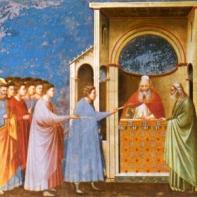
Giotto: AbiatharIn this example of revisionism we see the ancient struggle with minutiae which remains with us today. We fuss about who sits where and who wears what and who knows whom rather than focus on overcoming our fears and living our life to our fullest potential. We have seen this before; we understand the truth of these words. Deep within we know that must put aside our fretting over details and forget about any hierarchy we construct to turn instead to God’s generous goodness and high goals. Rather than lust after a name or position in society, rather than amass possessions to leave to our heirs, we must respond to God’s call.
Our true example is Jesus Christ, not the most popular person we know. And our true goal is to love as God loves us, not to love for the sake of gaining something. With all of this in mind, we remember those who squabble over petty gains, we remind ourselves that our vocation must be more than minutiae, and we ask for God’s blessing in all we do.
Mays, James L., ed. HARPERCOLLINS BIBLE COMMENTARY. New York, New York: HarperCollins Publishers, 1988. 323. Print.
First written on November 15, 2010, re-written and posted today as a Favorite.
A number of years ago I listened to a lecture about the importance of calling on the name of God, the name of Jesus, when we are in peril or distress, and verse 14 of this Psalm featured in that study.
Whoever clings to me I will deliver; whoever knows my name I will set on high.
We are named at birth, with our parents giving great thought to the selection of that name. We look up the meaning of our names. We set aside resources and petition entrance into a golf, swim or tennis club we hope to join. We frown or smile when we see labels on our clothing. The cars we drive, the kitchen appliances we buy, the stores whose bags we carry to a neighborhood event with a casserole dish – all of these bear names that we give consideration. What is the thought we put into the church we join or walk away from? What do believe to be our spiritual name; what is our own label? Who is our God? Do we call to this God for help? And how does God call us?
The Hebrew people, and later the Israelite tribes, did not utter God’s name believing it to be too sacred to pronounce aloud, and so they represented it with the four letters YHWH for Yahweh. Jesus turned his Jewish world upside down when he dared to say that he was the fulfillment of their hope for a Messiah, come to live among them. He angered the Jewish authorities when he dared to heal on the Sabbath, a day that was meant for complete rest from work and for worship of the God who had saved them countless times. We can see how and why his actions and words were revolutionary. From John 17:6: I revealed your name to those whom you gave me out of the world. After the resurrection, the full impact of this is described in Acts 3:15-16 when Peter explains that he is able to heal a crippled beggar merely by invoking the name of Jesus: The author of life you put to death, but God raised him from the dead; of this we are witnesses. And by faith in his name, this man, whom you see and know, his name has made strong, and the faith that comes through it has given him this perfect health, in the presence of all of you.
This is a powerful message to Peter’s audience, and it is a powerful message to us today. It reminds us that we have nothing to fear in that we know God’s name and invoke it just as Peter did. It reminds us that when we are in distress of any kind that we are to call out to our God and ask for healing for ourselves and others inGod’s name, in the name of Jesus the Christ.
Yet we humans believe that we can keep our dark secrets hidden.
I will give them a new heart and put a new spirit within them; I will remove the stony heart from their bodies, and replace it with a natural heart, so that they will live according to my statutes, and observe and carry out my ordinances; thus they shall be my people and I shall be their God.
Yet we humans believe that the world has something better to offer us: comfort, fame, a legacy to be remembered for generations.
But as for those whose hearts are devoted to their detestable abominations, I will bring down their conduct upon their heads, says the Lord God.
Yet we humans believe that we can keep our dark secrets hidden, and we can. For a time.
The Psalmist reminds us in 44:21: If we had forgotten the name of our God or spread out our hands to a foreign god, would not God have discovered it, since he knows the secrets of the heart?
Yet we humans believe that we can keep our dark secrets hidden, and we can . . . for a time, but God knows what we are plotting . . . and God offers us the opportunity to be free of the darkness. God offers us the newness of a natural heart.
Jesus heals as he moves through crowds, and he feels the power going forth from him. Jesus also heals those who are brought forward and laid at his feet – the blind, the lame, the mute and others. As we move through our days and look for counsel, release from anxiety, the healing of our physical pain, we too, are in that number.
Many who are healed are carried to Jesus by others because it is impossible for them to physically find their way to him on their own. Likewise, there are many who cannot be open to Christ’s healing because there is an emotional or psychological barrier blocking the way. These suffering servants are also in need of friends who will carry them to Christ.
It is easy to see someone in obvious physical pain and for these we easily pray. What is less easy to discern is one who suffers internally and as a result they try to control others, they suffer from overwhelming pride, they gossip about others, or they neglect their own spiritual growth. They do not want to change; and they do not want to go beyond the comfortable life they have fashioned for themselves. Do we do anything to bring these souls to Christ?
It is always dangerous to assume that we might be the conversion factor in someone’s life. We cannot heal as Jesus does. But we can bring others to Christ by our own example of fidelity to God, our own example of hope in Christ, and our own example of love in the Spirit.
It is always safe to assume that through love, all will be healed.
Rather than trying to drag someone to Jesus’ feet, let us live at the feet of Christ, let us walk in his footsteps, and let us pray for those who fear moving out of their comfort zone to go to the feet of Christ.
Inspired by 1 Kings 3:6-9, the writer of this prayer seeks wisdom in order that he might do God’s will; and he wishes to dispense justice as God does, with compassion and impartiality. He knows his human limitations well, and for that reason he hopes to tap into the divine place within where God speaks to the heart. The irony of this story is that Solomon ended his days out of touch with God. He allows his foreign wives to worship pagan gods. His mighty kingdom devolves into corruption and splinters. And the Hebrew people who followed Yahweh out of the desert to form the nation of Israel are later led into exile when the man for whom this prayer is named falls away from their covenant with God.
We are limited, we are human; yet when we call upon the divine we are wise beyond our humanity.
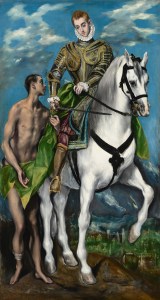
Today we celebrate the feast of St. Martin of Tours, a man born of non-Christian parents in the area of what is today eastern Europe in 316. We know of him today because he turned away from military life to embrace the monastic life; and he became an exemplary pastor, a bishop and the founder of monasteries. He used the wisdom granted him to edify and to build God’s kingdom. El Greco, a Renaissance artist born in Crete but who lived in Spain, depicts Martin in the stylized, elongated mannerism for which he is famous.
We have the opportunity today to think about wisdom: How we pray for it, how we see it changing our lives, what we do when we receive it, and how we encourage it in others.
From today’s MAGNIFICAT Morning and Evening Intercessions:Save your people, Lord.
In Saint Martin, you defeated the tempter in the desert: defeat in us the subtle forces of temptation. Save your people, Lord.
In Saint Martin, you taught love for the true treasures of heaven: keep us from attachment to material goods. Save your people, Lord.
In Saint Martin, you exchanged military weapons for the weapons of the Gospel: in all those who died in military service, exchange suffering and death for life. Save your people, Lord.
Through the intercession of Saint Martin, let us pray: Lord, you hear the cry of the poor.
For those who pursue wealth and power at the expense of the poor: grant them the insight of the Gospel. Lord, you hear the cry of the poor.
For those who regard the poor and homeless with indifference: grant them eyes to see you in their suffering. Lord, you hear the cry of the poor.
For those who care for the poor without reward: grant them Saint Martin’s reward. Lord, you hear the cry of the poor.
May Christ dwell in our hearts through faith, and may charity be the root and foundation of our life. Amen.
Rembrandt: Return of the Prodigal SonParaphrasing from LA BIBLIA DE AMÉRICA footnotes (899): The center of the accusation here against this king is that despite his wisdom and intelligence, he has forgotten that he is subordinate to supreme wisdom and the king of the universe. For this – and for his insolent attitude – he will be punished severely. This develops into a lament which describes the king, his splendor, his guilt, and his punishment. The king who represents Tyre will end his days in the abyss.
Perhaps the most important message we can take away today is this: No matter our apparent security, we must remain humble and we must remain grateful. The New Testament tells us something further: No matter how correct we are in the position we take, we must remain respectful, and we must remain open to the possibility of the enemy’s transformation. Jesus tells the story of the Prodigal Son and each time we hear it we realize anew how gracious is the forgiving father. How generous and how gracious is our God. We have never sinned too greatly; we have never wandered too far for our grateful and generous father to run to greet us and welcome us home. God is gracious . . . always; but it is only through our own humility that we will find the great joy that the father offers.
Today’s first Mass reading from Paul’s letter to Titus (3) reminds us of the proper place and the attitude we will want to maintain as we do God’s work. He reminds us to be under the control of magistrates and authorities, to be obedient, to be open to every good enterprise. [We] are to slander no one, to be peaceable, considerate, exercising all graciousness toward everyone. For we ourselves were once foolish, disobedient, deluded, slaves to various desires and pleasures, living in malice and envy, hateful ourselves and hating one another. But when the kindness and generous love of God our savior appeared, not because of any righteous deeds we had done but because of his mercy, he saved us through the bath of rebirth and renewal by the Holy Spirit . . .
As we meet corruption and misuse of power, let us be grateful always, humble always, slandering no one. Let us be considerate always, and let us exercise graciousness . . . always.
And then the high priest asked him, “Are these things so?”
If we were called to witness to the power structure; if we were asked: “Are these things so?”What would we reply? Some of us can imagine ourselves as brave witnesses; others of us know that we would have difficulty standing before our community to declaim the truth.
The story of power in scripture is about how it corrupts; it is also about how small and seemingly insignificant people gather courage to deliver a discourse of truth to an authority who wishes to control even the small details of lives.
Stephen takes to heart Christ’s admonition that we ought not worry about what to say or how to say it. (Matthew 10:19) He is so full of a light that pierces the darkness and reveals that which the power structure wishes to hide, that he is finally silenced with an angry stoning.
We are not likely to be called to put our lives on the line in a physical way, but we must be willing to speak out truth that does not coincide with or support in any way the false story woven by others – even if these others are our loved ones, our employers, or our popular heroes and heroines.
There is a fine difference between empowering and enabling others. The official in today’s reading does not want the crowd to hear Stephen’s words of salvation because then the crowd will stop paying tithes and bringing offerings. Rather than accept responsibility for his own part in the decay and collusion, the priest questions the messenger: Are these things so?”
When we find that our discourse of truth brings howls of objection from the authority that stands above us, ready to wield the first stone, then we will know that we have touched a raw nerve. Are these things so?”
And when the angry mob comes against us, may we be as ready as Stephen to say: Lord, do not hold this sin against them.
Just this morning a friend and I were discussing the concept of The Rapture, the Book of Revelation, and the end days. Today the Bible opens to Joel, the “prophecy rich in apocalyptic imagery and strongly eschatological in tone”. (CATHOLIC STUDY BIBLE, 1121)
Yet even now, says the Lord, return to me with your whole heart . . .
From today’s MAGNIFICAT Meditation of the Day by Catherine de Heuck Doherty: Faith is to believe without understanding, without seeing. God has blessed us with the gift of our intellect, and up to a point we understand many things about ourselves and the world around us. However, when you begin to move deeper into faith, something very strange happens. You have been walking in the sunshine of your intellect. God has helped you and encouraged you to use it. Then, just like in the tropics where there is no twilight and day becomes night within minutes, so God plunges you into the night. He says, “Put your head in your heart and believe! For now there is no answer. I am the answer. You won’t see me in the dark. You will follow me in faith, without knowing. Arise and believe!” There is a tremendous secret in God’s ways of doing things if we do follow him across that dark night of the tropics, of the soul . . . There will be a moment [when] he will appear. He will just be there. What you knew by your own intellect has blended together with what was added to you because you believed and walked in the darkness of night. You have entered into the fullness of the kingdom of God even before your death. The kingdom of God is in your midst now. What stands between us and the kingdom is our arrogance; the arrogance of our intellect. Our intellect has been given by God. It is my wrong use of it that is so terrible.
We too often wander through life bemoaning our circumstances, complaining of our worries and pain; and when we do, we miss the beautiful gift of the kingdom.
Yet even now, says the Lord, return to me with your whole heart . . .
We too often take for granted the abundance with which we live, fussing with the details of our lives; and when we do, we miss the powerful fidelity of the kingdom.
Yet even now, says the Lord, return to me with your whole heart . . .
We too often look at the darkness and curse it, thinking that we can learn nothing from it; and when we do, we miss the outrageous hope of the kingdom.
Yet even now, says the Lord, return to me with your whole heart . . .
We too often ask for evidence that God exists, creating stories that fit our own whims; and when we do, we miss the loving communion of the kingdom.
Yet even now, says the Lord, return to me with your whole heart . . .
We too often believe the lies we are told, thinking that the deception in which we find ourselves is more real than the gift of freedom and life we have been given by the creator; and when we do, we miss the overwhelming compassion of the kingdom.
The kingdom of God is in your midst now. What stands between us and the kingdom is our arrogance; the arrogance of our intellect. Our intellect has been given by God. It is my wrong use of it that is so terrible.
Yet even now, says the Lord, return to me with your whole heart . . . rend your heart . . . and not your garments . . .
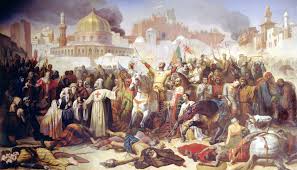
Emile Signol: Taking of Jerusalem by the Crusaders, 15th July 1099
Friday, November 15, 2024
“The sixth century B.C. was an age of crisis, a turning point in the history of Israel. With the destruction of the temple and the interruption of its ritual, the exile of the leaders and loss of national sovereignty, an era came to an end. Not long after the fall of Jerusalem (587) an eyewitness of the national humiliation composed these five laments. They combine confession of sin, grief over suffering and humiliation of Zion, submission to merited chastisement, and strong faith in the constancy of Yahweh’s love and power to restore. The union of poignant grief and unquenchable hope reflects the constant prophetic vision of the weakness of man and the strength of God’s love; it also shows how Israel’s faith in Yahweh could survive the shattering experience of national ruin.” (CATHOLIC STUDY BIBLE, 1017)
If, then, we have died with Christ, we believe that we shall also live with him. We know that Christ, raised from the dead, dies no more; death no longer has power over him. As to his death, he died to sin once and for all; as to his life, he lives for God. Consequently, you too must think of yourselves as [being] dead to sin and living for God in Christ Jesus. Romans 6:8-11
It is easy to fall into discouragement and to see our situation as hopeless. But discouragement is a tool of the enemy of mankind, the devil. Let us counter him by being agents of encouragement in our world. In doing so, we become a powerful force for good and for the kingdom of God. MAGNIFICAT Mini-Reflection, November 7, 2010 (97)
The world’s disordered affection loves pride, and God loves humility. The world looks for honor, status, greatness, and God spurned these things, embracing disgrace, scorn and insult, hunger, thirst, cold and heat, even to a shameful death on the cross. Catherine of Siena, MAGNIFICAT Meditation of the Day, November 6, 2010 (88-89)
The Book of Lamentations is the story of deep grief and extraordinary hope. It is the story of a people who suffer greatly – some through their own fault, some innocently; and it is perhaps our own story. We will – at one point or other in our lives – find ourselves betrayed, with no place and no way to rest, groaning, crying, and unable to rise. We will find ourselves in some sort of captivity, with no one to console us; our enemies rejoice at our misfortune. We will be dishonored – rightly or wrongly – and we will at some time find ourselves worn out with weeping; within our weakened spirit all will be in ferment. Our little ones will faint from hunger on the streets or in the sealed off places of the wounded heart. There will – at one time or other – be terror on every side.
Yet, accompanying this bottomless sorrow will be the Christ – for this is where Christ dwells, with the suffering and with those who are utterly discouraged. When we allow ourselves to die to the world’s wishes withChrist, we live – and we live eternally. In fact, it is impossible for us to take our worldly perspective with us if we die toand inthe eternal Christ. So why then are we in this world at all? Because here is where we learn to be and to act in God, in Christ, and in the Spirit.
We do not live for this world alone, but for the kingdom of heaven. It is easy to lose sight of the ultimate goal when the cares of this world become overwhelming. The world is good and a creation of God, but it is meant to direct us to the heavenly realities. Let us walk unwaveringly toward God and his kingdom. MAGNIFICAT Mini-Reflection November 6, 2010 (91)
When our earthly woes crowd round us to block out the light, let us call on the Christ who is beside, before, behind and within us – and let allow him to transform us. And let us witness to this world of woe that we are people made for a heavenly reality.






 The Noontimes