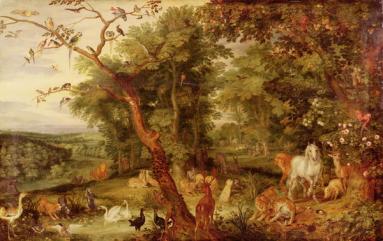
Jan Brueghel: The Temptation in the Garden of Eden
Friday, March 4, 2022
God created humans in God’ image; male and female God created them. God blessed them saying, “Be fertile and multiply; fill the earth and subdue it”.
On this first Friday in Lent, we contemplate the abundant gifts and mysteries of our planet. We ask for wisdom to use Mother Earth’s resources prudently. Today as we reflect we might read about or watch part of a Frontline episode and determine how we can improve the health of the Chesapeake Bay or the world’s rain forests.
When Jesus stills a sudden storm, his followers ask in amazement, “What kind of a man is this, that even the winds and the sea obey him?” Read this story in Matthew 8:23-27 or in Luke 8:22-25 and consider our complex relationship with the natural world and how we characterize our human dominion over earth’s resources.
The New Testament closes with the apocalyptic verses written by John of Patmos. Filled with extravagant symbolism and vivid descriptions of the coming end, these verses are best understood with a solid commentary. With its origin in a time of crisis, Revelation’s metaphors bring us the good news that each of us is the beautiful bride about to enter into holy and eternal union with Christ, the bridegroom. These are words that surprise the faithful . . . and us . . . with joy.
Just when turmoil and crisis are about to take over the new church of Jesus-followers, John of Patmos writes that they are saved in extravagant style. The message here is simple. “Hold on. Stand fast. Your hope will not be disappointed. Your joy is upon you”.
Revelation 19:7: Let us be joyful and glad! Let us give him glory! It is time for the Lamb’s wedding. His bride has made herself ready.
Linda Harris-Lorio: Dance of the Bride
“Persecution and suffering were undoubtedly real. These [early] Christians were faced with the choices of all who suffer oppression. Were they to resist violently and seek the overthrow of Rome? That was futile as well as contrary to their ethos. Were they simply to cooperate? That would be to lose their identity. They chose the path of passive resistance. They did not fight the beast, but neither would they do its bidding”. (Senior RG 575-576)
John of Patmos speaks to any of God’s faithful who suffer at the hands of unethical, dishonest or oppressive leaders; and he speaks to us today as we begin to close our Joy Through Scripture Seriesof reflections. What was true for the early Christians is also true for us: even in the most dire of circumstances, the faithful need not struggle against the oppression they experience. They – and we – can never be devoured by the beast. They – and we – are the bride of the eternal, forgiving, loving, redeemer Christ. Againstthis one, no beast will prevail. Withthis one, the faithful will survive. Forthis one the world has been waiting. Throughthis one, the faithful live in timeless, ever-present joy.
Let us move forward today in acceptance of this gift that is so graciously and wonderfully given in the darkest of times and places, the gift of Christ’s redeeming joy in us.
Senior, Donald, ed. THE CATHOLIC STUDY BIBLE. New York, Oxford University Press, 1990.RG 572, 575-577. Print.
Visit the PBS Frontline resource and read about the author of Revelation: http://www.pbs.org/wgbh/pages/frontline/shows/apocalypse/revelation/white.html
Explore the Frontline topics and consider how Christ’s joy might change the balance of power and the influence of corruption in our own lives. Spend time also considering how each of us might bring Christ’s joy to the world.
If this week’s Noontimes call you to search for more ways to encounter Joy or urges you to investigate the New Testament, click on the word Joy in the categories cloud in the blog’s right hand sidebar and choose a reflection, or enter those words in the blog search bar.


 The Noontimes