When God spoke to me I grew strong and said, “Speak, my Lord, for you have strengthened me”.
We look for strength through artificial means: drugs, food, exercise, power. And all the while we hold in our hands enough strength to live eternally, enough strength to forgive ceaselessly, enough strength to love everlastingly.
God says: You may find this difficult to believe but I truly live in you. You may wonder how or why but you need not spend much time worrying over those details. Many of you worry that you do not deserve my time and devotion; but you do. You must remember to value yourself as much as I value you. Many of you assume that you deserve my favor and love and you see yourself as fully content; you have forgotten how to listen to me and to others. You must remember to measure yourself a bit so that you listen more than you speak. I have given you great spiritual strength. Believe in this as you believe in me. And consider each day . . . how you spend this precious gift.
Jesus said to them: If you have faith the size of a mustard seed, you will say to this mountain, “Move from here to there,” and it will move. Nothing will be impossible for you”. (Matthew 17:20)
Enter the word strength in the blog search bar and explore God’s gift of your strength to you.
This scene may be familiar to us since it is replicated on Palm Sunday when Jesus rides into Jerusalem as king and paschal sacrifice. Jesus’ crowning by the marginalized people whom he cured and healed fulfills the hope which Solomon brings to the throne of Israel. David’s last instructions serve his son and his people. Solomon’s crowning bring his people hope for security and peace. Jesus’ last instructions bring rescue and redemption that last an eternity.
1 Kings 2 begins with David’s death discourse and we find that it has a familiar ring. David hands on his kingdom to Solomon in 970 B.C.E. and several hundred years later, Jesus comes to fulfill David’s and Solomon’s hope.
What does Solomon’s crowning mean for us today? We see the foreshadowing of Jesus, the true king who “keep[s] the mandate of the Lord . . . following his ways and observing his statutes, commands, ordinances and decrees as they are written in the law of Moses, that you may succeed in whatever you do, wherever you turn.”
We so easily forget this when life offers us an easy road and we feel confident. Our small egos take over and tell us that we do not need God. Then trouble strikes and we turn back to God whom we have forgotten and we find that God is there waiting to accompany us through any tragedy or pain. David’s last instructions, a call to live in the Law of Moses, presage the Law of Love which Jesus brings.
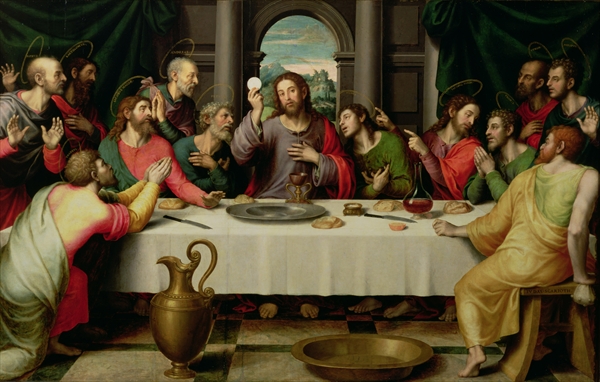
Vicente Juan Macip: The Last Supper
The apostle John tells us of Jesus’ last words to his followers. They are so simple and also so beautiful. Do not let your hearts be troubled . . . I will not leave you orphans . . . I am the true vine, and my Father is the vine grower. Remain in me as I remain in you . . . It was not you who chose me but I who chose you . . . I have more to tell you but you cannot bear it now . . . In the world you will have trouble, but take courage, Ihave conquered the world.These familiar words lay out the simple tenets of Jesus Law of Love which comes down to one lasting commandment: Love God, love one another.
This is such a simple instruction and yet so easily forgotten.
As David lies dying he gathers his last resources to leave final instructions to those he loves so well. Solomon is crowned and David’s words are passed on for generations.
As Jesus enters Jerusalem he gathers his strength for the harrowing road that lies ahead. He calls his apostles together, breaks bread and shares wine, and he leaves last instructions for those he loves so dearly. Do not let your hearts be troubled . . . Jesus’ words are passed down through an eternity.
As we confront any obstacle that falls to us in our journey, we might find wisdom and consolation in these last words which we so easily forget. And so we ask God’s help and we pray . . .
Faithful and forgiving God, abide with us as we journey through life forgetting, or perhaps not believing, that you are with us.
Constant and faithful God, sustain us with the hope so often predicted and so lovingly brought to us by your son.
Healing and loving God, fill us with the consolation and peace of your Holy Spirit, remembering that we are your own dear creations who long to be with you.
The second of the penitential psalms “is a joyous testimony of gratitude for God’s gift of forgiveness for those who confess their sins and follow the law of God. Instead of constantly pondering their sins, believers acknowledge their wretchedness before God and accept forgiveness and reconciliation. Their torment ceases, and a new person is born, overwhelmed by grace, confidence, and a sense of obedience.
“In praying the psalm, we can focus not only on the happiness resulting from the forgiveness of particular sin, but also on the more profound happiness obtained by the complete victory given us by God in Christ over sin in all forms”. (Psalms 86)
We too often emphasize all that is wrong with the world, our community, our colleagues and even our friends, family and self. Today’s reading invites us to accept the knowledge that we are not perfect, to ask forgiveness for the times we have wronged self and others, to graciously accept the pardon we receive, and to allow God’s grace, joy and peace to bring us profound happiness.This deep and lasting contentment is the gift of complete victorywe are free to reject or receive.
And so we pray . . .
Forgiving and unifying God, we lay all our imperfections in your hands.
Grant us this day the complete victory of your love as we come to you in truth.
Give us the confidence we need to believe that your love has the power to bring joy out of suffering.
Inspire in us such love for you that our obedience is a source of delight rather than a burden to shoulder.
Move in us a spirit of reconciliation that surmounts all fears, calms all anxieties, and heals all wounds.
Bring us your profound happiness that heals, binds, unifies and transforms.
Grant us your lasting gift of overwhelming grace that seeps into the bone, calms the heart, and warms the troubled soul.
We ask this as we ask all things through your son, Jesus Christ. Amen.
THE PSALMS, NEW CATHOLIC VERSION. Saint Joseph Edition. New Jersey: Catholic Book Publishing Company, 2004. 86. Print.
In this parable we see wicked people kill the owner’s son so that they can take over the land. We humans tend to interpret our own actions in the best light in order that they suit our own ends. We explain our lack of unity by calling up examples that support our own version of a story. By our lack of generosity and honesty, we demonstrate our belief that God is not good enough or big enough to help all of us. Our own stinginess and need to control demonstrate a belief that God is limited in some way. When we create division, confusion and disunity we forget that God brings order out of chaos and good out of harm. And we also forget that Jesus calls each of us to do the same. Jesus shows us how to heal with a touch rather than ostracize with a look, yet we reject Jesus as the cornerstone when we refuse to see God’s presence in the least of us.
In this story the wicked men answer their own question in verse 41:[The landowner] will put those wretched men to death and lease his vineyard to other tenants who will give him the produce at the proper time. There is no doubt about the message here: Fruit at the proper time – this is what we called to bear.
God wishes nothing more than for all of us go to him in unity. So let us ask for forgiveness and forgive. Let us make reparations and accept a reparation being made. Let us heal and be healed. Let us pray our enemies into goodness so that all of us might bear fruit.
God wants to include all of us in the work of the vintage time. God calls each of us to our seat at the great feast. God calls the slow as well as the swift, the unfaithful as well as the faithful, the lame as well as the walking. God makes a Universal Call . . . What will be our response?
Dearest God, we know that you will continue to beckon, continue to wait, continue to love, and continue to unfold your plan. We know that you ask each of us to bear fruit in your time rather than our own. Send us your wisdom, perseverance and generosity. Send us your love and strength. Speak clearly to us so that we might more readily hear your words as the landowner who sends his messengers to us. Grant that we come forward willingly with the fruit of your harvest. Grant that we find the courage to help even our enemies so that they might rise and go to you. And grant that we be alert and ready when the vintage time arrives. Amen.
To reflect more on The Wedding Feast and The Wedding Garment, enter these phrases into the blog search bar and explore.
Adapted from a reflection written on September 13, 2007.
There is an order to nature. Things do not happen by chance. This order comes from God as we hear in the opening lines of Genesis when God brings order and light out of chaos and darkness. We are the people who have walked in darkness and can now see a great light. We are messianic people. We bring light to the world, healing to the poor in spirit, hope to the hopeless, faith to those who live in anxiety, and love to those who have been abandoned or betrayed.
We are messianic people . . . and like Christ, we will be wounded in this journey we make toward the New Jerusalem that we see in Revelation. We will be hounded, persecuted, stoned, vilified and mocked, but we will also be healed, transformed, lifted up and brought up high, filled, rejuvenated and restored. Through the prophet Joel, our God tells us: I will repay you for the years which the locust has eaten. (2:25)
We are messianic people . . . and so many times we hear about restoration being promised from the story of Adam and Eve in the first book of God’s word to the last book of God’s Revelation of the New Jerusalem. We find ourselves slipping into the idea that this restoration comes in the next life but as children of God we are meant to feel this fullness now. The journey will be arduous but we follow where many have gone before us; it is the very journey itself that restores.
We are messianic people . . . and we are the work of God, therefore we cannot be complacent. We must move and act in God, for in this way we become the exit from sorrow and woe not only for others but for ourselves. In serving others from our own wounded-ness and from our own woe, we become healers of others and thereby we become healed.
We are messianic people . . . and as healers we have a part to play in the Economy of Salvation, in this Divine Plan of God’s for our happiness. We have an essential part to play in this world and in the next.
We are messianic people . . .a nd so when we experience woe, we know that we will rest in this grief for a time and we also know that there is joy and celebration to be found in the sadness for as children of God know that God turns all harm to good.
We are messianic people . . . and God yearns for intimate union with us. This union, so many times found through sorrow, brings complete and everlasting joy.
We are messianic people . . . and so we pray . . .
Dearest, loving God, draw us close to you for we wish to be with you always. We know that you are in all things and with all people. We believe that you set all things right. We hope for the perfection of your plan in each of us. We love those who most need our intercession and we understand that by asking for healing for those who need it most we meet you face to face. We are messianic people . . . and so we seek healing and restoration here, now, and for eternity. Amen.
Adapted from a reflection written on December 30, 2007.
As we read these words of Saint Paul we might think we are listening to political commentary on recent world and local events. Crisis brings out the worst and the best in us. Questions are asked but the answers are often not heard. Let us put a little time aside today to listen for God’s wisdom, to see God’s signs and to allow God to bring all debate into union with The Word.
Where is the wise one? Where is the scribe? Where is the debater of this age?
We cling to political views without considering how or even if they reflect the Gospel.
Has not God made the wisdom of the world foolish?
We wage wars and neglect the poor without seeing the chaos that these actions add to an already fractured world.
The foolishness of God is wiser than human wisdom, and the weakness of God is stronger than human strength.
We continue to rely on our own small powers more than God’s limitless ones without hearing these words in the context of today’s world.
And so we pray . . .
Patient and loving God, send us your wisdom and teach us how to replace our own human folly with your Word.
Good and forgiving God, continue to bless us with your many signs and open our eyes and ears and hearts to your voice and your touch.
Mighty and all-encompassing God, support us as we search blindly for you; protect us as we struggle to follow you, and guide us as we stumble beside you.
We ask this through your son Jesus the Christ together with the Holy Spirit. Amen.
“There is no English word that adequately translates the Hebrew mashal. It embraces a broad category of literary forms: oracle (Nm 23,7); discourse (Jb 29,1); parable (Ps 78,2); taunt-song (Is 14,4). In each case there is a lesson to be learned, and for this reason the mashalmight best be understood as ‘an example from life’ intended to instruct. (Although some scholars understand mashalin the limited sense of a specific form, it will be used here as a general category unless otherwise indicated.) This is the word that identifies two major collections as “The Proverbs of Solomon” (10,1; 25,1) and from which the book itself receives its name.
“The root meaning of mashalis ‘likeness’ or ‘comparison’ as in ‘Like mother like daughter,’ or in the contrast ‘better safe than sorry.’ As a comparison, it usually consists of two parts in some kind of poetic construction”. (Senior RG 256)
Solomon cannot have been more clear with his comparisons and explications. He writes with clarity and precision about the wisdom that guides him with the difficult and complex work as leader of a nation rising in stature and power. He shares all that he knows about how to avoid wrongdoing and how to keep to the narrow path that Wisdom lays down before us. The distractions of the world are many and they are deceptive. Temptation, when it succeeds in luring us away from God, comes to us gently, subtly, and in the guise of something or someone we love. Solomon warns us of pitfalls. He gives us clear words for success in God’s way; yet even Solomon himself ignores the very wisdom he imparts to us. We will want to avoid the fall comes to Solomon.
When we look at these chapters and verses we prefer to see their wisdom for change in our enemies and their wisdom of reinforcement for ourselves. We humans prefer that others adjust to our vision of reality rather than change anything about our own image as we take lesson from these mashal. And in this way of living we miss much of God’s Wisdom.
In the opening chapter several days ago, we have risen in full blossom with the beginning verses. Who among us does not see ourselves as intelligent and perceptive? And so we are. We yearn to be the wise one who gains sound guidance; we yearn for resourcefulness, justice and honesty. Yet also are we – from time to time at least – the ones who casts our lot with those who spread the net of gossip to gain an end. We are also – from time to time – among the number who love our own inanity. We petition God for wisdom, discipline, and security and this is what we find in these Mashalof Solomon. We must step outside of ourselves to read these verses and to assess who we are and what we do. This, of course, takes wisdom.
If we read the story of this wise King Solomonwe see what falls to him in the waning years of his life. (1 Kings 11) Even this wise, and powerful, and wealthy servant of God falls victim to the wide road as he leaves behind the narrow path of God. So it is that we read the words he brings to us today, and we pray.
Good and wise God, we ask for knowledge rather than power. We ask for hope rather than fame. We ask for the ability to love you as you love us rather than the false security of this world. Instruct us in your narrow way. Save us from our self-willing inanity. Keep us ever in the presence of your Wisdom. Remind us of her value each day. Shield us from bitterness and anger, and remind us that you and your Wisdom are with us always, even as we call out for you. Amen.
In the first chapter of Proverbs we find many references to knowledge as the source of wisdom and of how fools turn away from knowledge. The last verses even describe God as one who mocks the foolish. In truth we know that we mock ourselves, we mock our creation as a Child of God, we mock the very image of God when we turn away from knowledge and understanding.
For as Isaiah reminds us (55:11), God’s word does not return empty. My word shall not return to me void, but shall do my will. Jesus shows us this in his every act and word.
I am thinking about the hope that we hold and enact each time we step into our work day, each time we discipline ourselves, each time we enact the word we hear each morning on our rising from our creator.
In Proverbs 1 we see: words of intelligence, just and honest, knowledge and discretion, hearing and learning, wisdom and instruction . . . this is God’s Word to us.
In Proverbs 1:13 and 15 . . . All kinds of precious wealth shall we gain, we shall fill our houses with booty . . . My child, walk not in the way with them . . .
In verses 20 to 33 Wisdom warns us of the danger of rejecting her works. As we read these words we are reminded of the Gospels where we see Jesus, God’s Wisdom, rejected so many times because he did not conform to the culture of the corrupt hierarchy, because he called the comfortable to make room for the poor, because he turned the contemporary society on its head. He still turns us on our own heads today. Each time we feel uncomfortable we know that we are called to take a look at ourselves, to listen to Wisdom, to live patiently and hopefully, to follow the Way Christ shows us. We are called to be Christ to others. We are called to express God’s Word to others to the best of our potential. We are called to share and enact the hope God has planted in us.
And so we pray . . .
Dearest Lord, when you send us your wisdom, also send us your infinite patience for we humans are impatient. When you extend your hand, we wish to take it. Make your hand visible to us for we humans have eyes but we do not see. When you call to us, make our hearts open to your voice for we humans have ears but do not hear. When you send us Your Holy Spirit, also send the courage and fortitude that we will need to enact your Word each day. For we humans love you dearly and wish to do your will. We wish to send your Word back to you rather than allow it to return to you empty. We ask all of this in Jesus’ name. Amen.
Adapted from a reflection written on November 29, 2007.