Philistine captives being led away after their failed invasion of Egypt, from a relief at Ramses III’s mortuary temple at Medinet Habu, Thebes, Egypt. (Britannica online)
Wednesday, January 29, 2025
The stories in 1 and 2 Samuel are intriguing if we take the time to pause with them; and over the past weeks we have considered the variety of ways God speaks to us. We have paused to reflect on how we might hear, and then heed, God’s Word. Today it is the story of David, Achish, the Philistine King of Gath, and the Philistines.
Many of us perceive the Philistines as enemies of the Jewish people. As a noun describing characteristics, we define a philistine as “a:a person who is guided by materialism and is usually disdainful of intellectual or artistic values, or b: one uninformed in a special area of knowledge”. (Merriam Webster Online) No matter the context, we understand that David and his men align with Achish in order to somehow endure the wrath of Saul. And we further understand that the Philistine chieftains reject this small band who are trying to survive in a brutal world. The ancient order reflects our own as we too struggle to make and maintain alliances, as we look for connections and coalitions.
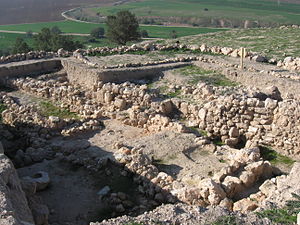
Archaeological findings at Gath
What might we learn from David’s dilemma today? That at times we are required to lie among the enemy. And at times even the enemy rejects us.
Many of us are familiar with the old Christmas carol, The Twelve Days of Christmas, and we may also be aware of varying theories about the derivation of the lyrics and tune. A number of resources report – some correctly and some incorrectly – the reason for the song’s origins, but in this holiday season we will put argument aside and enjoy celebrating the symbols we find.
The first gift is a partridge in a pear tree, and is symbolic of Jesus Christ, the Son of God. The mother bird of this species will feign injury to lure predators away from her young, and some say that it reflects Jesus’s words when he laments in Luke 13:34: “Jerusalem, Jerusalem! You kill the prophets, you stone the messengers God has sent you! How many times I wanted to put my arms around all your people, just as a hen gathers her chicks under her wings, but you would not let me!” (Snopes) Yesterday we reflected on Christ as our savior or Messiah and we recognize his willingness to endanger himself in order to save the faithful.
Two turtle doves in St. George Island, Fla. (AP Photo/Phil Coale)
On this second day of Christmas, we celebrate the presence of Christ as Logos in both the Old and New Testaments. Footnotes tell us that here that John the Evangelist lays out the themes that develop as his Gospel continues: life, light, truth, the world, testimony, the pre-existence of Jesus, the incarnate Logos who is God’s revelation and his expression of his love for us. When we think of the stories we hear and read in this Gospel, we know for certain that God is calling us to be diverse, to tend to that diversity and to place our hope in this diversity – because it is in this diversity that the Spirit manifests itself best.
God, most especially in the person of Jesus, calls us to intimacy. God asks us to commune with one another in a way we think is impossible. God asks much of us, both also gifts us with much. In this Christmas season, let us consider the gift of Logos, God’s Word, to all of creation brought to us in the sacred scriptures of the Old and New Testaments.
“The Twelve Days of Christmas.” snopes.com, 17 Dec. 2017, www.snopes.com.
Includes notes from autumn of 2007. Posted on December 26, 2017.
We are sometimes caught up in a well-developed argument, following its false logic to a false end. We can be led astray by philosophy that seems flawless, by practices that seem good and righteous. Long held traditions, jazzy new jargon, worship of something other than God that seems to do no harm, cheating that no one knows about, vanity so puffed up it has become ridiculous. These are all ideas and practices that Paul warns the Colossians – and us – to guard against. He tells them – and us – that these little demons enter our lives subtly, when we are occupied with daily work, when we are succeeding, when we are happy. Yet, he continues, if we live ofand through and in Christ, we can easily identify and walk away from all these tempting worldly thoughts and devices.
We know that this letter was written to a congregation that Paul did not establish. (CATHOLIC STUDY BIBLE, 318) The town of Colossae was having trouble disentangling itself from the cultic practices familiar to the people; they struggled against pagan teachings that Paul identifies as but “shadows” of the tenets brought to them by Christ. Epaphras, the man who founded the Christian church in Colossae, asks Paul’s help, and so the apostle writes this letter from prison. He wisely does not attempt to argue away against well-developed, long-held beliefs. Instead, he places Jesus before this little flock and allows the Spirit to work in their hearts. The Spirit works in our hearts as well. It enlightens our path that we might see the error of our own ways.
When we find ourselves struggling against a well-oiled, corrupt structure, we must turn our struggle over to Christ and allow him to give us courage.
When we find ourselves lost in the convolutions of a byzantine argument, we must turn our confusion over to the Spirit and allow her to give us the words we will use in witness.
When we find ourselves anxious about the state of the world and the kingdom of God being neglected, we must turn our anxiety over to God and allow God to instill in us the wisdom we will need to extract ourselves from the mire, to witness to the corruption, and to begin our intercessory prayer for those who choose to live in the darkness.
And we must remain in Christ’s light so that we might see our errors. And mend them.
The following are comments from a lecture I once heard on Jesus’ temptation. I do not remember the source but my scribbled notes indicate the haste with which I wrote. These ideas seem so true and on target.
Verse 3 – The devil is so clever that he knows to tempt Jesus inhis most important place – his spirituality.The lesson here for us is that the devil does not tempt us in big, overt, obvious ways; rather, he sidles into our lives carried in on the back of something both we and God find pleasing. This temptation is at once immediate, spectacular, and relevant.
Jesus replies with a quote from Deuteronomy 8:3 – Jesus, even though he is God, knows that the Creator alone gives and sustains life. Even Jesus obeys the Father.
Verse 6 – The devil is so clever that he tempts Jesus by offering him what he already is – the power of God.The lesson here for us is that the devil knows us so well that he knows our loves as well as our faults; and it is to the former that appeals, knowing that we will be less watchful. This temptation is bold, breathtaking, and daring.
Jesus replies with a quote from Deuteronomy 6:16 – Jesus understands that we are never alone, never abandoned by God. Jesus knows that there is no need to demand a sign from God.
Verse 9 – The devil is so clever that he tempts Jesus when he is at his best – praying in preparation for doing God’s work. The lesson here for us is that the devil will creep into our presence when we are at the top of our form and doing our best. This temptation is born of Satan’s envy, greed, and delight in havoc.
Jesus replies with a quote from Deuteronomy 6:13 – Jesus acts on his understanding of both God and Satan . . . and here Jesus rejects Satan soundly with the words we will hear him use again: Get away, Satan!
We tend to believe that the devil takes advantage of us when we are down, weakened, and at the ebb of our strength. It is true that when we are desperate we often lean further into descent rather than pulling ourselves out of the plummet into darkness. Yet here we see the opposite to be true. We are often susceptible to the devil’s clever ploys when we are happy perhaps even more than when we are depressed. When we are doing well we want to extend the happiness, we want to draw out this sense of independence and wellness. When we are doing God’s work with conviction and determination we feel full, complete and content; and this is when the clever demon slides into our thinking and into our lives – without our noticing.
Here Jesus has given us a blueprint for a well-executed rebuff of the devil – we are to rely on God alone, because even Jesus does not rely on his own strength. Even Jesus places his trust in God the Father.
Then the devil left him, and behold, angels came and ministered to him . . .
Paul explains here that faith has a way of saving us in a way that the Mosaic Law does not – and never will. It is impossible to reach heaven or to be one with God if we live a life full of checklists that attend to the duties prescribed by a structure. It is equally impossible to notbe saved if we live our lives inChrist if we live a life of actingaccording with the Law of Love – even when this Law puts us in danger.
Footnotes explain the references to Old Testament verses, and they also remind us that to speak as Paul does here – or to tell and enact the Gospel story as Paul reminds us we are asked to do – often puts us in danger.
In the first century, and in certain parts of the world today, being Christian brings exclusion from the wider society and even the death penalty. We will need to rely on Christ once we respond to the call to tell the story of salvation.
Among many cliques and groups both now and in Paul’s day, living a life of faith brings scorn and derision. We will need to rely on Christ once we commit to living a life of fidelity to Jesus’ Way.
In families, work places, schools, and any places where we humans gather, living a life of merciful justice and open trust brings ridicule and disdain. We will need to rely on Christ once we live as fully in him as he asks.
Paul warns us about all of this today. The easy, comfortable life spent in and for itself must fall away. The disciplined life of service that we are called to live is not appealing to rebellious and difficult people. And so we have this clear choice before us: to opt for contention and disobedience, or to choose freedom and salvation in Christ.
A number of years ago I listened to a lecture about the importance of calling on the name of God, the name of Jesus, when we are in peril or distress, and verse 14 of this Psalm featured in that study.
Whoever clings to me I will deliver; whoever knows my name I will set on high.
We are named at birth, with our parents giving great thought to the selection of that name. We look up the meaning of our names. We set aside resources and petition entrance into a golf, swim or tennis club we hope to join. We frown or smile when we see labels on our clothing. The cars we drive, the kitchen appliances we buy, the stores whose bags we carry to a neighborhood event with a casserole dish – all of these bear names that we give consideration. What is the thought we put into the church we join or walk away from? What do believe to be our spiritual name; what is our own label? Who is our God? Do we call to this God for help? And how does God call us?
The Hebrew people, and later the Israelite tribes, did not utter God’s name believing it to be too sacred to pronounce aloud, and so they represented it with the four letters YHWH for Yahweh. Jesus turned his Jewish world upside down when he dared to say that he was the fulfillment of their hope for a Messiah, come to live among them. He angered the Jewish authorities when he dared to heal on the Sabbath, a day that was meant for complete rest from work and for worship of the God who had saved them countless times. We can see how and why his actions and words were revolutionary. From John 17:6: I revealed your name to those whom you gave me out of the world. After the resurrection, the full impact of this is described in Acts 3:15-16 when Peter explains that he is able to heal a crippled beggar merely by invoking the name of Jesus: The author of life you put to death, but God raised him from the dead; of this we are witnesses. And by faith in his name, this man, whom you see and know, his name has made strong, and the faith that comes through it has given him this perfect health, in the presence of all of you.
This is a powerful message to Peter’s audience, and it is a powerful message to us today. It reminds us that we have nothing to fear in that we know God’s name and invoke it just as Peter did. It reminds us that when we are in distress of any kind that we are to call out to our God and ask for healing for ourselves and others inGod’s name, in the name of Jesus the Christ.
Yet we humans believe that we can keep our dark secrets hidden.
I will give them a new heart and put a new spirit within them; I will remove the stony heart from their bodies, and replace it with a natural heart, so that they will live according to my statutes, and observe and carry out my ordinances; thus they shall be my people and I shall be their God.
Yet we humans believe that the world has something better to offer us: comfort, fame, a legacy to be remembered for generations.
But as for those whose hearts are devoted to their detestable abominations, I will bring down their conduct upon their heads, says the Lord God.
Yet we humans believe that we can keep our dark secrets hidden, and we can. For a time.
The Psalmist reminds us in 44:21: If we had forgotten the name of our God or spread out our hands to a foreign god, would not God have discovered it, since he knows the secrets of the heart?
Yet we humans believe that we can keep our dark secrets hidden, and we can . . . for a time, but God knows what we are plotting . . . and God offers us the opportunity to be free of the darkness. God offers us the newness of a natural heart.
Jesus heals as he moves through crowds, and he feels the power going forth from him. Jesus also heals those who are brought forward and laid at his feet – the blind, the lame, the mute and others. As we move through our days and look for counsel, release from anxiety, the healing of our physical pain, we too, are in that number.
Many who are healed are carried to Jesus by others because it is impossible for them to physically find their way to him on their own. Likewise, there are many who cannot be open to Christ’s healing because there is an emotional or psychological barrier blocking the way. These suffering servants are also in need of friends who will carry them to Christ.
It is easy to see someone in obvious physical pain and for these we easily pray. What is less easy to discern is one who suffers internally and as a result they try to control others, they suffer from overwhelming pride, they gossip about others, or they neglect their own spiritual growth. They do not want to change; and they do not want to go beyond the comfortable life they have fashioned for themselves. Do we do anything to bring these souls to Christ?
It is always dangerous to assume that we might be the conversion factor in someone’s life. We cannot heal as Jesus does. But we can bring others to Christ by our own example of fidelity to God, our own example of hope in Christ, and our own example of love in the Spirit.
It is always safe to assume that through love, all will be healed.
Rather than trying to drag someone to Jesus’ feet, let us live at the feet of Christ, let us walk in his footsteps, and let us pray for those who fear moving out of their comfort zone to go to the feet of Christ.
And then the high priest asked him, “Are these things so?”
If we were called to witness to the power structure; if we were asked: “Are these things so?”What would we reply? Some of us can imagine ourselves as brave witnesses; others of us know that we would have difficulty standing before our community to declaim the truth.
The story of power in scripture is about how it corrupts; it is also about how small and seemingly insignificant people gather courage to deliver a discourse of truth to an authority who wishes to control even the small details of lives.
Stephen takes to heart Christ’s admonition that we ought not worry about what to say or how to say it. (Matthew 10:19) He is so full of a light that pierces the darkness and reveals that which the power structure wishes to hide, that he is finally silenced with an angry stoning.
We are not likely to be called to put our lives on the line in a physical way, but we must be willing to speak out truth that does not coincide with or support in any way the false story woven by others – even if these others are our loved ones, our employers, or our popular heroes and heroines.
There is a fine difference between empowering and enabling others. The official in today’s reading does not want the crowd to hear Stephen’s words of salvation because then the crowd will stop paying tithes and bringing offerings. Rather than accept responsibility for his own part in the decay and collusion, the priest questions the messenger: Are these things so?”
When we find that our discourse of truth brings howls of objection from the authority that stands above us, ready to wield the first stone, then we will know that we have touched a raw nerve. Are these things so?”
And when the angry mob comes against us, may we be as ready as Stephen to say: Lord, do not hold this sin against them.









 The Noontimes