Today we visit the first reading for today’s liturgy, and we reflect upon the difficulties of life when we believe our friends have betrayed us.
For I hear many whispering: “Terror is all around!
Denounce him! Let us denounce him!” All my close friends are watching for me to stumble.
On this Friday in our Lenten journey, we re-live Christ’s deep passion for eternal life, and deep love for God’s people, we reflect upon the path that is open to us when we feel terror on every side.
But the Lord is with me like a dread warrior; therefore my persecutors will stumble, and they will not prevail.
They will be greatly shamed, for they will not succeed.
On this Friday as we move forward toward Easter, we reflect upon the wonders that God works in our lives. And we give thanks.
Sing to the Lord; praise the Lord!
For he has delivered the life of the needy from the hands of evildoers.
Visit the posts Desire and Terror, and Terror and Wisdom on this blog by enterng the words into the blog search bar.
In Chapter 12 of Genesis, we hear God’s call to Abram: Leave your country, your relatives, and your father’s home, and go to a land that I am going to show you. I will give you many descendants, and they will become a great nation. I will bless you and make your name famous, so that you will be a blessing.
Today we ask ourselves if we are willing to leave all that we know in order to move toward an unseen promise. Do we have faith that God truly calls us as God called Abram? Do we believe in the hope of God’s covenant? Do we share God’s Spirit with open and giving hearts? In today’s Noontime reading, we move further into Abram’s story and we rest in the verses that tell us how and why Abram becomes Abraham. We hear the familiar words describing how and why Sarai becomes Sarah. And we ask . . .
Are we willing to step forward into the unknown as we follow God’s call? Do we anticipate the joy of the journey as we discover new places, times and peoples? Do we act with Christ’s mercy? Do we live in Christ’s joy? And like Sarah and Abraham, are we willing to leave the comfort of Ur?
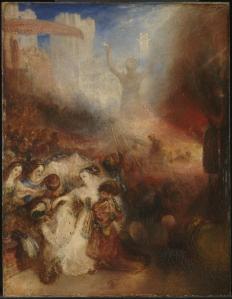
Joseph Mallord William Turner: Shadrach, Meshach and Abednego in the Burning Fiery Furnace – Tate Museum, UK
Today we choose verses from this well-known and well-loved story.
None of us is exempt from trials in the fiery furnace. Some of us suffer greatly; some only a little. Nevertheless, pain comes to each and all of us. And so we pray that in our difficult days, we will turn – as these young men do – to the one who saves. We pray that the angel of the LORD – as God promises – accompanies us in our fiery ordeals. And we pray that – as Christ calls us to do – to muster our courage to step forward into the promise of life.
Shadrach! Meshach! Abednego! Servants of the Supreme God! Come out!
Visit the Tales from the Disapora posts on this blog for more reflections. Or enter the words Furnaceor Shadrach, Meshach, Abednego into the blog search bar.
This week as we move toward Palm Sunday, we spend time with each morning’s first reading for daily liturgy. Today we explore our hearts as we look at our commitment to our covenant with God.
We ask . . . Do I feel present to others in God’s love? How do I act on the promises I have made to God? How does God interact with me? How do I interact with others – both those who follow Christ and those who do not? Am I aware of The Law written within? And if not, what do I do to open myself to the Spirit?
It is interesting that at the close of this story, we see Xerxes and Mordecai as heroes, while Esther – for whom the book is named – slips into the background. This is, of course, indicative of the ancient world in which society regarded women as possessions rather than full persons. We might then determine that the more important message is this: God loves the faithful so well and so endlessly, that salvation arrives in a time if crisis.In our contemporary era of unease, we hear this message gladly. This is good news for those who are beleaguered in physical, emotional and spiritual ways. This is redemption for those who work at transformation. This is deliverance for those who suffer.
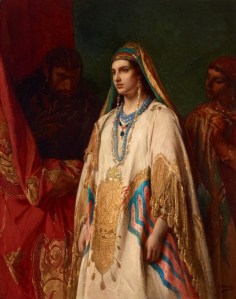
Living in exile, Esther keeps her Jewish heritage secret. As a woman with little influence in her own life, Esther moves quietly through Xerxes’ court, maintaining a low profile. Mordecai’s petition for her assistance pulls Esther out of anonymity and moves her into a life that requires courage, patience and wisdom; and we watch as she relies on God for these qualities.
We have much to learn from this young woman who allowed herself to be led by the source that created and called her. When do we speak up? Why do we remain silent? We have much to explore in her story of quiet obedience and patient trust. When do we question? Why do we follow?We have much to share about the wisdom of this brave young woman. When do we celebrate? Why do we rejoice?
Today we ask . . . what have we learned from Esther?
Tomorrow, Mordecai’s dream . . . Esther is the river.
Job understands the freedom God gives him to choose divinity, and it is the reason and foundation on which he stands. Job knows in his bones that he is good and that he suffers innocently, mysteriously. He knows nothing of the conversation that passed between Satan and God and still he persists in this endless and limitless hope. He expands his own horizons and rises above them. And it is in this expansion of his human self that he meets God. It is through his defense of his innocence against the false sympathy of colleagues that he rises to this divinity planted in him by God. He goes out of and beyond his former limits.
Fr. Alfred Delp, who died in a Nazi death camp, concludes . . . Human freedom is born in the moment of our contact with God. It is really unimportant whether God forces us out of our limits by the sheer distress of suffering, coaxes us with visions of beauty and truth, or pricks us into action by the endless hunger and thirst for righteousness that possess our soul. What really matters is that we are called and we must be sufficiently awake to hear the call.
As we move toward the season of Lent, we will want to spend time with Job to see how he stretches himself beyond his humanity to meet his divinity.
When we use the scripture link and the drop-down menus to explore the story of Job, we find wisdom, strength, courage, and the freedom to choose the gift of humanity offered to us by God.
Adapted from a reflection written on February 21, 2010.
Cameron, Peter John. “Meditation of the Day.” MAGNIFICAT. 21.2 (2010). Print.
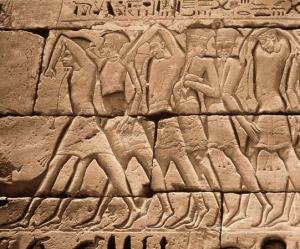
Philistine captives being led away after their failed invasion of Egypt, from a relief at Ramses III’s mortuary temple at Medinet Habu, Thebes, Egypt. (Britannica online)
Wednesday, January 29, 2025
The stories in 1 and 2 Samuel are intriguing if we take the time to pause with them; and over the past weeks we have considered the variety of ways God speaks to us. We have paused to reflect on how we might hear, and then heed, God’s Word. Today it is the story of David, Achish, the Philistine King of Gath, and the Philistines.
Many of us perceive the Philistines as enemies of the Jewish people. As a noun describing characteristics, we define a philistine as “a:a person who is guided by materialism and is usually disdainful of intellectual or artistic values, or b: one uninformed in a special area of knowledge”. (Merriam Webster Online) No matter the context, we understand that David and his men align with Achish in order to somehow endure the wrath of Saul. And we further understand that the Philistine chieftains reject this small band who are trying to survive in a brutal world. The ancient order reflects our own as we too struggle to make and maintain alliances, as we look for connections and coalitions.
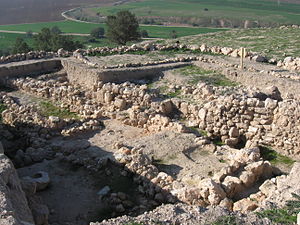
Archaeological findings at Gath
What might we learn from David’s dilemma today? That at times we are required to lie among the enemy. And at times even the enemy rejects us.
Many of us are familiar with the old Christmas carol, The Twelve Days of Christmas, and we may also be aware of varying theories about the derivation of the lyrics and tune. A number of resources report – some correctly and some incorrectly – the reason for the song’s origins, but in this holiday season we will put argument aside and enjoy celebrating the symbols we find.
The first gift is a partridge in a pear tree, and is symbolic of Jesus Christ, the Son of God. The mother bird of this species will feign injury to lure predators away from her young, and some say that it reflects Jesus’s words when he laments in Luke 13:34: “Jerusalem, Jerusalem! You kill the prophets, you stone the messengers God has sent you! How many times I wanted to put my arms around all your people, just as a hen gathers her chicks under her wings, but you would not let me!” (Snopes) Yesterday we reflected on Christ as our savior or Messiah and we recognize his willingness to endanger himself in order to save the faithful.
Two turtle doves in St. George Island, Fla. (AP Photo/Phil Coale)
On this second day of Christmas, we celebrate the presence of Christ as Logos in both the Old and New Testaments. Footnotes tell us that here that John the Evangelist lays out the themes that develop as his Gospel continues: life, light, truth, the world, testimony, the pre-existence of Jesus, the incarnate Logos who is God’s revelation and his expression of his love for us. When we think of the stories we hear and read in this Gospel, we know for certain that God is calling us to be diverse, to tend to that diversity and to place our hope in this diversity – because it is in this diversity that the Spirit manifests itself best.
God, most especially in the person of Jesus, calls us to intimacy. God asks us to commune with one another in a way we think is impossible. God asks much of us, both also gifts us with much. In this Christmas season, let us consider the gift of Logos, God’s Word, to all of creation brought to us in the sacred scriptures of the Old and New Testaments.
“The Twelve Days of Christmas.” snopes.com, 17 Dec. 2017, www.snopes.com.
Includes notes from autumn of 2007. Posted on December 26, 2017.
We are sometimes caught up in a well-developed argument, following its false logic to a false end. We can be led astray by philosophy that seems flawless, by practices that seem good and righteous. Long held traditions, jazzy new jargon, worship of something other than God that seems to do no harm, cheating that no one knows about, vanity so puffed up it has become ridiculous. These are all ideas and practices that Paul warns the Colossians – and us – to guard against. He tells them – and us – that these little demons enter our lives subtly, when we are occupied with daily work, when we are succeeding, when we are happy. Yet, he continues, if we live ofand through and in Christ, we can easily identify and walk away from all these tempting worldly thoughts and devices.
We know that this letter was written to a congregation that Paul did not establish. (CATHOLIC STUDY BIBLE, 318) The town of Colossae was having trouble disentangling itself from the cultic practices familiar to the people; they struggled against pagan teachings that Paul identifies as but “shadows” of the tenets brought to them by Christ. Epaphras, the man who founded the Christian church in Colossae, asks Paul’s help, and so the apostle writes this letter from prison. He wisely does not attempt to argue away against well-developed, long-held beliefs. Instead, he places Jesus before this little flock and allows the Spirit to work in their hearts. The Spirit works in our hearts as well. It enlightens our path that we might see the error of our own ways.
When we find ourselves struggling against a well-oiled, corrupt structure, we must turn our struggle over to Christ and allow him to give us courage.
When we find ourselves lost in the convolutions of a byzantine argument, we must turn our confusion over to the Spirit and allow her to give us the words we will use in witness.
When we find ourselves anxious about the state of the world and the kingdom of God being neglected, we must turn our anxiety over to God and allow God to instill in us the wisdom we will need to extract ourselves from the mire, to witness to the corruption, and to begin our intercessory prayer for those who choose to live in the darkness.
And we must remain in Christ’s light so that we might see our errors. And mend them.