Mustard SeedIf we can find the time this evening or this weekend, we will want to leaf through the first portions of the 13th chapter of Matthew and reflect. The Gospel writer is careful to record Christ’s words; he preserves them for us so many centuries after they were first spoken.
An essay in THE CATHOLIC STUDY BIBLE makes three points about this portion of Matthew’s Jesus Story. First, we must seek meaning in these verses and when we do, we will be rewarded with the wisdom and grace of Spirit’s presence. Second, we must always be confident in God’s promise and providence brought to us by Jesus. And third, leaders of all kinds will have to struggle with the gray world of often opposing forces. The past and present will be linked only when we seek and trust God.
“Parables are the trademark of Jesus . . . [T]hese pointed stories both reveal and veil the mystery of the Kingdom. Unless the listener is willing to probe beneath the surface of the parables, the true meaning of Jesus’ words will escape them . . . [T]rue followers of Jesus are to put aside everything and be fully committed to the compelling beauty of God’s reign.
“Many of the parables in Matthew’s Gospel have obvious moral messages . . . The parable of the weeds sown among the wheat explanation makes the point that the church, like the world itself, is a mix of good and evil. The disciples should not be discouraged by this but be confident that God’s grace will triumph at the end of time and evil will be punished . . .
“The conclusion of the parable discourse seems almost to be a signature of the Gospel writer . . . Bridging past and present in an open and respectful manner is one the greatest challenges of religious leadership”. (Senior RG 397)
And so we wait. We search. We question. We doubt. We struggle. We turn to and rely on God. We enter willingly into both the mystery and the revelation . . . for the more we know the more we question.
The Parable Discourse is a lesson on how to meet difficulty. It is a graced interchange and dialog with our God. And it is an open door that invites us to enter the world of Jesus. May we be confident enough and bold enough to accept this invitation.
Senior, Donald, ed. THE CATHOLIC STUDY BIBLE. New York, Oxford University Press, 1990.RG 397. Print.
E-piph-an-y: A Christian festival, the manifestation of a deity, a sudden intuitive perception or insight, a piece of literature presenting a revelation. These definitions define the holiday or the emotion, the state of being surprised by something we already know but have not yet acknowledged. This word may also define our relationship with Christ. Today we encounter Jesus in the midst of his work and this is what we find.
Jesus teaches. Jesus proclaims the Good News that we are free to choose life over death. Jesus heals. Jesus is moved with compassion at the sight of the crowds. All of this goodness is what God has in mind for us. All of this kindness is what God has in store for us. All of this love is what God intends for us. And this is what the Magi come to honor and worship.
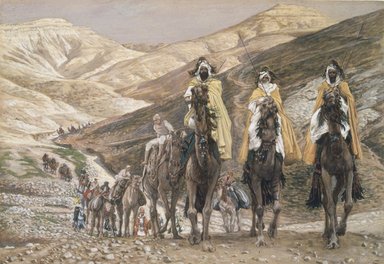
In our Western tradition we have come to know these three men as Melchior, a scholar from Babylon, the place of Israel’s exile about six centuries before Christ’s birth, Caspar, another scholar from Persia, the civilization that overran the Babylonians, and Balthazar, an Arab scholar. These learned men bring gifts of frankincense, myrrh and gold that serve as symbols for our own worship of the Son of Man. Frankincense, aromatic incense, is brought to purify the Lord; myrrh, perfumed oil often used in embalming, is offered to anoint the Lord; and gold, the symbol of power, is presented to honor the Lord. Some commentary suggests that the Magi bring forward these gifts for medicinal purposes; others propose that they are meant as tribute to this new kind of high priest, savior and king. Still others say that these gifts stand in stark contrast to the sacrificial gifts of birds, lambs and oxen that the Jewish people proffered to God. In any interpretation the story holds importance for us for these men have spent their lifetime studying the heavens and their search leads them to a small place in a small town where this small Jewish family shelters for a time. Who is more surprised? The Magi themselves? Mary and Joseph? The shepherds who tend their flocks and follow the Magi who follow the star? Or are we perhaps the most surprised?
All of this is tradition as we have said earlier but we hold and cherish this belief in the story of the Magi for a purpose. We love to hear the names read out rhythmically. We want to listen to the details of this story again. We want the mystery and surprise of this holy night to roll over us and wrap us in the warm and holy mystery of the Christ. We want to be children for a little time again.
When I was small my Eastern European grandmother made doughnuts and inside them she had hidden shiny, bright coins. Who would find the pennies, the dimes? Who would be lucky enough to encounter the rare quarter? Children understand how important it was to nibble the edges of the pastry carefully. Children know the importance of joyful anticipation. Children understand wonder and surprise. As adults we want the confirmation from these intelligent students of the heavens and stars. As adults we want to be affirmed that the Good News we have heard is true. As adults we want someone to stun us with a vivid and beautiful truth. We want the verification that wonderful surprises lie ahead of us. We want to see and hear and touch the reality of the Christ Child.
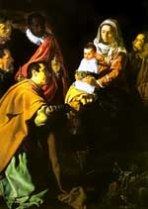
Velázquez: The Adoration of the MagiOn this Epiphany let us resolve to believe more and doubt less. Let us decide to act on our beliefs and turn away from a cynical view of the world. Let us announce to the world that we will love our enemies into goodness. Let us bow in homage to the Christ child. Let us lay at his feet the incense of our own suffering and the joy of our hearts. Let us come and worship the Lord. And let us allow ourselves to experience the surprise and enchantment of the Epiphany . . . just as God has intended.

 The Noontimes