Exodus 14: Making Pharaoh Obstinate
Wednesday, January 15, 2025

Each time I revisit the Exodus story I puzzle over the fact that God makes Pharaoh obstinate. This seems, at first glance, to be such a childish way to show strength. God determines to set the stubborn Pharaoh as an opponent – which God can do because God is all-powerful. And so Pharaoh sets out with soldiers, horses and chariots
I will harden Pharaoh’s heart, and he will pursue them, so that I will gain glory for myself over Pharaoh and all his army; and the Egyptians shall know that I am the Lord.
There would be much less drama in the story of the Red Sea crossing if Pharaoh and his troops were not galloping after the lumbering tribes of Israel. The story would be much less memorable if great walls of water did not destroy the Egyptian cohort. And we would be much less tempted to apply the story to our own lives.
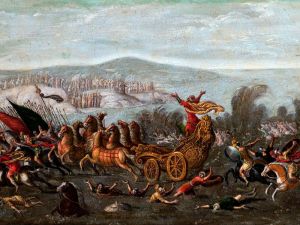 Scholars present various opinions on the accuracy of the Exodus story, but no matter their claims or evidence, we reflect on the accounting of a persistent nation longing to be free cast against a determined ruler who suddenly changes his mind. What does this accounting hold for us? Where do we see ourselves? And how much do we rely on the Lord when we are confronted by overwhelming obstacles?
Today we remember this ancient and familiar story as we find our own place in the tale. We are either the reckless pursuers or the holy faithful. We are either driven by obsession, or led by wisdom and hope. We are either blind followers of power, or seekers of freedom.
Does God call us to obstinacy to crash forward without thinking, or to cross the marsh while trusting in God’s wisdom? Today let us determine to set down our own story of untiring faith and profound hope.
Images from: https://en.wikipedia.org/wiki/Crossing_the_Red_Sea and https://www.smithsonianmag.com/smart-news/science-red-seas-parting-180953553/
When we use the scripture links to explore differing translations of this story, we find ourselves a
For more on the view that the Red Sea was actually the Sea of Reeds or Reed Sea, visit: http://www.biblearchaeology.org/post/2008/08/New-Evidence-from-Egypt-on-the-Location-of-the-Exodus-Sea-Crossing-Part-I.aspx#Article
For an information and an opinion piece that Moses and the Hebrews crossed the Lake of Tanis (in the Nile delta) rather than the Red Sea, visit:
https://www.smithsonianmag.com/smart-news/science-red-seas-parting-180953553/


 The Noontimes
To enter into the conversation, leave a reply