The High Priest ZadokWhen we discover that we focus on the minutiae of life rather than its living, we know that we have stepped over a line. When we begin to split hairs and argue the details, we know that we have gone a bit too far. When we become fascinated by the rules and parameters rather than the Spirit, we must take a step back and evaluate. Today we have an opportunity to reflect on the minutiae and the living of our lives.
“Historically, this organizational system [of priestly duties] was developed only after the return from Babylon and not in David’s day. Two motivations led to its development. The first is a practical matter: the increased number of priests required a rotation of priestly duties. Second, this ordering of the priesthood may have been an attempt to resolve a squabble between the line of Abiathar, banned from the priesthood by Solomon (1 Kings 2:26), and the line of Zadok, represented by those priests returning from exile . . . [in which] both are linked with Aaron through his two sons”. (Mays 323)
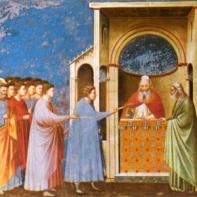
Giotto: AbiatharIn this example of revisionism we see the ancient struggle with minutiae which remains with us today. We fuss about who sits where and who wears what and who knows whom rather than focus on overcoming our fears and living our life to our fullest potential. We have seen this before; we understand the truth of these words. Deep within we know that must put aside our fretting over details and forget about any hierarchy we construct to turn instead to God’s generous goodness and high goals. Rather than lust after a name or position in society, rather than amass possessions to leave to our heirs, we must respond to God’s call.
Our true example is Jesus Christ, not the most popular person we know. And our true goal is to love as God loves us, not to love for the sake of gaining something. With all of this in mind, we remember those who squabble over petty gains, we remind ourselves that our vocation must be more than minutiae, and we ask for God’s blessing in all we do.
Mays, James L., ed. HARPERCOLLINS BIBLE COMMENTARY. New York, New York: HarperCollins Publishers, 1988. 323. Print.
First written on November 15, 2010, re-written and posted today as a Favorite.
Inspired by 1 Kings 3:6-9, the writer of this prayer seeks wisdom in order that he might do God’s will; and he wishes to dispense justice as God does, with compassion and impartiality. He knows his human limitations well, and for that reason he hopes to tap into the divine place within where God speaks to the heart. The irony of this story is that Solomon ended his days out of touch with God. He allows his foreign wives to worship pagan gods. His mighty kingdom devolves into corruption and splinters. And the Hebrew people who followed Yahweh out of the desert to form the nation of Israel are later led into exile when the man for whom this prayer is named falls away from their covenant with God.
We are limited, we are human; yet when we call upon the divine we are wise beyond our humanity.
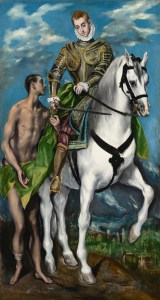
Today we celebrate the feast of St. Martin of Tours, a man born of non-Christian parents in the area of what is today eastern Europe in 316. We know of him today because he turned away from military life to embrace the monastic life; and he became an exemplary pastor, a bishop and the founder of monasteries. He used the wisdom granted him to edify and to build God’s kingdom. El Greco, a Renaissance artist born in Crete but who lived in Spain, depicts Martin in the stylized, elongated mannerism for which he is famous.
We have the opportunity today to think about wisdom: How we pray for it, how we see it changing our lives, what we do when we receive it, and how we encourage it in others.
From today’s MAGNIFICAT Morning and Evening Intercessions:Save your people, Lord.
In Saint Martin, you defeated the tempter in the desert: defeat in us the subtle forces of temptation. Save your people, Lord.
In Saint Martin, you taught love for the true treasures of heaven: keep us from attachment to material goods. Save your people, Lord.
In Saint Martin, you exchanged military weapons for the weapons of the Gospel: in all those who died in military service, exchange suffering and death for life. Save your people, Lord.
Through the intercession of Saint Martin, let us pray: Lord, you hear the cry of the poor.
For those who pursue wealth and power at the expense of the poor: grant them the insight of the Gospel. Lord, you hear the cry of the poor.
For those who regard the poor and homeless with indifference: grant them eyes to see you in their suffering. Lord, you hear the cry of the poor.
For those who care for the poor without reward: grant them Saint Martin’s reward. Lord, you hear the cry of the poor.
May Christ dwell in our hearts through faith, and may charity be the root and foundation of our life. Amen.
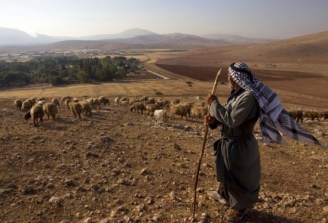
The prophet Amos left his sheep and fig trees to speak God’s word to the faithful and unfaithful alike. These words came at a time of prosperity, when his prognostications were easily and readily jeered by those who enjoyed luxury at the expense of the poor. From our 21st century perspective, we can see that his audience would have done well to listen better to this simple yet eloquent man. His sober, ardent proclamation is concise, pointed and brief . . . but carrying a deeply important message for the part of the Gospel which is eagerly forgotten by many. It is not enough to be kind, in the New Kingdom. We are called to be just as well.
It is easy to look at foreign countries in civil war, at the poor in our own city streets and point to the places where justice cannot flourish or even get a foothold. What is more difficult is to look to our own lives to find the pockets of impoverishment and injustice there. When have we walked away from a situation in which we should have given voice to God’s word? When have we reacted in an anger that stirs the pot rather than in patience which opens doors for communication? When have we avoided? When have we harassed? When have we neglected? When have we manipulated?
Justice shall flourish in his time, and fullness of peace forever.Psalm 72 calls on God to make his justice clear to those who yearn for it.
Justice shall flower . . .
May God rule . . .
God shall rescue the poor . . .
God shall have pity on the lowly . . .
The lives of the poor God shall save . . .
We ought not to shrink from God in our poverty of spirit, for it is the poor in spirit whom God touches quickly, heals surely, abides with eternally. We ought not shrink from confessing our lacks, from asking for our needs, for expressing our heart’s desire. Let us offer up our impoverishment daily.
May God remember your every offering, graciously accept your holocaust, grant what is in your heart, fulfill your every plan. (Psalm 20:4-5)
Amos reminds us when he speaks of the woes that God knows the content of our hearts. There is nowhere we can hide our secrets. So when we mourn, let us open our hearts fully to the God who created us. It is with this small action that we will be healed. It is with this openness that we best love God. It is through this honesty that we bring about the justice that the prophet Amos yearns to witness. Let us take our offerings of our own accord, let us seek impoverishment, and let us place them on the altar of our life.
Adapted from a reflection written on November 15, 2009. In memoria for my mother who always preached Killing with Kindness
The name Maccabees means the hammerand as we read through these books in scripture we experience a great deal of violence in the name of God. These books are stories about “the attempted suppression of Judaism in Palestine in the second century B.C. . . . [The author’s] purpose in writing is to record the salvation of Israel which God worked through the family of Matthias . . . Implicitly the writer compares their virtues and their exploits with those of the ancient heroes, the Judges, Samuel, and David”. (Senior 550) Portions of this book may be used when dedicating an altar . . . or when praying for persecuted Christians. The lesson here is that living the life of an apostle of Christ will inevitably include bloodshed – whether it be spiritual, mental or physical. Each time I pray to my Mother for a special intercession, I find myself in this story. She, the gentlest of shepherds, realized real battles in her life. Her slogan was: Kill them with kindness.
St. Gertrude of Nivelles (626-659)
There is no avoiding the central message of Jesus’ life: When in doubt, exercise kindness and compassion . . . and listen for the word of God to tell us which way to turn, when to pause, when to proceed. Tomorrow is the Feast Day of St. Gertrude. My mother and my sister – both deceased – are named for this saint. Both of these women had a plodding, patient persistence when confronted with evil, and they were formidable and unmoved when it came to right and wrong. The Morning Prayer for tomorrow begins with a verse from Isaiah (30:15): By waiting and by calm you shall be saved, in quiet and in trust your strength lies. I reflect on the betrayal and carnage we witness when we read Maccabees. The deception of the son of Abubus who gives the faithful a deceitful welcomeshakes me to the core. There is nothing more wicked than luring in the innocent to later spring up, weapons in hand, to rush upon the loyal servant of God – thus repaying good with evil.
What do we do when we are witness to this? We are utterly astounded as is John in today’s reading. We go to God who tells us to shake the dust of the unfaithful from our feet and move on. And we do as my mother always recommended: Kill them with kindness.
Gertrude the Great was a German Benedictine mystic with a special dedication to the Sacred Heart of Jesus. A number of her writings are still in publication today. Gertrude of Nivelles founded an abbey with her mother, Itta, in present day Belgium. She is the patron saint of gardens and cats.
Senior, Donald, ed. THE CATHOLIC STUDY BIBLE. New York, Oxford University Press, 1990.550. Print.
Cameron, Peter John. “Prayer for the Morning.” MAGNIFICAT. 16.11 (2009). Print.
In becoming human, Jesus shows us that our humanity is not an obstacle to our communion with God, but rather the only path to our divine destiny . . . If my heart is not begging, “Come, Lord Jesus” in my ordinary life today, then I cannot pretend I would have recognized him when he first came, and I cannot expect truly to welcome him at is glorious return. That is why the church gives us this season of Advent, to recognize the longing in our hearts for a salvation which we cannot give ourselves, but for which we can beg today and for ever, “Come, Lord Jesus”. Fr. Richard Veras, November 28, 2010, THE MAGNIFICAT ADVENT COMPANION (17)
What is this newness that is ours in our humanity?
What is this divinity we have been gifted as part of our destiny?
What is this fulfillment of salvation that we cannot give ourselves?
Today our Noontime takes us to the proclamation of the new kingdom, the baptism of Jesus, and God’s announcement that he is well pleased with the beloved son.
Today we have the opportunity to think about our own place in the divine plan as a human creature.
We have the opportunity to open ourselves to the newness of the season and the cyclic beginning again of a calendar year.
We have the opportunity to make ourselves ready – as Jesus made himself ready – for the days ahead.
Let us heed the words we hear in today’s Gospel . . . So too, you also must be prepared, for at an hour you do not expect, the Son of Man will come (Matthew 24:44) .
We will want to receive this newness that brings hope – Come, Lord Jesus.
We will want to be open to this healing that mends mortal wounds – Come, Lord Jesus.
We will want to experience this divinity that manifests in the obstacles of our humanity – Come, Lord Jesus.
And we will want to be awake and ready for the salvation with which we have been graced, the peace and serenity that are our heritage – Come, Lord Jesus . . . and fulfill this longing in our hearts . . .
Written on November 28, 2010 and posted today as a Favorite.
Annibale Carracci: The Samaritan Woman at the Well
Friday, November 1, 2024
This letter contains some clear restrictions for women – they are to be silent and not speak out. Men are put in charge of prayer and liturgy. Women are meant to be on the sidelines in this ancient world. Some men today wish women to remain so – as unequal partners. Other men today are wise enough to understand that women have equal worth before God and it is indeed a woman who brings Christ into the world. We can allow ourselves to be contained by these sentiments or we can rise above them. Modern commentary points out that these injunctions against women are a sign that the Holy Spirit was clearly in motion, encouraging the oppressed half of humankind to speak up and speak out. The oppressing half of humanity responds in the way it knows best – it calls for silence. Equality, in the end, will be gained. Women, as the oppressed gender, have the opportunity to understand and to know that as a part of the marginalized in society they hold a special place.
John Martin Borg: Woman Caught in Adultery
In the Gospels, Jesus pays attention to women – the Samaritan woman at the well (John 4), the woman (and we notice that the man is not brought forward) whom the men wish to stone for adultery (John 8), women suffering, women grieving, and his own mother at the time of his crucifixion (John 19). Jesus makes wine of water at his Mother’s request. Jesus includes women as his apostles. Jesus values women as equal to men.
In Thursday’s MAGNIFICAT Meditation, Father Bede Jarrett writes: When we say God is everywhere, we mean that he is in all things because he made all things. Not only does the whole world lie outstretched before his eye and is governed by his power, but he himself lurks at the heart of everything. By him things have come into existence . . . Wholly is God everywhere, not as some immense being that with its hugeness fills the world, but as something that is within every creature he has made.
Rogier Van Der Weyden: Deposition or Descent from the Cross
We believe this to be so and when we do, we believe that women and men are created as equals in a glorious, mysterious dance of opposites that resist and yet attract. This marvelous tension draws us in to ponder the inscrutability of life. This equality that is rejected by many is actually the foundation of life itself. This union of contrasts is stronger than the binds which hold together like beings.
When the age-old conflicts of gender and sexuality surface, we might remember this: Wholly is God everywhere, not as some immense being that with its hugeness fills the world, but as something that is within every creature he has made.
Do we reject this different-ness from ourselves? Or do we take it in, and in so doing, welcome a Jesus we have yet to meet?
Cameron, Peter John. “Meditation of the Day.” MAGNIFICAT. 13.11 (2009). Print.
Adapted from a reflection written on November 13, 2009.
Today we have the opportunity to read about a promise review. God has promised territory to a people who were enslaved. God promises a place in which they might live, work, play, celebrate and worship. God promises to remain with them, to guide them and to protect them. They, in turn, promise to reverence this God only, to follow the Lord’s commandments only, and to teach their children and their children’s children to do the same. We might take this opportunity to pause and to survey our own promises, the ones we make willingly, the ones we perhaps make grudgingly, the ones we keep and the ones we forget. How and why do we make promises? When and why do we keep them or disregard them? Do we ever pause to remember what promises we have made and why we made them?
We do not only receive the gifts of our talents and souls, we also are given the gift of time and space each morning when we rise. What do we chose to do with these presents from our creator? When we examine our lives – as we do frequently during our Lenten or Advent journeys – what new territories do we find that we now occupy? Which harassing and recalcitrant tyrants have we conquered through God’s grace and hand? What have we taken in that is new to us? How has this newness affected the other parts of our lives? What can we expect from ourselves? Do we see others differently than we saw them before as a result of our newness?
Jericho
It is always good to evaluate and assess because from this kind of exercise can come a deeper and better understanding of who we are – why we are – where we are going – and who we are meant to be. When we take a scan of our actions we have to be honest and sometimes this can be brutal; but it is the only method of integrating what we say with what we do. The act of self-scrutiny, when done in a healthy and open manner, is the only real method of determining if and how we have kept the promises we have made. It is also the only real way to discovering if we are making the proper kinds of promises. This kind of examination is the only real path to integration. It is the only true response to the God who creates us lovingly and tends to us unceasingly.
What are the promises we have already made? What promises are we about to enter into? What promises do we dream about?
What promises have we kept? What promises do we intend to keep? What promises do we hope to take into the future?
Only an honest survey will tell us what we will need to know. Only an honesty survey will tell us if and how we value integrity.
Romans 6:1-11: Seek Freedom from Sin: Seek Life in God
Tuesday, October 29, 2024
Today’s reading is Paul’s defense against the idea that to live as Jesus lived is to live without regard for the Law of Moses or without regard for Jesus’ own act of fulfilling that Law. This new covenant does not promote moral laxity; rather it brings the opportunity to live a full life of union with the law, with the spirit of the law more than the letter. Paul also goes on to remind us that we all receive the gift of resurrection through Christ. He delineates ably an argument to those who say that life in Christ and in the Spirit lacks morality because it forgives. He shows us that life in Christ is the exemplar of morality if being lived well.
So many times we forget that we ought to tend to our spiritual health as assiduously as we do our physical, emotional or mental health. We practice yoga, eat organic food, look for advice, and forget to make a stillness in our lives where we can best listen to the voice which speaks within.
Humans so often seek to separate and divide. God always seeks to unify. God brings us freedom from a life of division. He brings us life in Christ and union in the Spirit. Jesus came to live with us as God’s Word. Christ remains among us as God’s Spirit. Christ lives in us, in spite of us, always with us, ever keeping us in God’s love. Life in God is freedom, freedom to become our best potential, freedom to fulfill God’s best dream for us. Let us seek freedom to live in God.
Adapted from a Favorite written on November 6, 2017.
The prophet Zephaniah wrote sometime between the years of 635 to 630 B.C.E. His is a brief prophecy and its message is succinct: there is a day if universal judgmentwhich will arrive surely, and this judgment will be followed by restoration. Earlier in this chapter he refers to the town of Cushsaying that beyond the rivers of this town the scattered peoples will bring offerings. Cush was located south of the upper cataracts of the Nile in the area referred to as Nubia. It was a land of great wealth with commerce routes which brought to the Mediterranean materials such as gold and silver, cosmetics, balsam, incense, myrrh, ostrich eggs, and other wild animal products. Jeremiah also refers to this place as a source of topaz. Further, these people were from to time a powerful political force: the Nubian pharaoh Shebitku defeats the Assyrian Sennacherib in Israel in 701 B.C.E. – an astounding account recorded in 2 Kings. (Zondervan 1519.) Their power, however, seems to have collapsed after 671 B.C.E.
What does all of this signify? The restoration this prophet foretells is universal. It will be bestowed on even those who have been scattered as far off as Cush – even those who have been held captive by her alluring power and cosmopolitan life.
Sing, O Daughter Zion; shout aloud, O Israel! Be glad and rejoice with all your heart, O Daughter of Jerusalem! . . . I will give you honor and praise among all the people of the earth when I restore your fortunes before your eyes.