Israel splits from Judah and sets up a new capital in Bethelto rival the city of Jerusalem but in this temple Jeroboamplaced a golden calf. All of this mocks the beautiful covenant established between Yahweh and the faithful but, as the people will discover when the Assyrians invade, it is impossible to replace Yahweh’s fidelity and love with a mere golden calf. We might well ask what the followers of this idol were thinking when they centered their lives on the false hope of an inanimate statue. And when we do, we also ask ourselves where we might find golden calves in our own lives.
Hosea predicts ruin and destruction for the followers of the calf. He points out the ways and places that wickedness, perversity and falsehood are cultivated in this false spirituality. He also describes the folly of relying on the power of chariots and warriors and the turmoil of the tribes when superior forces overrun their cities.
Hosea reminds his readers that they are called to sow justice but instead of reaping fruitful crops the bitter wormwood plant which, because of its bitterness, cannot serve as fodder or animals or birds. In the hope of reaping rich harvest, those who are lured by false promises and false gods will instead gather in the bitterness they themselves have sown.
Hosea asks each of us to examine what it is we sow, and what it is we hope to harvest. Is it fertile and bountiful goodness, or the bitter fruit of wormwood? Only we can know.
Today we continue our exploration of the kingdom by going to the UNICEF web site. To examine the status of immunization in the world. Find other sources of information on this topic and consider the pros and cons. What does Jesus say to us about immunizations especially for children? How does God’s Spirit move us to celebrate humanity and those who call us to care for the children?
Tomorrow, the promise of the kingdom.
Click on the image above to explore how to save lives and why one in five children are denied vaccines. Discover what science has to tell us about eradicating polio and other devastating diseases.
If we want to find another parable that Jesus tells us while exploring this idea, we may want to use a parable index like the one at http://www.ccel.org/contrib/exec_outlines/pa.htm This is a tool to sort through the stories Jesus tells us and you may have another that you want to recommend in a comment.
Today we continue our exploration of the kingdom by going to the Food and Agricultural Organization of the UnitedNationsweb site. Find other sources of information on world hunger and consider the pros and cons. What does Jesus say to us on this subject? How does God’s Spirit move us to celebrate humanity and those who call us to sow and reap a harvest for the poor?
Click on the image above to discover what may endanger the Mediterranean diet, the diet long considered the world’s healthiest and most sustainable regimen. Discover what science has to tell us about the factors that affect hunger.
Tomorrow, another challenge from the kingdom.
If we want to find another parable that Jesus tells us while exploring this idea, we may want to use a parable index like the one at http://www.ccel.org/contrib/exec_outlines/pa.htm This is a tool to sort through the stories Jesus tells us and you may have another that you want to recommend in a comment.
Today we continue our exploration of the kingdom by going to the United Nations web site on climate change to examine the topic. Find other sources of information on this and consider the pros and cons. What does Jesus say to us on this subject? How does God’s Spirit move us to celebrate science and those who bring us their discoveries?
Click on the image above to explore the NASA Global Climate Change: Vital Signs of the Planet and discover what science has to tell us.
Tomorrow, another story from the kingdom.
If you want to find another parable that Jesus tells us while exploring this idea, you may want to use a parable index like the one at http://www.ccel.org/contrib/exec_outlines/pa.htm This is a tool to sort through the stories Jesus tells us and you may have another that you want to recommend in a comment.
Today we continue our exploration of the kingdom by going to the United States FDA web site and examining the topic of genetically engineered animals. Find other sources of information on this topic and consider the pros and cons. What does Jesus say to us on this topic? How does God’s Spirit move us to celebrate science and those who bring us their discoveries?
Click on the image of the mosquito above to read an article from the BBC asking if the world is ready for work in this arena.
If you want to find another parable that Jesus tells us while exploring this idea, you may want to use a parable index like the one at http://www.ccel.org/contrib/exec_outlines/pa.htm This is a tool to sort through the stories Jesus tells us and you may have another that you want to recommend in a comment.
Today we continue our exploration of the kingdom by going to the World Health Organization web site and examining the topic of genetically modified crops. What are the pros and cons? What does Jesus say to us on this topic? How does God’s Spirit move us to celebrate science and those who bring us their discoveries?
Tomorrow, another facet of the kingdom.
If we want to find another parable that Jesus tells us while exploring this idea, we may want to use a parable index like the one at http://www.ccel.org/contrib/exec_outlines/pa.htm This is a tool to sort through the stories Jesus tells us and you may have another that you want to recommend in a comment.
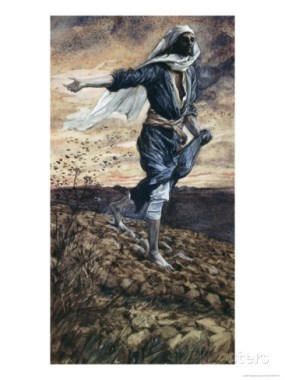
Jesus says: This is how it is with the kingdom of God; it is as if a man were to scatter seed on the land and would sleep and rise night and day and through it all the seed would sprout and grow, he knows not how.
With our high-tech science in which we manipulate the very substance of plant and human DNA; and we establish pros and cons explaining how we are helping or harming the planet. These are discussions that did not occur with Jesus’ contemporaries yet Jesus is with us still today, guiding us. If only we might make ourselves full citizens of the kingdom. If only we might awaken to the word of God and the movement of the Spirit. If only we might follow Christ.
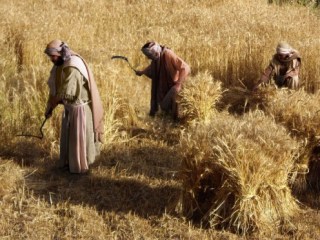
Jesus says: Of its own accord the land yields fruit, first the blade, then the ear, then the full grain in the ear. And when the grain is ripe, he wields the sickle at once, for the harvest has come”.
Jesus uses this and other parables to bring home his thoughts to his audience. Two thousand years ago Jesus used the mystery of the grain in the harvest to call workers to the kingdom. Today, what parable does he use? Perhaps it is the story of genetically modified crops. We may not be aware that Jesus is present as we make decisions that affect the world for generations; yet Jesus’ word is as important to us today as it was to ancient peoples.
Harvest Reapers
Jesus says: To what shall we compare the kingdom of God, or what parable can we use for it? It is like a mustard seed that, when it is sown in the ground, is the smallest of all seeds on the earth. But once it is sown, is springs up and becomes the largest of plants and puts forth branches, so that the birds of the ski can dwell in its blades.
Jesus uses parables with us today, but do we apply the lessons he is teaching? Do we explain away the kingdom with our scientific prowess which, when we pause to think of it, is a gift from God in itself? Are we open to the mystery of the kingdom and our world? Do we call others to partake of this mystery? And do we celebrate the gift of Jesus’ presence in every moment and every space of our lives?
The disciple Mark says: With many such parables he spoke to them as they were able to understand it. Without parables he did not speak to them, but to his own disciples he explained everything in private.
Women Reaping
As followers of Christ and readers of God’s word we have become his disciples. Jesus speaks to us in our hearts, explaining the mysteries that puzzle us and healing the wounds that cripple us. When we spend time with scripture we spend time with Christ. Read varying versions of today’s citation . . . and listen for the word of God. For Jesus speaks to each of us so that we might better understand the mysteries of our world, so that we might better comprehend the miracle and gift of this elusive gift of kingdom that we seek . . . but that we already possess and enjoy.
We have looked at the mystery of God, Jesus, he Spirit, power, rendering, resurrection and incarnation. This week we pause to spend time with scripture, looking for the kingdom that is already ours as explained by Jesus to his followers, and as found in the words of the Old and New Testaments. Today we begin our journey as we use the scripture link of this citation from Mark to compare texts . . . and to listen for the Word of God.
This is St Paul’s goal. And as modern apostles, it can be ours. We work on our own conversion, we rebuke sinners, we pray for our enemies, we hope for the impossible, and we abide in the faith that all will be well.
The letter to the people of Colossae was written before Paul had visited the town east of Ephesus. A small Jesus community had begun there but they had no clear disciple to follow. A man named Epaphrasasked Paul’s help in instructing the people about the Christ . . . and so we have these words today.
Paul writes that suffering and persevering through the antics of pagans and heretics is precisely the work of a disciple of Christ. This letter is a mini-lecture on who the Christ is, the nature of our work done in his name, various warnings against false teachers, and what our mystical end ought to be. It is a snapshot of who and what we are, and who and what we hope to be. The letter is a perfect message for us when we find ourselves surrounded by ineptitude, corruption, deceit, envy, pride and vice.
When we reflect on some of the conversations we have had during these weeks of lent, we might use these verses.
When we think about our Noontimereflections this week, we might use these words.
When we consider the gift of a Lenten journey and our Easter Resurrection, we might enact this message.
When we put ourselves in the first century in the place of those in Colossae, we might better understand that the perfection to which we are called is not a lock of error, but rather a perfection in perseverance. For it is in this way that we best find Christ in us.
Tomorrow, the poor in body and spirit.
Adapted from a Favorite written on April 20, 2007.
The word of the Lord came to Jonah a second time: “Set out for the great city of Nineveh, and announce to it the message that I will tell you”. So Jonah made ready and went to Nineveh, according to the Lord’s bidding.
Ninevehwas the capital of the ancient empire of Assyria and it is thought that the word derives from the name Nin, a pagan god closely associated with the Greek god Hercules. Legend tells us that this settlement was begun on the banks of the Tigris River by the ancient leader and king Ninus, or Nimrod. Today the city’s ruins are located opposite Mosul, but at its apogee this enormous metropolis was the largest in the world. As early as the year 1800 B.C.E. the city was the center for the worship of Ishtar, goddess of love, war, sexuality and fertility. In 612 B.C.E. it was sacked by an alliance of Assyria’s former subject nations. We have a great deal to learn from Nineveh.
At the time of Jonah’s ministry (785-775 B.C.E.), Nineveh was a thriving cultural, social and political hub of enormous importance. We can well imagine the prophet’s hesitancy to preach God’s word in this environment; but at this time “Assyria had suffered military reverses, diplomatic setbacks, famine and domestic uprisings”. In addition, two eclipses had taken place in 784 and in 763 B.C. E. It is likely that all this prepared the Ninevites for a foreign prophet who suddenly appeared to bring them news of how they might make a positive change. (Zondervan 1469) Although reluctant, Jonah does as God asks of him and he sets out on the road to Nineveh. We have a great deal to learn from Jonah.
When challenged by corrupt Pharisees, Jesus says: This generation is a wicked generation; it seeks for a sign, andyet nosign will be given to it but thesign of Jonah. For just asJonah became a sign to the Ninevites, so will the Son of Man be to this generation.(Luke 11:29-30)
Spend time with this story of Jonah and with Jesus’ words as recorded by both Luke and Matthew (12:38-45), and consider the meaning of these verses in our own lives. When we reflect on where our own Nineveh might lie and on who brings us our greatest challenge, let us also consider if we, like the reluctant Jonah, might make ready. Let us consider if we might rely fully on God. Let us decide to put aside our fears and anxieties as we carry the word of God. And let us, like Jonah, set out for the city of Nineveh.
For news about the condition and status of ancient Nineveh today, click on the carving image above or visit: http://www.ancient-origins.net/news-history-archaeology/tragedy-militants-bomb-2700-year-old-nineveh-wall-iraq-002632
ARCHAEOLOGICAL STUDY BIBLE (NIV). Grand Rapids, Michigan: Zondervan, 2005. 1469. Print.