James Tissot: The Meal in the House of the PhariseeRecognizing their craftiness, he said to them, “Show me . . .” [Yet] they were unable to trap him by something he might say before the people, and so amazed were they at his reply that they fell silent.
Craftiness approaches us from many angles and wearing many different kinds of shoes. In our work and in our family life, particularly when we trust others from a sense of habit rather than from a discernment of a truth we see in them, we may fall into a trap which Jesus cleverly avoids in today’s reading.
When we operate from a source of good, we may be easily fooled by others when we speak in and for ourselves.
When we operate from a source of good, we will amaze our enemies when we speak in and for Christ.
In another place in Luke’s Gospel, Jesus tells us: When they take you before synagogues and before rulers and authorities, do not worry about how or what your defense will be or about what you are to say. For the Holy Spirit will teach you at that moment what you are to say. (12:11)
In our sense of panic when we are attacked, we may automatically sink to the level of deception which has assailed us, thinking to outwit our opponents. Or, we might put our fear on hold and call on God to give us the proper words that will amaze and silence our challengers.
The value of speaking with God morning, noon and night is this: When we are under siege – whether from a known enemy or a loved one – we will have a well-trained homing instinct, a ready portal, a clean and open conduit to God. The answer we seek in desperation comes to us nearly unbidden so that we might amaze and silence those who seek our ruin or even our end.
As we travel through our days, moving from one activity to another with little time for introspection, we must take time to recognize and give thanks to the Spirit which keeps us free and holy. It is this relationship which guides us in recognizing craftiness in others. It is this relationship which guides us in recognizing what is Caesar’s and what is God’s. And it this relationship which gives us the gift of sudden grace to recognize the difference between those who live in the world of deception, darkness and illusion and those who live in the wholeness and goodness of God.
A 1915 Postcard: New Year’s ResolutionsA new day dawns, a new year begins . . . we have before us a new opportunity for reconnection and rebirth. In today’s Noontimewe examine part of Paul’s farewell speech to the Ephesian elders in Miletus in which he lays out a kind of instruction manual for those whom he has brought into Christ’s infant church . . . and for whom he has great love.
As we begin a new year, we might resolve to take Paul’s admonitions seriously; we might decide to be faithful followers of the Gospel . . . and this may be more difficult than we first think.
I did not shrink from proclaiming to you the entire plan of God . . . As we begin a new year, let us resolve to be fearless in proclaiming the Good News to all we know. In our secular world it is so easy to say nothing when others rant about how the poor are lazy, about how we need to take back America from the immigrants. It is easy to remain silent in the face of such anger. It is convenient to forget that most of us are not descended from indigenous peoples.
I know that after my departure savage wolves will come among you, and they will not spare the flock . . . As we begin a new year, let us resolve to be both watchful and loving, and let us determine to be in the world but not of it. In a presidential election year it will be easy to join a drumbeat of complaint. It will be difficult to listen without judging. It will be awkward to express a view that is contrary to the majority.
Keep watch over yourselves and over the whole flock of which the Holy Spirit has appointed you overseers . . . As we begin a new year, let us resolve to maintain healthy boundaries as we take care of ourselves even as we tend to the needs of others. In a self-centered society we will often find ourselves alone when we advocate for the disenfranchised. We will be at odds with conventional wisdom. We will run counter to general opinions. We will struggle with knowing which work is our own and which is not.
Miletus: Agora with public buildingBe vigilant and remember that for three years, night and day, I unceasingly admonished each of you with tears . . . As we begin a new year, let us resolve to be prudent and compassionate in all that we do in Jesus’ name. In a time when a show of emotion is characterized as a weakness we will be against the tide. In an era when the phrase “personal responsibility” is used to erase God’s call to heal the broken-hearted and help the marginalized, we will stand out as different and even bizarre. We will be targets for people’s hatred.
In every way I have shown you that by hard work of that sort we must help the weak, and keep in mind the words of the Lord Jesus who himself said, “It is more blessed to give than to receive” . . . As we begin a new year, let us resolve to be determined to live out the Gospel message in our support of the marginalized. Let us acknowledge that the world will disparage who we are and what we do . . . and that Christ will be working right beside us.
When he had finished speaking he knelt down and prayed with them all . . . As we begin a new year, let us resolve to join others in prayer whenever and wherever possible to unite our voices and hearts in unison with the Creator. Let us recognize that the work of Christ’s disciples is difficult at best . . . but amazingly rewarding and well worth our personal cost.
Paul reminds the faithful that Christ’s call will run counter to what is comfortable or popular; yet Christ’s message will be wonderfully simple and beautifully plain. On this New Year’s Day let us remember the gift of Christmas as we resolve to both fashion and fulfill new resolutions that will ask much of us . . . but that will be well worth the sacrifice and even the pain.
Written on February 25 and posted today as a Favorite . . .
Scripture persistently warns us about how to live, whom to follow, and what traps lie ahead to ensnare us. All we have to do is to pay a bit of attention.
Each of us has our personal impediments to the progress of the soul. All of us must come face to face with ourselves and the lives we have lived. Our antagonists are sometimes in our faces, but more frequently they slip in among our friends and loved ones to betray us in our inmost heart. Those who oppose us openly are easily identifiable; the more dangerous enemies, Isaiah warns, are those who come in the guise of goodness – and for this reason the Lord turns the world upside down – to see who shakes out, and who has learned the skills needed by the faithful.
If we have fed the hungry, clothed the naked, given shelter to the homeless and taken in the lost, we have been putting ourselves through our lessons well.
If we have mourned the dead, tended to the sick, ministered to the imprisoned and entered into the vineyard to do God’s work, we have becomes accustomed to living in mercy and compassion.
If we have witnessed to evil, rebuked our companions, atoned for our sins and made changes in our lives, we know how to live in God’s vineyard. And we will put our heads down, go indoors, and await the passing of the dreadful singing of the harvesting sword.
We ought not fear the obstacles we constantly stumble against for they are lesson plans that refine us. If we have answered God’s call and accepted our work as remnant toiling in God’s vineyard, then we need not fear the coming of the day as we see it here, for with God all things are possible. God will turn all that is evil to an end that is goodness, and we will know peace out of chaos, justice out of ruin, humility out of pride, love out of envy, and joy out of sorrow. Our elusive antagonists who have hounded our heels and sent chills of fear through our bones will have honed our skills at kingdom building and as remnant, and we will find to our amazement, that we will have readied ourselves for the work of God’s eternal city.
We consider the gifts of humility and satisfaction that God grants Job – and us – for offering the Lord a life of fidelity, honesty and humility. And we are grateful. Today we celebrate the wisdom and hope this story engenders. We acknowledge the choice that God puts before us . . . the choice to live doubtfully or hopefully, dishonestly or faithfully, deceitfully or lovingly. And we affirm the choice we take to live in God’s wisdom as best we are able.
My Choice
Like a leaf windmilling in the
Quick current of life,
I tumble, waiting for the words,
All is well.
Like a flake of hoarfrost clinging to thin glass,
I lean on the hope of my choice that
God alone is enough.
I am a thought of God
sent into the wind,
Pinned to this fragile life I am gifted by
One so great.
I extend myself beyond my own imagining.
I give myself over to the only choice before me.
I bend all into the Spirit of the Lord, to rest in God’s healing wisdom.
Commentary will explain for us that what we read today will both settle and unsettle us. After reading the accounts of combat, the writer brings us to a kind of resting place where he summarizes for us the results of recent warfare; we have the borders of David’s new nation defined. We also see how David determines to administer his newly-forged kingdom, and with this description of personnel and policy we have a foreshadowing of what is to come. An uneasy feeling may flicker through us when we realize that David – who has been so faithful to God – now allows himself to nibble at the edges of his authenticity.
From THE HARPERCOLLINS BIBLE COMMENTARY, page 267: “Skirting the edges of Deuteronomic law (“nor is he to multiply greatly for himself silver and gold,” Deut. 17:17), the king dedicates gifts and booty of silver and gold to Yhwh [Yahweh] (8:11). So “Yhwh gave David victory everywhere he went (v. 14) . . . For David’s sons to be priests is to flout the Mosaic law that draws the priesthood exclusively from the tribe of Levi . . . Many versions, like many commentators, have attempted to smooth the text by rewriting it”. It seems that with David – just as we find in our own lives – with every gain of stability there will be a fluttering of worry.
Almost daily in our world of instant, mass communication we have word that more nepotism has been exposed. Another leader falls to the noisy masses; one more plot of corrupt practices covered by officials is revealed. There is nothing new in our modern headlines and today we see that bureaucracy breeds its own end. Transparency may be the present watchword for leaders, but dishonesty appears to be the practice. There is something about power that corrupts even the best of us.
In Jesus’ early church the structure was horizontal; it lacked a hierarchy of platoons and divisions; there was no ladder for priests to climb. Jesus names Peter as the rock (Matthew 16:18) on which the church will be erected by those who accompany him . . . and by billions of kingdom-builders to come. Christ does not lay out an elaborate bureaucracy of functionaries. Instead, he charges each of us with our own participation function in his community according to our gifts.
In 2 Samuel 11 we hear of David’s sin with Bathsheba. Can it be that we begin to see David wobble in chapter 8 once he establishes the kingdom of Israel, once he becomes comfortable? Perhaps we can learn a lesson from today’s story, and perhaps it is this. When we find ourselves on firm ground and feeling confident in a newly-formed strength, we will want to pause and reflect on the subtle snares that lie hidden in our success. This is not to say that we ought not enjoy the satisfaction that comes from having achieved stability in our lives; but it is to say that once we humans conquer our enemies and our fears . . . we must remember who it is who makes all of this conquest and all of this steadiness possible. And so we pray . . .
Good and patient God, Remind us that when we celebrate stability after chaos, we celebrate you. Tell us often that when we find peace after struggle, that peace is you. Guide us in the remembering that layers of power do not govern well but that a convoluted structure leaves many little places for little demons to hide. We know that you want to erase fear from our lives. We know that you want to bring us stability. We know that you are present to us and in us directly. We know how much you love us. Keep us from creating labyrinths that separate us from one another and from you. We ask this in Jesus’ name, together with the fellowship of the Holy Spirit who lives in each of us. Amen.
Mays, James L., ed. HARPERCOLLINS BIBLE COMMENTARY. New York, New York: HarperCollins Publishers, 1988. 267. Print.
David evidently was in denial about his son Absalom. All we need do to read about this young man’s abuse of the status and power given to him is leaf back a few pages to Chapters 13 through 18 to read the details of his story. It is not positive. Yet, David mourns the loss of this child, ignoring the horror that Absalom played out even against his own father. We watch David struggle with the reality he does not want to see and now in this reading we watch David give over to his grief completely. We wonder – does he mourn the loss of what actually was? Or does he mourn the loss of what might have been? We have no way of knowing.
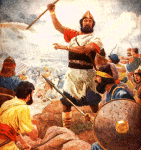
Joab approaches David with words that eventually bring about a reconciliation between king and people. His words are harsh and to the point; David comprehends quickly. The greater offense here seems to be not so much that David mourns the loss of a child but that he appears to be oblivious to the harm this child’s behavior has brought about. Many of us can identify with this. We have likely gone to a family member or friend to try to being clarity to a murky situation only to be accused of speaking ill or of causing problems. When delivering bad news, we must always be prepared to be blamed; and if we are not, we can breathe a sigh of relief and thank God.
In today’s story, David’s fragile state becomes apparent despite Joab’s recalling him to the realities of his role as leader and king. We may not be as fortunate as Joab; but whether we are believed or rejected, we must consider the difficulty we bring someone when we bring bad news about a loved one; and we must deliver our words carefully. If we are the ones who receive this bad news, we must be prepared to see another’s reality or else . . . Not a single man will remain with you overnight, and this will be a far greater disaster for you than any that has afflicted you from your youth until now.
Whether we be Joab or David, we do well to remember that dreams fulfilled are welcome allies while dreams not realized are formidable enemies. If we hope to step out to sit at the gateas David does, if we hope to bring the dreadful truth to someone so that it is heard as Joab does, we do well to enter the interaction carefully, and always include God in the exchange. Only then can we hope for reconciliation.
On this Monday before Palm Sunday, we reflect on the morning’s first reading for liturgy. Today we look to one who trusts God as a model for our anxious minds and weary hearts. The LORD says . . .
I will bless the person who puts her trust in me.
She is like a tree growing near a stream and sending out roots to the water.
It is not afraid when hot weather comes, because its leaves stay green;
it has no worries when there is no rain; it keeps on bearing fruit.
We ask . . . do we believe that we will not succumb to the times of drought? Do we trust that we will weather barren days and dark nights? Are we willing to bear fruit when our resources are low? DO we send out roots to water and stretch limbs to the sky?
E-piph-an-y: A Christian festival, the manifestation of a deity, a sudden intuitive perception or insight, a piece of literature presenting a revelation. These definitions define the holiday or the emotion, the state of being surprised by something we already know but have not yet acknowledged. This word may also define our relationship with Christ. Today we encounter Jesus in the midst of his work and this is what we find.
Jesus teaches. Jesus proclaims the Good News that we are free to choose life over death. Jesus heals. Jesus is moved with compassion at the sight of the crowds. All of this goodness is what God has in mind for us. All of this kindness is what God has in store for us. All of this love is what God intends for us. And this is what the Magi come to honor and worship.
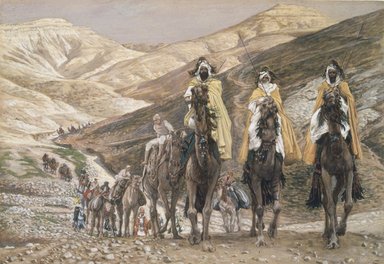
In our Western tradition we have come to know these three men as Melchior, a scholar from Babylon, the place of Israel’s exile about six centuries before Christ’s birth, Caspar, another scholar from Persia, the civilization that overran the Babylonians, and Balthazar, an Arab scholar. These learned men bring gifts of frankincense, myrrh and gold that serve as symbols for our own worship of the Son of Man. Frankincense, aromatic incense, is brought to purify the Lord; myrrh, perfumed oil often used in embalming, is offered to anoint the Lord; and gold, the symbol of power, is presented to honor the Lord. Some commentary suggests that the Magi bring forward these gifts for medicinal purposes; others propose that they are meant as tribute to this new kind of high priest, savior and king. Still others say that these gifts stand in stark contrast to the sacrificial gifts of birds, lambs and oxen that the Jewish people proffered to God. In any interpretation the story holds importance for us for these men have spent their lifetime studying the heavens and their search leads them to a small place in a small town where this small Jewish family shelters for a time. Who is more surprised? The Magi themselves? Mary and Joseph? The shepherds who tend their flocks and follow the Magi who follow the star? Or are we perhaps the most surprised?
All of this is tradition as we have said earlier but we hold and cherish this belief in the story of the Magi for a purpose. We love to hear the names read out rhythmically. We want to listen to the details of this story again. We want the mystery and surprise of this holy night to roll over us and wrap us in the warm and holy mystery of the Christ. We want to be children for a little time again.
When I was small my Eastern European grandmother made doughnuts and inside them she had hidden shiny, bright coins. Who would find the pennies, the dimes? Who would be lucky enough to encounter the rare quarter? Children understand how important it was to nibble the edges of the pastry carefully. Children know the importance of joyful anticipation. Children understand wonder and surprise. As adults we want the confirmation from these intelligent students of the heavens and stars. As adults we want to be affirmed that the Good News we have heard is true. As adults we want someone to stun us with a vivid and beautiful truth. We want the verification that wonderful surprises lie ahead of us. We want to see and hear and touch the reality of the Christ Child.
Velázquez: The Adoration of the MagiOn this Epiphany let us resolve to believe more and doubt less. Let us decide to act on our beliefs and turn away from a cynical view of the world. Let us announce to the world that we will love our enemies into goodness. Let us bow in homage to the Christ child. Let us lay at his feet the incense of our own suffering and the joy of our hearts. Let us come and worship the Lord. And let us allow ourselves to experience the surprise and enchantment of the Epiphany . . . just as God has intended.
Jesus says: I will ask the Father, and he will give you another Helper, who will stay with you forever. (GNT)
God the Creator says: I know that on many days you feel disconnected and ungrounded; but my Spirit lives in you to bring you home to me. I know that you spend nights feeling alone or even abandoned; but my Spirit is with you always. Do I not promise this to you in your exodus journeys that bring you out of enslavement to dangerous ways of life or thinking?
Jesus says:I will ask the Father, and he will give you another Advocate, to be with you forever. (NRSV)
God the Creator says: Do I not, in the person of my son during the great Discourse on the evening before my human death, promise that I will be with you always?
Jesus says: I will ask the Father, and he will give you another comforting Counselor like me, the Spirit of Truth, to be with you forever.(CJB)
God the Creator says: Do I not promise to abide in you every morning at your rising, every noonday when you pause to rest in me, and every evening when you lie down to rest?
Jesus says: I will talk to the Father, and he’ll provide you another Friend so that you will always have someone with you. This Friend is the Spirit of Truth. (MSG)
God the Creator says: You can rely on me. You can believe in me. You can stand firm on my shoulders. I speak the truth of my love to you when I tell you that I have been with you since before your inception; and I am with you through endless time and space. Rest peacefully in me. Always.