Our lives seem full of words and in particular this recent election cycle seems to have the very air full of them. Words for, words against, words that describe, words that deceive, words that inflame, words that bring peace, empty words, words that fill, but so many words. At this point in his prophecy Jeremiah has spouted many life-saving words and yet the prophet is being ignored. He will eventually disappear from the world stage but his words will remain for they are God’s words. The words Jeremiah utters and writes down will prove him to be on target and in tune with God. We might wish to be so in accord with our creator. In the midst of so many words we stumble across this verse as we reflect on how we might make God’s words our very own.
Jeremiah 15:16:When your words came to me, I ate them; they were my joy and my heart’s delight, for I bear your name, O Lord God Almighty.
Jeremiah repeated the words the Lord gave him to say; we pray that we might be so ardent.
Jeremiah spoke faithfully in the name of God Almighty; we pray that we might be so persistent.
Jeremiah lived out the creator’s words; we pray that we might be so authentic.
Jeremiah sticks to the message the Lord gave him to deliver; he does not go off message nor does he incorporate his own agenda into the words he is given to speak. Jeremiah complains to God that he is cursed by many; he says that he ought never to have been born. He lives in pain as a consequence of his fidelity to God; yet Jeremiah does not give in.
Jeremiah delivers God’s words and in doing so he also delivers hope. Jeremiah speaks difficult words and in doing so he makes them his heart’s delight. Jeremiah makes God words his own, and in doing so he makes the invisible God visible.
Sirach 51:11:I will ever praise your name and be constant in my prayers to you.
When we celebrate, let us remember to thank God.
God says: I am happy to help you when you call on me. I love to rush to your side when you are in need. But I especially love to dance and rejoice with you when your news is good. Remember me in joy even as you remember in sorrow. Call on me in happiness even as you call on me in sadness. And love me in your grief even as you love me in your exultation.
God remains ever constant in us. Let us try to remain ever constant in God.
Infidelity, prostitution and alcoholism. It is easy to brush these three nouns aside to say that they have nothing to do with us; but we might want to ask ourselves: Do we remain constant to principles that flow from the Gospel, are we willing to sell ourselves for something we know has little value, do we numb our senses in an attempt to live a life of denial rather than reality.
These words represent not only private or individual separations from God; they are transgressions against the whole, the entire Mystical Body. We have reflected on this concept before during our Noontimes that we fool ourselves if we believe the often repeated sentence: I’m not hurting anybody but myself – so leave me alone and stop judging.
It is true that we ought not judge one another, for judging is left to God alone. But it is also true that as members of Christ’s Body we are called to speak and to listen to one another. We are called to rebuke. We are called to show mercy. We are called to forgive and to be forgiven. We are called to unite in the hope that all will be whole, that all will be one.
Where do we find pleasure? Where do we find joy? In a conversation with a friend over the week end, this topic held us for fifteen minutes or so. Pleasure is temporary, sense-numbing thrill-seeking. Joy is eternal, magnifying, uniting with goodness. St. Paul reminds us in Romans 14:17-19 from the morning prayer in MAGNIFICAT: The kingdom of God is not a matter of food and drink, but of righteousness, peace, and joy in the holy Spirit; whoever serves Christ in this way is pleasing to God and approved by others. Let us then pursue what leads to peace and to building up one another.
In today’s Gospel from John 17 we hear Jesus say in prayer to the Father: Father, the hour has come . . . I revealed your name to those whom you gave me out of the world. They belonged to you, and you gave them to me, and they have kept your word. Now they know that everything they gave me is from you, because the words you gave to me I have given to them, and they accepted them and truly understood that I came from you, and they have believed that you sent me. I pray for them.
Paul speaks to us, and the Corinthians, and then he poses a question (1 Corinthians 6:12-20): The body is not for immorality, but for the Lord, and the Lord is for the body . . . Do you not know that your bodies are members of Christ? . . . Do you not know that your body is a temple of the holy Spirit within you, whom you have from God, and that you are not your own? For you have been purchased at a price. Therefore glorify God in your body.
We are not our own. When we hurt one, even ourselves, we hurt all. We have been purchased at great sacrifice. We are greatly loved. When we hide in the shadows and seek temporal pleasure, we throw away a gift of great value, the gift of eternal life. So let us call ourselves and let us call one another to joyful union that satisfies for an eternity. Let us forgo pleasure and seek joy. Let us give up that which satisfies today for that which will fill us for eternity.
Cameron, Peter John. “Prayer for the Morning.” MAGNIFICAT. 5.26 (2009). Print.
I will stand at the guard post and station myself upon the rampart, and keep watch to see what the Lord will say to me, and what answer he will give to my complaint.
I love these verses. They speak to us of fidelity, constancy, and patience. They call us to commit ourselves for eternity. They ask us to be reliable as God is reliable. They are difficult words to follow but they are a life-giving and sustaining command. They also give us permission to deliver our grievances to God, asking for intercession and deliverance.
If it delays, wait for it, it will surely come, it will not be late.
We live in an “instant” world. I have just read that video gaming causes us to expect reward every 10 to 15 seconds and I find this to be sad. Our insistence on immediate gratification cheats us of the exquisite anticipation of God’s intervention and reply. Our denial that God is responding in God’s time erases the opportunity to arrive at a deep knowing that God hears us and is considering the best reply. Our impatience leads us to believe that God does not love us, that God is off tending to some other business far more important, or that we are too insignificant for God to even notice that we exist. We are a people who do not wait well.
If it delays, wait for it, it will surely come, it will not be late.
By deciding that God is “late” when we do not receive instant messages to all of our requests we admit to the belief that God is a puppet to be manipulated, or they we are puppets who merely respond to God’s string pulling. We refuse to see that we are in conversation with God and that the creator is giving us a bit of space to grow and learn. These words speak to us of hope. They tell us how to suffer well. They remind us that we survive best when we rely on God.
If it delays, wait for it, it will surely come, it will not be late.
The message of Habakkuk is one that any human being who has suffered can comprehend. He wrote his prophecy in the face of intense corruption and desperate circumstances. The notes in the NAB tell us that “there was political intrigue and idolatry widespread in the small kingdom.”
On a personal level, many of us are aware of intrigue and idolatry, either as an interior, personal flaw or as something we experience in a work or family group. It seems that no matter where we go we will not escape plotting, conniving and deceit; but the one with integrity will wait on the Lord. We often hear these verses read out to us when we touch on the theme of waiting.
How long, O Lord? I cry for help but you do not listen! I cry out to you, “Violence!” but you do not intervene. Why do you let me see ruin; why must I look at misery? Destruction and violence are before me; there is strife, and clamorous discord. Then the Lord answered me and said: Write down the vision clearly upon the tablets, so that one can read it readily. For the vision still has its time, presses on to fulfillment, and will not disappoint; if it delays, wait for it, it will surely come, it will not be late. The rash one has no integrity; but the just one, because of his faith, shall live.
And this life that we will live is foreshadowed in the closing verses of the prophet Zephaniah, the book following Habakkuk.
At that time I will bring you home, and at that time I will gather you; For I will give you renown and praise, among all the peoples of the earth, When I bring about your restoration before your very eyes, says the Lord.
This is surely something worth waiting for. This is surely the life we have been promised. It is the life we can expect, if only we might wait.
Commentary points out to us that king Amaziah is faithful to Yahweh and wins a campaign against Edombecause of his fidelity; later he is the victim of assassination. The Chronicler feels compelled to explain this good king’s reversal of fortune and explains it this way in verse two: He did what was pleasing in the sight of the Lord, though not wholeheartedly.
We can never know the truth of the detail in the story of Amaziah; however, what we can do is to take to heart the warning of the writer that in all things we must be faithful, with a full and open heart. Because God has created us and knows us so well, there is no point in trying to skirt issues or in attempting to hide parts of our history. God knows all.
Psalm 139 is often cited as one in which the Psalmist expresses this idea of intimacy with God.
Lord, you have probed me, you know me; you know when I sit and when I stand; you understand my thoughts from afar.
Nothing escapes God, not even our inmost thoughts.
My travels and my rest you mark; with all my ways you are familiar.
Nothing escapes God, not even the experiences we try to keep secret.
Even when a word is on my tongue, Lord, you know it all.
Nothing escapes God, not even any hidden meaning behind our words.
If I ascend to the heavens you are there; if I lie down in Sheol you are there, too.
Nothing escapes God, not even our dreams and fears.
If I fly with the wings of dawn and light beyond the sea, even there your hand will guide me, your right hand hold me fast.
Nothing escapes God, not even our attempts to strike out on our own when we have planned our flight to the last detail.
You formed my inmost being; you knit me in my mother’s womb.
Nothing escapes God, not the origin of our faults, not the origin of our gifts.
And perhaps this is why God loves us so. God knows us as well as he knows himself. And we are created in God’s image to abide with him in eternity for eternity. Is it possible to be so well loved?
A conspiracy forms against Amaziah; he flees but is pursued and hunted down. How does his story speak to us today? The Chronicler tells us that Amaziah’s heart is not true. The Psalmist tells us that God reads our inmost being. When we feel compelled to run, it is better to stay and remain in the Lord. When we feel too ashamed to face a new day, we must rise and turn to the Lord. When we feel too frightened to step into the world, we must take courage and trust the Lord. When we feel too discouraged to open a new door, we must stay and hope in the Lord. When we feel too angry to interact with those around us, we must stay and love the Lord. Love God with a heart that is open, and honest, and full, and true.
These three chapters are filled with sad yet beautiful images, and they follow closely on the heels of a conversation which I have just had with a close friend. The wicked appear to prosper – they have the immediate joys of this world – the faithful gain, through their suffering, the joy that is abiding and eternal. True happiness comes from knowing that the correct thing has been done, that justice has been enacted, the broken-hearted have been tended to, the weary have been comforted, the exiled welcomed home. True, deep and abiding happiness permeates the body, the soul, the mind and the heart when God is allowed to dwell within, when a welcome hearth and table have been laid for the guests, when the Spirit finds a resting place within us. True, deep and abiding happiness blooms when the soul finds its homing path to the Creator. True, deep and abiding happiness engenders serenity – even during conflict – when the ego is emptied of self and Christ steps in. When we celebrate the Feast of The Sacred Heart, we celebrate the groom who takes us to himself.
The verses from Jeremiah speak of complaint, corruption, a broken wine flask, disgrace, skirts stripped away, violation, sacrifices to no avail . . . yet this prophet asks, as we ought, in chapter 12: You would be in the right, O Lord, if I should dispute with you; even so, I must discuss this case with you. Why does the way of the wicked prosper, why live all the wicked in contentment?
He challenges further: How long must the earth mourn, the green of the whole countryside wither? For the wickedness of those who dwell in it, beasts and birds disappear because they say, “God does not see our ways.” If running against men has wearied you, how will you race against horses? And if in a land of peace you fall headlong, what will you do in the thickets of the Jordan?
He speaks of innocence defiled: Yet I, like a lamb led to slaughter, had not realized that they were hatching plots against me: “Let us destroy the tree in its vigor; let us cut him off from the land of the living so that his name will be spoken no more.”
Then the answer to this plaint finally arrives: Giveear, listen humbly, for the Lord speaks. Give glory to the Lord, your God, before it grows dark; before your feet stumble on darkening mountains; before the light you look for turns to darkness, changes into black clouds. If you do not listen to this in your pride, I will weep in secret many tears; my eyes will run with tears for the Lord’s flock, led away to exile.
Tears shed in mourning and petition rise to the Lord in a cloud of incense. Suffering offered as an act of redemption in unity with the Christ ends the wickedness. Our mourning becomes dancing with the indwelling of the Spirit. The economy of God’s plan must and will be fulfilled – in a kaleidoscope array of acts of kindness that counteracts acts of scandal. Division is transformed into union in a symphony of promise and fidelity as the Lord turns all hate to good.
Humanitarian aide in Haiti
There is no place, no thing, no person who heals as does the touch of Christ. There is no achievement, no award, no comfort as lasting as is the true knowledge of Christ. There is no separation, no sin, no evil that cannot be bridged by the covenant with Christ or undone by the strength of Christ. There is no miracle, no impossibility, no marvel that cannot be achieved by the courage of Christ. There is no harm, no sinner, no lost sheep that cannot be converted by the love of Christ.
Christ is the transforming bridegroom which Jeremiah promises in later chapters. This groom will write his vow of fidelity on our hearts. Let us open ourselves to this Lord. Let us open ourselves to this pledge. Let us open ourselves to this miracle of love in this place where the wicked no longer prosper.
A re-post from April 26, 2012.
A Favorite, written on May 30, 2008 and posted today. The Feast of the Sacred Heartis celebrated 19 days after Pentecost and in 2012 it falls on June 15.
Early Christian Martyrs, Eugene Romain Thirion: Triumph of Faith, Christian Martyrs in the Time of NeroBless the Lord, all you works of the Lord, praise and exalt him above all forever . . .
The verses in chapter 3 will reveal something special for us. Nebuchadnezzar asks, “Who is the God who can deliver you from my hand?” Hanaiah, Mishael, and Azariah reply so simply: If the God whom we serve is able to save us from the burning fiery furnace and from your hand, O king, he will do so; but [even] if not, let it be known to you, O king, that we will not serve your gods.
This demonstration of dying to self in love for the Creator is so simple yet so eternal. Why do we find it difficult to give ourselves over to God when we know that we are here to serve, know and love this God who so loves us that he dies to self for us in the person of Jesus Christ all day every day? Why do we serve the pagan gods of fame, fashion, fortune, power and control? Why do we succumb to the gods of addictions to behaviors that are so damaging to self and others? Why do we preserve self and neglect those to whom we are sent? These young men speak to us down through the years in both their words and actions when they make their bold statement and step forward to witness to their vocation: Even if their God sees best that they be consumed in the fires of this furnace which is meant to reduce bodies to ash they will not abandon this God. They will not refuse to witness to this God for they know and understand that this God is greater than all else.
Bless the Lord, all you works of the Lord, praise and exalt him above all forever . . .
We find further examples of human fidelity to God from the days of the early Christian Church when we explore the PBS FRONTLINE site at http://www.pbs.org/wgbh/pages/frontline/shows/religion/why/pliny.html Here we see how Christ’s early followers gain strength from the adversity they experience. Pliny the Younger and the Emperor Trajan exchange correspondence and agree that some of the Christ followers must be punished yet they are cautious, knowing that this Jesus movement will likely outlast them all.
The fidelity of these early Christians and other martyrs on the site is impressive. Nothing can make them turn away from God. As we read we wonder at the human capacity to endure such pain, the human ability to refuse the temptation to seek revenge, and the human spirit that exalts what is good in the face of wickedness. And so we pray . . .
Bless the Lord, all you works of the Lord, praise and exalt him above all forever . . .
We are God’s works, faithful and true. Let us act as though we believe in this truth. Praise and exalt God above all forever.
We are God’s art, varied and vibrant. Let us speak as though we believe this is so. Praise and exalt God above all forever.
We are God’s children, frightened and small. Let us love one another as the father loves us. Praise and exalt God above all forever.
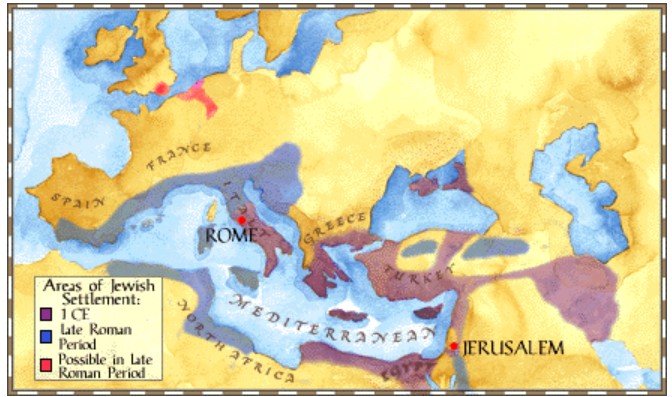
Click this image to follow a link to the PBS FRONTLINE site on the Jewish Diaspora for more about what it means to Christ’s followersDuring the Easter Octave this verse of Daniel, and others surrounding it, are recited in thanksgiving for the Easter Miracle. In this Eastertide, let us examine one of the church’s most popular and most powerful prayers.
Bless the Lord, all you works of the Lord, praise and exalt him above all forever . . .
Over the many months that we have shared Noontimes, we have reflected on this apocalyptic prophecy nearly two dozen times, and about half a dozen of those times have been from The Tales of the Diaspora, the first six chapters of this book. These chapters have roots in Israel’s wisdom literature and they are pedagogical in nature, the characters providing role models of fidelity to and trust in Yahweh, the one true god and creator of all. Daniel was also a figure mentioned in Canaanite texts of the fourth century B.C.E. (his name was Dnil) where he is described as a righteous judge and hero. He is seen as one who communicates with God through angels and understands information about the future of the world. Because of his virtue, his words and deeds – along with those other Jewish youth held in captivity – these stories remain with us today, and they serve to help us in our own times of trial – our own fiery furnaces and lions’ dens. They were recorded between the years of 167 and 164 B.C.E. (Mays 623-629)
Bless the Lord, all you works of the Lord, praise and exalt him above all forever . . .
As a child, I loved the stories of the four young Jewish boys, Daniel, Hanaiah, Mishael, and Azariah. I was stunned by the fact that they had to abandon their Jewish names to take on new, foreign ones, Balthazar, Shadrach, Meshach and Abednego. I was frightened by the fact that they were not only torn from hearth and home but were also being forced to abandon their God. It was actually this story which caused me to want to know and understand other languages, realizing that one day I might find myself snatched from all that is familiar to wake up in a daze in foreign territory. And I would want to know what these strange people were saying about me and my destiny. I also remember realizing that it was notthe linguistic ability, the intelligence, the strength or the bonds of family or friendship which sustained these young people when they found themselves controlled by pagan foreigners and taken from their temple, their home, their families and community, their physical and spiritual places of comfort. When they were completely separated from the things which most of us cling to in times of crisis and stress, they relied on the one thing which sustained them through the trial of a fiery crematorium and exposure to hungry lions. They had Yahweh. They had their trustin Yahweh. And they had their fidelityto Yahweh. This alone fed them, rescued them, and restored them to a place of dignity and honor.
Bless the Lord, all you works of the Lord, praise and exalt him above all forever . . .
Thursday and Friday evenings as I stepped off the church walkway and into the darkness I realized that the night sky was not as dark as usual. The large Paschal Moonhovered over the campus, challenging the brightness of the large, artificial, man-made lamp stands. Having stayed later than most worshipers to spend a bit of extra time reflecting, I was nearly alone on the campus. And I said a small, quiet prayer to the Creator for all the gifts I so easily use that God has so lovingly given. It was a sacred moment which I wanted to hold, much as the apostles wanted to hold the beauty and fullness of The Transfiguration. We who live in a place where food and peace are aplenty have much to be grateful for. We who are called to labor in the vineyard of the one who knows us intimately have much to be faithful to. We who are so well-loved and guided in the Spirit have much to be hopeful in. God’s justice, Jesus’ compassion and the Spirit’s fidelity can be counted on. Always. This we can predict. Just as Jesus’ predicted his own passion, so too can wepredict our own struggle with loved ones, colleagues and strangers. And our own struggle to follow Christ.
Hans Suess von Kolmbach: Mary Salome and Zebedee with their sons Janes the Greater and John the Evangelist
Perhaps the Sons of Zebedeetoday give us a picture of our relationship with Jesus, or maybe we better see ourselves as their mother, Salome. Like the early friends and relatives of Jesus, we often do not see the consequences of our requests; and we are surprised and even angry at the twists and turns of fate that seem to us to be capricious gods that play havoc with our hopes and dreams. We become bogged down and may even wallow in self-pity and indignation when events and people beyond our control disrupt our plans. We see that what we had predicted for ourselves is somehow not budding, is for some reason refusing to come to fruition. We blame all sorts of people and circumstances, all the while neglecting to give thanks for the one sure thing that we can all predict with ease: we will be loved always, we will be cared for and rescued always, and we will live in eternal union with our brother, the Christ. What a great, and awesome and marvelous God we have. What a sureness. What a constancy. What a greatness. What a God!
The full Easter moon rides high across the skies during this extraordinary season of forgiveness. Its cool light breaks through the darkness, telling us of the daytime sun that bathes the opposing side of the globe. The tin-tinted orb reminds us that even when we do not feel the warmth and brilliance of Jesus he is with us anyway.
The Paschal Moon rises just as expected, just as predicted. God guides and protects us, just as expected, just as predicted. Jesus sacrifices self and rescues us, just as expected, just as predicted. The Holy Spirit abides with us and graces us, just as expected, just as predicted. Discipleship will be difficult and arduous, just as expected, just as predicted. The reward for fidelity will be greater than we have ever imagined, just as expected, just as predicted. All of this we can foretell with certainty. The events of our lives, the time and manner of our dying, the size of our income, and the number of our days we cannot. So tonight, if the sky is clear, step outside your door for just a moment to search the heavens for the Paschal Moon and remember all that has been predicted. And in the hush and quiet of that moment let us recall all that we have requested and all that we have been given. And let us pray:
Jesus dies, Jesus rises. We are saved. We are loved. And all, just as expected, just as predicted. Amen.