For the next several days there will be no Noontimes posts but I will continue to pray with you each day at noon and record thoughts in an old-fashioned paper journal to share later. In place of receiving a daily post, you may want to explore ideas on the Connecting at Noontimepage offered in the hope that you find a suggestion to feed the soul and strengthen your bond with and in Christ.
Our spiritual life is always about Call and Response. God creates and calls us. We listen, and then return God’s word. This blog is one small way for us to listen, to seek, to discern, to come together, to puzzle through and to respond in full voice to God’s mysterious and beautiful invitation to life in the Spirit. It is our daily visit with God that nourishes and sustains us. It is our persistent connecting with the one who created us that reminds us of who and why we are. It is our constant hope and our fervent prayer that buoy us up when the road is difficult. And it is Christ’s love for each of us that keeps us on The Narrow Way. Thank you for taking part in our Noontimes journey. We are creatures meant to travel together and, like Paul writing to the Romans, I am convinced that neither death, nor life, nor angels, nor principalities, nor present things, nor future things, nor powers, nor height, nor depth, nor any creature will be able to separate us from the love of God in Christ Jesus the Lord.
New posts will return later this month. In the meantime, may you each know and experience Christ’s peace. May you seek and discover God’s Wisdom. And may you be fortified in the Love and Counsel of the Spirit. I hold each of you in prayer as always. S
Keeping each of you in prayer while I am away from electronics. Holding you in prayer at noon each day.
We rise, put on our strength and let the bonds fall away from our necks.
We are an Easter People. We examine ourselves. We investigate the brokenness and sorrow. We lean on one another. We accept the fact that we must trust God alone. We find the comfort of Christ in others who share our grief. We are the compassion of Christ for one another as we respond to the grief in those around us. We wait through the darkness in active and hopeful patience . . . and then, just as promised, we are restored. The promise we know we were destined to live is fulfilled.
When we use the scripture link and commentary to explore this prophecy, we find hope in the darkness, the promise of restoration, and the fulfillment we seek.
Keeping each of you in prayer while I am away from electronics. Holding you in prayer at noon each day.
We gather our worn flesh and our broken bones. We take one last look around us at the weariness, poverty and darkness in which we find ourselves . . . and we prepare for restoration.
Just when we believe that we escape all that terrifies us, we learn again that life holds no guarantee. Just when we believe that we escape our worries and anxieties, we learn again that eternal life is a promise on which we can rely.
When we use the scripture link and commentary to explore this book, we discover that there is no guarantee that we will not suffer; but there is a guarantee that the light of God’s love will overcome the darkness to bring us new life.
We share these reflections from Holy Week of 2007 while I am away from electronics. Keeping all of you in prayer each day at noon.
Use those words [of prophecy] as weapons in order to fight well, and keep your faith and a clear conscience. (Verses 18-19)
Once we have examined ourselves and become vulnerable to God, we will allow ourselves to form a true community, one with the hallmarks of Humility, Purity, Family, Justice and Mercy.
Paul’s advice to Timothy – and to us – reminds us that we rest in the Old Testament as we enact the New.
When we use the scripture link and commentary to explore this letter, we find words that bring new energy to old worries, new healing to old wounds, and new life to old communities.
We share these reflections from Holy Week of 2007 while I am away from electronics. Keeping all of you in prayer each day at noon.
Once we trust God, and once we make a faithful and honest Examination of Self, we enter into intimacy with God. This special relationship brings with it a new understanding of how and why we are grateful after a time of affliction. This new relationship that comes to us after great tribulation, and after a new understanding of our human frailty, is God’s celebration of new life and a new creation in us.
Paul’s description of the valleys and mountains in his relationship with the people of Corinth is a mirror of his – and our – relationship with God. We can rely on Jesus to shepherd us, and the Spirit to heal us.
When we use the scripture link and commentary to explore this letter, we realize that none of us is perfect; and we discover that with each crisis and the ensuing aftermath, we arrive at a newness we had not thought possible. We also discover anew that with God, all that appears to be impossible is, in reality, possible.

We share these reflections from Holy Week of 2007 while I am away from electronics. Keeping all of you in prayer at noon each day.
Wisdom preserves her followers. When we trust in God and listen in active patience, we are restored. Once we give over all control to the one who created us, we are able to put aside our ego, envy, pride and anxiety. Our search for justice is complete not when we achieve justice, but when we place our hopes and
Wisdom arrives in the cacophony that surrounds us when we exercise patience and the willingness to listen for God’s voice. Jesus tells us that God hears the prayer of each one of us, even when we whisper in the darkness as we wait for the dawn.
When we use the scripture link and commentary to explore this book, we find words that bring us hope and courage.
We share these reflections from Holy Week of 2007 while I am away from electronics. Keeping all of you in prayer at noon each day.
Trust in God is the only action left when we are at the bottom of the pit. When we hit that bottom, there is nothing left but God – but God alone is enough. We have realized that there is no point in protesting or struggling. We have only to rest in God.
Jesus tells us that he is with us in every circumstance, in every moment, in every place, and so we share sorrow and joy with one another as we become one in Christ.
When we use the scripture link and commentary to explore these two psalms, we find verses that speak to us.
We share these reflections from Holy Week of 2007 while I am away from electronics. Keeping all of you in prayer at noon each day.
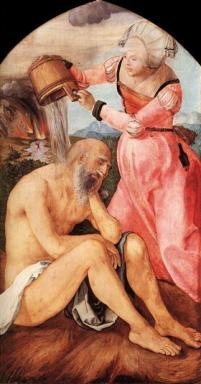
Holy Monday 2007: Job’s last exhausted protestation of innocence. Jesus is accused of challenging Caesar but he is innocent of the charge. We, too, may have been unjustly accused or we may find ourselves innocently involved in terrifying circumstances. We are not alone in this intense suffering.
Jesus tells us that he yokes himself with us in both our joys and sufferings, and so we share thoughts and prayers with one another as we hand over our burden to Christ.
When we use the scripture link and commentary to explore the Book of Job, we find verses that speak to us.
We know that Judges is the book in the Old Testament that takes us from the time following the death of Joshua through several hundred years of leaders, or judges, who include Gideon, Deborah and Samson, to the time of Jesse, father of David. It delineates the story of a people struggling to understand themselves and one another, a people who constantly cycle through a loop of straying, repenting, returning, and forgetting. The last verse of the book speaks about the attitude of the people regarding not only their civic relationship with one another, but also their spiritual relationship with God. In those days there was no king in Israel; everyone did what he thought best.We reflected on this idea several days ago, saying that this is a sentiment we might apply to our contemporary times as we watch events unfold over which we have little and no control. It seems that in all ages we humans . . . do what we think best. We also see God’s reaction to human waywardness: God allows the weeds to grow up with the wheat.
A number of years ago I came across a painting in the National Gallery’s Pompeii exhibit. It showed maenads, those who stir themselves to frenzy with wine and orgy, and who sink so low that they tear apart their own children. They are the famous Bacchae of Dionysus, the distraught female followers of this god of wine who exacts revenge on any woman who will not submit to his will. This Dionysus is the antithesis of the God of Israel. This pagan god takes what he wants for his own satisfaction, and his followers are too exhausted to see the truth of his and their existence.
We are constantly faced with a choice in our lives because God grants us the freedom to either follow in The Way or to strike out on our own, to enact love or to deaden our senses with the wine of self-pleasure and self-gratification.
The painting by Sir Lawrence Alma-Tadea entitled The Women of Amphissa shows the exhausted maenads as they awaken the morning after a night of mad running through the hillsides in rapacious, orgiastic delight. We can see their numbness to the light and to life. The local townswomen protect them and arrange for them to be returned home unharmed; but the damage has already been done, and they remain powerless, forever in the grip of Dionysus. They cannot escape from his cruel delight in watching them destroy others. They have no God who loves them enough to sacrifice himself in redemption of their souls. There is no Christ who refuses to leave his faithful to do what they think best.
Our God, the God of the Twelve Tribes, the one God of all of us here is not a God who holds us bound by the secrets or the dark debauchery that surround us. Our God does not destroy with threats, but rather calls us to grow amid the weeds through faith in God’s own hope and love. Ours is the God who forgives many times and constantly. Our God welcomes those who witness and turn to goodness. Our God does not chain us, does not bind us, does not force us into relationships, and does not take revenge. Our God brings light, and truth and redemption. And this God asks us to behave in like manner. God sets us free to search for God’s goodness with our whole heart and our whole soul, to love or to turn away. Our God is always hoping that when we dowhat we think best, we will respond in joyful hope to the call of light and truth and authentic, unencumbered love.
Adapted from a reflection written at the close of 2008.