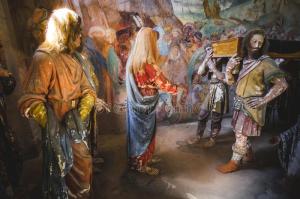
Sacro Monte di Varallo: The Raising of the Son of the Widow of Nain
Wednesday, April 9, 2025
This is such an important message that we will spend a few days pulling our thoughts together. We consider how Christ might be the resurrection for each of us. We ponder how this miracle affects us. And we decide how we will rest in the power of this message.
I love this story. It shows Jesus’ compassion in such a real way. It is about true resurrection.
Jesus understood that the death of this young man was doom to his mother, a widow with no resources for her survival. With a single touch, Jesus brings the young man back from death and thus cures the life of this woman as well. He also demonstrates how we should act, how we should breathe life into relationships rather than doom them. And with this act, Jesus speaks to the world.
This report about him spread through the whole of Judea and in all the surrounding region.
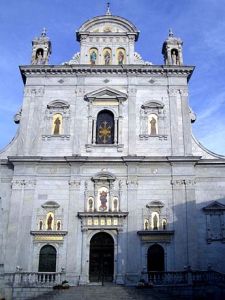
Sacro Monte di Varallo Church, Piedmont Region in Northern Italy
The story reaches our ears today. We see and hear how we are to behave in relationship with one another. We see that just as Jesus is an expression of God’s love for each of us, so are our actions our expression of how much and in what way we love one another and thus God.
May our acts and our words be healing ones.
May our expression of God reflect the hope placed in us.
May all that we say and do become not only our own resurrection, but may it lead to union with all the holy ones, union with God. Let us spread this report through the whole of our communities, so that we might share the good news of resurrection.
Enter the words Widow of Nain into the blog search bar to search for more reflections about this woman, her son, and their interactions with Jesus.
For more on the village of Nain, visit: https://www.biblestudytools.com/dictionary/nain/
We continue to explore the definitions with which Jesus defines himself, looking for The Way to better follow his lead, seeking the Good Shepherd who guides and protects, searching for Vine so that we might be the Branches.
The Book of Revelation is full of apocryphal images that we struggle to understand without consulting a commentary. We may want to set aside a chunk of time to study this book since it is the culmination of the before, the now and the yet to come. It is the Word, written and brought to us by the Holy Spirit. It is the Word, Christ himself, both microcosm and macrocosm. It is the Word that is God, God the beginning and God the end, God who is all. With these verses, we come to know that there is nothing else but this triune God.
John 1:3: Through him God made all things; not one thing in all creation was made without him. (GNT)
The Apostle John tries to put into words all that he has experienced with the human and risen Jesus. Can we say that Christ is our beginning and end?
Isaiah 41:4: Who did this? Who made it happen? Who always gets things started?
I did. God. I’m first on the scene. I’m also the last to leave. (MSG)
The prophet Isaiah asks us how we understand God. Can we say that God is the source and goal of all we do?
Matthew 5:17: Don’t think that I have come to abolish the Torah or the Prophets. I have come not to abolish but to complete. (CJB)
The disciple Matthew records Jesus himself telling us that he is with us to fulfill rather than destroy. Can we say that we build up more than e tear down?
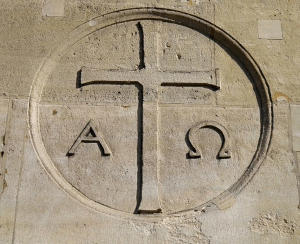
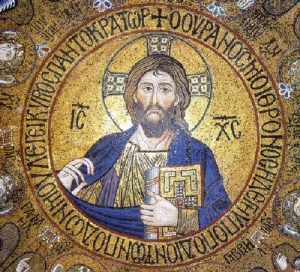
Revelation 22:13: I am the Alpha and the Omega, the first and the last, the beginning and the end. (NRSV)
Jesus himself describes to us how the first becomes last, and the last first. He becomes for us the parable described in Matthew 20:16. How do we order our days? How do we prioritize our hours? What do we do with the precious moments of time that God gives us?
Once we begin to open our lives to Christ, the true Revelation of how we embody God’s image becomes our own alpha and omega.
When we compare other translations of these words, we better see how we might be both first and last in Christ.
Click on the images to explore.
Images from: http://www.stfrancisnyc.org/2014/08/alpha-and-omega/ and https://cost-of-discipleship.blogspot.com/2010/11/alpha-and-omega.html
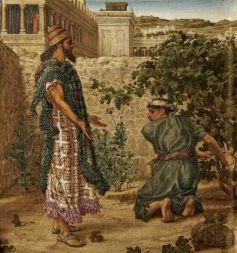
Near King Ahab’s palace in Jezreel there was a vineyard owned by a man named Naboth.
We know the goodness of the well-tended vineyard. The Master maintains a sturdy wall to protect the vines from those who would plunder the fruit of sun and soil. The crop flourishes under the caring hands of the workers who gather the harvest in due time. Jesus uses the metaphor of the grapevine to explain to us the nature of our relationship with him; and yet, Jesus also knows the familiar story of how Naboth’s vineyard aroused envy and later fury in those who held power.
John Liston Byam Shaw: Queen Jezebel
One day Ahab said to Naboth, “Let me have your vineyard; it is close to my palace, and I want to use the land for a vegetable garden. I will give you a better vineyard for it or, if you prefer, I will pay you a fair price.”
We hold on to that which we hold dear; we cling to the beliefs that support us as we engage in our work and play.
“I inherited this vineyard from my ancestors,” Naboth replied. “The Lord forbid that I should let you have it!”
My father always advised us that the better we became at our work, the more enemies we would have. He also reminded us that there is a difficult line to walk between minding our own business and speaking up about injustice. My mother advised us to stay away from gossip and squabbles, and always, no matter the circumstance, to “kill your enemies with kindness”. My parents knew that these adages would not keep us safe from the world; but they also knew that in living with Christ, we would survive calamity with the more valuable gift: unity with Christ, transformation, redemption.
The officials and leading citizens of Jezreel did what Jezebel had commanded. They proclaimed a day of fasting, called the people together, and gave Naboth the place of honor.
The schemes of Ahab, Jezebel, and their powerful friends are insidious; these corrupt leaders strike at the heart of Naboth’s industry; they mock his fidelity, and ignore his goodness. They lure him to the feast only to betray him on the deepest level. When we put aside our negative emotions to read this story with patience, we see Ahab ride to his death in battle. Later, in 2 Kings 9; and we witness Jezebel’s gruesome end. We might be tempted to gloat over these outcomes that feel like divine justice. We may want to join in the chaos of war or the crowd’s frenzy; but rather than seek revenge, we might instead focus on Naboth’s goodness that despite the fact that it has the capacity to bring out the worst in his enemies, it also delivers redemption.
Thomas Matthew Rooke: Naboth Refuses King Ahab his Vineyard
In Eastertide we will hear several times the words Jesus speaks to his followers, words we will want to hear again today as we read about Naboth: If the world hates you, just remember that it has hated me first. If you belonged to the world, then the world would love you as its own. But I chose you from this world, and you do not belong to it; that is why the world hates you.(John 15:18-19)
Be ready, Dad would say, to find that enemies accompany your successes. Be ready, Mother would remind us, to kill your enemies with kindness. This is our work in the vineyard. No matter the circumstances, we must cling to the vine that sustains us; we must produce good fruit in good time; and we must remain always in Christ who saves, transforms and redeems.
Tomorrow, Jesus is the alpha and the omega.
Compare the GOOD NEWS TRANSLATION with others for a better understanding of these verses.
For more reflections on Naboth, Ahab, Jezebel, or vineyardenter the words into the blog search bar and explore.
How bad was Jezebel? Visit: https://www.biblicalarchaeology.org/daily/people-cultures-in-the-bible/people-in-the-bible/how-bad-was-jezebel/
With this adapted Favorite fromFebruary 13, 2011, we give thanks for the presence of The Spirit as we struggle against all that would hold us down, all that would keep us from remaining on The Vine.
From the MAGNIFICAT Evening Prayer for Saturday, February 12: A good person brings forth good out of a store of goodness, but an evil person brings for the evil out of a store of evil. Matthew 12:35)
The power of evil is insidious. It conceals itself within our lives posing as good. Discernment is the process of determining what is the counterfeit of good and what is true good. Let us apply ourselves wholeheartedly to discernment and to living godly lives.(MAGNIFICAT Mini-reflection, 168)
The power of evil is insidious . . . There is so much around us locally and globally that discourages us. We feel as though evil has taken over the world and that God does nothing to prevent this evil; yet here is a reminder that God is notevil, that God invitesgoodness, and that God isgoodness.
Evil conceals itself within our lives posing as good . . .Matthew reminds us (6:12) that where our treasure lies there also is our heart. Jesus tells the rich young man, and us, that if we seek perfection we must sell what we have, give it to the poor and follow him (Matthew 19:21, Mark 10:21 and Luke 12:33-34 and 18:22).Not many of us have the confidence to follow God in this way. Not many of us trust God enough to believe that God will truly care for our needs. We too often are planted in well-prepared soil and produce little fruit, and then we blame God for the evil in the world. We trick ourselves into thinking that we have done all that can be humanly done. Or we convince ourselves that we are powerless.
Discernment is the process of determining what is the counterfeit of good and what is true good . . . Over the past weeks and days we have witnessed the will of thousands to overcome oppression in northern African countries. I am imagining how the world might be different if all of us were to speak out against evil in our families and communities. The vineyard in which we are growing might then grow the beautiful, full and nourishing grapes which the vineyard keeper has planted rather than the puny, wild grapes of unpredictable quality we allow to grow. It is not difficult to distinguish what is good from what is evil, what is true and what is false. When we begin to trust God to lead us, our sensitivity to goodness heightens and it becomes easier with practice to distinguish what we are to do and what we are to say.
Let us apply ourselves wholeheartedly to discernment and to living godly lives . . . Isaiah’s Vineyard Song is followed by descriptions of the “doom of the unjust” and the subsequent invasion. Woe to those who are wise in their own sight, and prudent in their own esteem!If we are vague about who or what indicates wild grapes, Isaiah provides us with an exact listing. We cannot say that we have not been told or that we do not understand what evil is and does. We cannot say that we do not know what goodness is and what goodness does. We ought not be surprised, therefore, at our fate.
Israel turned away from the God who saved and nurtured her and we are given the same choice to choose our own fate. In today’s reading for Mass we have a clear description in Sirach 15:15-20, 1 Corinthians 2:6-10 and Matthew 5:17-27. We have a clear road map with clear markers along the way. When we join in singing Isaiah’s Vineyard Song, do we sing with full throat and heart? We will want our voices to join with those who yearn to live in the kingdom.
The power of evil is insidious. It conceals itself within our lives posing as good. Discernment is the process of determining what is the counterfeit of good and what is true good. Let us apply ourselves wholeheartedly to discernment and to living godly lives.
Tomorrow, Naboth’s vineyard.
Cameron, Peter John, Rev., ed. “Mini-Reflection.” MAGNIFICAT. 12 February 2011. Print.
We continue our exploration of the way in which Jesus describes himself, helping us to sustain strength on our difficult journey, to remain always in and for the Lord.
Because he understands the difficulties of our lives, Jesus explains our connection to him with a simple yet powerful image. This power, wisdom, strength, and understanding were predicted by the prophet Isaiah. Listen while I sing you this song, a song of my friend and his vineyard. (Isaiah 5:1)
Later, Jesus tells his followers – as he tells us – just how important we are to his kingdom.
I am the Real Vine and my Father is the Farmer. He cuts off every branch of me that doesn’t bear grapes. And every branch that is grape-bearing he prunes back so it will bear even more. You are already pruned back by the message I have spoken.
Jesus says to his disciples – as he says to us – that we are essential to God’s plan.
Live in me. Make your home in me just as I do in you. In the same way that a branch can’t bear grapes by itself but only by being joined to the vine, you can’t bear fruit unless you are joined with me.
Jesus wants each of us to experience the joy of sorrow becoming celebration, of grief turning to gladness.
I have told you this so that my joy may be in you and that your joy may be complete. My commandment is this: love one another, just as I love you. The greatest love you can have for your friends is to give your life for them. And you are my friends if you do what I command you.
Jesus leads us into the newness of redemption and resurrection with the grace of fidelity. Jesus leads us from fear to mercy with the gift of transformative love. Jesus shows us the Way from shadow to sunshine and invites us to join him in outrageous hope.
Tomorrow, Isaiah and The Vineyard Song.
When we compare other translations of John 15, we discover how we might become strong branches on Christ’s sustaining vine.
Yesterday we explored the idea of Jesus as The Way. Today we reflect on the difficulties we encounter as we move through our own passage of life.
We frequently explore the idea of restoration in our Noontimes, and today we re-visit the story of Ezra and Nehemiah who secured permission for the people of Israel to return to Jerusalem to rebuild all they had lost. Nehemiah enters into the story with us.
One day four months later, when Emperor Artaxerxes was dining, I took the wine to him. He had never seen me look sad before, so he asked, “Why are you looking so sad? You aren’t sick, so it must be that you’re unhappy.” I was startled and answered, “May Your Majesty live forever! How can I keep from looking sad when the city where my ancestors are buried is in ruins and its gates have been destroyed by fire?”
Later, after obtaining letters of safe travel, Nehemiah and the Israelite journey to their homeland with a military escort as a safeguard. We can imagine the level of anxiety as this faithful remnant wondered what conditions they would actually find.
I went on to Jerusalem, and for three days I did not tell anyone what God had inspired me to do for Jerusalem. Then in the middle of the night I got up and went out, taking a few of my companions with me. The only animal we took was the donkey that I rode on. It was still night as I left the city through the Valley Gate on the west and went south past Dragon’s Fountain to the Rubbish Gate. As I went, I inspected the broken walls of the city and the gates that had been destroyed by fire. Then on the east side of the city I went north to the Fountain Gate and the King’s Pool. The donkey I was riding could not find any path through the rubble, so I went down into Kidron Valley and rode along, looking at the wall. Then I returned the way I had come and went back into the city through the Valley Gate.
A century and a half after his people left their city in sorrow, Nehemiah returns with the faithful to begin anew. As we read this story, the details prompt memories of our own times of calamity, distress, evaluation, renewal and restoration. We recall the emotional journey as grief gives way to release, and our tears of pain become tears of joy. Nehemiah’s conversion becomes our own as he scouts out possibilities while reckoning with reality.
Later the priest Ezra takes the faithful through a similar process. While Nehemiah rebuilds the city, walls and Temple, Ezra renews the soul of this people. Some of the actions he takes exclude others from the promise of God’s covenant, but despite this exclusion, we see this Old Testament leader as steadfast, and in full understanding of the power and importance of the Spirit. In the transformative leadership of these two men, we see the possibility of redemption, and a foreshadowing of the savior to come.
We may want to shrink from the challenges of life, but we must then recognize that our passage is not about safe harbors and static circumstances; rather, it is about change, process, and promise. The skills we learn as we traverse this lifespan are essential if we hope to walk in The Way of our lives to come. We cannot know the twists and turns of our journey, nor can we predict its hills and valleys; but what we can envisage is the ever-present guidance of God, the steady wisdom of Christ, and the constant, healing love of the Spirit.
Tomorrow, vine and branches.
Explore more reflections on Nehemiah, Ezra, and the rebuilding of Jerusalem on this blog by using the search bar.
This week we continue our exploration of the manner in which Jesus describes himself, helping us to find our beyond the obstacles on our path, to accompany one another in both sorrow and joy, to give thanks for God’s always present power.
We ask which way to go, how to speak, what to do with what we hear and see; and Jesus speaks constantly in our ear. When we question, we receive. When we knock on the door, it opens. When we seek, we find.
Jesus answered [Thomas], “I am the way, the truth, and the life; no one goes to the Father except by me. Now that you have known me,” he said to them, “you will know my Father also, and from now on you do know him and you have seen him.” Jesus answered [Philip], “For a long time I have been with you all; yet you do not know me?”
We are astounded by Jesus’ confidence and long for his compassion. We are eager for Jesus’ friendship and rely on his wisdom. We are hopeful in Jesus’ message and give thanks for his understanding.
Jesus told them, “Do not be worried and upset. Believe in God and believe also in me”.
These words are so well known. They are straightforward and astounding. They promise the unthinkable and spell out the profound.
We constantly look for the Spirit’s presence and miracles; yet we too often give up on following The Way that lies before us. Yesterday we remembered the guidance we receive from Jesus, The Good Shepherd. Today we step boldly onto Christ’s Way.
This week we continue our exploration of the manner in which Jesus defines himself, helping us to better understand the importance of his example, to better respond to the Creator’s call, and to better practice the Spirit’s New Law of Love. Today we share this reflection adapted from a Favorite written on April 24, 2007.
These words are so well known. They are so beautiful and complete. They embody the paradox that is our life. All fades away except for the one vibrating and constantly resonating truth. Love. There is nothing else. It is a gift freely given to us by the Creator, Incarnate in the Son of Man, and ever present in the In-Dwelling of the Spirit. All we need do is return the love. Because God alone is enough.
Love is patient; love is kind; love is not envious or boastful or arrogant or rude. It does not insist on its own way; it is not irritable or resentful; it does not rejoice in wrongdoing, but rejoices in the truth. It bears all things, believes all things, hopes all things, endures all things. Love never ends.
We constantly look for presence and miracles; yet we too often ignore The Way that lies before us. Yesterday we remembered the guidance we receive from Jesus, The Good Shepherd. Today we step boldly onto Christ’s Way.
God says: I understand that The Way I lay before you is full of pitfalls and stumbling blocks. Today I ask you to remember that every obstacle that obstructs your path is a stepping-stone for you to use as you grow and live in me. I ask you to remember that every gaping hole that suddenly appears to gobble up The Way, is an opportunity for you to rely on me. I will guide and protect. I will lead and heal. I will restore and transform. I am The Way, and I send my son to you to live in that Way with you.
When we consider Paul’s description of Jesus’ Law of Love, we open our hearts to possibility.
May those who are wise understand what is written here, and may they take it to heart. The Lord’s ways are right, and righteous people live by following them, but sinners stumble and fall because they ignore them.
We constantly look for messages and signs; yet we too often ignore the Word before us. Yesterday we reflected on Jesus as The Good Shepherd. Today we explore the many ways each of us might respond to God’s call.
Hosea, a prophet about whom we know little, brings us the heartbreaking image of one who loves greatly and suffers deeply. Some might say that in pledging himself to the prostitute Gomer, Hosea deserves the anguish she brings him. Others will admire his steadfastness, mercy, and hope. The imagery we see today leaves us with no doubt that no matter the severity of any pain we cause the Creator, the Good Shepherd will always welcome us back to the sheepfold.
The Lord says:
“I will bring my people back to me.
I will love them with all my heart.
“I will be to the people of Israel like rain in a dry land.
They will blossom like flowers; they will be firmly rooted like the trees of Lebanon.
“I will answer their prayers and take care of them. Like an evergreen tree I will shelter them; I am the source of all their blessings.”
These Old Testament words foreshadow a new prophet who will search endlessly for the last lost sheep. How can we turn away from one who follows us so closely? How can we reject a love that runs so deep and true? How can we reject a hope that transforms us forever?
May those who are wise understand what is written here, and may they take it to heart.
Tomorrow, Jesus as The Way.
When we compare varying translations of these verses, we open our hearts to the Good Shepherd.







 The Noontimes