With Christmastide ending, we find ourselves observing the official feast of Epiphany. What significance does this feast hold for us? To further explore, we return to a Noontime reflection on the wisdom of the Magi. We reflect on the wisdom they reveal, the wisdom of patience, willingness, and openness as they listen to God’s voice that speaks within.
I love this portion of the Christmas story. The wise men are sowise that they are able to read Herod’s secret intent. Nothing can be hidden from the wise because they are so connected to the creator that they seem to have special insight. What they really have is patience, serenity, and a finely tuned ear for God’s word. And so the wise men left for their own country by another road.
I am thinking about the number of times I have averted disaster because that calm, strong voice within indicated that I was to stay put. We notice that an attitude of patience and a willingness to obey always accompany the wise. They do not appear to be brash or excitable. They do not speak harshly, nor are they silenced. Like the Persistent Widow, they know when to persevere in speaking God’s word. And like the Three Magi, they know when to stand down and melt away into God’s protecting presence.
The wise know when to stand and witness – and when to leave quietly by another road.
When is it appropriate to flee rather than witness? When do we step away from injustice rather than challenge it?
After [the Magi] had left, an angel of the Lord appeared in a dream to Joseph and said, “Herod will be looking for the child in order to kill him. So get up, take the child and his mother and escape to Egypt, and stay there until I tell you to leave.” (GNT)
Commentary tells us that, “Egypt was a place of refuge for those fleeing from danger in Palestine (see 1 Kgs 11, 40, Jer 26, 21), but the main reason the child is to be taken to Egypt is that he may relive the Exodus experience of Israel.” (Senior 9)
The Holy Family become refugees in a world of turmoil. A world that persists in tumult today. Seeking shelter, much like their Hebrew ancestors, Mary, Joseph and the child Jesus understand that it is time to seek sanctuary.
Joseph got up, took the child and his mother, and left during the night for Egypt, where he stayed until Herod died. This was done to make come true what the Lord had said through the prophet, “I called my Son out of Egypt.” (GNT)
Leaving during the night . . .
The act of slipping away in the darkness tells us that Joseph and Mary understood the gravity of the threat. They know that although they have shepherded light into a shadowy world, and despite their belief that God’s light pierces those shadows, they must also act in prudence. They must listen to the voice of God that comes to them through the angel.
“I called my Son out of Egypt . . .”
Jesus re-experiences the exodus journey of his people, showing us that if his family trusts God enough to step away from evil, then so must we.
Stay there until I tell you to leave . . .”
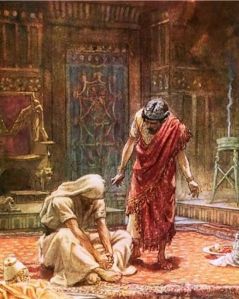
Today we reflect on the flight of The Holy Family to hear what it has to say to us.
After the scholars were gone, God’s angel showed up again in Joseph’s dream and commanded, “Get up. Take the child and his mother and flee to Egypt. Stay until further notice. Herod is on the hunt for this child, and wants to kill him.” (MSG)
Are we open to the angels who bring us God’s word?
Joseph obeyed. He got up, took the child and his mother under cover of darkness. They were out of town and well on their way by daylight. They lived in Egypt until Herod’s death. This Egyptian exile fulfilled what Hosea had preached: “I called my son out of Egypt.” (MSG)
Do we obey the call of God’s voice?
He got up, took the child and his mother under cover of darkness . . .
Are we willing to take flight from injustice?
Stay until further notice . . .
And are we prepared to return when God calls us?
When we use the scripture links to read varying translations of these verses, we open our hearts to the messages of angels.
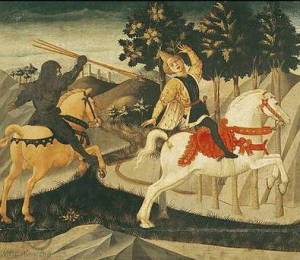
Gentile da Fabriano: Flight Into Eygpt
Senior, Donald, ed. THE CATHOLIC STUDY BIBLE. New York, Oxford University Press, 1990.9. Print.
On the twelfth day of Christmas, my true love gives to me twelve drummers drumming.
These twelve drummers lords represent the twelve beliefs held in the Apostles Creed.
When the circumstances of life challenge us, we take our burdens to the LORD . . .
We believe in God, the Father Almighty, Creator of heaven and earth.
When life confuses us about how we are to behave and where we are to go, we take our worries to Christ . . .
We believe in Jesus Christ, God’s only Son, our Lord.
When life presents impossible obstacles that seem insurmountable, we remember that with God all things are possible . . .
We believe that Jesus was conceived by the power of the Holy Spirit and was born of the Virgin Mary.
When life’s pain seems to have no purpose, we remember that Christ offers salvific suffering for us each day . . .
We believe that Jesus suffered under Pontius Pilate, was crucified, died, and was buried.
Women Apostles
When horrible events destroy innocent people, we remind one another that Christ overcomes all evil and brings goodness out of harm . . .
We believe that Jesus descended into hell and on the third day rose again from the dead.
When dictators and oligarchs wipe out cultures and truths, we remind ourselves that God’s kingdom is the only kingdom that lasts forever . . .
We believe that Jesus ascended into heaven and sits at the right hand of God.
When corruption thwarts justice and exploits the marginalized, we remember that there is only one judgment that lasts forever . . .
We believe that Jesus will come again to judge the living and the dead.
When we are abandoned, alone, or rejected, we remember that we are all on in the Spirit . . .
We believe in the Holy Spirit.
When the structures we design to protect us become tools of subjugation, we recall that the Spirit lives in our ancestors who go before us, and in our children’s children who follow . . .
We believe in the holy catholic Church and the Communion of Saints.
When we are beleaguered, overwhelmed or undone, we recall that God’s goodness overpowers any errors we commit . . .
We believe in the forgiveness of sins.
When we are unloved, unwanted or numbed by tragedy, we remember that Christ brings us home to new life in The Way . . .
Giovanni Battista Gaulii: The Three Marys at the Sepulchre
We believe in the resurrection of the body.
When we are duped or deceived by life on earth, and when we lose all hope, we remember that God is with us always, loving us into eternal goodness . . .
We believe in life everlasting.
This is what we believe, this is what we share, this is what we know.
Pushkin Museum – Moscow, Russia: The Synaxis of the Holy and the Most Praiseworthy Twelve Apostles
Apostleship: Following the Call
Thursday, January 2, 2025
On the eleventh day of Christmas, my true love gives to me eleven pipers piping.
These eleven lords represent the eleven apostles who doubted, yet remained faithful to Christ.
When crisis comes into our lives, we often retreat into hiding, taking our fear and exhaustion with us. We revert to what we know and do well; just as Peter and the other fishermen-followers did when they returned to their boats after the horrible events of Holy Week in Jerusalem. Like the story in John 21, we flounder in our boats while Jesus stands “on the shore” of our lives. Like the apostles in this story, we too often do not recognize the faithful Jesus. After fishing all night in the dark, we – like the apostles – remain frightened. Jesus calls to us, saying, “Children, have you caught anything to eat?” We answer, as the apostle did, “No?” And Jesus says, “Cast the net over the right side”. We roll our eyes as we might guess the apostles did. But when we do as Jesus asks, we haul up the net that is “not torn . . . even though it was full of so many” fish. Then we, like Peter, must take the leap over the side of the boat and flail to shore . . . because there Christ is waiting with the brazier of live coals to cook us a meal, to bring us comfort, to open The Word to us, to free us from oppression, to raise us from the dead. And when Christ asks, “Do you love me?” we, like Peter who days earlier had denied that he knew Christ, must respond, “You know that I love you”. It is then that we will be told what and how to do: Feed my lambs, tend my sheep, feed my sheep, follow me.
Nicolas Poussin: Ordination of the Apostles (detail)
And we must follow. We must take the leap when Christ calls us from the shoreline. We must have faith and we must choose to enact our faith as the faithful followers did. We must cast our nets even though we have been at the task all day and all night without finding success. When we hear the call, we must step out into the water and fly to the shore, because there is truly nothing else more important. This is where the salvation of humankind lies.
Adapted from a reflection on apostleship written on April 22, 2007.
According to tradition, the remaining eleven continued to follow Christ in this world as they continued to build the Kingdom. Tradition also tells us that the faithful eleven continued to preach The Word all the days of their lives. Some died violently, others did not. For more details, and for short video clips about the facts we know, use the links below, or visit: http://www.catholic.org/saints/
In Matthew 27:5 we learn that Judashanged himself; but in Acts 1:18, his death is described as resulting from a fall. As always, those who explore Scripture are invited to read, reflect, and meditate on The Word that Christ brings to us as his followers.
On the tenth day of Christmas, my true love gives to me ten lords a-leaping.
Many of us are familiar with The Ten Commandments that Yahweh gives to Moses, but how often do we pause to think of the fact the God, through Moses, not only gives us a simple set of rules to follow, but that he explains the effect these rules will have on our lives. God sees our authenticity by the way we live, and by the way we do or do not say, “Yes,” in response to God’s call. Today the old Christmas carol poses these questions to us: do we see the Gospel stories as a fulfillment of God’s hope in the covenant God establishes with us in the promise of the Ten Commandments?
This part of the Exodus story is bracketed by two convergent episodes: the provision of quail, manna and water by God to the Israelites, and the planning and building of a desert temple-tent for Yahweh by the Israelites. We see actions by both God and the Chosen People that speak of their desire to live in a covenant relationship. And the actual agreement, along with its explanations and implications, lies between these two actions in chapters 20 to 24.
The Holy Spirit
God takes the Israelites out of bondage – just as Jesus later does for all when he comes to live among us and to institute the Kingdom (in Luke 4:14-30). With the giving of the commandments, God foresees the struggle of the people in the desert. God’s preservation and protection of these people bring to God not only fame, glory and praise, but also an arrogant, contemptuous rejection by us. So too does Jesus arrive among God’s people to fulfill the Mosaic Law, to provide and protect us, and then to suffer at our hands; yet ultimately, God the Father and God the Son both offer their compassion and mercy to us when we are wayward. All that is required of us is that we repent of our past transgressions and then respond to the call. Just as God sent an angel to guard the Israelites and bring them to the place God had in mind for them (23: 20-33), so too does Jesus send the Holy Spirit to dwell with us after Jesus’ resurrection – to guide and protect, and to lead us to the holy place he has prepared for us. Of course, later in Chapter 32 of Exodus, the people tire of waiting for Moses to descend Mt. Sinai, so they create and worship the Golden Calf. Moses returns, breaks the tablets and loses his patience. The people repent, agree to do as Yahweh asks and Yahweh restores the tablets. A familiar story that we repeat today – we only need to read and compare history and current events. And it is no wonder that we stray – no wonder that the Israelites strayed. When we look at chapters 20 to 24 of Exodus, we see the social implications of the Mosaic Law. We might pay special attention to some of the verses that hold ideas difficult to take, verses that call for us to respect ourselves and one another: 22:15, 23:1, 22: 1-3, 22: 20, 21:35-36.
So on this day when we continue our celebration of God’s truest gift of love, we take a few moments to recollect our experiences in covenant relationships with others. We might mediate for a bit on how we might remain faithful to the one central covenant in our lives. And we might decide how best to renew that covenant each day with our Creator.
Adapted from a reflection on The Ten Commandments written February 14, 2007.
On the ninth day of Christmas, my true love gives to me nine ladies dancing.
But the Spirit produces love, joy, peace, patience, kindness, goodness, faithfulness, humility, and self-control. There is no law against such things as these. (Galatians 5:22-23 GNT)
Are we able to think of others before ourselves? Are we willing to love our enemies into goodness? This is the lovethat Jesus describes.
Are we able to rejoice in our suffering? Do we praise God even in times of stress and turmoil? This is the joythat Jesus describes.
Do we rely on our relationship with God to guide us in all we do? Are we able to settle into the peaceof this relationship despite the confusion the world promises? This is the peace that God brings us.
Are we willing to listen more than we speak? Do we wait for God to tell us which way we are to walk and what we are to say? This is the patienceJesus practices.
Do we offer our words gently when we speak truth that is difficult to hear? Are we able to act with compassion no matter the circumstances? This is the kindnessthat bears fruit in the Spirit.
Are we able to obey Jesus’ call to return good for evil? Are we open to seeing the good that comes out of harm when we allow Christ to lead us? This is the goodness we see in the Spirit.
Are we willing to abide with those who live on the margins? Do we maintain a steady course without falling to temptation? This is the faithfulnessJesus models for us.
Can we put aside our desire to get ahead and to find comfort at all cost? Do we put our ego aside to allow others to share scare resources? This is the gentlenessthat flourishes in the Spirit.
Do we work toward consensus? Do we collaborate as we share in decision-making? It is the gentle invitation to others to join us in kingdom-building that exhibits the Spirit’s gift of self-control.
These nine fruits of the Spirit are difficult to practice but they are essential to life in the Spirit; and they are the mark of one who follows Christ. Today we reflect on the presence of these gifts in our daily thoughts and actions.
But what happens when we live God’s way? God brings gifts into our lives, much the same way that fruit appears in an orchard—things like affection for others, exuberance about life, serenity. We develop a willingness to stick with things, a sense of compassion in the heart, and a conviction that a basic holiness permeates things and people. We find ourselves involved in loyal commitments, not needing to force our way in life, able to marshal and direct our energies wisely. (MSG)
When we compare versions of these verses, we begin to see that the fruits of our life in the Spirit are essential to life as a follower of Christ.
On the eighth day of Christmas, my true love gives to me eight maids a-milking.
The ancient carol reminds us that happiness comes to us in a variety ways; and as Jesus tells us, all ways lead to The Way. Christ continues to lead us along the path that asks us to reduce ourselves so that he may increase in our lives. This Way is narrow yet full of blessing and promise that come to us through inversion – as does so much that Christ explains to us.
Blessed are the poor in spirit, the mourning, the meek, the ones who hunger and thirst, the merciful, the pure in heart, the peacemakers, and those who suffer persecution for righteousness’ sake.
Rather than encourage self-centered thinking, Jesus asks us to care for others as readily – or even more – than ourselves. This is difficult living, Christ reminds us, yet the reward will be great indeed.
Theirs is the kingdom of heaven, they will be comforted, they will inherit the earth, they will be filled, for they will receive mercy, they will see God and be called children of God, for again . . . theirs is the kingdom of heaven.
Contrary to a world that tells us to tend to ourselves, Christ asks us to show preference for those on the margin. Despite this apparent contradiction to survival, Jesus promises a life that is beyond any we might have expected. A life that produces fruit in endless abundance.
Rejoice and be glad, for your reward is great.
On this first day of the new year, let us explore the words Christ has for us about happiness, one of the gifts he brings to us this Christmastide; and let us consider how we might find this eternal bliss today and all days.
For notes on the Beatitudes, click on the post image, or enter the word Happinessinto the blog search bar and explore.
On the seventh day of Christmas, my true love gave to me seven swans a-swimming.
Wisdom, understanding, counsel, fortitude, knowledge, piety, fear of God. These seven gifts freely given by the Spirit reside with us – whether we know it or not, and whether we believe it or not. When we least expect it, the Spirit rises to provide us with the tools we need for the circumstances we experience.
Wisdomcomes to us with patience and with waiting on the LORD. When we reflect on the persons who hold wisdom, we realize that they listen more than they speak, praise more than they berate, and love more than they disparage. These gifted ones share their wisdom with us, and we do well to share God’s wisdom with others.
Understandingis more than comprehending, more than accepting, and more than believing. Understanding pierces darkness, brings lights, nurtures love in others and enacts love in all. When we practice understanding, we receive more than we expect, and more than we can hold. Understanding grows wherever it resides.
Counselallows each of us to respond to God’s call no matter how challenging, no matter how awkward, no matter how uncomfortable we may feel. Counsel converts fear into courage. Counsel transforms hatred into love. Those who are open to God’s counsel are better able to see The Way of Christ and to follow.
Fortitudebrings us the strength to do what needs to be done when few others will do it. Fortitude brings us the resolution to endure suffering, and to allow God’s hand to convert our suffering into joy. When we allow God’s fortitude to support us in difficult times, we remember Psalm 126: they go out weeping and return rejoicing.
Knowledgeof the LORD brings us the foundation on which to stand as we enact the work God calls us to do in this world that struggles to be Kingdom here and now. This gift, perhaps more than any other, allows us to speak and act with authority as Jesus does. Knowledge instructs our decisions, lives in our words, and guides our actions. Knowledge informs our sense of justice and mercy, brings order out of confusion, and love out of hate.
Pietyis not a saccharine, duty-bound quality of sweetness; rather, it is love bolstered by God’s power, fidelity strengthened by God’s steadfastness, and hope empowered by God’s promise. Piety is faithful because it makes the choice to persist in God’s love and to believe in God’s covenant. Piety does more than just show up. Piety acts with compassion and patience; and piety is unshakable.
Fear of Godis not the experience of anxiety or alarm; it is instead love of God for God’s sake. It demonstrates respect, seeks to worship, and shares joy in the experience of God. One who fears the LORD, stands in awe of God’s goodness and is eager to share the Good News of our rescue from pain and worry.
These seven gifts are more than words. They are tangible forces in our lives. They are stones with which we lay the foundation for our relationship with God. Those who would be wise, are also understanding. Those who give counsel also provide fortitude. Those with knowledge and piety live in awe of God who loves us into creation, and who abides with us even beyond the end of time. On this eve of a new year, we do well to open ourselves to these gifts freely given.
Isaiah 11 describes the Spirit’s gifts as does Paul in his first letter to the Corinthians, Chapter 12.
On the sixth day of Christmas, my true love gave to me six geese a-laying.
Light and dark, heaven and earth, plants of many kinds, stars and heavenly bodies, creatures that live in the water and on land, humanity. With each of the six days of creation, God sees that it was good.
Arguments continue between those who believe in a literal progression and those who turn to science for a deeper understanding of our origins. No matter our perspective, the stories in the opening of Genesis bring us an opportunity for deeper intimacy with God.
And it was good.When we understand that God has created all that surrounds us, we often leap to the conclusion that this goodness must continue unchallenged and unchanging. We struggle to understand why natural and man-made catastrophes harm and even destroy the innocent. How does God allow such suffering to take place? How do we handle the stress that comes with persecution both perceived and real? The Apostle Paul writes his first letter to the people of Thessalonica as they struggle to maintain the community they established when Paul was with them.
And it was good.Paul’s letter is so brief, and so inspiring that it is easily read with commentary. Today, particularly if we struggle with the de-creation of a community we hold dear, we find a path forward through chaos with Paul’s verses. They give us an antidote for the suffering we feel when we witness the destruction of our work or the severance of ties that once sustained us. When studying Paul’s words, we remember that, despite the circumstances surrounding us, God always turns harm to good, even when it is difficult to perceive this goodness. Destruction of someone or something we have loved brings us to our knees and asks us to pass through the narrow gate of transformation when we rely on God’s promise that all things are possible. The ruination of some idea or some structure that produces goodness brings us into deeper intimacy with our creator when we realize that goodness supersedes harm always.
Charles (Charlie) Pellerin: NASA’s former director of astrophysics
And it was good. Today we ponder the loving act of creation, our willingness to believe God’s promise of love, and the belief that God will always lead us out of the darkness of de-creation.