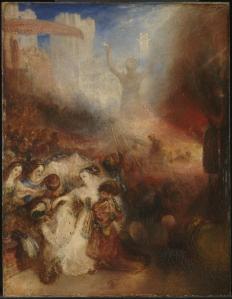
Joseph Mallord William Turner: Shadrach, Meshach and Abednego in the Burning Fiery Furnace – Tate Museum, UK
Today we choose verses from this well-known and well-loved story.
None of us is exempt from trials in the fiery furnace. Some of us suffer greatly; some only a little. Nevertheless, pain comes to each and all of us. And so we pray that in our difficult days, we will turn – as these young men do – to the one who saves. We pray that the angel of the LORD – as God promises – accompanies us in our fiery ordeals. And we pray that – as Christ calls us to do – to muster our courage to step forward into the promise of life.
Shadrach! Meshach! Abednego! Servants of the Supreme God! Come out!
Visit the Tales from the Disapora posts on this blog for more reflections. Or enter the words Furnaceor Shadrach, Meshach, Abednego into the blog search bar.
Early Christian MartyrsBless the Lord, all you works of the Lord, praise and exalt him above all forever . . .
The verses in chapter 3 will reveal something special for us. Nebuchadnezzar asks, “Who is the God who can deliver you from my hand?” Hanaiah, Mishael, and Azariah reply so simply: If the God whom we serve is able to save us from the burning fiery furnace and from your hand, O king, he will do so; but [even] if not, let it be known to you, O king, that we will not serve your gods.
This demonstration of dying to self in love for the Creator is so simple yet so eternal. Why do we find it difficult to give ourselves over to God when we know that we are here to serve, know and love this God who so loves us that he dies to self for us in the person of Jesus Christ all day every day? Why do we serve the pagan gods of fame, fashion, fortune, power and control? Why do we succumb to the gods of addictions to behaviors that are so damaging to self and others? Why do we preserve self and neglect those to whom we are sent? These young men speak to us down through the years in both their words and actions when they make their bold statement and step forward to witness to their vocation: Even if their God sees best that they be consumed in the fires of this furnace which is meant to reduce bodies to ash they will not abandon this God. They will not refuse to witness to this God . . . for they know and understand that this God is greater than all else.
Bless the Lord, all you works of the Lord, praise and exalt him above all forever . . .
We find further examples of human fidelity to God from the days of the early Christian Church when we explore the PBS FRONTLINE site at http://www.pbs.org/wgbh/pages/frontline/shows/religion/why/pliny.html Here we see how Christ’s early followers gain strength from the adversity they experience. Pliny the Younger and the Emperor Trajan exchange correspondence and agree that some of the Christ followers must be punished yet they are cautious, knowing that this Jesus movement will likely outlast them all.
The fidelity of these early Christians and other martyrs on the site is impressive. Nothing can make them turn away from God. As we read we wonder at the human capacity to endure such pain, the human ability to refuse the temptation to seek revenge, and the human spirit that exalts what is good in the face of wickedness. And so we pray . . .
Bless the Lord, all you works of the Lord, praise and exalt him above all forever . . .
We are God’s works, faithful and true. Let us act as though we believe in this truth. Praise and exalt God above all forever.
We are God’s art, varied and vibrant. Let us speak as though we believe this is so. Praise and exalt God above all forever.
We are God’s children, frightened and small. Let us love one another as the father loves us. Praise and exalt God above all forever.
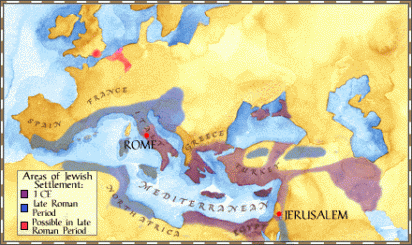
Click this image to follow a link to the PBS FRONTLINE site on the Jewish Diaspora for more about what it means to Christ’s followersDuring the Easter Octave this verse of Daniel, and others surrounding it, are recited in thanksgiving for the Easter Miracle. In this second week of Eastertide let us examine one of the church’s most popular and most powerful prayers.
Bless the Lord, all you works of the Lord, praise and exalt him above all forever . . .
Over the many months that we have shared Noontimes, we have reflected on this apocalyptic prophecy nearly two dozen times, and about half a dozen of those times have been from The Tales of the Diaspora, the first six chapters of this book. These chapters have roots in Israel’s wisdom literature and they are pedagogical in nature, the characters providing role models of fidelity to and trust in Yahweh, the one true god and creator of all. Daniel was also a figure mentioned in Canaanite texts of the fourth century B.C.E. (his name was Dnil) where he is described as a righteous judge and hero. He is seen as one who communicates with God through angels and understands information about the future of the world. Because of his virtue, his words and deeds – along with those other Jewish youth held in captivity – these stories remain with us today, and they serve to help us in our own times of trial – our own fiery furnaces and lions’ dens. They were recorded between the years of 167 and 164 B.C.E. (Mays 623-629)
Bless the Lord, all you works of the Lord, praise and exalt him above all forever . . .
As a child, I loved the stories of the four young Jewish boys, Daniel, Hanaiah, Mishael, and Azariah. I was stunned by the fact that they had to abandon their Jewish names to take on new, foreign ones, Balthazar, Shadrach, Meshach and Abednego. I was frightened by the fact that they were not only torn from hearth and home but were also being forced to abandon their God. It was actually this story which caused me to want to know and understand other languages, realizing that one day I might find myself snatched from all that is familiar to wake up in a daze in foreign territory . . . and I would want to know what these strange people were saying about me and my destiny. I also remember realizing that it was not the linguistic ability, the intelligence, the strength or the bonds of family or friendship which sustained these young people when they found themselves controlled by pagan foreigners and taken from their temple, their home, their families and community . . . their physical and spiritual places of comfort. When they were completely separated from the things which most of us cling to in times of crisis and stress, they relied on the one thing which sustained them through the trial of a fiery crematorium and exposure to hungry lions . . . they had Yahweh . . . they had their trust in Yahweh . . . and they had their fidelityto Yahweh. This alone fed them, rescued them, and restored them to a place of dignity and honor.
Bless the Lord, all you works of the Lord, praise and exalt him above all forever . . .
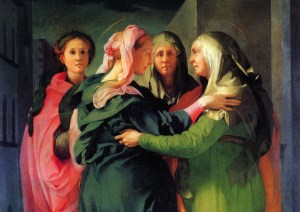
In yesterday’s Gospel reading of Mary’s visitation (Luke 1:39-45) with her cousin Elizabeth we heard again the familiar story of how the child John leapt for joy in his mother’s womb, knowing that the Redeemer was near. The pre-Messiah era was drawing to a close and these two women alone knew what the rest of the world would in time discover. The old way was about to be swept into a raw newness. The present laws of the One God with whom these people lived in covenant were about to be superseded by the Law of Love. These two women greeted one another; one was quite young and at the beginning of her life, the other was beyond child-bearing years and yet heavily pregnant. These two women shared the Good News that would be shunned by some and believed by many. Elizabeth would bring to life the child John who would announce the great coming. Mary had become the New Ark of the New Covenant.
Within you is my true birthplace.
The Jewish people into whose traditions and customs the young Jesus was born believed that God dwelt in the great Temple in the holy city of Jerusalem. Today’s Noontime reflection reminds us of how much God loves his holy city the gates of Zion, more than any dwelling in Jacob (Israel). And from this city the people of God were divided and sent into exile. As this Diaspora lived for centuries in scattered places they mourned the loss of their center, their core. When the city and Temple were later restored they made long pilgrimages to this holiest of places. The entire focus of this people rested in this one sacred site. This people saw their origin and their destiny as rising from this one hallowed place: the Jerusalem Temple.
Within you is my true birthplace.
When the angel Gabriel announces to Mary the coming of the Spirit upon her he also announces the changing of all the world knew and understood about God, and yet this change had been predicted by Judaism’s own prophets. When Mary agrees to become the Ark of the New Covenant she knows that the world will never be the same. We might wonder how much she understood the scope of this change. From her humble smallness, did she fully comprehend the effect her son would have on the history of the world? Might she have completely grasped the depth and breadth of his coming? Did she know that her simple acquiescence was a remarkable response to a complex question? Did she entirely recognize that in her singular act she had become the one true birthplace of not only the Messiah but the New Covenant as well?
Within you is my true birthplace.
Pontormo: The Visitation
Except for those who do not believe, the world holds its collective breath as it awaits the arrival of the Christ child. Within you is my true birthplace.
Except for those who refuse to follow, the world waits to burst into celebration the arrival of Healing and Redemption. Within you is my true birthplace.
Except for those who reject this new birthplace within, the world makes ready each heart for the in-dwelling of the Spirit. Within you is my true birthplace.
As this Nativity so ardently predicted and so eagerly awaited draws near, let us remember Mary’s fiat – her simple answer of Let your will be done to me – and let us celebrate this new birthplace of Salvation. Let us be glad and sing out in one accord with shepherds and kings and angels that we see and welcome this new, this true, this one . . . birthplace of Peace.



 The Noontimes