It happens so regularly that it’s predictable. The moment I decide to do good, sin is there to trip me up. I truly delight in God’s commands, but it’s pretty obvious that not all of me joins in that delight. Parts of me covertly rebel, and just when I least expect it, they take charge. (MSG)
Paul describes something that happens to each of us. Our best intentions succumb to our desire to control our environment. Our most outrageous hopes falter when we face ominous obstacles alone. Our deepest faith falters when the reality of the world crowds our thinking. We cannot understand how loving those who hate us will bring an end to all that plagues society.
Who will rescue me from this body bound for death? (CJB)
Despite all that looks dark in the world, Christ brings us light. Despite all that threatens to pull us under, the Spirit raises us up.
This, then, is my condition: on my own I can serve God’s law only with my mind. (GNT)
When events loom, when life overwhelms, when hope abandons and faith cannot abide, we are left with the only law that matters. Christ’s unfailing, always-saving, eternal Law of Love.
You have heard that our fathers were told, ‘Love your neighbor— and hate your enemy’. But I tell you, love your enemies! Pray for those who persecute you! (CJB)
We have spent time with these verses before but we do well to spend a bit of time with again.
Why should God reward you if you love only the people who love you? Even the tax collectors do that! And if you speak only to your friends, have you done anything out of the ordinary? Even the pagans do that! (GNT)
We have reflected before on the importance of loving those who hate and we do well to reflect again.
In a word, what I’m saying is, Grow up. You’re kingdom subjects. Now live like it. Live out your God-created identity. Live generously and graciously toward others, the way God lives toward you.”
God says: I know how difficult it is to follow my son and act in this Law of Love. This is the very reason I come to walk among you as one of you and not as a distant God. This is why I spend time with the margins of your societies. And it is why I ask you to dwell there with me. Do not lose heart. Have courage. Have I not prepared a Way for you? Do I not accompany you on your way? Do I not love you more than I love myself? And do I not want you to be with me forever?
For millennia Jesus has told us how we are to act when our sisters and brothers hate us.
But I say unto you, love your enemies, bless those that curse you, do good to those that hate you, and pray for those who speak evil about you, and persecute you. (JUB)
For millennia we have heard that Jesus will abide, heal and comfort us, his little children. Let us behave each day as though we believe this to be so.
When we use the scripture link and drop-down menus to explore these words, we begin to understand that Jesus gives us sound advice; we begin to recognize that Jesus’ request brings us closer to him in every way; and we begin to find a way to love those who have done us such damage.
We have read about the women and men who bring us an accounting of the rise and fall of the human journey along God’s Way. We see the acts and hear the thoughts of those who are willing to share their experiences – both the ugly and the beautiful – of their encounters with the Living God. Today we reflect on all that we have learned as we pray.
Singular and gathering God, we know that you are the beginning and end of our faith. We realize this in your Alpha and Omega presence in Christ among us.
Patient and persistent God, we see that you are the form and substance of all hope that is true and everlasting. We see this in all of creation that constantly strives to return to you.
Healing and transforming God, we understand that nothing matters and no one exists in a world without your Law of Love. We experience this mercy and forgiveness in the goodness that you pull from each harm that we commit or have done unto us.
Teach us to also forgive. Lead us always into the light. Protect us from all that would obliterate us. Love us into your goodness. Bring us your truth. Counsel us in your healing and nurturing way. Re-tell us the stories of our shared and sacred history. Shelter us in the warmth of your embrace. And keep us always ever close to you. Amen.
The two books of Chronicles have four major portions that show us very human leaders; they illustrate the rise and fall of a people and nation. These verses tell us how division and exile can lead to forgiveness and return. Our sacred history shows us how we will want to learn to replace pride with humility. Our shared story guides us in moving from fear to love. These holy stories are treasures we will want to examine often, and share with the world.
For more on this amazing story, enter the words God’s Love Letter into the blog search bar and explore.
In the opening verses of this Chapter, Jesus begins to explain that misfortune or disability is not a sign of our sin; it is only misfortune or disability. Jesus cures a man of blindness as if to make a point. A miracle occurs yet in verses 8 through 12 we see how the people doubt that the cure has taken place: No, he just looks like him. In verse 13 the Pharisees become involved. The healing happened on a Sabbath; work has occurred. This is a transgression for which the temple leaders must have an accounting. This man is not from God. The healed man is called a second time and asked what has happened, to which he replies in verse 24. I told you already and you did not listen. Why do you want to hear it again?The Pharisees continue to question and he replies: This is what is so amazing, that you do not know where he is from, yet he opened my eyes . . . If this man were not from God he would not be able to do anything.This is a challenge to them. They cannot comprehend – or accept – the miracle before them and so . . . Then they threw him out.
In the final verses of this chapter Jesus speaks to the healed man to assure him that they have not broken God’s truelaw – the Law of Love. Explaining that he is the light that has come into this world of darkness, Jesus gives his listeners something to think about: I came into this world for judgment, so that those who do not see might see, and those who do see might become blind. This tweaks the Pharisees – who have refused to see and accept this cure as coming from God. Jesus says to them: If you were blind, you would have no sin; but now you are saying, “We see”, so your sin remains.Jesus points out to these men that they have seen the truth and reject it, so that they might believe themselves to be in control. They irony is this: They were never in control as they have imagined themselves to be.
Christ Healing the Blind Man at Bethsaida: Gioacchino Assereto
In this story we are again in the world of inversion where up is down and down is up, poor is good, disability is a plus. Jesus is the light and the Pharisees set themselves against this healing force. We have the opportunity to examine our reaction to miracles. Do we accept the gift of life which each of us is offered? Or do we put aside our petty haranguing with one another in order to unite in Christ? Are we stubborn Pharisees or are we blind people cured?
Do we flail against the light and insist that what we see is not really happening? Can we accept in confidence the gift of healing and give back to God our total trust?
If this man were not from God he would not be able to do anything . . . so when the light enters our lives as it so often does let us not thrash against the goodness and the warmth.
Michelangelo Merisi da Caravaggio: The Taking of Jesus, Judas betrays Jesus with a kiss
We have reflected on seeking, finding and recognizing Jesus. We have thought about Jesus as God’s Word in human form among us. We have explored what God must mean when coming to live with us and one of us and we have been incredulous as we see how God, through Jesus, converts the impossible to the possible. Perhaps we remain incredulous. Today we see Jesus act in a most challenging way . . .
When Judas had left them, Jesus said . . .
We cannot escape betrayal, abandonment, deception or chaos. These disruptive forces must be seen for what they are. When in doubt we might follow Jesus, the one who knows both pain and joy, corruption and peace.
Children, I am with you for only a short time longer. You are going to look high and low for me. But just as I told the Jews, I’m telling you: Where I go, you are not able to come.
Jesus does not stop Judas from reporting his whereabouts to the authorities. Instead, he prepares those who love him. When confronted with our own Judas, we might follow Jesus, the one who knows both sorrow and rejoicing, evil and mercy.
Let me give you a new command: Love one another. In the same way I loved you, you love one another. This is how everyone will recognize that you are my disciples—when they see the love you have for each other.
Jesus does not stop us from doing evil. Rather, he calls us to his side, to accompany him as a child follows a loving parent. When lost in our world of ego and self-orientation, we might follow Jesus, the one who knows both cruelty and kindness, hate and love.
When we suffer at the hands of Judas, let us remember to follow Jesus in love.
Compare differing versions of these verses today and allow God’s Word to bring reconciliation so that we might better love the Judas in our lives. Or enter the words Judasor betrayalinto the blog search bar and explore.
These are interesting words from Paul to the people of Ephesus; and they serve us today as we move through another political season. Use the scripture link to compare THE MESSAGE version cited here with another translation to see if perhaps different words speak to you.
And so I insist—and God backs me up on this—that there be no going along with the crowd, the empty-headed, mindless crowd. They’ve refused for so long to deal with God that they’ve lost touch not only with God but with reality itself. They can’t think straight anymore. Feeling no pain, they let themselves go in sexual obsession, addicted to every sort of perversion.
Paul warns the Ephesians and he warns us that the life we fashion for ourselves is much less interesting, much less challenging, and much less loving than the life God has in mind for us.
That’s no life for you. You learned Christ! My assumption is that you have paid careful attention to him, been well instructed in the truth precisely as we have it in Jesus. Since, then, we do not have the excuse of ignorance, everything—and I do mean everything—connected with that old way of life has to go. It’s rotten through and through. Get rid of it! And then take on an entirely new way of life—a God-fashioned life, a life renewed from the inside and working itself into your conduct as God accurately reproduces his character in you.
What does it mean to take a new way of living? How might we better enact Jesus’ Law of Love as we move through our days? How do we deal with the challenges that greet us when we cast off unhealthy living? Why do we cling to the empty-headed, mindless crowd?
Do we fully understand the depth of Jesus’ words? Do we fully open ourselves to Jesus’ transformation?
Jesus says: Don’t suppose for a minute that I have come to demolish the Scriptures—either God’s Law or the panorama. God’s Law is more real and lasting than the stars in the sky and the ground at your feet. Long after stars burn out and earth wears out, God’s Law will be alive and working.
Do we fully understand that when we mock creation we mock ourselves? Do we fully open ourselves to the wonders of God’s universe?
Jesus says: Trivialize even the smallest item in God’s Law and you will only have trivialized yourself. But take it seriously, show the way for others, and you will find honor in the kingdom. Unless you do far better than the Pharisees in the matters of right living, you won’t know the first thing about entering the kingdom.
God says: You work inordinate hours. You fret over the past and worry about the future. You wriggle through plans that you lay for yourselves. You create rules and parameters that you hope will keep you safe. The Law I speak about is simple indeed – it is the only law the actually keeps you safe. It is the Law of Love. The Law of forgiveness. The Law of generosity and kindness. The Law of healing and comfort. The Law of mercy. Rest in me. Bring your worries to me. Allow my Law of Love to reconcile, restore and rebuild. Allow yourself to step into my kingdom of love.
We continue our Lenten practice as we consider how we might bring others to God’s kingdom of love. Rather than thinking: “The dream of peace is an unreal and distant illusion,” let us think instead, “The dream of peace we hold is present in God’s kingdom. And God’s kingdom is now”.
Tomorrow, Beelzebub.
For another post on these verses, enter the words A Teaching on the Law into the blog search bar and explore.
Matthew 5: God’s Yardstick – The Law of Love – Part VI
Jesus The Word and Law
Sunday, January 22, 2023
We continue to see God’s yardstick in the New Testament, rising from the covenant in the Old Testament.
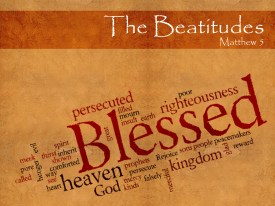
Often when a group begins a gathering in prayer and reads Christ’s Beatitudes, the leader will trail off after the “blessed” verses, omitting the last words Jesus gives un on persecution. This may be in error. By forgetting the final verses, we think only about the irony of verses 3 through 9 and that irony seldom fulfills or satisfies. The true paradox of Christ can only be seen when we include the final two verses that speak about the paradox of joy being gained through suffering. To recite the first seven blessings without the last two is to tell the Gospel story ending at the crucifixion and omitting the Resurrection, the road to Emmaus, the meal shared with the apostles along the bank of the sea, the return of Christ to the Upper Room, the Ascension, and finally the descent and in-dwelling of the Holy Spirit. There is nothing lasting if we neglect the last two verses. The prayer becomes hollow. And so we pray . . .
Blessed are the poor in spirit, for theirs is the kingdom of heaven.
Blessed are those who mourn, for they will be comforted.
Blessed are the meek, for they will inherit the earth.
Beatitude is blessing. Beatitude is happiness.
Blessed are those who hunger and thirst for righteousness, for they will be filled.
Blessed are the merciful, for they will receive mercy.
Blessed are the peacemakers, for they will be called children of God.
Beatitude is a gift freely given by God.
Blessed are those who are persecuted for righteousness’ sake, for theirs is the kingdom of heaven.
Blessed are you when people revile you and persecute you falsely on my account.
The desire for beatitude is written on each of our hearts by God.
Rejoice and be glad, for your reward is great in heaven, for in the same way they persecuted the prophets who were before you.
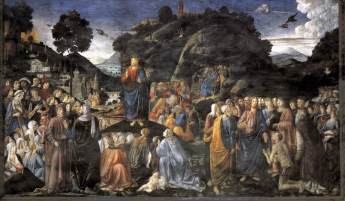
Cosimo Roselli: Jesus Delivers the Eight Beatitudes
Beatitude is a promise that challenges us to make moral choices. It is a covenant that invites us to purify our hearts, to seek God, and to rest serenely in beatific joy with God . . . because God alone is enough.
Tomorrow, concluding our reflections on the Law of Love.
When we spend time with Matthew 5, we explore the idea that we are salt and light, and we give ourselves the opportunity to unfold Christ’s wondrous Law of Love.
Matthew 5: God’s Yardstick – The Law of Love – Part I
Happiness and the Beatitudes
Tuesday, January 17, 2023
In these opening days of a new year, we have looked at women in scripture who see and use God’s yardstick in their lives. Over the next few days we explore how we find God’s yardstick in both Old and New Scripture.
As we move from the Old Testament to the New, God is moving us away from the external, vengeful, jealous, patriarchal God to a God of the internal. Through the prophet, God promises us a new covenant to replace the old. TheLordsays, “The time is coming when I will make a new covenant with the people of Israel and with the people of Judah. It will not be like the old covenant that I made with their ancestors when I took them by the hand and led them out of Egypt.I will put my law within them and write it on their hearts. I will be their God, and they will be my people”. (Jeremiah 31:31-33)
God who writes the covenant of love on our hearts, also comes among us a human. God who promises to redeem and save, also comes to dwell within as Spirit. In the Old Testament, God rewards good people and punishes the bad in order to gain their trust. In the New Testament, God calls us to spiritual maturity, God calls us to perfect union, to deep intimacy (Psalms 42 and 62). In the New Testament God asks that we accept the Creator, the giver . . . rather than the gifts.
Jeff Cavins, in his lecture on Matthew 5, outlines four levels of happiness: 1) instant gratification, 2) personal achievement, 3) philanthropy, and 4) union with God. The first two are about the self; the second two are about the other. Level one concerns the ego and what it can find, acquire or possess. Level two refers to awards we receive. Both of these levels give immediate satisfaction but are not lasting because, as scripture points out, we are created for more than this. In Level three we begin to move outside of ourselves to care about others, but this still is not lasting, not beatific. It is when we arrive at Level four that we find real happiness, real communion with our creator, intimate union with God. This is the union for which we are created. This is the Law of Love that supersedes the Mosaic Law of the Covenant. This is the measure with which God measures creation.
Tomorrow, The Sermons on the Mount and the Plain.
Adapted from a Favorite written on January 5, 2007.
 Paul describes something that happens to each of us. Our best intentions succumb to our desire to control our environment. Our most outrageous hopes falter when we face ominous obstacles alone. Our deepest faith falters when the reality of the world crowds our thinking. We cannot understand how loving those who hate us will bring an end to all that plagues society.







 The Noontimes