Perhaps it was in deep gratitude that Mary, Lazarus’ sister, uses a jar of expensive aromatic oil to anoint and massage Jesus’ feet when he visits his friends’ home in Bethany. These are the same feet that will be pierced in a short time giving us a sign of Jesus’ deep sacrificial love for each of us. Other omens of the drama to come unfold in these verses: Judas’ betrayal and the plot to do away with Lazarus. As we read and reflect on these verses today, let us consider how Jesus’ great love is met with great betrayal. On this Holy Monday, let us resolve to bring healing and peace to the world – even in the face of great deceit or duplicity – so that in our small way we might perform our own anointing of Jesus’ feet.
Matthew tells the story of Jesus’ anointing in Bethany in the house of Simon, a man who suffers from leprosy. (Matthew 26:6-13) For another Noontime reflection, enter the words The Anointing in the blog search bar.
As we enter Holy Week with the celebration of Palm Sunday, we remind ourselves that human history has the unmistakable pattern of flight and return. We flee when we sense danger. We shrink to hide when we are overwhelmed. We reject the story before us that reminds us of our shortcomings. But the powerful story of the coming week is one of return, redemption, forgiveness and a love that is so powerful that it can erase any transgression.
Today we take time to visit the story of Ezra to look for the clues it gives us to our own road to retrieval, renovation, and recovery. We stray and yet while we wander the roadways that lure us away from God who sustains us, we hear the voice that continues to call. We celebrate a life we believe is free when we throw away our relationship with Christ to live a life with no controls, but still we hear that quiet voice that continues to beckon. We sink into the easy life that offers no obstacle to our whims and yet we feel the abiding presence of the Spirit.
Ezra and the Israelites return to Jerusalem to rebuild the city that had sheltered them and had represented their unique relationship with God. Together with Ezra and Nehemiah the people respond to that voice that has never ceased calling. This distance and return are foreshadowed in the Christmas story that we have been visiting. We know that the Holy Family flee to Egypt to avoid the hatred and envy of Herod. We also know that they return once God calls them back.
Bartolomé Esteban Murillo: The Holy Family with Little Bird
Today we return. Whether we have fled because we have felt no need of God, or because we experience deep danger, we know we must return. We hear the call of the Shepherd’s voice, we feel the warmth of Christ’s love, we remember the loving embrace of the Spirit. And we return to the sure safety of the Holy Family. In the days of Holy Week that unfold before us, let us confess that we are not always present to God’s call. And let us enter this holy time with the surest and purest of intentions that we re-commit ourselves daily to the unfailing love of God.
As we celebrate the transforming path of mercy that leads to the Paschal Mystery, we will want to have eyes to see the Word of God among us so that we might take heart when we are discouraged, so that we might have hope when we are in despair, so that we might have light when we are in darkness.
The prophet Ezekiel tells us: Son of man, you live in the midst of the rebellious house, who have eyes to see but do not see, ears to hear but do not hear; for they are a rebellious house. (Ezekiel 12:2)
The wisdom writer tells us: What the eyes see is better than what the soul desires. This too is futility and a striving after wind. (Ecclesiastes 6:9)
The prophet Zechariah tells us: Then the angel who was speaking with me went out and said to me, “Lift up now your eyes and see what this is going forth”. (Zechariah 5:5)
In Luke’s Gospel we hear Jesus say: Blessed are the eyes which see the things you see, for I say to you, that many prophets and kings wished to see the things which you see, and did not see them, and to hear the things which you hear, and did not hear them. (Luke 10:23-24)
The evangelist John tells us in his first letter: What was from the beginning, what we have heard, what we have seen with our eyes, what we have looked at and touched with our hands, concerning the Word of Life – and the life was manifested, and we have seen and testify and proclaim to you the eternal life, which was with the Father and was manifested to us – what we have seen and heard we proclaim to you also, so that you too may have fellowship with us; and indeed our fellowship is with the Father, and with His Son Jesus Christ. These things we write, so that our joy may be made complete. (1 John 1:1-4)
Once we see how God’s Word heals the wounded and transformed the faithful, we will want to respond to God’s call. We need not use words. We need only act. As we near the Easter feast, let us decide how we will convey the love of the Living God to all. Let us decide how we will join those who also long for the world’s joy to be complete.
We celebrate The Octave of Easter on the pathway we have chosen, and as we celebrate the Paschal Mystery, we will want to have ears to hear the Word of God so that we might take heart when we are discouraged, so that we might have hope when we are in despair, so that we might have light when we are in darkness.
The prophet Jeremiah cries out: To whom shall I speak and give warning that they may hear? Behold, their ears are closed and they cannot listen. Behold, the word of the Lord has become a reproach to them; they have no delight in it. (Jeremiah 6:10)
The prophet Isaiah replies: Your ears will hear a word behind you, “This is the way, walk in it,” whenever you turn to the right or to the left.” (Isaiah 30:21)
The prophet Ezekiel tells us: And the man said to me, “Son of man, look with your eyes, and hear with your ears, and set your heart upon all that I shall show you, for you were brought here in order that I might show it to you. Declare all that you see to the house of Israel.” (Ezekiel 40:4)
The psalmist replies: We have heard with our ears, O God, our forefathers have told us, the deeds you did in their days, in the days of old. (Psalm 44:1)
In Matthew’s Gospel Jesus tells us: Then the righteous will shine forth as the sun in the kingdom of their Father. He who has ears, let him hear. (Matthew 13:43)
The evangelist John records Jesus as saying: Truly, truly, I say to you, the one who hears my word, and believes the one who sent me, has eternal life, and does not come into judgment, but has passed out of death into life. (John 5:24)
Once we hear God’s Word we will want to reply. We need not use words. We need only act. As we near the Easter banquet, let us decide how we will reply to the one who calls us to live as Children of the Living God.
This scene may be familiar to us since it is replicated on Palm Sunday when Jesus rides into Jerusalem as king and paschal sacrifice. Jesus’ crowning by the marginalized people whom he cured and healed fulfills the hope which Solomon brings to the throne of Israel. David’s last instructions serve his son and his people. Solomon’s crowning bring his people hope for security and peace. Jesus’ last instructions bring rescue and redemption that last an eternity.
1 Kings 2 begins with David’s death discourse and we find that it has a familiar ring. David hands on his kingdom to Solomon in 970 B.C.E. and several hundred years later, Jesus comes to fulfill David’s and Solomon’s hope.
What does Solomon’s crowning mean for us today? We see the foreshadowing of Jesus, the true king who “keep[s] the mandate of the Lord . . . following his ways and observing his statutes, commands, ordinances and decrees as they are written in the law of Moses, that you may succeed in whatever you do, wherever you turn.”
We so easily forget this when life offers us an easy road and we feel confident. Our small egos take over and tell us that we do not need God. Then trouble strikes and we turn back to God whom we have forgotten and we find that God is there waiting to accompany us through any tragedy or pain. David’s last instructions, a call to live in the Law of Moses, presage the Law of Love which Jesus brings.
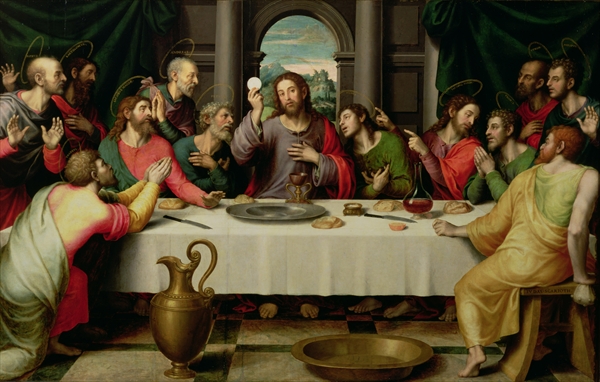
Vicente Juan Macip: The Last Supper
The apostle John tells us of Jesus’ last words to his followers. They are so simple and also so beautiful. Do not let your hearts be troubled . . . I will not leave you orphans . . . I am the true vine, and my Father is the vine grower. Remain in me as I remain in you . . . It was not you who chose me but I who chose you . . . I have more to tell you but you cannot bear it now . . . In the world you will have trouble, but take courage, Ihave conquered the world.These familiar words lay out the simple tenets of Jesus Law of Love which comes down to one lasting commandment: Love God, love one another.
This is such a simple instruction and yet so easily forgotten.
As David lies dying he gathers his last resources to leave final instructions to those he loves so well. Solomon is crowned and David’s words are passed on for generations.
As Jesus enters Jerusalem he gathers his strength for the harrowing road that lies ahead. He calls his apostles together, breaks bread and shares wine, and he leaves last instructions for those he loves so dearly. Do not let your hearts be troubled . . . Jesus’ words are passed down through an eternity.
As we confront any obstacle that falls to us in our journey, we might find wisdom and consolation in these last words which we so easily forget. And so we ask God’s help and we pray . . .
Faithful and forgiving God, abide with us as we journey through life forgetting, or perhaps not believing, that you are with us.
Constant and faithful God, sustain us with the hope so often predicted and so lovingly brought to us by your son.
Healing and loving God, fill us with the consolation and peace of your Holy Spirit, remembering that we are your own dear creations who long to be with you.
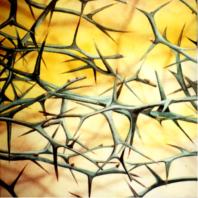
A number of months ago we looked at Ezekiel 2 and focused on the image of the scroll. Today as we watch Jesus’ triumphant entrance into Jerusalem we look at just a few of the verses. From the Jerusalem Bible: The[y] are defiant and obstinate; I am sending them to you to say, “The Lord Yahweh says this”. Whether they listen or not, this set of rebels shall know there is a prophet among them. And you, son of man, do not be afraid of them, do not be afraid when they say, “There are thorns all around you scorpions under you”. There is no need to be afraid either of their words or of their looks, for they are a set of rebels. You must deliver my words to them whether they listen or not, for they are a set of rebels. Jesus knows that he is about to settle into the thorns; he is aware that scorpions lie in wait; yet he goes willingly to do as the Father asks.
In today’s reading from Philippians (2:6-11) Paul describes for us Jesus’ manner before God. Perhaps when we spend some time reflecting on these verses we will be better able to do as God asks. We know that this obedience will lead us from time to time to sit among thorns and be surrounded by scorpions; yet we obey as Jesus obeys, knowing that we are led and loved by God.
And so we pray . . .
Christ Jesus, though he was in the form of God, did not regard equality with God something to be grasped . . .
If Christ himself does not try to supersede the creator, why do we?
If Christ himself does as the Father asks, why cannot we?
He emptied himself, taking the form of a slave, coming in human likeness . . .
If Christ empties himself so that the Spirit may enter, why cannot we?
If Christ enslaves himself to the will of God, how might we?
Found human in appearance, he humbled himself, becoming obedient to the point of death, even death on a cross . . .
If Christ humbles himself and bows to the creator, when can we?
If Christ obeys unto death, even death on a cross, when do we?

Because of this, God greatly exalted him.
If Christ settles into thorns to sit among the scorpions, why don’t we?
If Christ calls us to follow . . . even into the thorns and among the scorpions, why don’t we?
What do we fear . . . when we know that we are led and loved by God?
Let us place our cloaks on the ground to make a passage way for Christ. Let us take up the fronds of palm to wave them in joy. And let us follow the one who leads and loves so well . . . even knowing that we go among the thorns and the scorpions. Amen.