It is dawn and we are on the sea in a boat with seven of the Teacher’s followers who have returned to their former occupation after the events in Jerusalem during the last Passover. We have been working all night and are bone-weary. More than that, we have a certain uneasiness about how we are to continue to follow the Teacher now that he is risen. Although we say little to our companions, we are anxious, confused, and drained.
Then from the shoreline comes that voice, calling, “Children, have you caught anything to eat?” and we answer, “No”. Again the voice calls out, “Cast the net over the right side of the boat and you will find something”.
What can this stranger mean? We are experienced at this work and we have been casting all night. How can moving the net from one side of the boat to the other make a difference in the catch? Either the fish are below us or they are not.
With a quick exchange of glances and a nod from Peter, together the disciples shift the net to the opposite side of the boat.
So they cast the net and they were not able to pull it in because of the number of fish . . . It is in that moment that John turns to Peter and says with quiet, unwavering certainty, “It is the Lord”.
Tomorrow in our lives as Easter People, leaping from the boat . . .
Jesus continues to appear to his disciples, encouraging them to join him in the work of kingdom building. Still mystified by how they will fulfill this mission, they return to the profession they know . . . to their boats, their nets, and the Sea of Tiberias. It is here that we find Simon Peter, Thomas called Didymus, Nathanael from Cana in Galilee, Zebedee’s sons John and James, and two others. They have been fishing all night . . . and they have caught nothing.
Dawn arrives and they must be wondering what they are to do next.
When they made the decision to follow Jesus they had left their work as fishermen behind them, not questioning how they would earn a living. They had followed the Teacher for several years until that sudden ending when they had last gone up to Jerusalem for Passover. Jesus has returned, risen, wounded, yet whole, and he has visited with them, shared bread with them, told them they need fear nothing. He has given them his blessing and God’s peace; yet they are uncertain what to do next in this new life of following the risen Christ so they have turned to their former occupation; but this once familiar work is proving fruitless.
They must be questioning all that has happened to them in the last several years.
We, like the apostles, will find ourselves casting nets into familiar seas yet coming up empty.
We, like the disciples, will return to places and relationships we once took for granted searching for strength yet finding little.
We, like all of Christ’s followers, will encounter the Christ just when and where we least expect to find him.
Let us spend some time today watching and waiting in Easter joy. Let us carry our worries and fears to the risen Christ. And let us look for the risen Lord in every detail of all that we do in his name today and all days.
Today we examine our lives as Easter People. Tomorrow, recognizing Jesus . . .
So they set out at once and returned to Jerusalem . . .
In the moment that Cleopas and his companion realize that they have been journeying with Jesus, they rise from the supper table to return to Jerusalem. The place that a short time before had symbolized disappointment, defeat and danger now is the focus of all their hopes. They must return to tell the other disciples what has occurred on the road to Emmaus.
So must we tell others about the Easter story as we place all our hope in Christ.
They found gathered together the eleven and those with them who were saying, “The Lord has truly been raised and has appeared to Simon!” Then the two recounted what had taken place on the way . . .
The Emmaus disciples rejoice with the disciples who had stayed behind in Jerusalem; they celebrate the reality that the Christ is still with them.
So must we rejoice as we celebrate with Christ.
While they were still speaking about this, he stood in their midst and said to them, “Peace be with you”. But they were startled and terrified and thought that they were seeing a ghost.
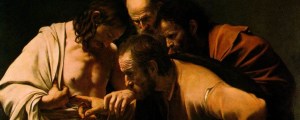
It is difficult to ask our reason to bow to the miracle before them. A few short days from now Thomas will stand before them insisting on hard evidence that Jesus has returned. He must see and touch before he will believe; yet Jesus invites offers Thomas the evidence he needs in order to believe.
So might we be startled and terrified; so might we believe.
Then he said to them, “Why are you troubled? And why do questions arise in your hearts? Look at my hands and my feet, that is it myself. Touch me and see, because a ghost does not have flesh and bones as you can see I have”.
Rather than preach to us, Jesus talks with us. He never ceases to tell us in every way he can that he understands our circumstances and our emotions.
So might we be troubled with fear and doubt; so might we touch, see and trust.
While they were still incredulous for joy, and were amazed, he asked them, “Have you anything here to eat?” They gave him a piece of baked fish; he took it and ate it in front of them.
Jesus still shares a meal with his friends just as he has done so often before. He demonstrates undeniably that he is real for a phantasm cannot eat and drink and laugh with them.
So might we be amazed and incredulous; so might we share a familiar and intimate meal with Christ.
Then he opened their minds to understand the scriptures . . .
The Teacher never misses an opportunity to instruct them again on the Law of Love and the newness of God’s Kingdom. The disciples allow themselves to be open to The Word.
So might we listen for the voice of Jesus; so might we be open to The Word.
Then he said to them, “You are witnesses of these things . . . but stay in the city until you are clothed with power from on high.
Jesus requires affirmation from his followers. He also counsels them on the next steps they must take in their newly found work of Kingdom-building.
Oh how foolish you are! How slow of heart to believe all that the prophets spoke!
If only we might realize that we are Emmaus People, a people who hold a truth too wonderful to keep secret.
Two of Jesus’ disciples were going to a village seven miles from Jerusalem called Emmaus, and they were conversing and debating.
If only we might remember that we are Emmaus People, a people who know that disappointment and despair wither in the face of courage and hope.
Jesus himself drew near and walked with them, but their eyes prevented them from recognizing them.
If only we might recall that we are Emmaus People, a people living the victory of light over darkness, of life over death.
What are you discussing as you walk along?
If only we might affirm that we are Emmaus People, a people accompanied by a God who loves us intensely and forever.
Are you the only visitor to Jerusalem who does not know of the things that have taken place there in these days?
If only we might avow that we are Emmaus People, a people in the constant companionship of Jesus, our brother.
What sort of things?
If only we might believe that we are Emmaus People, a people in whom the Spirit resides, bringing us Wisdom and Peace.
The things that happened to Jesus the Nazarene, who was a prophet mighty in deed and word before God and all the people, how our chief priests and rulers both handed him over to a sentence of death and crucified him.
If only we might trust that we are Emmaus People, a people chosen by God, made in God’s image, held in God’s intimacy.
We were hoping that he would be the one to redeem Israel.
If only we might share the Good News that we are all Emmaus People,a people saved and protected, a people guarded, loved and called.
Oh how foolish you are! How slow of heart to believe all that the prophets spoke!
If only we might realize that we are Emmaus People, a people created and living in union with God, a people holding a truth too wonderful to keep secret.
We travel the road to Emmaus with Jesus at our side, with Jesus engaging us in conversation, with Jesus breaking bread and sharing himself with us. Let us be quick of heart rather than slow. Let us be joyful in spirit rather than downcast. And let us tell the world how our hearts are burning with the fire of Christ’s love.
Unless I see the mark of the nails in his hands and put my finger into the nailmarks and put my hand into his side, I will not believe.
The loveliness of Thomas is that he is passionate; he leaves no doubt in anyone’s mind what is required to bring him to the conclusion that Jesus is risen. We might see ourselves or someone we well know in this story today. We may even be Thomas ourselves.
A week has passed since the incredible event at the garden tomb; so many rumors fill the Jerusalem air that it is impossible to sort through them. The disciples are again inside, we are told, and this time Thomas is with them.
Jesus came, although the doors were locked, and stood in their midst and said, “Peace be with you”.
Again the stunned surprise as the disciples look to one another to see who still stands in doubt. It is likely that Thomas is not the only follower of the Teacher who needs convincing of the mysterious truth that Jesus is no ghost but a man, scarred by his crucifix experience, but still . . . a full, living, breathing, resurrected man. Not resuscitated as was Lazarus, but risen. The disciples in the Upper Room struggle once more to gain the peace Jesus so easily grants them. All eyes move back to Jesus, who holds out his hands palms upward as he says to Thomas,Put your finger here and see my hands, and bring your hand and put it in my side, and do not be unbelieving, but believe.
Thomas’ response is five brief words that contain the theology by which he will live out the remainder of his days – a theology by which we too might easily live our entire lives . . . if we might only see and believe: My Lord and my God!
We might wonder what words erupted from the other disciples who may have chided Thomas for his lack of belief. We might imagine that there was a new solemnity in the air as these friends struggled to find new footing in this new place of total faith. Or we might as easily believe that they fell into conversation just as they had so often done before this last Passover. John does not record any detail but what we can see is Thomas’ unrelenting passion. As strongly as he insisted on seeing evidence before committing himself to this incredible belief . . . he now as strongly validates the mystery standing before them. My Lord and my God!
And so we pray . . .
Good and forgiving God, visit with us this day and each day in such a way that we cannot deny you: My Lord and my God!
Good and patient God, remain with us through our days of doubt and our nights of fear in such a way that we will always praise you: My Lord and my God!
Good and loving God, guide us in our times of trial and our times of rejoicing in such a way that we will always love you: My Lord and my God!
“Peace be with you,” Jesus said to them. “As the Father has sent me, so I send you.
When life presents us with circumstances that confuse our senses, how do we bring reality into focus? What fears do we bow to? How do we unravel ourselves from our emotions?
When family or friends hurt or disappoint us, how do we recover? How do we avoid seeking revenge? What do we do to manage our desire to control others?
When we suffer a loss that is too great to handle, how do we move forward? What do we hide? What do we reveal?
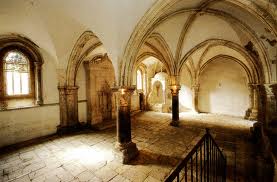
Fearful and confused, the disciples have gathered in the upper room where they shared that last meal with Jesus. We can only imagine their bewilderment when Jesus appears among them. They quiz one another about who did or did not lock the door. They quiz Jesus about how he comes to be with them. Their mourning has turned into rejoicing.
They are startled by the Teacher’s actions and words. Here he is – somehow whole and back with them yet bearing the crucifixion wounds – and he is behaving as if this were their normal Passover journey to Jerusalem. And now he tells them that he expects them to go out into the world – the world that has just put him to death – and teach others as he has taught them. Even more surprisingly, he tells them that whose sins they forgive are forgiven and whose sins they retain are retained. They are beyond confused. They are stunned.
There is no other experience in their varied lives that has prepared them for what stands before them. How, they ask themselves, could they have been so blind to Jesus’ real mission? How had the Teacher been so patient with them? Why does he value them so much? Can it be that he truly loves them this deeply and this well?
We are often blind-sided by circumstances. What have we learned from these experiences? Have we really noticed that it is Jesus who breathes life into our wounded lives with his own, powerful breath? Have we taken his gentle urging seriously that we go into the world to do as he has done? Do we fully and enthusiastically believe that Christ’s peace will be with us as we unlock the door behind which we have buried ourselves to go out into a world that will be both loving and hostile?
Today we reach the half-way point in the Easter Octave and if we still stand frightened and locked away rather than thankful, open, amazed and engaged in the world we have missed entirely the Easter story. We have missed the announcement of the end of fear. We have missed the liberation of our bodies, minds and souls. But – and this is the truly amazing point of the Easter story – despite the fact that we have hidden ourselves away, Jesus comes through all locked doors to retrieve us. Jesus breathes life back into our exhausted lives. Jesus will go to hell and back in order to set us free from our fears and anxieties. It is in this way that we know the breadth and depth of God’s love. Jesus sends us, just as he was sent. And Jesus goes with us always so that we have nothing to fear.
Mary turned and saw Jesus there, but she did not know it was Jesus. Jesus said to her, “Woman, why are you weeping? Whom are you looking for?” She thought it was the gardener and said to him, “Sir, if you carried him away, tell me where you laid him, and I will take him”.
When life presents us with circumstances that confuse our senses, how do we bring reality into focus? What promises do we make; what vows do we forswear?
When family or friends hurt or disappoint us, how do we recover? To what lengths do we go? What bridges do we build?
When we suffer a loss that is too great to handle, how do we move forward? What do we expect? What do we hope?
Mary Magdalene’s sorrow and love are evident in this brief exchange. So churned by emotion that she does not recognize the Teacher, she speaks to a man she takes for a stranger and asks for his help. No matter the consequence, no matter the danger, she is more determined than ever to at least bring proper respect to Jesus’ body. Tears cloud her eyes as she waits for an answer, and then . . .
“Mary!” Jesus says to her.In that instant Mary hears the familiar call . . . and she feels, more than sees, the Christ standing before her.
“I have not yet ascended to the Father,” Jesus tells her, “But go to my brothers and sisters and tell them, ‘I am going to my Father and your Father, to my God and your God”.
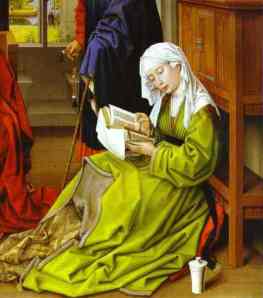
Ven der Weyden: Mary Magdalene
In this quick conversation Jesus and Mary have said all they need say to one another. She is distressed. He wants to calm her fear. She is distraught. He wants to sooth her too-jangled nerves. She needs more strength than she can muster on her own. He wants to give her his broad shoulders that carry the heaviest of yokes. She is exhausted with grief and he has paused in this most important of journeys to stay a moment with her because he sees that she needs him.
She asks . . . he gives . . . generously.
What does Jesus tell us when we call on him in our Magdalene moments?
Jesus tells us that all is well. He explains that God has the situation in hand. God his Father, God our Father. Jesus also wants the word to go beyond just him and the Magdalene, beyond just you and me. Jesus wants the world to know that he has not abandoned us. He wants each of us to know that he is aware of what is happening at every moment in our lives. Jesus wants to take each of us with him to the Father.
Why are you weeping? Jesus asks. Let us be honest and tell Jesus all.
Mary stayed outside the tomb weeping. And as she wept, she bent over into the tomb and saw two angels in white sitting there, one at the head and one at the feet where the body of Jesus had been.
When life presents us with circumstances that confuse our senses, how do we bring reality into focus? What strategies do we employ; what philosophy do we invoke?
When family or friends hurt or disappoint us, how do we recover? How do we regain our sense of well-being or at least regain our footing?
When we suffer a loss that is too great to handle, how do we move forward? To whom or to what do we turn?
It is likely that Mary Magdalene has been anxious for weeks as she followed Jesus in his preamble to death. She has served him, listened to him, talking with him and sat with him. She must have sensed that their lives would change inexplicably and forever. As events have unfolded she has winced with every insult, died a small death with every curse, and somehow handled the gnawing dread that all was going horribly wrong . . . yet the Teacher had remained so calm, so focused, so compassionate . . . and so determined.
What were the conversations among the women that took place on that Sabbath that bridged Good Friday and Easter Sunday? What had they discussed? Did they unravel the horror they had witnessed? It is likely they had tried to prepare themselves, but this . . . this disappearance . . . this mysterious end was more than she could take in. Had someone taken the body away? How deep was the hatred against the Teacher? How narrow were the minds of Jesus’ single-minded persecutors? And now . . . was she really seeing two angels seated calmly in the tomb?
One at the foot. One at the head. Exactly where the body had been. She knows she will remember this detail forever. She knows she is not mistaken. This is the tomb. That is where the body lay. What does this mean? Who are these creatures and what have they come to tell her? Suddenly a new fear explodes within. Will she be able to bear any more bad news? Will they know where Jesus’ body has been taken? What have these creatures come to tell her and why do they sit so tranquilly?
Gian Girolamo Savoldo: Mary Magdalene Approaching the Tomb
Suddenly one of them speaks – asks a question, actually – and she realizes that the voice is consoling and almost sweet; yet strong and steady. “Why are you weeping?”
No, this unearthly creature does not understand. Another hope dies as she attempts to explain: “They have taken my Lord, and I don’t know where they have laid him”.
It istoo much to bear and so she turns away, crying openly now that she has been forced to put into words her greatest fear: She had reconciled herself to having lost Jesus in life, and now she must deal with losing him in death. She will not even have a grave she can visit and remember . . .
Mary gathers herself as she has done so often in her life. She turns . . .
Tomorrow, the continuing reflection at the empty tomb . . .
As we continue our journey through a pandemic, we visit Easter Week post reflections from 2013. God guides and protects. Christs visits and heals. The Spirit comforts and abides.
The details that appear so simply in John’s accounting of the open tomb call us into the scene. We are invited to notice small, tangible points that tell the story so well that none have since forgotten it.
Mary of Magdala came to the tomb early in the morning, while it was still dark . . .She must have fretted most of the night, unable to sleep, anxious to return to the place where his body was laid. We follow her down into the abandoned quarry that now serves as a cemetery and we see that the open tomb, the heavy stone moved, no soldiers and no body. Even in the darkness Mary knows that Jesus has gone. She senses, more than sees, that he has gone. But where?
So Peter and the other disciple both ran, but the other disciple ran faster than Peter, and arrived at the tomb first . . .Being younger than Peter, John arrives first on the scene once the women alert them. A thousand possible scenarios surge through his brain. He tries to process them but he lets those thoughts go unprocessed. His only thought is to stand in that tomb to see for himself. Yet he holds back, waiting for the panting Peter who goes into the tomb without pausing. As the light curls across the morning sky Peter and John squint into the darkness, sensing, more than seeing, that Jesus is not there. But if not here, then where?
They saw the burial cloths there, and the cloth that had covered Jesus’ head, not with the burial cloths but rolled up in a separate place . . . This peculiarity does not escape them and they try to make sense of what they see. They quickly speculate a number of reasons for this small detail but they do not want to be drawn away from the bigger question: where has Jesus gone? They sense, more than know, that his message at the Thursday evening supper might just make sense. Is this what Jesus meant when he said those confusing words? If I go and prepare a place for you, I will come back again and take you to myself, so that where I am you also may be. Where does Jesus intend to take them? Where are they to meet him so that they might go together?
Then the disciple who had arrived at the tomb first, saw and believed . . . They search one another’s faces then shift their gaze back to the cloths. The winding-sheet folded carefully as if by an attendant, the face cloth neatly rolled nearby. An image of the Christ pausing to lay the rolled cloth aside before he leaves the tomb begins to take shape in the disciple’s mind; slowly a knowing begins to form and John allows himself to smile as his eyes move from face to face, then back to the cloths. Abruptly the first rays of morning light filter into the empty tomb and the apostle is seized by a mixture of joy and fear.
They did not yet understand the Scripture that he had to rise from the dead . . .They know not what is to come. They know not where they will go. They do not know how or when Jesus will return but a truth beings to form within just as the early dawn brings light into the empty quarry cave. Jesus has not died. Jesus lives. Jesus has not abandoned them. Jesus will return.
And in that flash of a moment they see and they believe.
Let us rise up with Easter joy as we examine the story before us. Let us run to tell what we now know. Let us say to anyone who will listen that we too, have seen. And that we too, believe.
![3957687394_0e887e752b_m[1]](https://thenoontimes.com/wp-content/uploads/2013/04/3957687394_0e887e752b_m1.jpg?w=302&h=221) It is the Lord
It is the Lord


![holy_spirit_sketch[1]](https://thenoontimes.com/wp-content/uploads/2013/04/holy_spirit_sketch1.jpg?w=300&h=266)

![Mary Magdalene cave[1]](https://thenoontimes.com/wp-content/uploads/2013/04/mary-magdalene-cave1.jpg?w=300&h=192)

![open-tomb[1]](https://thenoontimes.com/wp-content/uploads/2013/03/open-tomb1.jpg?w=300&h=218)
![Grave Clothes[1]](https://thenoontimes.com/wp-content/uploads/2013/03/grave-clothes1.jpg?w=182&h=240)
 The Noontimes