This prophecy, along with Haggai’s, was written as an exhortation to those who had returned from exile who were rebuilding the city and temple of Jerusalem. We might turn to these books when it is a time of renewal and we are still exhausted from the journey back home. Chapter 3 describes the high priest, Joshua, changing his mourning garments for festive ones. So too, might we exchange tears for joy when we find we have returned to God after exile.
We hear the angel’s assurance: If you walk in my ways and heed my charge, you shall judge my house and keep my courts, and I will give you access among these standing here.
These prophetic visions are full of symbolism and reading the notes or a good commentary helps us to understand the message God conveys through Zechariah. But putting symbolism aside, we can reflect on the importance of recognizing the end of exile, the importance of the presence of the bridegroom, the importance of acknowledging graces received. So often, when sorrow endures, we forget to look up. After weeks or months or years of watching our feet as we slog through difficult days, we forget that there is a heaven, that blessings are bestowed on us daily.
Zechariah describes the changing of vestments as a symbol of passage. We may want to think about our own clothing. What does our outward appearance say about our inner self? Do we change our robes gladly or do we wait in the shadows for a future which has already come? And do we step into our clean garments with sorrow or with joy?
We are always petitioning God, and that is as it should be. By placing our petitions before our Creator, we demonstrate that we understand our true relationship with the LORD. By asking Jesus to show us the way, we demonstrate that we understand him as a model for our own behavior. By seeking wisdom from the Spirit, we demonstrate that we understand that true wisdom comes from God.
When we ask all of these things, howdo we ask? In tiny whispers?
When we ask all of these things, why do we ask? In order to complain?
When we ask all of these things, whendo we ask? Only when we have journeyed beyond our limits?
God expects us to petition heaven constantly . . . with full voice . . . with our hopes, our fears, our impossibilities and our joys. And he expects us to call out with full voice.
When we arrive at the door to God’s house, are we welcome guests? Have we put on our wedding garment? Have we prepared for this eternal party? Are we blameless? Do we slander or scorn? Do we look on other with disdain?
“The Psalmist presents a summary of moral conduct in the form of instruction to those who have access to God at his temple . . . In praying this psalm, Christians keep in mind that by becoming man the Word has pitched his tent among us”. (THE PSALMS: ST JOSEPH NEW CATHOLIC VERSION, 2004, page 48.)
If we cannot treat our friends and enemies alike with compassion and with authentic caring and love, are we welcome guests? If we look down on our companion pilgrims with disdain and envy, are we welcome guests? If we stand mute rather than witness to injustice, are we welcome guests? If we make excuses for the places where we are deficient, are we welcome guests? If we enable bad behavior rather than empower that which is good, are we welcome guests?
Do we take joy in becoming welcome guests of God? If not, we might turn now to begin our journey anew.
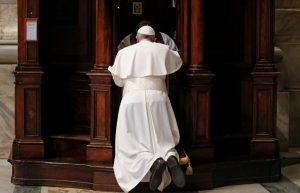
A clergyman hears confession from Pope Francis during a Lenten penance service March 9 in St. Peter’s Basilica at the Vatican. The service marked the start of the worldwide celebration of “24 Hours for the Lord,” a period when at least one church in every diocese was invited to be open all night — or at least for extended hours — for confession and eucharistic adoration. (CNS photo/Stefano Rellandini, Reuters) See POPE-LENTEN-PRAYER-SERVICE and POPE-CONFESSORS March 9, 2018.
The psalmist cites six times that the nation of Israel turned away from Yahweh: in Egypt, in the desert, in their camp, at Horeb, in their tents, at Baal-Peor, at Meribah, and in Canaan. Each of us might be able to easily make a list of the times we regret having strayed too far from the core of Christ which is in each of us. As we read through these beautiful stanzas laced with sorrow and joy, let us remember that God always saves. This much we know. We might do well to give thanks for this fact as often as we can each day because our God is a loving, powerful, saving God who delights in our returning home, no matter our confession.
And this much we also know, that with our words of contrition, we find a stirring of peace, and love and joy.
Say to those whose hearts are frightened: Be strong, fear not! Here is your God, he comes with vindication; with divine recompense he will save you.
Perhaps we do not use our imagination enough when we pray and plan with God. Perhaps our dreams of vindication and recompense and kingdom building are not bright enough.
From the writings of Katherine Drexel (MAGINIFCAT Meditation for March 3, 2010): I looked up in wonder at God’s wonderful ways and thought how little we imagine what may be the result of listening and acting on desire he puts in the heart. If he puts it into the heart, he will bless it, if we try to act upon it, and great will be the effect before God. It will be success before God even if it be not so to our weak understanding. For God means that which he breathes into the soul should bring forth fruit to eternal life.
Perhaps we do not give free rein to our hope when we petition God for the desires of our broken hearts. Perhaps we see our situation as a kind of purgatory rather than as a vineyard where we are workers in the kingdom.
Then will the lame leap like a stag, then the tongue of the dumb will sing. Streams burst forth in the desert, and rivers in the steppe.
Perhaps we do not share our faith enough with others, encouraging fellow pilgrims to remain steadfast and to persevere. Perhaps we see joy as something that other people experience but do not picture it in ourselves.
Katherine Drexel: These are the desire God has placed in your hearts and great will be the effort if you continue as you do, to nourish these desires and act upon them. He will fulfill your desires with good things far beyond your expectations.
Perhaps we do not act in love as we might, thinking that others do not need our concern or prayers. Perhaps we do not realize how great a price God has paid and continues to pay for us each day.
Those whom the Lord has ransomed will return and enter Zion singing, crowned with everlasting joy; they will meet with joy and gladness, sorrow and mourning will flee.
Perhaps we do not fully comprehend that we are remnant.
Perhaps we might begin today to sing in praise and joy.
Commentary tells us that the meaning of these two allegories has been lost but that scholars believe the two young cubs in the first refer to princes who were deported to Egypt and to Babylon (likely Jehoahaz and Zedekiah), and that the mother vine represents Judah. Ezekiel already knows that Jerusalem has been destroyed and perhaps he writes these two metaphors in order to convey the trauma of the event. We will never know; yet what we do know is this: Even though this prophet writes of a nation whose roots have been destroyed forever, yet he holds out hope for a new arising, for a rebirth, for restoration, for another coming. In 37:24-28 he tells us: My servant David shall be prince over them, and there shall be one shepherd for them all; they shall live by my statutes and carefully observe my decrees. They shall live on the land which I gave to my servant Jacob . . . I will make them a covenant of peace; it shall be an everlasting covenant with them, and I will multiply them, and put my sanctuary among them forever. My dwelling shall be with them; I will be their God, and they shall be my people.
If we choose, we might write our own allegory, describing how and why we elect to follow this God who promises much and who never forgets his promises.
God’s dwelling has been made among us, just as he has promised.
In this season in which we anticipate the coming joy of Advent, let us celebrate his coming.
The shoot from the stalk of Jesse has come to shepherd us.
In this season of hope as we gather in the fall harvest, let us rise to walk with this God.
A covenant of peace has been made with us.
In this season of coming peace of Advent, let us share the good news of this coming and this covenant.
God’s Law of Love is written on our foreheads and on our hearts.
In the coming season of Advent love, let us share this love with others – especially those who do us harm.
We have our God, and we are God’s people.
In the coming season of Advent possibility, let us dare to be one with this God.
And may Christ’s peace and joy and love be upon us all. Amen.
For notes on Ezekiel 19 click on the image above, or visit: http://www.lorisreflections.com/god-lessons/friday-revelation-lament-israel/
A Favorite from December 12, 2009. Adapted and re-posted today.
The Books of Wisdom call us to fidelity; they give us a reason to come together in outrageous hope; and they call us to love as God loves, with compassion, patience and understanding. This sapiential literature offers us the miracle and wonder of joy. If today’s exploration of the Book of Job calls you to search for more surprises, click on the word Joy in the categories cloud in the blog’s right hand sidebar and choose a reflection, or enter the word Joy in the blog search bar. You may also want to visit the Joy for the Journey blog atwww.joyforthee.blogspot.comto see how joy surprises you there. Today we find joy in times of turmoil, travail and turbulence.
If the story of Job is unfamiliar to us, we will want to spend time with notes and commentary. If the story is a familiar one, we will know where to look for the verses that bring hope to the hopeless and joy to the joyless. In either case, the verses offered below give us a door to the miracle of joy found in the tempest of life.
Verse 5:11:Yes, it is God who raises the humble and gives joy to all who mourn.
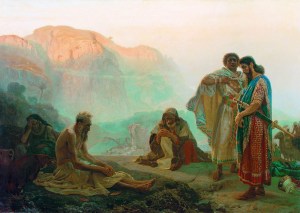
Ilya Yefimovich Repin: Job and His Friends
God says: My son Jesus tells you that I am always with the broken-hearted, the down-trodden, the oppressed and forsaken. He brings this promise to you daily. Jesus also shows you how humility and patience bring not woe but joy. Open the story of my servant Job and you will see how he persists in loving me even when he has nothing. Open your heart to the authority of Christ within you and you will experience joy in the stormy days of your life.
Verse 8:19:Yes, that’s all the joy evil people have; others now come and take their places.
God says: My Spirit cannot be contained or owned; yet she inhabits all there is and was and will be. The Spirit abides, consoles, heals and mends. The Spirit engenders joy even in the midst of the storm and the swirl of deceit. The Spirit fashions joy out of cruelty and dishonesty. The Spirit creates joy in the face of pride and haughtiness. Open your heart to the power of the Spirit within you and will find joy in the dark nights of your journey.
Verse 22:26:Then you will always trust in God and find that he is the source of your joy.
God says: I am the Alpha and the Omega. I am the beginning and the end. I am the source and summit. I am the impetus and the goal. I am. And I am within you. Open your heart to the power of my love within you and unleash the joy that conquers all evil. Open your heart to the miracles I create for you and discover the full power of my presence. Like my servant Job, you will experience joy in the most dire of circumstances and the most horrific of situations. Examine his story today and look for the dawn that always follows the deep darkness of overpowering storms.
Verse 38:7:In the dawn of the day of creation the stars sang together, and the heavenly beings shouted for joy.
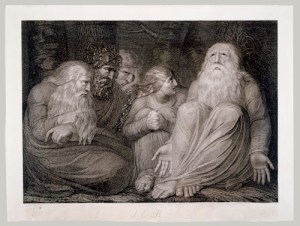
William Blake: Job’s Tormentors
Job suffers every kind of humiliation and pain at the hands of Satan; yet he survives and is fully restored as God’s wondrous creation. We too, are God’s creation and so today we ask for the gift of fidelity to God’s call, for the grace of God’s hope that brings us patience, and the presence of God’s love that is the miracle of joy we seek.
The Books of Maccabees unfold for us violence, rebellion, abhorrence and fear. We may be surprised to find that joy threads its way through these stories. As we examine the tales of theMaccabees family, let us consider how our own families are caught up in global and local affairs . . . and how miserable circumstances may well be hiding glimmers of joy . . . if we might only look. If today’s story calls you to search for more surprises, click on the word Joy in the categories cloud in the blog’s right hand sidebar and choose a reflection, or enter the word Joy in the blog search bar. You may also want to visit the Joy for the Journey blog atwww.joyforthee.blogspot.comto see how joy surprises you there. Today we find joy even when we suffer at the hands of the arrogant.
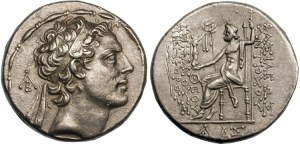
The effects of arrogance are far-reaching and long-lasting. Arrogance leads us into ourselves and a belief that we can resolve all conflicts and overcome all obstacles. Arrogance leads us away from God and a healthy understanding that ultimately, we cannot control all that touches and surrounds us. Arrogance is a wall the weak construct behind which to hide. Arrogance uses the tools of bullies, obfuscators and liars. Arrogance is not found in Christ himself, who showed us that humility and meekness before God lead us to truth, goodness and even immortality. Antiochus IV is one of history’s lessons on arrogance.
Verses 9:1-4: About this time Antiochus was retreating in disorder from Persia,where he had entered the city of Persepolis and had attempted to rob a temple and take control of the city.The people took up arms and attacked Antiochus, forcing his army to retreat in disgrace. He became furious and decided to make the Jews pay for the defeat he had suffered. So he ordered his chariot driver not to stop until they reached Jerusalem. With great arrogance he said, “I will turn Jerusalem into a graveyard full of Jews”. But he did not know that he was heading straight for God’s judgment.
Antiochus falls ill on his way to eradicate the Jews.
Verses 9:7-8: But this in no way caused him to give up his pride. Instead he became more arrogant than ever, and breathing out fiery threats against the Jews, he gave orders to drive even faster. As a result he fell out of his chariot with such a thud that it made every bone in his body ache.His arrogant pride made him think he had the superhuman strength to make ocean waves obey him and to weigh high mountains on a pair of scales. But suddenly he fell flat on the ground and had to be carried off on a stretcher.
At last Antiochus capitulates to forces he knows he cannot control, and he decides to ask forgiveness of the people of Jerusalem in a letter which he writes to them.
Verses 9:20-21: I hope that you and your families are in good health and that all goes well with you. My hope is in God,and I remember with a deep sense of joy the respect and kindness that you have shown me.
We might see our neighbors, friends, work colleagues, loved ones or even ourselves in Antiochus today. Let us pause to consider how we might break the misery of arrogance that lives in the world’s power centers; and let us call one another to a new humility and meekness that Jesus shows us. As we reflect on the conversion of this intense and complex man, let us look for the joy that lives somewhere deep inside the most entrenched and ugly faces of arrogance.
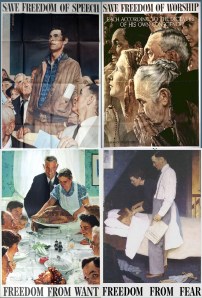
Soon in the United States we celebrate the feast of Thanksgiving for the many gifts God has shared with us. Freedom of speech, freedom of worship, freedom from want and freedom from fear are outlined ina speech by Franklin Delano Roosevelt,32nd President of the United States, in January of 1941, months before the U.S. entry into the global conflict that we now call World War II.
Norman Rockwell
In Galatians 5, Paul tells us that the great gift of Christ is freedom. As we reflect on the joy that enters our lives when we live in Christ’s freedom, we give thanks for the gift of freedom to experience joy even in the darkest of days and in the most punishing of circumstances.
“Freedom is what we have—Christ has set us free! Stand, then, as free people, and do not allow yourselves to become slaves again”. Galatians 5:1
If today’s Noontime calls you to search for more surprises, click on the word Joy in the categories cloud in the blog’s right hand sidebar and choose a reflection, or enter the word Joy in the blog search bar. You may also want to visit the Joy for the Journey blog at www.joyforthee.blogspot.com to see how joy surprises you there.





 The Noontimes