And the firmament shows forth the work of God’s hands.
Day unto day takes up the story
And night unto night makes know the message.
No speech, no word, no voice is heard
Yet their span extends through all the earth,
Their words to the utmost bounds of the world.
This spring we have reflected on the importance of preaching God’s Word with every small and great act in our lives. We have pondered the Lesson of the Fig Tree and the worth of even the smallest of sparrows. We have spent time examining our experience of Christ and we have compared the ideal with the real. Today we arrive at understanding that each day and each night are filled with God’s grace even when we cannot see or feel it. We have arrived at believing that just as the firmament extols God’s goodness . . . so must we. No speech is necessary. No word need be uttered. We have only to spend each waking moment doing God’s work. We have only to put our slumber into God’s trustworthy hands for it is in this way that we enter into God’s eternal goodness.
Is this what the Apostle John has seen and heard? Is this the goodness we seek? Is this the gift we have already been freely given?
Tomorrow, a prayer for our days and nights.
Visit the scripture link above and read the versions of this citation that have been pre-selected. Choose another version and ponder how the firmament speaks without words.
The short version ending to Mark’s Gospel might leave us looking for more . . . Then they went out and fled from the tomb, seized with trembling and bewilderment. They said nothing to anyone, for they were afraid . . . And they reported all the instructions briefly to Peter’s companions. Afterwards, Jesus himself, through them, sent forth from east to west the sacred imperishable proclamation of eternal salvation. Amen.
This quick end is simple and direct; yet it leaves us with a number of questions. What instructions were so quickly repeated? Why this hasty summation? Who exactly were Peter’s companions? What does it mean that others were sent forth by Jesus through them? We believe we know the substance of the sacred, imperishable statement of everlasting redemption, but might we not have a bit more detail?
Fortunately, we can turn to the longer story which describes more fully the resurrection, the commissioning of the eleven, and finally Jesus’ ascension; but what the shorter ending gives us a sense of immediacy, an understanding of the fear these disciples experienced, and the knowledge that something quite remarkable has been passed to us through centuries.
Spend some time today with the shorter ending of Mark’s Gospel and decide . . . do we need the details we long for . . . or might we trust God to fill in all the blanks? Is this merely a story to entertain or amaze us . . . or are we asked to do something more with the details we hope for? Is the fear the followers of Jesus experience an emotion we observe and document . . . or do we allow our own fear to affirm for us the importance of this singular, sacred Easter story of salvation?
This is my comfort in affliction, your promise that gives me life. Your laws become my songs wherever I make my home. Even at night I remember your name . . . This is my good fortune.
The meaning of this letter is complex but the meaning of this stanza is not.
God says: Do you hear my voice blending with yours when you raise your hands and voice to me? Do you trust that I will fulfill the promise I first planted in you? Do you know that I consider you my own? Do you know that you are my good fortune?
We so often see ourselves as separate from God when in truth we live in union with God. In this seventh lesson of Psalm 119 we learn that our trust in God overcomesthe arrogant who utterly scorn me,or the rage that seizes me. When we begin and end each day in God we find comfort in affliction,and God’s song of love in our hearts.
Praise be to the God and Father of our Lord Jesus Christ, the Father of compassion and the God of all comfort, who comforts us in all our troubles, so that we can comfort those in any trouble with the comfort we ourselves have received from God. (2 Corinthians 1: 3-4)
I am a sojourner in the land; do not hide your commands from me.
Traveling, wandering, seeking, searching, always on the move.
We look for signs and indicators. We ask for affirmation and assurance.
God says: You are always asking for clarity and this is fine but I also want you to trust me. I know that my prophet Jeremiah gives you words with which to rebuke me: “You duped me, O Lord, and I let myself be duped”. (Jeremiah 20:7) But I never trick you; rather, I call. I do not deceive you; I ask that you trust me. I do not steer you wrongly; although at times you fear that I do. I hide nothing from you and I love you more than you imagine. You want a map of all that is to come and all that is to take place but this information is not as useful as you might believe. Rather than ask me for details, dates, times and places . . . ask me to accompany you. This I do out of sheer love for you. There is nothing we cannot do together. Of this you may be assured. In this you may be affirmed. This you may trust. Rely on me always.
We too often allow our fear of life’s enormity to overshadow our reliance on God’s love. We take ourselves too seriously and believe ourselves omnipotent and all-knowing. As we journey through life we need none of the artificial safety nets we scramble to assemble. All we need is an ear well-tuned to God.
Today we reflect on the third lesson in Psalm 119. It is God’s simple invitation to cease our search for life’s roadmap and to instead trust God’s providence and care. Tomorrow, Daleth.
How long, Lord? Will you utterly forget me? (Psalm 13:1)
And God replies: I am here beside you where I have always been.
Save me, O God, for the waters have reached my neck. I have sunk into the mire of the deep, where there is no foothold. I have gone down to the watery depths; the flood overwhelms me.
Anyone who has stepped into murky waters at land’s edge will know the sensation of mud oozing between toes. It does not take much imagination to conjure up the feeling of water rising slowly to envelope us. Death by drowning overtakes the lungs, strangling any cry for help.
God says:The chaos and deception of the world have frightened you; but remember that I am always with you. The dragging darkness threatens you; but keep in mind that I guide and protect you. The feelings of loss and desperation weigh you down, robbing you of your natural buoyancy and positive outlook. Turn to me when the world sweeps over you. Rely on me when darkness becomes too heavy. Trust me when you are at your last ounce of energy and hope. When great distress paralyzes you and saps your very breath, allow me to breathe for you. I have plumbed the breadth and depths of the ocean; I know the boggy reed beds where you have lost your way. Lift your eyes and heart and hopes to me. And I will pull you out of your great distress.
We recognize that we too often rely on self rather than God. Let us determine today that it will be God’s name we call upon when shadowy depths bring us great distress.
Trust in the Lord with all your heart, on your own intelligence rely not; in all your ways be mindful of God, and God will make straight your paths. Be not wise in your own eyes, fear the Lord and turn away from evil; this will mean health for your flesh and vigor for your bones.
We need not over-simplify or over-complicate our relationship with God. The formula for eternal success is simple: trust God, rely on God’s wisdom, practice humility, avoid what we know to be wrong, and love God with all that we have and all that we are. This brings us peace and energy. This brings us health and a wealth that cannot be measured.
God says: I know that when you are frightened or weary or confused you want to rely solely on your own resources and yet even your greatest stores have limits. I am limitless. I know that when you are happy, relaxed and content you forget to invite me into your celebration and yet your joy is incomplete if you forget me. I want to accompany you in your sorrow; I want to join you in your delight. Trust in me. You need no other strength. Believe in me. You need no other god. My strength and serenity have unbounded depth and breadth and height. My love knows no bounds. Your body, heart, mind and soul will rest well when they rest in me.
In all ways we are to be mindful of God for what we now see as crooked we will then see as straight. In all ways we are to trust God for what we now experience as a labyrinth of sorrow we will come to know as the Kingdom of God. In all ways let us turn to God.
I gave you a land which you had not tilled and cities which you had not built, to dwell in; you have eaten of vineyards and olive groves which you did not plant.
We become accustomed to the daily blessings we receive from God and ask why God has not given us more.
God says: I see your daily going out and return and I cannot bear to be without you; and so I accompany you. I hear your prayers and petitions and I cannot bear to deny you; and so I give you all those gifts I know will enrich your life and strengthen your soul. I know your sorrow and your joy; and so I both grieve and celebrate with you. I give you Living Water to slack your thirst, vineyards and olive groves to strengthen your body. And grace you with my Spirit to console and heal you. I walk with you each day and never leave your side. Trust me to sustain you in your time of need. Include me in your festivals when you celebrate the goodness of life.
We curse the darkness and take the light for granted. We enjoy the comforts of a modern life and become impatient when they are withdrawn for a short time. We forget that God chooses to live with us and forget to live with God. As we search for the best way forward during the pandemic we share, let us remember God’s grace and gifts today and all days.
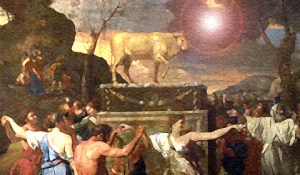
Nicolas Pouisson: The Adoration of the Golden Calf
Baruch, the prophet Jeremiah’s faithful secretary, paints a clear contrast for us between false, little gods and the one, true and living God; he leaves us with no doubt that pagan deities are nothing more than air while God is good and God is great. As useless as one’s broken tools are their gods, set up in their houses; their eyes are full of dust from those who enter. If we take time today we might discover where we have placed our little gods whom we tend to night and day. And we might also consider how and when and why we tend to our relationship with the Living God . . . and all that our God has done for us even during those times when we allow ourselves to be lured away.
They are wooden, gilded and silvered; they will later be known for frauds. To all peoples and to all kings it will be clear that they are not gods, but human handiwork; and that God’s work is not in them. Yet we slide into easy comfort as we worship fashions that ebb and flow, sports figures who bring home temporary trophies, and television or Hollywood personalities who sap our time and energy by drawing us in to their tragedies and triumphs.
Despite the gold that covers them for adornment, unless someone wipes away the corrosion, they do not shine; nor did they feel anything when they were molded.
The petty gods of our addictions, the small, little gods of our vain ambitions, the trivial gods of our toxic relationships hold sway over us as we tend to them more than we tend to the people in our lives.
If they fall to the ground the worshipers must raise them up. They neither move of themselves if one sets them upright, nor come upright if they fall; but one puts gifts beside them as beside the dead.
These tiny and silly gods must be cared for by those in the household or they wither and decay. They do not give life, they do not revive the dead, and they do not encourage the living.
How then can one not know that these are no-gods, which do not save themselves either from war or disaster?
Why do we allow these trifling and senseless gods into our lives? Why do we tend to these meaningless gods who must be served and cosseted? They do not save, they do not rescue, and they do not transform.
The Gospel reading on this First Sunday in the Lenten season retells the story of Satan’s attempt to lure Jesus to himself and way from God. We watch Jesus deftly manage the skilled arguments by resting in the knowing that God is all and that God alone is enough. Why can we not rest in this same knowledge?
Jesus is tired and hungry from his fast in the desert and Satan believes him an easy target, but in the end Jesus relies on God alone. Why cannot we rely on this one true source of life?
Even after Jesus dispatches Satan we read: When the devil had finished every temptation, departed from him for a time. We must keep watch against these little daily assaults. We must check in constantly with God who redeems and saves.
And so we pray . . .
Good and generous God, keep our hands away from our broken and useless tools and hold us in your own steady hands. Help us to see beneath the gilding and artifice to the emptiness inside our little gods. Guide us in seeing that our futile gods cause us too much work and too much anguish. Call us to see that you serve us more than we can ever serve you. Continue to keep us from the dark world of wars and disaster. And keep us always in your light. Amen.
Adapted from a post written on February 17, 2013.
The Book of Baruch was written during the Maccabean era and for this reason is not always included in all versions of the Bible and some versions, while they do contain the letter of Jeremiah’s secretary, do not include the last chapter. Click on the scripture link above to explore this marvelous closing to Baruch’s letter. For more on Baruch, visit: https://wol.jw.org/en/wol/d/r1/lp-e/2006604
 Trinity Sunday, May 30, 2021
![Zayin-sd_small[1]](https://thenoontimes.com/wp-content/uploads/2014/01/zayin-sd_small1.jpg)
![images[4]](https://thenoontimes.com/wp-content/uploads/2014/01/images4.jpg)
![Psalm-69-14[1]](https://thenoontimes.com/wp-content/uploads/2013/11/psalm-69-141.jpg?w=300)