I love this story of a joyful people who realize that they have been saved from the teeth of death. They fully know that their God loves them despite their collective and individual transgressions, and they also recognize that they have another opportunity to begin anew. We can all use this message from time to time.
The people in today’s story are still close to the bitterness of their exile experience and they have not allowed time to dim or re-write their reality. They have not yet given in to the temptation to morph memories into events which did not happen. They are still being honest with themselves.
St. Paul writes to the Colossians (3:12-14) and to us to remind us of how we are to live in our new life after our own exile and return. He tells us what we yearn to know: How are we to be when we come into God’s presence? How are we to wear Christ as a garment into a society which is focused on the things of the world? Paul says simply: Put on, then, as God’s chosen, heartfelt compassion, kindness, humility, gentleness, and patience, bearing with one another and forgiving one another, if one has a grievance against another; as the Lord has forgiven you, so must you also do. And over all these put on love, that is, the bond of perfection.
The people in today’s reading are chosen and loved by God. We today are also chosen and loved. We so often seek perfection in our actions and words. We try to avoid error in order to steer clear of pain. We return from our exile times and wonder how to begin again.
Today we read about a great shout of joy and weeping that goes up from the returned. We might want to add our own tears and voices to the chorus.
Written on September 25, 2009 and posted today as a Favorite.
This is one of the shortest psalms in the Bible – only 3 verses – and yet its message is one of the most important. We must trustGod. And if we truly do, we will have less anxiety, less fear, more hope, and more serenity. This is so simple, and yet so difficult.
Jesus demonstrates his own filial boldnesswhen he tells us, whatever you ask in prayer, believe that you receive it, and you will. (Mark 11:24) He abides by the Father just as the Father abides by him and he reminds us to knock, seek and ask. (Matthew 7:7-14)Jesus believes that the promises he has been given will be fulfilled – and they are, but not without suffering.
We need not look to Jesus for our only inspiration to trust. We also have the marvelous examples of the Roman centurion and the Canaanite woman. (Matthew 8:10 and 15:28) Jesus himself remarks on the depth of their faith, and we can see their persistence. The Catechism in paragraph 2613 reminds us to pray always without ceasing and with the patience of faith (my italics). And this many of us do, but perhaps we leave out one important step. A true prayer of faith is not only the words and the intent, but the true disposition of one’s heart to do the will of the Father. (My italics again) Jesus calls his disciples to bring into their prayer this concern for cooperating with the divine plan. (CCC 2611)
Why do we not trust God enough to let go of our little and big worries? Why do we doubt that God will do anything but what is good for us? God is goodness itself and truth itself, and so God is incapable of doing anything but the best for us. Perhaps we mull over conversations we have had with God which have not brought us precisely what we thought we deserved. Maybe be believe that we have a better plan in mind.
As I watch my life and that of others, as I observe the sun and the stars and the moon and the seas, as I watch a flock of birds lift in unison, or trees bend before the force of a hurricane, I am stunned by how little I trust. The simplest and greatest of God’s creation trust that all will be well better than I. Perhaps I do not humble myself enough. Perhaps I think I understand more than the birds or the planets or the flowers because I am a creature who has the power of reason and problem solving. If this is so, I must turn to this simplest of psalms which holds so much truth. And I must humble myself to believe that God has a far better plan for my life and the lives of those around me than I could ever devise.
Lord, I am not proud; nor are my eyes haughty. I do not busy myself with things that are too sublime for me. Rather, I have stilled my soul, hushed it like a weaned child. Like a weaned child on its mother’s lap, so is my soul within me. Israel, hope in the Lord, now and forever. Amen.
Written on October 5, 2008 and posted today as a Favorite.
Ferdinand Bol: David’s Dying Charge to SolomonToday’s reading is full of violence and intrigue – not unlike the political and social landscape in which we constantly find ourselves. People do not hide out much in the tent of the Lord these days, nor do they order heads to be severed from bodies in retribution; but we do indeed destroy reputations, we intimidate and threaten, we use ever kind of subtle and not so subtle violence to get what we want. We usually do this without counting the cost to others; and we also forget to measure the ultimate cost to ourselves.
In this forgetting of self and others, we show our forgetfulness of God.
David leaves a kingdom and a way of life to his son, Solomon because he knows how difficult it is to maintain fidelity and remain inGod. David also knows how much God loves his people and how willing God is to forgive us our faults. The aging father tries to pass along his understanding of “the measure” to his young son and when we read this entire story we see how much Solomon is able to retain; we find out how and if he prospers from his father’s final words.
Jesus makes the rules of his kingdom clear to us: The measure that you measure with is measured out to you. There is only one true commandment – love God and love one another, even as I have loved you.In this week’s scripture class we are asked to re-think the yardsticks we constantly use to make decisions about what we will say and what we will do. Do we show partiality to a special group of people or to a special idea? How do we perceive others? How do we perceive ourselves? How do our actions demonstrate our perception of God?
James calls us back to the realization that we do not see as God sees, and he reminds us that when we make judgments we so often are looking at the external and forgetting that Jesus lives in everyone we meet – even those people we do not like. James tells us in 2:1-13 that when we show deference to those with money and power, we neglect those who are poor in worldly treasures and those who are poor in spirit. We neglect those with whom Jesus chooses to reside, the physically, emotionally and spiritually marginalized. Jesus calls the poor and the broken-hearted to himself in order that he might heal them. These are the people for whom Jesus demonstrates compassion. And so ought we. Jesus calls the rich and powerful to an accounting. He is moved to rebuke them for their lack of regard for his poor and broken-hearted. And so ought we to be moved if we wish to bring about the kingdom.
Today we read of all the plotting and scheming that occur as the young King Solomon consolidates his kingdom. He lives in treacherous times. So do we. And so we pray . . .
Dear Lord,
It is so very difficult to trust in you alone. We so often forget that you are watching over us and accompanying us in our journey. The world seems so very scary and in our human survival reaction to our fears, we forget to rely on you alone. Help us to see as you see. Help us to look past the external. Help us to feel as you feel. Move us with your compassion. Grace us with the gift of your love. Help us to free ourselves by acting in humility, mercy and forgiveness. Help us to see that by freeing others we also free ourselves. And when we move to consolidate our forces from our feeble human weak places, remind us to come together with others in you. We ask this in Jesus’ name as we give ourselves over to the power of the Holy Spirit who lives and moves in us, and who calls us to unity.
Amen.
Adapted from a reflection written on January 30, 2010 and posted today as a Favorite.
Written on August 2, 2008 and posted today as a Favorite.
Footnotes tell us that much of this imagery can also be found in Ezekiel, where God is seen as surrounded by worshiping figures. All of these creatures and people are symbolic; and good footnotes or a good commentary are helpful when sorting and understanding all of these ideas. What makes so much sense to me is the idea that it is right and good to live a life in constant praise of God. I like this thought. It brings me comfort to know that the angels, saints and all creatures celebrate God in heaven just as we do here on earth. I think that being in God’s presence necessitates a willingness to worship, to praise, to thank and to petition. What will we do in heaven if we have not practiced coming together to be near to God? How can we expect to understand any heavenly rite if we do not accustom ourselves to ritual here on earth? Why would we think that we might get along with lambs who frolic among lions if we cannot live in harmony here on earth?
We have many earthly opportunities to demonstrate our willingness to be humble, to build bridges between ourselves and our enemies, to be peacemakers. Where do expect to stand when we arrive at the heavenly throne room? How do we expect to know how to behave? Why do we expect that in another place we will suddenly be able to love when we have not learned to do so here?
We have this idea so often that God is in his heaven while we are in the world. We have forgotten the lesson of this story, that the kingdom is now, the kingdom is here. We are every waking and sleeping moment in God’s presence. And how do we behave?
Today we might begin anew with our lessons for Heavenly Worship. We might begin anew in our lessons of Love and Unity.
When surprisesprings upon us we stagger a bit in wonderment and then we too often we move forward quickly, passing by the opportunity to reflect with God about how the surprise he has given us will continue to change our lives. It is these changes and surprises that tell us we can trust God. It is these changes and surprises that reveal God’s fidelity and care for us. It is these changes and surprises that bring us evidence of God’s deep and abiding love.
Today we spend time thinking about the new order. Zechariah predicts the newness that accompanies the Messiah. The Pharisees do not want to hear this news. From today’s Gospel reading from Luke: Some Pharisees came to Jesus and said, “Go away, leave this area because Herod wants to kill you.” He replied, “Go and tell that fox, ‘Behold, I cast out demons and I perform healings today and tomorrow, and on the third day I accomplish my purpose’.”
God brings order out of the chaotic universe. Jesus brings order out of the corrupt hierarchy when he tells us that we are priests in our own right, the adopted daughters and sons of the creator, no longer needing the intercession of priests in the temple. We are our own temple, Christ having destroyed the old and having become the new. We enter into that temple when we humble ourselves, take up our assignments, and follow.
To have a deep understand of the meaning in the Book of Zechariah it is best to read notes and commentary; but even at a quick glance we can feel the newness of these words. The Word is rain in the spring season. The Word brings about the falling away of deceitful dreams and empty comfort. The Word gathers up the sheep who wander searching for meaning and feeling in their lives that lasts and does not flicker and vanish with the slightest whisper of struggle. The Word strengthens us so that we might walk in his name.
Whoever strives to be made God’s dwelling place, should strive to make himself humble and peaceable, that he may be known to be God’s servant, not by his greed for talk and pliability of mien, but by the reality of his lowliness; for goodness of heart requires no false unction of talk. (Saint Columban, d. 615- MAGNIFICAT, Oct 30, 2008)
When I suddenly find myself swimming upstream against tremendous odds, I know that it is time to halt, to humble myself, to take stock and to listen so that I might hear The Word that never fails. When I find that I do not comprehend what is before me, I know that I have entered into a new time – an exciting time – when I am accompanied closely by Christ. Zechariah predicts his coming to the people, his coming to each of us. In all of our struggle and anticipation we might overlook the fact that he already walks among us.
The True Word is not false. It does not flatter. It does not waver. It does not manipulate. It frees. It speaks truth always. It produces good fruit in due season. The Word is the New Order. We have heard this story many times. Let us act as if we believe.
Let us not forget the surprising good news that the prophet Zechariah brings us.
Cameron, Peter John, Rev., ed. “Meditation of the Day.” MAGNIFICAT. 30 October 200. Print.
These three chapters are filled with sad yet beautiful images, and they follow closely on the heels of a conversation which I have just had with a close friend. The wicked appear to prosper – they have the immediate joys of this world – the faithful gain, through their suffering, the joy that is abiding and eternal. True happiness comes from knowing that the correct thing has been done, that justice has been enacted, the broken-hearted have been tended to, the weary have been comforted, the exiled welcomed home. True, deep and abiding happiness permeates the body, the soul, the mind and the heart when God is allowed to dwell within, when a welcome hearth and table have been laid for the guests, when the Spirit finds a resting place within us. True, deep and abiding happiness blooms when the soul finds its homing path to the Creator. True, deep and abiding happiness engenders serenity – even during conflict – when the ego is emptied of self and Christ steps in. When we celebrate the Feast of The Sacred Heart, we celebrate the groom who takes us to himself.
The verses from Jeremiah speak of complaint, corruption, a broken wine flask, disgrace, skirts stripped away, violation, sacrifices to no avail . . . yet this prophet asks, as we ought, in chapter 12: You would be in the right, O Lord, if I should dispute with you; even so, I must discuss this case with you. Why does the way of the wicked prosper, why live all the wicked in contentment?
He challenges further: How long must the earth mourn, the green of the whole countryside wither? For the wickedness of those who dwell in it, beasts and birds disappear because they say, “God does not see our ways.” If running against men has wearied you, how will you race against horses? And if in a land of peace you fall headlong, what will you do in the thickets of the Jordan?
He speaks of innocence defiled: Yet I, like a lamb led to slaughter, had not realized that they were hatching plots against me: “Let us destroy the tree in its vigor; let us cut him off from the land of the living so that his name will be spoken no more.”
Then the answer to this plaint finally arrives: Giveear, listen humbly, for the Lord speaks. Give glory to the Lord, your God, before it grows dark; before your feet stumble on darkening mountains; before the light you look for turns to darkness, changes into black clouds. If you do not listen to this in your pride, I will weep in secret many tears; my eyes will run with tears for the Lord’s flock, led away to exile.
Tears shed in mourning and petition rise to the Lord in a cloud of incense. Suffering offered as an act of redemption in unity with the Christ ends the wickedness. Our mourning becomes dancing with the indwelling of the Spirit. The economy of God’s plan must and will be fulfilled – in a kaleidoscope array of acts of kindness that counteracts acts of scandal. Division is transformed into union in a symphony of promise and fidelity as the Lord turns all hate to good.
Humanitarian aide in Haiti
There is no place, no thing, no person who heals as does the touch of Christ. There is no achievement, no award, no comfort as lasting as is the true knowledge of Christ. There is no separation, no sin, no evil that cannot be bridged by the covenant with Christ or undone by the strength of Christ. There is no miracle, no impossibility, no marvel that cannot be achieved by the courage of Christ. There is no harm, no sinner, no lost sheep that cannot be converted by the love of Christ.
Christ is the transforming bridegroom which Jeremiah promises in later chapters. This groom will write his vow of fidelity on our hearts. Let us open ourselves to this Lord. Let us open ourselves to this pledge. Let us open ourselves to this miracle of love in this place where the wicked no longer prosper.
A re-post from April 26, 2012.
A Favorite, written on May 30, 2008 and posted today. The Feast of the Sacred Heartis celebrated 19 days after Pentecost and in 2012 it falls on June 15.
Several days ago we reflected on the meaning of our public image in the Book of Daniel; today with Sirach we might spend time with how this compares to our private life. The Irish culture holds an image of a man who is a street angel but a house devil, pleasant and amiable – even lovable – to his neighbors while beating his wife and children behind closed doors. How many of us harbor devils inside that we do not show to the world? How do these devils slip into our lives without our knowing?
We are advised by Jesus ben Sirach to bring our public and private lives into line with our covenant promise with Yahweh.
In this book of wisdom, we are cautioned that we must be humble in our dealings with one another; we ought not seek out the high places at the table. We are warned to refrain from seeking work as a judge unless we have the strength to root out crime; otherwise we succumb to corruption and mar our integrity. We ought not flaunt our wisdom, our power, our wealth, our specialness in any way for our pride will be our undoing. This is how humility arrives.
We are also advised to steer clear of situations the catechism refers to as near occasions of sin:those times when we ourselves do not sin but come dangerously close to slipping over the precipice into evil. Standing by wordless as we watch malevolence occur without offering witness to injustice is not the way of the Lord. When we lack courage, we only need to look to God for strength. This is how fortitude arrives.
We ought to pray in earnest and not hurry through prayer as this leaves room for a false sense of independence from God. We humble ourselves appropriately when we come before the Lord and so we ought to enter into prayerfulness with deliberation and patience so that we might all the better hear the word of God. This is how wisdom arrives.
In private and in our family life, we need to continue to live with thoughtfulness, with intention. Treating servants well – or the people we meet in the mall, in the supermarket, in the gas station – leads us to treating all well. Honoring elders, respecting the living, remembering the dead. This is how piety arrives.
Refrain from bartering for friends. Mourn with those who mourn. Steer clear of those who do not. Visit the sick. This is how compassion arrives.
When we eliminate fear and pain from our lives by blocking them out and riding over these powerful emotions, we also eliminate important opportunities for learning the ways of God. We erase the opportunities for God to guide and protect us. When we petition God and thank him for bounty, we indicate our understanding that we are God’s creatures. This is how faith arrives.
When we balance our inner self with our outer self, we clear away the dark corners where housedevils might lurk. Integrity finds a comfortable dwelling place within, and chases away these devils to make room for angels. This is how hope arrives.
When we bring into focus our whole mind, our whole heart, our whole body and our whole soul to celebrate our union with God, we enter into his divinity. This is why the words of Jesus ben Sirach are so important to us today. With all your strength, love your Creator. This is how love arrives.
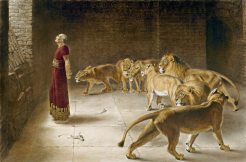
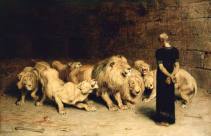
Anton Rivière: DanielNearly three years ago we looked at Chapter 6 of Daniel – the well-known story of the young man’s trial in the lion’s den. We reflected at that time on the vigor of Daniel’s enemies. Today we might want to spend time thinking about what brought Daniel out of the den: his – and God’s – constancy, his – and God’s – hope, his – and God’s – expectation of goodness.
Even when Daniel hears dreadful news he remains optimistic – because it is his custom to trust in God.
Even when Daniel is sent in the lion’s den he remains fearless – because it is custom to give all to God.
Even when Daniel spends the night with the animals that later attack and kill his enemies he remains hopeful – because it is his custom to expect that God will act for and in him.
Anton Rivière: Daniel in the Lion’s DenEven when Daniel exits the lion’s den unharmed he remains humble and hopeful – because it is custom to always expect great things from God, and to remember that God converts all harm to good.
From today’s MAGNIFICAT Meditation by Mother Elvira Petrozzi, founder of a community with a presence in fifteen countries that opens its arms to the lost and desperate: The biggest sickness in our world is sadness, indifference, and loneliness. Like parched land waiting for water, so the world is waiting for those who will proclaim hope. God has freely chosen us to proclaim this hope. He has given us the strength to follow him and has put in our hearts the desire to embrace this wounded humanity. In receiving mankind, the living hope in us must become love in gestures, in works, and in life. Jesus is telling us to give life, to give ourselves, not only a part of us or a few hours of work. If we do not give our life, spend our life for others, it will vanish from our hands. (107-108)
This is what Daniel knows: that the life he has is really God’s life in him.
This is what Daniel believes: that by giving his life on earth, he gains eternity with God.
This is what Daniel does: all that God asks – even when it does not seem to make sense.
Today’s Gospel is an accounting of one of the times Jesus cured a man of leprosy (Luke 5:12-16) and the mini-reflection in MAGNIFICAT speaks to the expectation this man had when he approached Jesus with these words: Lord, if you wish, you can make me clean. “When the leper approaches Christ filled with expectation, his entire life changes”. (102) How much better we might be if we approach our worries in this fullness of expectancy. How much better might the world be if we all were to approach our problems in an expectation of goodness, hopeful of kindness, joyful in our vindication by God.
And so we pray . . . Good, and gracious, and gentle, and hope-bearing God, you walk amidst us, sharing our sorrow, lifting our fears. Bring us to you in joyful expectation of your mercy. Bring us to you in the fullness of your time and your plan. Give us courage. Give us constancy. Give us perseverance. Give us hope. Give us the spirit of Daniel as he enters the lion’s den, as he lingers there, and as he comes forth into the light of a new day. Give us Daniel’s humility. Give us Daniel’s peace. We ask this in Jesus’ name. Amen.
Konstantin Flavitsky: Brothers Sell Joseph into Slavery
In Genesis 45:5-8 we hear the beautiful words of forgiveness which Joseph speaks to his brothers who colluded to exterminate him . . . do not be distressed, and do not reproach yourselves for having sold me here. It was really for the sake of saving lives that God sent me ahead of you . . . for you are a remnant on earth and to save your lives is an extraordinary deliverance. So it was not really you but God who had me come here . . .Joseph understands how God’s plan arrives at benefit for all through the suffering of some. He believes – because he has witnessed it in his own life – that God turns harm to good, envy to love. Today we reflect on his action of interceding with Pharaoh on behalf of his brothers who sold him into slavery. This is a message of willing obedience, open readiness, faith in goodness, hope in the outrageous, and love for the unlovable. It is a story of fidelity in its truest sense. Fidelity to God, to the remnant people, to self. Joseph lives up to his true potential, to God’s best hope for and in him.
I love this story of a joy-filled child who invokes envy in his siblings, of a handsome youth who innocently stirs lust in his mistress, of a young man who continues to believe in his God despite his apparent ill luck. I am moved by the willingness in which he lives. I am encouraged by the honesty with which he treats not only others but himself. I am inspired by the magnitude of his gestures, the purity of his thinking. Joseph carries no rancor. He is not bitter. He refuses to be discouraged. He rejects complicity and deception. He is cautious and prudent; yet giving and tender. Joseph is one of my favorite figures of Scripture. His story is a good one; and it is one to which we ought to refer when we find ourselves in endless turmoil or deep grief.
Joseph knows how to mourn. He knows that when he waits in God, goodness will follow on the heels of evil. He knows how to sacrifice in honest willingness.
Joseph knows how to keep his word. He knows how to abide in patient loving, just as God has abided with him. He knows how to wait for fruition and fulfillment.
Joseph Bourgeois: Joseph Recognized by his BrothersJoseph knows how to share. He knows with a keen understanding that his success is sweetest when given back to God. He knows that God is the source and summit of all that is good and that to hoard this goodness for himself is counter to the action of God’s mercy which he himself has experienced.
Joseph knows how to celebrate. He knows that he cannot take credit for the goodness he experiences. He knows that humility conquers pride and that littleness is greatness, for he sees this in the actions of God in his own life.
Joseph knows how to praise God. He knows that even when success finally arrives, he must continue to follow God’s lead. He knows that all that he has and all that he is belong to God alone.
Joseph waits, he witnesses, and then he acts out of his own salvation. He allows his own conversion in God to convert others, and so in this way he allows his willingness to save more than himself. He helps to save the very people who would have seen his destruction.
We might want to sit with the story of Joseph for a bit today to ponder our own willingness to enter into God’s plan, to examine our own willingness to intercede with Pharaoh for those who would have eliminated us, but who have begun their own conversion.
 I love this story of a joyful people who realize that they have been saved from the teeth of death. They fully know that their God loves them despite their collective and individual transgressions, and they also recognize that they have another opportunity to begin anew. We can all use this message from time to time.