Written on January 8 and posted today as a Favorite . . .
The house is to be rebuilt . . .
Habitat for Humanity Volunteers rebuild after a disaster in Nepal
We are so often exhausted by life’s demands that we cannot experience joy when we hear good news . . . the house is to be rebuilt.
In today’s Noontime, King Darius reiterates the original command given by King Cyrus . . . the house is to be rebuilt.Nehemiah, the administrator, and Ezra, the priest, set about restoring the city and temple in Jerusalem. They travel through dangerous territory and carry with them a letter of safe-passage from their former enemy. They arrive in Jerusalem to find a pile of rubble so dense that horses cannot find a pathway – they must pick their way on foot through toppled stone. They return from exile most likely drained of energy, but there is hope and even joy because . . . the house is to be rebuilt.
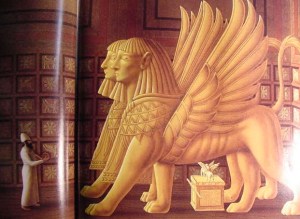
I am struck by the concordance of the instructions in the decree we read today with the original description of the temple that Solomon built which we read in 1 Kings 7. God does not forget his promise to the Jewish nation that . . . the house is to be rebuilt.
Nor does God forget all that God has promised us, his daughters and his sons. Just like the destroyed temple, we too will be rebuilt and in fact are being rebuilt each day. We are the temple in which the Spirit dwells, and as the cares of the world tear at its pillars and nibble at is foundation, Jesus becomes the master planner who constantly offers to help us reconstruct. His constant attention and love remind us that . . . the house is to be rebuilt.
I am thinking of Psalms 126 and 127. Those who go out weeping return singing . . . we labor in vain unless the Lord is the master builder of our house.
Whatever our flaws, whatever our sorrows, all will be converted to joy for we are promised that . . . the house is to be rebuilt.
Whatever our obstacles, whatever our fears, they become our stepping stones to serenity once we remember that . . . the house is to be rebuilt.
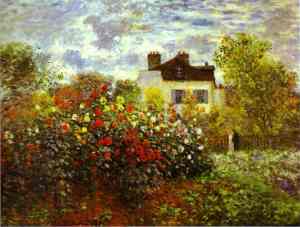
Monet: Monet’s Garden at ArgentueilJesus ben Sirach reminds us that life’s prime needs are water, bread, and clothing, a house, too, for decent privacy.This simple axiom can be so difficult to remember, especially in our competitive society which regards appearances as more important than substance. Be it little or be it much, be content with what you have, and pay no heed to him who would disparage your home . . .
Frugality has earned the unhappy reputation of stinginess; and yet in its purest sense frugality means prudence in the avoidance of waste. Each time we throw out food because we do not like leftovers, each time we buy a pair of shoes we really do not need, each time we hoard something away so that we will have it when others do not, we use something that someone else might have used better. This is an extravagance that the faithful cannot afford. It is an excessiveness that makes it impossible for us to find serenity. It is an injustice that works against kingdom-building.
When I become impatient with God’s timing – wanting results to arrive more rapidly, wishing events would move more swiftly – I am reminded by God’s pace and stamina that God is teaching us to practice prudence in the avoidance of waste.God is showing us a productive and generous kind of frugality; and in his infinite wisdom God knows that when we have something before we can fully appreciate it, we will likely waste the benefit.
Healthy contests that pit equals against one another are good for all of us, individually and collectively. Creativity, critical thinking, and industrious behavior are essential if society is to move ahead; but in all of the bustle of the marketplace we must keep in mind that in the end . . . life’s prime needs are water, bread, and clothing, a house, too . . . and that frugality is prudence in the avoidance of waste.
There are many ismsin our world: capitalism, communism, socialism, favoritism, entrepreneurialism, dominionism, fascism, patriotism, and on and on. Each of these attitudes has something to bring to a discussion – and the practice – of how we humans co-exist. Each has advantages and disadvantages, each has pitfalls and pluses. Some of these isms teach us stinginess; none will teach us frugality. None can bring us stability, dependability, or union with others we trust implicitly. None can bring us what we really seek – peacefulness, reliability, contentment with ourselves and the world.
And so we pray . . .
Generous and caring God, we need your constant guidance to remind us to share the essentials of life.
When we work over-long hours to the neglect of our family to finance an extravagant lifestyle, we have moved off the path that leads to serenity. Tell us to wrap up the work and go home.
When we hoard goods and refuse to share with those who have less than we, we have somehow been lured away from the light and into the darkness. Remind us that the world has enough resources for all if we share.
When we begin to think that five bathrooms and four vehicles are a necessity, we have slipped away from reality. Ask us to share the planet’s storehouse prudently.
When we have become stingy in the name of frugality, we have ceased listening to your voice. Call to us again in a way we cannot miss.
Life’s prime needs are water, bread, and clothing, a house, too. Let us share what we have prudently, let us avoid wasting the bounty your creation unfolds for us, and let us practice the same generosity you so lovingly pour out on us. Amen.
Gentileschi: Judith Beheading HolofernesWe have visited the story of Judith frequently this year and there is much to be learned from the narrative as she enacts sublime fidelity and heroic love. A favorite Noontime reflection on the Book of Judith may interest you. It is linked to the Favorites page above, or through the Pages tab in this blog.
Just yesterday we reflected on the concept of fasting. Today we see Judith set aside her sackcloth and ashes to break her mourning; she goes out to face the enemy, armed with her woman’s weapons of beauty and speech. Judith will save a nation – and she will do this by first seeking and then living inGod. She will receive God’s favor – and she will become the vehicle of a people’s salvation.
We notice that God is central in every decision Judith makes and in every act she performs. Judith is able to escape the enemy’s revenge by walking past the sentries with her maid – and with the head of Holofernes hidden in their food pouch – precisely because she and her companion have walked out each night to pray at the ravine of Bethulia. The guards are accustomed to seeing this regular ritual and so do not intercept the two women; they do not even search the food pouch. After bathing each evening, Judith seeks God’s help – and she receives it.
We watch Judith as she leaves the city of Bethulia – a city which has provided her people safety and is now threatened by the Assyrian enemy: Order the gate of the city opened for me, that I might go to carry out the business we discussed” . . . Judith and her maid went out . . .
When we are called to go out of our comfort zone we are frightened. We tell God that he has chosen the wrong emissary. We say that we are too consumed with all the many other tasks he has assigned to us. We find reasoning and excuses for not doing God’s will and yet, when we pray as Judith does, when we develop steadfastness as Judith has, when we trust God and take each step as it comes to us rather than worry about the distant future, we are able to rejoice – as Judith does – in the favor God bestows on her.
And so we pray . . .
Good and holy God, we are both fear-filled and awestruck at your power. We watch as Judith goes into the very heart of the enemy camp – for this is where you need her – and we worry that we will not be able to slay the enemy in your name as Judith does. We watch Holofernes and his soldiers set Judith in a place of honor – knowing that these acts come from lust – and we worry that we may not be as clever as Judith is. Give us the courage to remain faithful to you. Give us the endurance to wait on your plan. Give us the prudence and patience to allow you to unfold before us, through us, and in us so that we, like Judith, may rejoice in you. Amen.
Many religions and cults include the practice of fasting as a form of worship; and in most cases the act of abstaining from food, drink or activities is meant to indicate one’s belief in or attitude toward some higher power. In the case of Christians, fasting is prescribed on certain days in the liturgical calendar; the practice of denying one’s self food and drink is meant not as an outward sign or status but as an expression of interior penance. The Catholic catechism states the following: “Fasting: Refraining from food and drink as an expression of interior penance, in imitation of the fast of Jesus for forty days in the desert. Fasting is an ascetical practice recommended in Scripture and the writings of the Church Fathers; it is sometimes prescribed by a precept of the Church, especially during the liturgical season of Lent”. (“Glossary” 879) Prayer and almsgiving are other forms of this interior penance described in paragraph 1434 of the catechism.
None of this should be a surprise to those who are familiar with the prophecy of Isaiah in which we hear today that this, rather, is the fasting that I [the Lord] wish: releasing those bound unjustly, untying the thongs of the yoke; setting free the oppressed, breaking every yoke; sharing your bead with the hungry, sheltering the oppressed and the homeless; clothing the naked when you see them, and not turning your back on your own. These words are echoed beautifully in the Beatitudes spoken by Jesus in Matthew 5, yet we persist in thinking that the poor are without resources because they are lazy or ignorant, victims have somehow brought their circumstances upon themselves, and the hungry and homeless just have not planned their lives well. We continue to believe that refugees have gotten themselves in their sorry state; and immigrants need to “go back home.” It seems that many of us prefer to believe that life’s circumstances can be controlled yet there but for the grace of God are we.
I am wondering if we might feel better about ourselves as a society if once a month, we prepared casseroles of food and took them along with gently used clothing to shelters for women, children and men who find themselves in circumstances they do not deserve and have not asked for. Of course, we would want to do this without judging how or why some of us need such help from others. I am imagining how the world might be different if we stood up to corruption and the abuse of power. I am visualizing our communities if we were to come together in small or large groups to exert all our efforts to the improvement of life for all of us and not just some of us. I am thinking that we would be happy with the results and that we might even enjoy ourselves in the process.
There are worthy organizations that build homes for the marginalized and take on legal cases for victims who cannot afford decent advocacy; there are medical and legal professionals who quietly give of themselves in pro bono work for the disadvantaged. The least we can do is to support these groups with our own resources of time, treasure, talent and prayer. We always receive far more than we give once we find time in our busy lives to exert ourselves and to expend our energy in true kingdom-building.
The psalmist reminds us in Psalm 40:7-8: Sacrifice and offering you do not want; but ears open to obedience you gave me. Holocausts and sin-offeringsyou do not require; so I said, “Here I am . . .”
And so, we pray . . .
Here I am . . . to do your will, Lord . . . here I am.
Here I am . . . to answer your call, Lord . . . here I am.
Here I am . . . to do offer my gifts, Lord . . . here I am.
Here I am . . . to love your sheep, Lord . . . here I am. Amen.
A re-post from Friday, August 12, 2011.
“Glossary.” CATECHISM OF THE CATHOLIC CHURCH. 2nd ed. Vatican: Libreria Editice Vaticana, 2997. Print.
Because she was afraid, Sarah dissembled, saying, “I didn’t laugh”. But he said, “Yes you did.” It seems that when we are afraid, or even uncomfortable, we hide. Perhaps we want to protect ourselves from unwanted criticism at a time when we feel vulnerable. Society would benefit from our willingness to put aside fear in order to practice honesty. Our families would flourish if we might find a way to establish trust in order that we become less defensive. Our work and play communities would prosper if we were free of ridicule. Putting aside fear so that we might live a life of authenticity is what God asks us to do. We all fail at this constantly – and this is something that God knows well.
Fear has been with us since our genesis as humans; it is not an aberration that arises after eons of human evolution. Nor is it a modern phenomenon brought on by rapid change or sudden advances in technology. Fear must have been with the first humans who hunted and gathered food and sought shelter. Dissembling was likely a defense against isolation or separation from the tribe, a strategy for survival. Is it a tool we want to use today? Do we need to shave edges from truth? Do we need to shape the opinion of those around us? Are we willing to go to God and ask that we begin again – in total honesty – without dissembling?
It is good to remind ourselves that God is quick to pardon when we ask forgiveness, and that God has infinite mercy for us. We know that all God asks is our gratitude and our willingness to do as he asks. God constantly assures us that we are loved – and God asks for our love in return. We need not fear. We need not dissemble. And we need not nurture this dissembling in ourselves or others. When we are fearful, we know what we must do.
From today’s MAGNIFICAT Morning Prayer (Cameron 129-130)
Jonah 2:3: Out of my distress I called to the Lord, and he answered me.
Isaiah 43:12: Fear not, for I have redeemed you; I have called you by name: you are mine. When you pass through the water, I will be with you; in the rivers you shall not drown. When you walk through fire, you shall not be burned; the flames shall not consume you.
And so we pray . . .
When we feel fear begin to consume us, rather than dissemble and begin to weave a complicated web, we must call on God to bolster us in the truth.
When we are tempted to mislead others, rather than add to the illusion, we must ask God to help us to be honest and authentic.
When we come upon a rat’s nest of lies and deceit, rather than turn away with blank face and trembling heart, we must rely on God to help us witness to what we know to be truth.
Good and honest God, you have allowed us to choose if and how we are to follow you. Guide us to see through the clever tricks of the expert weavers of lies and lead us to be merciful with those who dissemble out of fear. Protect us as we mark a straight path to you with the signs of our little and big sufferings. Lead us out of the maze of confusing dissembled responses others give to us. Give us the courage to speak candidly, to act compassionately, and to love into goodness those who would harm us with their dissembling words. We ask this of you who has created us, you who has shown us the way of authenticity, and you who abides within us always. Amen.
Cameron, Peter John. “Prayer for the Morning.” MAGNIFICAT. 13.6 (2011): 129-130. Print.
Caravaggio’s JudithCommentary will tell us that Judith is an apt symbol for Israel in this story as she is a childless widow, a defenseless figure in society and one who is to be protected rather than stalked and raped. What we read today is Judith’sPrayer, and through it we have a view of Judith’s plan to act as God’s agent. In some way – she does not tell us exactly – Judith will use her words and her guile against the enemy. Many wonderful lessons come from this story and one of them is that despite any action she takes herself, Judith continues to see God as the author of all events. Judith’s ego does not claim success as her own other than her willingness to be God’s instrument. She further identifies God through a beautiful litany as theGod of the lowly, the helper of the oppressed, the supporter of the weak, the protector of the forsaken, and the savior of those without hope. If we ever wanted a description of God, Judith gives it to us with simplicity and power.
Judith is so faithful to God and knows God so well that after she calls upon the Lord she petitions this God of the humble who authors all events to allow her to act on God’s behalf – and to do so in a subtle and beguiling way. The entire story is well worth our reading and if you have time in these hot and hazy days of summer, sit with Judith for awhile. You will be rewarded.
Caravaggio: Judith Beheading HolofernesTHE CATHOLIC STUDY BIBLE tells us on page 520 that although we do not know the identity of the author of this story, and although we cannot determine the reasons for its origin, we do know that it was written to strengthen the faithful in the belief that God truly lives among them. “The book of Judith is a tract for difficult times; the reader, it was hoped, would take to heart the lesson that God was the Master of history, who could save Israel from her enemies. Note the parallel with the time of Exodus: as God had delivered his people by the hand of Moses, so he could deliver them by the hand of the pious widow Judith . . . Any attempt to read the book directly against the backdrop of Jewish history in relation to the empires of the ancient world is bound to fail. The story was written as a pious reflection on the meaning of the yearly Passover observance.” Clearly Judith’s story is one that we will want to read when we feel that we stand alone before an imposing enemy; it is one we will want to read when we have lost the feeling that God is with us. Perhaps as we read Judith’s prayer today, we will want to pray along with her . . .
All merciful and ever-tender God, take us up to cradle us away from danger. You care for the abandoned, the betrayed and the forsaken. Gather us up into your safety, bring us into your fold today and every day.
All good and ever-compassionate God, you shepherd the lowly, the meek and the humble. You defend the oppressed, the beaten, and the weak. You allow the oppressor to succumb to their own plots. Rescue us, heal us and restore us today and every day.
All loving and passionate God, you care for the vulnerable, the powerless and the marginalized. You bring goodness out of all that is wicked and evil. You turn harm back on its author. Cure us, mend us, and renew us today and every day.
Almighty and ever-powerful God, you know all things before they come to pass. You see and hear all things that are beyond our comprehension. You accomplish all things that are beyond our ability. Remain with us, protect us and guide us today and every day.
You who are the author of all events and lover of the lowly, hear our cry and come to our aid. Remain with us today and every day. Amen.
A re-post from August 8, 2011.
Senior, Donald, ed. THE CATHOLIC STUDY BIBLE. New York, Oxford University Press, 1990.520. Print.
The Gospel writers tell us that Jesus feeds thousands from a few fish and several loaves of bread; yet we store up food and goods against the fear that we will one day be without. Famine grips the horn of Africa and war zones while the people who live in these places of death wait on the generosity of others. And despite the abundance in which others live, these images stir some to sharing and others to hoarding. In either case, we fear that we will one day be without. Today’s Mass readings deal with the intense fear that seizes us when cataclysm strikes and we fear the worst. The homily we heard at Mass today was moving. Father reminded us that although we seek physical signs of God’s presence, we do not see the markers God constantly posts along the route of our journey. Fear has the effect of eliminating sight and reason.
In 1 Kings 19:9a-13a, Elijah hides in a cave, fearing that Queen Jezebel’s men will find him and execute him in the same way she has put to death other prophets. God calls to Elijah that it is time for him to come out of his hiding place. Go and stand on the mountain in the presence of the Lord, for the Lord is about to pass by. And Elijah hears the Lord not in the tumult of the storm or the crashing of the earthquake, but in the whisper of the gentle wind.
In Romans 9:1-5, Paul bears witness to God’s presence even though he suffers great anguish. Rather than succumb to fear, Paul continues to tell the good news story that Christ is risen and present. He persists in responding to God who first called him in the bolt of blinding light in Acts 9 when he says to him: Get up and go into the city, you will be told what you must do.Paul finds God in the blinding light.
In Matthew 14:22-23, the apostles become frightened during a storm that threatens to swamp their boat. Jesus walks toward them over the water and says: Take courage, it is I; do not be afraid.Peter gets out of the boat to walk toward Jesus but doubt overtakes him and he begins to sink. Immediately Jesus reaches to pull him to the water’s surface. Peter finds God in his willingness to risk the dangers of the storm-tossed waters.
God is constantly telling us that we need not be afraid . . . yet we cannot hear the voice for the cacophony of the world.
God is constantly showing us that God is with us . . . yet we cannot see God for the blinding confusion of the world.
God is constantly proving to us that God wants to heal and rescue us . . . yet we cannot feel God’s presence for the fears that we harbor.
Our daily experiences frighten us and so we ask God to give us a sign that God is present . . . forgetting that God already is. God feeds us daily.
We allow the details of living to stir up so much fear that we can no longer hear or see or touch the goodness and providence of God . . . and still God says to us: Take courage, it is I; do not be afraid.
Mother Teresa of CalcuttaWe fret over minutiae, we become anxious about events that are too overwhelming for us to handle, anxiety overtakes us . . . and still God says to us: My heart is moved with pity for you have been with me many days now and have come a long distance. Do not be afraid for I am always with you. I will sustain you. You are mine. There is nothing to fear.
Francisco Goya: Las pinturas negras“The anguish of death has rarely found expression in such touching images as those of the present psalm: prison, shipwreck, solitude, and darkness. The suppliant has experienced the depths of misfortune. Has God abandoned him? Despite the depths of the distress, the believer refuses to admit such a thing; he puts down all thought of rebellion within himself. For although no expressions of hopeful expectation (as in most psalms) are present and the last word speaks of darkness as ‘my closet friend,’ the psalmist firmly believes that the Lord is ‘the God of [his] salvation.
“This psalm illustrates the hazy ideas that the ancients harbored about life after death before they arrived at faith in the resurrection: in the netherworld (‘Sheol’), in the subterranean pit, the dead have no more communication with God; they are no more than dull shadows of themselves in the land of no recall. It is a prayer of a man who experiences the depths of human misery, a prayer of Israel at the edge of collapse, but also a prayer of everyone on the brink of hopelessness.” (“THE PSALMS, NEW CATHOLIC VERSION” 229)
It is suggested by some that this psalm may have been written by someone who at one time had taken an active part in liturgies but who is now isolated from the community by a disease such as leprosy that would exclude him from human contact. No matter the cause for separation, the plaint in this psalm is almost too difficult to read; and it is for this reason that it is so important. I have a friend who says: Everyone takes a turn, and by this she means that no matter life circumstances, each of us will suffer deeply at one time or another.
Several of my friends experience depression and the words of this psalm express their feeling aptly. A sense of being the shadow of whom we are meant to be, the feeling of intensely dark isolation, the state of deepest despair where there is not even a spark of hope – these are all conditions described by my friends. The psalmist here touches the unfathomable sensations of grief, sorrow, and despair that depression brings on and yet, in this psalm the suppliant continues to reach for God despite the fact that he cries out from a place that has no recall, no memory, and no expectation of anything other than misery. We might wonder how this petitioner is able to pray at all for we are left at the end of this psalm with nothing but silence. This is the world we want to avoid; yet it is the world in which many live. From Job 19:13-16: My brethren have withdrawn from me, and my friends are wholly estranged. My kinsfolk and companions neglect me, and my guests have forgotten me. Even my handmaids treat me as a stranger; I am an alien in their sight. I call my servant but he gives no answer, though in my speech I plead with him . . .
Platitudes offer nothing to those whose existence is so bleak that what they once knew as commonplace no longer exists; they are well beyond comprehension of well-meaning words such as, there is never a cross too heavy to bear, another door opens when one is shut, every cloud has a silver lining.When living in the murky depths we encounter today only real contact, genuine assurance, and honest encouragement will begin to penetrate this darkness; words and ideas do not serve.
And so as always, we pray . . .
For those who feel as though they drift in oblivion, for those for whom it is impossible to experience anything but pain, for those who are blinded and deafened by the darkness . . . we ask your intercession, Lord.
For those who cannot help themselves out of the abyss, for those who are the caregivers of the deeply depressed, for those who accompany loved ones in their journey of anguish . . . we ask you mercy, Lord.
For those who are convinced that there is no hope, for those who are incapable of experiencing joy, for those who cannot find you even with help . . . we ask you compassion, Lord.
Oh, loving and ever tender Lord, keep all of us, we pray, from the darkness of Sheol. Oh good and gentle Lord, do not let us slip into the land of no recall . . . for you are our only salvation. Amen.
THE PSALMS, NEW CATHOLIC VERSION. Saint Joseph Edition. New Jersey: Catholic Book Publishing Company, 2004. 229. Print.
Senior, Donald, ed. THE CATHOLIC STUDY BIBLE. New York, Oxford University Press, 1990.318. Print.
To learn more about the work and life of Francisco Goya, visit: https://www.theartstory.org/artist-goya-francisco.htm
We will need to look at notes in order to understand the references in today’s Noontimeand the following information is from THE CATHOLIC STUDY BIBLE. Ephraim(note verse 17) was the tribal area that remained in the northern kingdom of Israel after the Assyrian invasion. The woodand wand(note verse 12) refer to any carved idol or utensil used in the practice of divination. Ritual prostitutionpracticed in Canaanite shrines was introduced into sanctuaries dedicated to Yahweh (note verse 14). Gilgalhere (note verse 15) is in reference to a sanctuary in the north in Bethel where there was an association of cult prophets (2 Kings 2 and 4:38); it is not a reference to Gilgal in the south where Joshua sets up memorial standing stones (Joshua 4). Finally, the priestsare in for heavy criticism because they are seen as the ones who lead the people away from God as they set up a schism between genuine and cult prophets. All of this information helps to clarify the link between the prophet Hosea’s deep sorrow over his wife Gomer’s prostitution of herself and the descent of the nation of Israel into this same harlotry. Hosea sees the individual and collective return to idolatry as a seal of the fate of the nation and its people. They are all caught up in the coming whirlwind of disaster. (Senior 1112-1113)
The psalmist reminds us that: The idols of the nations are silver and gold, the work of human hands. They have mouths but speak not; they have ears but see not; they have ears but hear not; no breath is in their mouths. Those who make them will be like them, and so will all those who trust in them.(Psalm 135:15-18) If only we humans might remember that in the end these little gods cannot forgive us, save us, redeem us or love us as God does.
We have reflected during our Noontimesthat little gods creep into our lives without notice and it is in this way that we become unwitting collaborators in the creation of an illusion; today we look at how a nation of people who have been blessed by God turn away from God’s goodness. The children’s story of The Emperor’s New Clothes from the Hans Christian Anderson collection is an apt allegory not only for Hosea’s society but for our society today. We have only to determine if we number among the adults who have ceased to think for themselves or if we are the astonished child who announces: The emperor is naked! Like the child, Hosea cries out to the people of Israel. And like the child, our prophets of today cry out against the obtuse among us.
When we become frustrated with a herd mentality that drives idiotically toward the precipice or when we give up all hope that the small voice of truth might be heard above the clamor of a self-deceiving crowd, we must turn away from our little gods of anxiety and desperation and turn to God, for it is God who best understands what is to be disbelieved and dispossessed. And it is God who knows well how to convert the darkness of despair into the beauty of joy, for it is in the darkness that God plants the seeds of new life.
And so we pray . . . Good and forgiving God, remind us that we have only to be open to a newness that you will bring out of the ignorance and despair we witness today. Show us the newness born of the dark that is your compassionate healing and eternal transformation.Amen.
Senior, Donald, ed. THE CATHOLIC STUDY BIBLE. New York, Oxford University Press, 1990.1112-1113. Print.