From time to time we will post new pages to the A BOOK OF OUR LIFE tab above. These posts can be used as a way to better understand a particular Book in the Bible; and they can also be used as a challenge to each us to enact scripture in our own lives. We always hold before us the thought that . . . the only Bible some folks will read will be the book of our own lives.
Wishing you peace as we near the Lenten season, a time of deep reflection when we prepare to meet Christ in a life-changing way.
Wednesday, November 19, 2008 – Proverbs 16 – Plans of the Heart
Today is a day when we traditionally make resolutions or new plans for the future. For that reason we post as a Favorite this reflection written on November 19, 2008 . . .
Man may make plans in his heart, but what the tongue utters is from the Lord. All the ways of man may be pure in his own eyes, but it is the Lord who proves the spirit. Entrust your works to the Lord, and your plans will succeed. The Lord has made everything for his own ends, even the wicked for the evil day . . . In his mind a man plans his course, but the Lord directs his steps.
Humans have a fertile imagination; and weaving a story about ourselves is part of what we do as we form our self-concept. We are often anxious about the future: What am I to do? Where am I to go? What am I to say? How am I to act? We may worry about the past: Why was I so blind? How did I miss what they were saying? And all the time we worry . . . we are missing the blessed present . . . with its opportunity to open our hearts to God’s economy. The writer of Proverbs reminds us that the best plans are those guided by God. Trusting in divine providence is so very difficult . . . yet so essential to serene living.
Better a little with virtue, than a large income with injustice . . . How much better to acquire wisdom than gold! To acquire understanding is more desirable than silver . . . A patient man is better than a warrior, and he who rules his temper, than he who takes a city.
Wisdom is our best instructor. Living a life characterized by prudence and temperance is difficult in a society which values the supersize in everything. It is easy to overdo: too much food, too much drink, too much money spent on heat or air conditioning, too much television, too many movies, too many books, too many people making claims on our time, too much aloneness, too much neglect, too much fuss. Is there such a thing as too much justice? Too much hope? Too much faith or hope? Too much love? Finding moderation and balance is a challenge; but our model is the Christ, who interchanged periods of heavy activity with times of prayer and retreat . . . leaving his sacred heart open to God’s plan.
By kindness and piety guilt is expiated, and by fear [love] of the Lord man avoids evil.
It is never too late to be open to a conversion of the heart. There is always time to enter through the narrow gate, to step onto the narrow road, to sow peace rather than discord. It is never too late to open the door and windows of the mind . . . to allow the master planner to enter the heart . . . to move us through our days . . . to guide us in our thoughts . . . to thaw our stiffened necks . . . to melt our hardened hearts.
Let us vow today to open ourselves . . . to the mind of God . . . that we might receive our plans from his own sacred heart.
Saturday, December 24, 2011 – Ezekiel 4 – Inevitability
Michelangelo: EzekielThere is a certain inevitability about Ezekiel’s prophecy. He is certain that his predictions will come to pass. From our place in history centuries later, we can easily see that what seemed impossible for Judah and Jerusalem does indeed take place. Their fortified city is besieged and destroyed; their powerful and comfortable leaders are killed or deported. Why did anyone doubt Ezekiel and the other prophets? They reported what they saw in the present and what they saw to come. They were accurate, so why did anyone have reservation about their words? Most likely it was because the naysayers had too much invested in the corrupt system. We might learn a lesson from all of this.
There is a certain inevitability about Jesus’ story. He comes to tell us that he is Emmanuel – God Among Us. From our place in human history we can read about the miracles he performed. We can also number the times that impossibilities take place in our own lives. Jesus tells us that he will be destroyed and yet rise again in new life. He tells us that he has come to take us with him on this amazing journey as his well-loved sisters and brothers. Jesus tells us what the Creator has asked him to report to us: that we are free, liberated from anything that holds us to the material world in which we live. This freedom includes freedom from anxiety and stress. Why do we cling to our old and familiar discomfort when there is a newness offered to us without cost? Why do we behave as those who heard but ignored Ezekiel’s words? Do we doubt what Jesus has told us? What are the reservations we have about his words or his actions? On this eve when we celebrate his coming into the world as a vulnerable baby, why do we continue to ask for additional proofs and for further assurance that he will complete his promise to bring us to the new life he experiences? Why do we hang on to our fears and reject the possibility of joy?
Gerard Van Honthurst: The NativitySo on this Christmas Eve, as we await midnight in order to join in praise of God’s goodness to us, we have this to ponder about our own acceptance of what we have heard and what we have seen. What is it about Jesus’ story we do not believe? What are the further proofs we demand before we accept the prophecy of his coming as true? Who has lured us away from the one true story of redemption and the promise it holds for all? How have we become like those who hear but so not listen? When will we tire of hiding behind subterfuge, of supporting corrupt systems and people? Why do we persist in being as blind as the inhabitants of Jerusalem to whom Ezekiel spoke?
Let us reflect on God’s gift of inevitability as we pray . . .
Tomorrow is the feast of Christ’s birth . . . the feast of the birth of newness in each of us.
Tomorrow is the celebration of a new-found freedom . . . the celebration of our release from fear and anxiety.
Tomorrow is the commemoration of the arrival of hope and God’s promise . . . the commemoration of God’s coming to dwell among us.
God’s love is inevitable. Let us cease our resistance. Let us rejoice in this good news and be glad. Amen.
Friday, December 23, 2011 – Matthew 12 – Confronting Evil
The PhariseesThe Pharisees in today’s reading ask for a sign that Jesus’ healings are from God; Jesus replies that they have the sign of Jonah. We spent time with the Jonah story on December 20 and 21 and perhaps we better understand that the three days spent in the belly of the whale are an opportunity for conversion, the chance to thank God for the goodness we have received. Today we have the possibility of understanding the deeper meaning in Jesus’ words and actions, of more fully understanding that we have nothing to fear, of better understanding that our persecutors cannot touch what really matters – our souls. And we more fully see that God himself has overcome the evil of the world.
The Pharisees try to trip Jesus up by challenging him on the details of the cumbersome Mosaic Law. When they realize that Jesus is too clever – and too grounded in God – to be caught in a trap of their design, they challenge his very authority. This is the beginning of their undoing.
How does Jesus defend himself and what lesson can we take from his actions? Jesus does not waste words of explication but instead asks questions. What did David do? What do the Pharisees themselves do? We might follow this tactic and practice asking questions rather falling into the trap of arguing when we confront evil.
How does Jesus reveal the fallacies in false charges? Rather than point out the hardness in the Pharisees’ hearts, Jesus describes what happens when people work against one another in a greedy struggle for control. Again he asks questions. By whom do your own people drive out demons? How will a kingdom stand when it is divided against itself? We might follow this strategy and develop our own skills of looking for the truth rather than focusing on proving others wrong.
Jesus calls to his listeners using an image of trees bearing good fruit. Jesus teaches with his healing acts and leads by turning to God and allowing the Spirit to work through him. The crowds of people know where the evil lies . . . and it is not in the man who heals them even on the holiest day of the week; instead it lies in corrupt leadership, it lies in the collaborators who encourage the corruption to flourish, and it lies in the hearts on anyone who would rather sacrifice the kingdom in order to build a personal power base. We have so much to learn from Jesus.
Tissot: The Pharisees Confronting Jesus
Teacher, we wish to see a sign from you . . . Are we members of this crowd?
An evil and ungrateful generation seeks a sign, but no sign will be given it except for the sign of the prophet Jonah . . . Do we understand Jesus’ wordsthat resurrection follows days of uncertainty and pain in the belly of the whale?
When we see evil we know that we must confront it but we must do so wisely – as Jesus does – lest we empty our house of several small demons only to let in the monster Beelzebub to take up permanent residence in our hearts. Let us take a lesson from the master and decide that rather than argue with the devil, we will ask questions instead. Rather than point fallacies and errors to those around us, we will empty ourselves of our well-honed arguments and allow the Spirit to speak instead. And rather than throw ourselves against barricaded corruption and power in high places, we will turn to the God who knows and sees all, and give thanks to the God of all creation. In this way we bear fruit for the kingdom . . . and we ask God to confront evil.
Tomorrow is Christmas Eve, the day when all creation gathers in anticipation of the One who fulfills God’s promise to us. So let us prepare to receive this most wonderful, most impossible, most loving gift.
Thursday, December 22, 2011 – Matthew 11 – An Evil Generation
El Greco: Jesus Healing the Blind
The New American Bible designates this portion of Matthew’s Gospel: Opposition from Israel. Today and tomorrow we will examine Chapters 11 and 12 to discover more fully Jesus’ role in Israel. We will prepare more deeply for the arrival of the Spirit that brings joy and hope into our own lives and hearts. And we will understand more intensely what it means to totally and unconditionally depend on God for all.
As Chapter 11 opens, messengers arrive with word from Jesus’ cousin John to ask if what they have heard is true. Are you the one who has come or shall we look for another? We also want to know the answer to this question. Is it true that someone will take away our pain? Will we really begin to see an end to all the struggling between us? Can we at last relax and not worry so much about all we have to do? Is it true that someone will finally begin to right wrongs and deliver justice for those who suffer at the hands of the wicked? Jesus answers John’s messengers and he answers us as well.
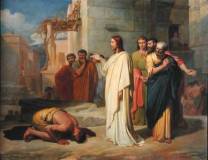
Jean-Marie Melchior Doze: Jesus Healing the Leper
Go and tell John what you hear and see: the blind regain their sight, the lame walk, lepers are cleansed, the deaf hear, the dead are raised, and the poor have the good news proclaimed to them. And we wonder . . . Is it true that the baby born in a few short days does all of this for us? We watch and take in the news. We work with others and we see how conditions might be improved. We interact with family and friends and hope for the best; yet we see too well the dark side of our reality.
Poor leaders and insincere co-workers use fear and guilt and manipulation to achieve their own goals. If we read Matthew 11 and 12 carefully we understand that a kind word and a committed heart call more people to a cause than force and coercion. Jesus confronts this evil generation and calls us as he called to the unrepentant towns: If the mighty deeds had been done in Sodom, it would have remained to this day.
Corrupt family and friends use subterfuge, dishonesty and tricks to force others into committing to their point of view. If we to read Matthew 11 and12 mindfully we see that honesty and courtesy invite more people to commitment than passive aggression and duplicity. Jesus challenges this evil generation and urges them as he urges us: Whoever has ears ought to hear.
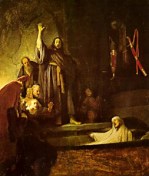
Rembrandt: The Raising of LazarusDeceitful loved ones use betrayal, secrecy and projection of their own problems onto others because they cannot or do not want to grow. If we read Matthew 11 and 12 intentionally we comprehend that openness and love bring more people to union than threats and lines drawn in the sand. Jesus speaks to this evil generation and assures them as he assures us: My yoke is easy, and my burden light.
As Jesus moves about Israel healing, preaching and converting, the power structure feels its own influence dwindling . . . and those invested in the status quo begin to panic. They oppose Jesus at every turning and we watch to see how Jesus will meet this opposition.
Jesus the Healer knows that words mean little while actions mean all. Jesus the Interceder knows that corruption runs deep and is not easily unseated. Jesus the Cornerstone knows that we are like children playing games who sit in the marketplace calling out to one another. Jesus the Redeemer knows that we are in need of his help and that God is the only one who can fully confront this evil generation. Jesus, the Son of Man, knows that his authority and strength are in God alone.
Tomorrow we take a look at how Jesus confronts those who challenge him. Today let us depend on God as Jesus does, and let us we pray as Jesus prays.
I give praise to you, Father, Lord of heaven and earth, for although you have hidden these things from the wise and the learned you have revealed them to the childlike. Yes, Father, such has been your gracious will. Amen.
Wednesday, December 21, 2011 – Jonah 2 – A Prayer from the Belly of the Whale
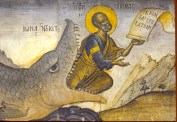
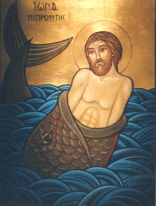
JonahYesterday we reflected on this short but crucial portion of Jonah’s story; why does he offer a prayer of thanksgiving when he finds himself devoured by a whale? Read the December 20 Noontime and then join Jonah in his prayer . . .
Out of our distress we cry to you . . . the waters swirl about us, threatening our lives . . . the abyss envelops us . . . the soul faints within and we remember the Lord.
As we near the coming holiday we have much to accomplish. Some of our chores we do gladly; others weigh heavily on us. Good and wise God, help us to sort out the trivial from the real as we struggle to balance work and play.
As we approach the festival of joy we continue to be haunted by old angers and anxieties; we might relish this turmoil or we may want to cast it off. Good and patient God, lead us to the understanding that what looks like death is life, what seems to be the end is a new beginning.
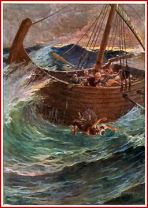
Carlo Antonio Tavella: Jonah and the WhaleAs we move toward the celebration of hope we have sorrows and fears; we may be managing to stay afloat in this sea of turmoil or we may be sinking into its cold depths. Good and compassionate God, remind us that living for a time in the belly of the whale means that in the end . . . we have the opportunity to draw ever closer to you.
Our prayer reaches God . . . we give God resounding praise . . . we are delivered by the hands of the Lord.
Tuesday, December 20, 2011 – Jonah 2 – In the Belly of the Whale
When the Pharisees and teachers of the law challenge Jesus in Matthew 12 and Luke 11 about his authority and ask him for a sign, Jesus points out the wickedness of this demanding approach to miracles, and he says that the only sign they will receive is the sign of Jonah. Today we look at an interesting point in the story of the man who lived in the belly of a whale for three days to be delivered in order to do God’s work. Commentary tells us that Jesus refers to his own three days between death and life that he will experience in order to save the world. Further commentary tells us why the psalm we read today is so important to us.
The story of the great fish is miraculous only in the sense that God supernaturally provided a whale to swallow Jonah. There are three critical issues here:
The great fish may indeed have been a large whale, which would not normally have been found in the eastern Mediterranean, but the provision of the whale so far from its usual habitat is the miraculous part of the account.
The word for “belly” . . . in Hebrew is imprecise and does not necessarily mean “stomach”. Jonah may have been in the oral cavity of a large-mouthed whale.
A whale, being a mammal, is a warm-blooded air breather that periodically resurfaces for air. It therefore would have provided Jonah with oxygen, while its body heat would have prevented hypothermia.
Jonah’s psalm (ch.2) makes no sense in context. The prophet is depicted praising God for his salvation while still inside the fish . . . The psalm is intelligible if we reconstruct events as follows: (1) Jonah, cast overboard during a storm and unable to swim, sank immediately (2:6). (2) A whale scooped him up and carried him to the surface, allowing him to breathe. (3) When the whale kept Jonah near the surface, the prophet recognized God’s provision and was able to praise him. (Zondervan 1474)
JonahWhen placed in this context, the story of Jonah has special importance for us as we traverse the last days of Advent.
Jonah is called by God to do something he does not want to do and so he flees. Jonah ran away from the Lord and headed for Tarshish. (Jonah 1:3) We may also want to reject a task God has laid out for us.
Once on board, Jonah admits to the sailors that he has indeed fled the Lord. They try to save him but the storm is too great for them and Jonah volunteers to go overboard. But the Lord provided a great fish to swallow Jonah. (Jonah 1:17)
On dry land, Jonah goes to Nineveh to do as the Lord has asked. When the people have a change of heart and heed the prophecy Jonah delivers, the Lord has compassion on them for turning from their evil ways. (Jonah 3:10)
The dialog between Jonah and Yahweh continues in chapter 4 where we see a push-pull relationship between the two. The conversion in Nineveh greatly displeased Jonah and he became angry; (Jonah 4:1) still, God abides with his servant and continues to present to him his own pathway for conversion. God continues to provide a journey away from anger toward compassion. God might be speaking to us when he says to Jonah: Do you have a right to be angry?
Jonah runs from the Lord and finds that he has come up against an obstacle too large to overcome. Leaping into the raging storm he expects death . . . and yet he is saved.
Monday, December 19, 2011 – Numbers 9:15-23 – God’s Presence in the Desert
Yesterday we reflected on the image of the fiery cloud, the pillar of smoke and flame that both guides and protects the Hebrews. Today we remain for a while in this image as we begin our final desert crossing to Christmas. Many of us have too much to do in the days that run up to December 25th. We must be wary of placing all our energy in the physical preparations for the coming holiday because we will need much more than food, water, and a sturdy tent to cross through the desert of consumerism; we will need patience and forbearance, to navigate shopping malls, food stores and traffic. And we will need forgiveness and compassion to plot a successful course through tricky family dynamics, demanding colleagues, and the needs of friends and strangers. We will want to fill our internal stores with heavy doses of God’s Word, God’s voice . . . and God’s presence.
So much of life seems to be a desert existence, a constant struggle againstunseen but powerful forces that appear to control all we do and much of what we think. In dark days we struggle against headwinds that deliver blasts of driven sand; we hunker down in our tents to secure ourselves against the onslaught. When we must move from place to place, we barely survive the trek from one oasis to the next. There are timesof happiness in which we experience joy; yet with those times there is often a sense of impending doom; somewhere inside us is a haunting that tells us to enjoy our contentment while it lasts because darkness stalks us on each leg of our journey. The desert crossing is one we do not want to experience alone. We know that we will need both stamina and provisions yet where do we find the surety and comfort that will see us through? There is only one presence that provides all for the body, mind and soul . . . the presence of God.
Gobi Desert OasisIt is the fool who prepares carelessly for the wilderness journey; a wise woman or man goes first in search of God. The fool stores up supplies and necessities; the wise one makes plans and trusts in the Lord. The fool believes that security and comfort can be purchased; the wise one knows that happiness and eternal safety lie in doing what is just. The fool relies on personal strength and durability; the wise one perseveres in seeking God, knowing that everything we need for the journey is found in one place . . . only in the presence of God.
The fiery cloud we reflect on today is a pre-figuration of the Holy Spirit whom Jesus sends after his Ascension to the Father as tongues of fire that produce speech that all can understand. (Acts 2) Just as Jesus and Scripture are the Word of God, The Holy Spirit is the Breath of God, and for that reason this advocate has inspired the writing of scripture. The symbols of the Holy Spirit are: water, the oil and the seal of anointing, fire, the hand/finger of Jesus who heals, the dove which finds the olive branch after the flood along with the dove which descends at Jesus’ baptism, and the image of cloud and light. This cloud that accompanies the Hebrews, descends when Solomon builds the Temple in Jerusalem and also at Jesus’ Transfiguration. This Spirit surrounds Jesus at his Ascension. This Spirit lives with us today to accompany us on our desert wanderings. This Spirit is the presence of God.
I have always liked this image. It is, as we have said before in our Noontime reflections, not a place of destruction but a place of sure refuge, a place of certain peace. It is something we can step into when we find we have a very difficult and frightening task to complete. It is a fiery pillar of refinement that draws us toward and not away from God. It is a blazing column of smoke and ash that scours off the excess of life to leave behind the pure gold of God’s presence. It is the only sure guide and protector that will guarantee us safe passage through the searing experience of the desert.