Worker’s tools used in the restoration of the wall at the Damascus Gate in the Old City of JerusalemWe have reflected on surprise. We have reflected on The New Orderof the Word who is Alpha and Omega – beginning and end. Today we read about Restoration. . . the return from exile . . . the state we all seek.
I love reading this book by the prophet who left his work as a shepherd in Judah to denounce the empty wealth of the northern tribes. His words rankled the power structure and so he was expelled from Bethel. . . to return to his pastoral work. He brought a message of destruction . . . but a destruction which carries within the promise of restoration for the faithful. This may be a surprise to many. It is certainly the message of The Word. It is The New Order of things. It is Restoration of the Remnant. Do we have the fortitude, the perseverance, the hope, the love . . . to be remnant?
When our own fallen hut is raised up . . . do we recognize the voice of the shepherd enough to follow it?
When the breaches have been healed . . . do we allow our wounds to cure so that we might hear the new words of the shepherd?
When the plowman and the vintner overtake the reaper and the sower . . . will we know the way to the celebration with the shepherd?
When the ruined cities are rebuilt . . . will we recognize our new homes?
When we arrive to drink the new wine and eat the new fruits . . . will we possess the white garment to wear at the marriage feast? Will we recognize Christ as the groom . . . and ourselves as the Bride?
Written on October 31, 2008 and posted today as a Favorite.
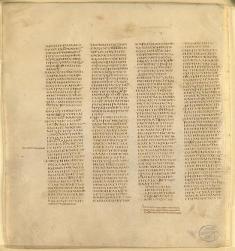
A page from The Book of Jeremiah: St. Catherine Monastery Bible, Egypt
We have spent a good deal of time lately thinking about exile and captivity. Here is a Favorite from August 12, 2007 which we post it today as a letter to all those in captivity of any kind. It is a reminder that God is constantly sending us love letters . . . we must be willing to open them.
Many believe that our existence here on earth is a Babylon.
We love God, we worship him, we are in a covenant relationship with him, yet we are brought here to live a life physically apart from God, a life which does its best to distract us from God and from the promises we have made to him and him to us. If we are so loved, why does God not snatch us up immediately and take us to him? Because he created us to be like him, and we are given the choice to try to behave as he does or to go off on our own. This Babylon is our classroom, and we are to bloom where we have been planted. How do we know this? God has written us a letter, through Jeremiah, to tell us so.
Look at verses 5 through 7: Build houses to dwell in; plant gardens and eat their fruits. Take wives and beget sons and daughters; find wives for your sons and give your daughters husbands, so that they may bear sons and daughters. There you must increase in number, not decrease. Promote the welfare of the city to which I have exiled you; pray for it to the Lord, for upon its welfare depends your own.
And my favorite in this chapter is verse 11: For I know well the plans I have in mind for you, says the Lord, plans for your welfare, not for woe! Plans to give you a future full of hope.
But continue with verses 12 to 15: When you call me, when you go to pray to me, I will listen to you. When you look for me, you will find me. Yes, when you seek me with all your heart, you will find me with you, says the Lord, and I will change your lot; I will gather you together from all the nations and all the places to which I have banished you, says the Lord, and bring you back to the place from which I have exiled you.
I remind myself of another Jeremiah citation by which I live: 42:10-22. When I am most thinking that I need to pull up stakes and move off to begin a whole new life, I remember the words that the Lord God spoke to the remnant: If you remain quietly in this land I will build you up, and not tear you down; I will plant you, not uproot you; for I regret the evil I have done you . . . If you are determined to go to Egypt [another place – to make a new beginning]; the hunger you dread shall cling to you no less in Egypt, and there you shall die.
And so we pray: Compassionate God, remind me daily that “this vale of tears” is only a pathway to you. As I build my house and settle into this land, remain near. As I promote the welfare of my exile city, be my hands and feet. My only wish is that you increase and not decrease. Abide with me, your remnant. Hold me ever close to you. Amen.
A re-post from the Third Sunday of Easter, April 22, 2012
Eastertide is the traditional time in the liturgical year when we rejoice that we are loved and rescued by God, that we are redeemed and saved by Jesus, that we are consoled and nurtured by the Holy Spirit. We celebrate our new life; we give thanks that we are not forgotten. Our Noontime Easter journey has taken us, however, in a different direction: we have re-visited the Tales of the Diaspora; we have gone into exile and remained remnant; and we have heard the news that even when we feel abandoned and defeated. We hear that especially at these times God abides with us in our sorrow and pain. Rather than be downcast when we are held captive, we have every reason to experience Easter joy because we know that Christ’s love for us pierces the darkness of addiction and obsession.
Babylon appears to be the winner as she conquers little Israel; but as always we see that God abides with the little and the oppressed, the sorrowing and the broken-hearted. We have been swept away into captivity and exile; but God has remained with us. The tiny remnant becomes the messenger of good news. The rejected lover becomes the cornerstone of the new kingdom. Let us join our voices with Jeremiah’s as we watch mighty Babylon fall . . . as we come to understand that God resides with the homeless; God heals the grieving and wounded; God loves us infinitely . . . and calls us to witness to this amazing love. Jeremiah predicts the fall of the empire that has deported and held captive the people of Israel. He also predicts the coming of the one who will release all nations on earth.
In today’s Gospel Luke (24:35-48) tells the story of Jesus’ appearance on Easter Sunday night when the two disciples who had met the risen Christ on the road to Emmaus joined the apostles to describe their experience with the risen Christ that day. While they were still speaking about this, he stood in their midst and said to them, “Peace be with you”. But they were startled and terrified and thought they were seeing a ghost. Then he said to them, “Why are you troubled?
We too often tremble in hidden places hoping to escape the notice of oppressors. Jesus comes to us to ask us as he asked the disciples, Why do questions arise in your hearts?
We too suddenly accept gloom and refuse to find hope when all is dark. Jesus comes to us to show us his wounds as he showed them to the disciples as he says, Touch me and see, because a ghost does not have flesh and bones as you can see I have.
We too quickly accept the last words of a bully or tyrant as the ultimate outcome in a conflict or as a final decision that will last forever. Jesus comes to us as he came to his apostles and he says, It is written that Christ would suffer and rise from the dead on the third day and that repentance, for the forgiveness of sins, would be preached in his name to all the nations . . . You are witnesses of these things
And so we pray with the words of Jeremiah as we retell the story of the risen Jesus.
Come, let us join ourselves to the Lord with covenant everlasting, never to be forgotten . . . and let us turn to Christ who comes to us through the locked doors of our hearts.
Lost sheep were my people, their shepherds mislead them, straggling on the mountains . . . let us follow Christ who gathers us up to lead us to our peaceful home with him.
For Israel and Judah are not widowed of their God, the Lord of hosts . . . we have not been left behind by Christ.
You are my hammer, my weapon for war . . . you are Christ’s faithful ones, you are witnesses to the goodness he has done . . . go and tell what you have seen. Amen.
The Ark of the CovenantWritten on July 19, 2008 and posted today as a Favorite . . .
The HARPERCOLLINS COMMENTARY gives a wonderful exegesis of all four books of the Maccabees, but today we look at just these first 2 chapters of 2 Maccabees which the Douay Version refers to as the incident of the hidden temple fire or as “The Hidden Ark during the Captivity”. All of this sets me to thinking about the wonder of our creation, about the mystery of our personal and collective evolution, and about how and when we go into captivity . . . how and when we return from exile.
We all experience captivity. Some say that life here on earth is nothing more than that – an exile, a place of suffering and pain. Optimists see life as a series of experiences, gifts, blessings and celebrations. Still others see life as a combination of many opposites, dichotomies, bifurcations and amalgamations. From any of these perspectives, when we look honestly and carefully, we see that each life has its own Captivity with its own Ark in which reposes the Fire of the Spirit. This fire is the very breath of God at our creation, the mission for which we are destined, the karma for which we are to live, the potential gift God offers to the world as an act of love. And when we are led away into captivity, all of this is held hidden for a time to be called forth at a precise moment.
Recently I have come to understand that Captivity is not all bad. It can be a time of suffering and separateness, and it can also be a time of forced retreat, a time of letting go and giving over to God, a time of healing and restoration. Taken this way, we understand that exile is a time to behidden, to be held confined for a time away from something we have thought we desired, to be held safely just long enough that we reach the precise point in our pilgrimage where we see something clearly for the first time. Captivity of the Spiritendures long enough for us to cease thrashing against the world and against ourselves. It lasts to the precise tipping point at which we jettison all that has pained us . . . because there is nothing else to do.
And all the while that we have been apart and away, the spark of our creation has burned as brightly as ever even though it appears – as we read today in Maccabees – to be mud and water. Nothing has diminished; rather, all has been clarified, magnified. All that was captive and hidden now glorifies God more than before. Imagine our surprise when we, like the Jews who rededicated their temple, lay the tinder to offer holocausts to our God and we realize that we have ignited the offering with the mud from the hidden place of our exile. Suddenly we see our captivity as gift rather than punishment.
There is a need from time to time to go into exile, to find the place that is to remain unknown and to hide away in this secret place the tent and tabernacle, the altar of incense and fire, and the ark. We are meant to block this place off and to seal it up so that the hidden spirit and temple fire might be rediscovered when God calls it forth. And this tabernacle, with its sacred fire appearing as mud, is meant to be reopened and rededicated.
We have learned to fear captivity and the restriction it symbolizes. How much better we will be when we come to see it as a quiet time in which the living fire of our soul learns to rekindle in God. Like the people in today’s reading, once we begin to look for resurrection in loss, we will be amazed that the fire of our spirit comes forth from the mud and we will see as gift what we thought to be punishment. We will marvel that God again resides in the Ark of our lives and we will finally come to understand . . . that he was never truly gone.
Here Jeremiah foretells the continuing conflict between warring nations in the Middle East. As we have observed before, the political environment has not changed much over the millennia despite the changing of political systems and figures, and the names of sovereign nations and their leaders. Cultures, religions, and peoples continue to clash. And Jeremiah uses the round number of 70 to say that the present generation may not return – they must die and a newer, perhaps more faithful generation, will renew Hebrew history. Notes from the ARCHAEOLOGICAL STUDY BIBLE tell us more (Zondervan 1234).
Since the numeric systems in this region of the world at this time were often based on ascending groups of six, the logical maximum number of measurement would be 60. The amount of 70 indicates a number of major proportion – and importance. In this case it represents the fact that the present generation must die out before the exile will end.
Jeremiah foresees a time when Judah will serve Babylon, and that following this time Babylon herself will serve another nation. This history plays out as Jeremiah predicted. Judah became a vassal state of Babylon in 604 B.C.E. and although the arithmetic is inexact, almost 70 years later Babylon was taken over by Persia. The people of Israel will return home from exile under the Persian king Cyrus as recorded in Ezra and Nehemiah.
Another calculation that may be seen as predicted from this prophecy is the span of time between the physical destruction of the temple in 586 B.C.E. and its re-dedication in 515 B.C.E.
In either case, Jeremiah predicts an exile which outlasts the present generation and thus serves as a punishment for the wayward Israelites. The exile Jeremiah describes does take place. And exile will occur in each of our lives in some way at some time.
This we can also predict.
I have come to understand that periods of separation and loss in our lives cannot be avoided. No amount of planning or good behavior exempts us from the sort of exile that Jeremiah forecasts for his people. The prestige of nations will rise and fall almost whimsically; power will ebb and flow. This is something we cannot avoid. Our personal influence and authority will likewise rise and fall. We may even be held captive for a time by invader ideas; new policies and procedures, new fads and crazes will overtake us. We have only to stand still for a day in our fast-paced world and the advances of technology fly past us to leave us feeling disconnected. Some of us self-impose this kind of exile while others are forced into it by economics and talent.
We can never have control over the cataclysmic changes that happen around and to us. In reality we seldom control much more than the small details of our lives and for some of us even that is a reach. We have fooled ourselves into thinking that we have made the most of life by choosing the proper career and the proper life partner when our personal and economic status is often chosen for us; our political destiny is driven by many whom we do not even know exist.
So is there anything we can do about who we are and how we live? Absolutely. Is there any way we can control nature? Not much. What are our options when it comes to our political and civic lives? Depending on our nation of origin we have various degrees of input. Some of us live in flourishing democracies while others live in closed societies that stifle any cry for freedom. What do we do about improving our status and making a difference in the world? When we join in the struggle to build God’s kingdom . . . all the rest falls into place.
Jeremiah speaks to an ancient nation but he also speaks to us when he describes the coming whirlwind that threatens on the horizon. When we see the impending peril and sense the advent of our own bitter captivity, what are we to do?
We will spend some time during the rest of this Easter Week reflecting on our options.
Thursday, December 20, 2012 – Jeremiah 32 – Purchasing the Field
Field of Wildflowers
Here is something I have read and understood before but have never fully felt. I am looking particularly at verses 24 to 27. What you threatened has happened, you see it yourself; and yet you tell me, O Lord God: Buy the field with money, go call in witnesses. But the city has already been handed over to the Chaldeans! Then the word of the Lord came to Jeremiah: I am the Lord, the God of all mankind! Is anything impossible to me?
Jeremiah has predicted the fall of Jerusalem and the city is about to be handed over to Nebuchadnezzar; yet God has asked the prophet to buy a particular field for a particular amount of money with particular witnesses for a deed written under particular circumstances. Jeremiah knows he will obey this directive . . . yet it does not make sense to him. Why ought he to invest himself in a place which is in the process of falling to the enemy? In verses 37 to 43 explain more . . . and then we read verse 44. Fields shall be bought with money, deeds written and sealed, and witnesses shall be used in the land of Benjamin, in the suburbs of Jerusalem, in the cities of Judah and of the hill country, in the cities of the foothills and the Negeb, when I change their lot, says the Lord.
The faithful who live in exile . . . those who turn their faces to God and not their backs, those who follow the counsels of the Lord . . . these seekers of light and life . . . have shown their fidelity with the deeds they have drawn up and sealed under the eyes of witnesses. They make their commitment to the promise of Yahweh public, even at the expense of being mocked for the act of purchasing a field in a land from which they are about to be deported.
God asks us to invest ourselves . . . even when days are darkest . . . in the places and people through which we have known him . . . but from which we are about to be separated.
God asks us to make our commitment to these people and places official . . . before witnesses . . . even when it appears that this might be a fruitless expenditure of our spiritual resources.
God asks us to believe so much in the power of the impossible . . . in his power to call order out chaos, light out of darkness . . . restoration out of separation . . . that we purchase the particular field which he has designated for us . . . even in the face of mockery . . . even as we go into exile.
God promises to restore the dream we once had that we find him in and through others who are likewise faithful . . . and who honor him and worship him in constant, authentic praise.
God promises that the light will come again.
God promises that this restoration lies in our act of faith in his ability to keep this impossible promise.
God loves us so much that he wants to grants our heart’s desire. When we purchase the field . . . before witnesses . . . and keep that sealed deed in the earthen jar of our hearts . . . to be opened at the time of Restoration . . . we demonstrate to God our desire is to be with him. And so we pray . . .
God in heaven, God on earth, God in our hearts and minds, accompany us as we seek the witnesses you indicate, abide with us as we place our names upon the deeds for the fields you have asked us to purchase . . . and keep these covenants in our hearts. In this Advent time we wait for your coming in hope-filled joy. Amen.
Written on December 20, 2008 and posted today as a Favorite.




 The Noontimes