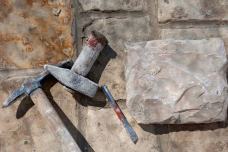
Worker’s tools used in the restoration of the wall at the Damascus Gate in the Old City of JerusalemWe have reflected on surprise. We have reflected on The New Orderof the Word who is Alpha and Omega – beginning and end. Today we read about Restoration, the return from exile, the state we all seek.
I love reading this book by the prophet who left his work as a shepherd in Judah to denounce the empty wealth of the northern tribes. His words rankled the power structure and so he was expelled from Bethelto return to his pastoral work. He brought a message of destruction, but a destruction which carries within the promise of restoration for the faithful. This may be a surprise to many. It is certainly the message of The Word. It is The New Order of things. It is Restoration of the Remnant. Do we have the fortitude, the perseverance, the hope, the love to be remnant?
When our own fallen hut is raised up, do we recognize the voice of the shepherd enough to follow it?
When the breaches have been healed, do we allow our wounds to cure so that we might hear the new words of the shepherd?
When the plowman and the vintner overtake the reaper and the sower, will we know the way to the celebration with the shepherd?
When the ruined cities are rebuilt, will we recognize our new homes?
When we arrive to drink the new wine and eat the new fruits, will we possess the white garment to wear at the marriage feast? Will we recognize Christ as the groom? Will we recognize ourselves as the Bride?
Written on October 31, 2008 and posted today as a Favorite.
Last week-end when I was returning home after several days packed with more activity than reflection, I turned on the radio and the words of a sermon saluted me in the dark. The voice spoke through the car speakers saying: Life is not about knowing and understanding what we are doing next, it is about being prepared. The homilist then developed his theme by reminding his radio flock of the number of times that God leads people into greatness without their full comprehension of how or whenthis plan God speaks of will unfold. The radio voice then told a series of stories and it pointed out that this string of figures from scripture hold something in common: the protagonists are all prepared to receive the word . . . and to follow it in faith . . . hoping against hope . . . obeying, trusting and loving God.
As I made my way home through the warm, falling darkness, the headlamps of my car were only lighting the winding way a hundred yards or so before me. The night was creeping up behind and snugging in beside me; the light before me was fading fast. And even though I was traveling a well-memorized route, I really had no idea of what lay ahead of me in the darkness the headlights did not pierce. But the voice on the radio and the night beyond the car’s head beams drew me on. The homilist reminded listeners that when God invites us to move to a new place he does not divulge the entire plan – this plan is too complex in the first place and knowledge of its entirety is not necessary in the second. It is enough that we follow and enact God’s will as best we can. That is all that is required of us. God knows our strengths and weaknesses. God did, after all, create us.
This always happens to me when I tell God that I think I am an improper servant to do the LORD’s work after God has sent me into the fray of life and I feel that I have come up short of God’s and my own expectations. Without fail when I am feeling this way, I receive a clear signal that God well knows what God is doing, and that I must doubt God and myself less, and trust in God and my relationship with God more. The LORD delivered the message again on that beautiful dark night last week-end, and here God delivers it again through St. Paul in this recounting of Abraham and Sarah’s leap of faith.
I must devote myself to being more prepared in this life. I must remember that with God all things are possible. And I must be prepared to answer God’s call, being fully aware that whatever God has promised God is able to perform.
Written on June 1 and posted today as Favorite. Sunday’s Gospel reading was the story of the wedding guest who appeared without a wedding garment . . .
The Parable of the Wedding GarmentThis story frightened me as a child. So much violence, so much anger. Weddings were enormous family celebrations for us; just inviting aunts, uncles, cousins and grandparents was automatically a guest list of at least two hundred. My parents were from large families, and these families valued and celebrated life, and they accepted all – even the various black sheep. On the Sunday this parable was read we five had lots of questions for Mother and Dad: Why did this guy invite people who did not want to come? Who would miss a wedding and a chance to gather the clan in the first place? Why did this guy kill people who made him mad? Why did he invite people and not tell them there was a dress code? When we were young Mother and Dad would patiently explain that those who were invited should have gone, that the images here are dire because Jesus is making a point, that in those days everyone had “a wedding garment” that was worn when one was invited to a wedding. When we were older it was explained that this story was more about the presence of the kingdom here and now, and about the “wedding garment” being our own conversion of heart. Our “wedding garment,” they explained, cannot be bought or borrowed from another. It cannot be feigned or imagined. God has a specific measure and infinite mercy. God calls each of us. God has a plan in mind which Jesus shows us and the Spirit nurtures. Our proper response to this invitation is to follow Jesus’ model, and to allow the Spirit to live within in order that we discover true repentance, so that we cultivate an honest softening of the heart and a willing obedience to do as God asks. When we receive the invitation to the feast, which happens frequently – in case we hadn’t noticed – we are to go, and we will need to be prepared. We understood this since the traditions of scouting and the military life were woven through everything we did as a family: One needs to always be prepared for any eventuality, we learned. This was only prudent. This was wise. This was wearing how one wore the “wedding garment.”
I am amazed at the haphazard way in which so many people live, bouncing from one problem to another like a pin ball – or from one thrill to another, from one addiction to another – without much investment in discovering how to stop any insanity in their lives. I understand when I read this story today that the ejected guest is the colleague I work with who complains but does not want to solve the problem, or the family member who persists in unhealthy behavior and refuses to move down a path that brings clarity and resolution to a worrying problem. Mother and Dad were right. This story is not about the nit-picking God who invites all to come to the banquet of life. It is really about the stubborn creatures who have heard a message and refuse to believe it. Once seen in this light, the parable makes sense and it is something to be taken seriously.
For today we might pause to reflect and ask ourselves . . . Do we have a wedding garment prepared to wear when we receive invitations to wedding feasts – are we ready to do God’s work when called in the Spirit and as Jesus does? Do we know where our garment is, does it need mending, does it need cleaning up – when was the last time we examined it carefully? Do we know what this wedding garment signifies – are we ready to say to the God who created us . . . “We have worked hard on ourselves to soften our hearts and bend our stiff necks. We have discarded our wide phylacteries and long tassels to put on the simple garment of Christ. We have come to labor in the vineyard to do the work you need rather than the work we want.”
In the Christian Baptismal Rite, a white garment is often bestowed on the baptized child. Many infants wear a special white baptismal dress. We later see white fabrics used in First Communion dresses and suits, in confirmation and graduation robes and dresses, and even in wedding gowns. With all of this imagery to remind us, let us dig out our own wedding garmentfrom the closet or chest where we have stored it for a special day. Let us clean it, repair it, refurbish it, for every day is Banquet Day in the Kingdom and we have need of it often. Do we act as if this is this something we know?