There are many times in our lives when we do not recognize the Christ who works, kneels or plays beside us. We believe ourselves alone or abandoned. We find that we are overwhelmed with work or emotion. We look for a loved one, friend or colleague who will fill the emptiness. We throw ourselves into play or work, and all the while we overlook the gentle leader who stands waiting before us, calling our name.
Mary Magdalene works and lives with Jesus for several years and yet she mistakes him for the gardener. Let us consider if or how, when or why we look past Jesus when he stands ready to help us. And let us determine to step into the newness and freedom Christ gives us today.
Enter the words Why are you Weeping into the blog search bar and explore.
Jesus says: “To anyone who has, more will be given and he will grow rich; from anyone who has not, more will be taken away”.
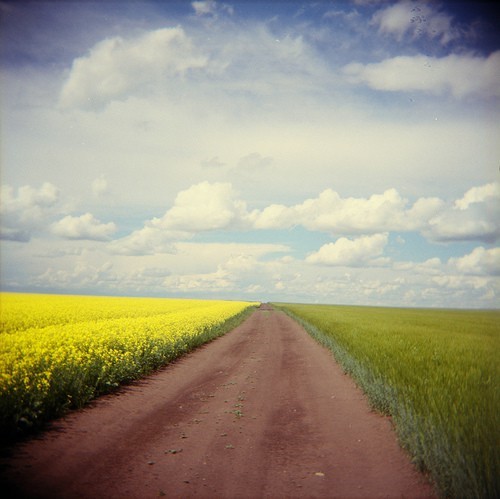
Some lives are hidden journeys, following tracks laid down by unknown forces that pull us forward rapidly. We fly past dense underbrush that hides us from the openness of the world. We are enslaved to a strict pathway that does not allow for deviation in any way. Journeys like this seem pleasant and ordered but they eliminate the opportunity to make choices. We find that we have no freedom. When we realize that we have chosen a pathway that thinks for us and keeps us away from the fullness of creation, we find that we are missing out not only on risk and danger but on our own development. We begin to understand Jesus’ words when he says that those with more will prosper and those with little will fail. It dawns on us that these words do not refer to material goods but rather, to a life lived in fullness of heart versus a life lived with a narrowness of mind. A constricted, prescribed and confining journey brings with it its own punishment of more constriction; while open and generous pathways call us out of ourselves and ask us to stretch. Open and flexible journeys offer us a new prosperity of love, peace and fulfillment. We discover that as we move away from restriction to stretch beyond our comfort zones, we learn about the depth and breadth and beauty of our gifts.
“This is why I speak in parables, because ‘they look but do not see and hear but do not listen or understand’. Isaiah’s prophecy is fulfilled in them”.
There are paths that bring us changes that are so sudden that at first we believe ourselves to be lost. Huge, impassable obstacles loom large before us and all we see is a roadblock. All we hear is chaos. When we look closely, however, to discern God’s plan and call, we notice alternative routes we had not previously seen. We hear precious words of advice and encouragement to which we had earlier been deaf. With this new discovery of trusting God, we also realize a life of eagerness, adventure and acumen. We become wiser. We hear better. We see further. We find endurance. We find that we can bear far more that we had imagined. We understand that we are loved far more than we had hoped. Our eyes see opportunity where before we had seen loss; our ears hear rejoicing where before we heard only dirges.
Blessed are your eyes, because they see, and your ears because they hear. Many prophets and righteous people have longed to see what you see but did not see it, and to hear what you hear but did not hear it.
Some journeys convince us that the world is made of two kinds of people: the good and the bad. We find ourselves believing the illusion that we can divide everyone and every idea into opposing camps or positions. And then we find ourselves either allying with the position we think is the safest and most suitable . . . or we struggle to achieve an impossible compromise that addresses none of the problems we find before us. This kind of living begins as an innocent attempt to simplify our journey, and it ends in a passage that is rigid, unforgiving and blind.
Rescue me . . . Take up my cause . . . Redeem me . . . Give me life . . . Give me life.
As we near the close of this psalm we have come to understand that real and permanent rescue lies only in God.
God says: You have spent many days exploring this longest of Psalms and through your persistent study and faithful prayer a new clarification begins to seep into your bones and sinews. Take me with you in your heart and mind, your body and soul as you go about your work, rest and play. Invoke me when you are frightened. Celebrate with me when you experience joy. Remember always that I love you and that my love for you erases all wrong and rights all injustice. With me comes the dawn of a new light, the breaking in of a new wineskin, the shifting away from old habits and customs that tie you down and do not bring the lasting freedom of the heart as I do. Remain in me always and everywhere, for only in me do you find clarity.
We are sometimes quite stubborn and refuse to believe that contentment might be gained by examining our old traditions to jettison those that hamper our development. We are sometimes quite slow in taking up the gift of new life. We are often not willing to die . . . so that we might live.
For if we have grown into union with [Christ] through a death like his, we shall also be united with him in resurrection. We know that our old self was crucified with him, so that our sinful body might be done away with, that we might no longer be in slavery to sin. (Romans 6:5-6)
Living in Christ is never easy for we must be willing to examine our thoughts, words and deeds and we must be willing to live in a new way. We ask for clarity when we already have it . . . but refuse to understand it . . . because our understanding will call for action on our part. Yet, living in Christ is always rewarding for we are quickly forgiven, always loved, and always blessed. We ask for clarity and we already have it . . . let us be willing to understand the gift of new life that we hold in our hands.
When the fullness of time had come, God sent his Son, born of woman, born under the law, to ransom those under the law, so that we might receive adoption. As proof that you are children, God sent the spirit of his Son into your hearts crying out, “Abba, Father!” So you are no longer a slave but a child, and if a child than also an heir, through God.
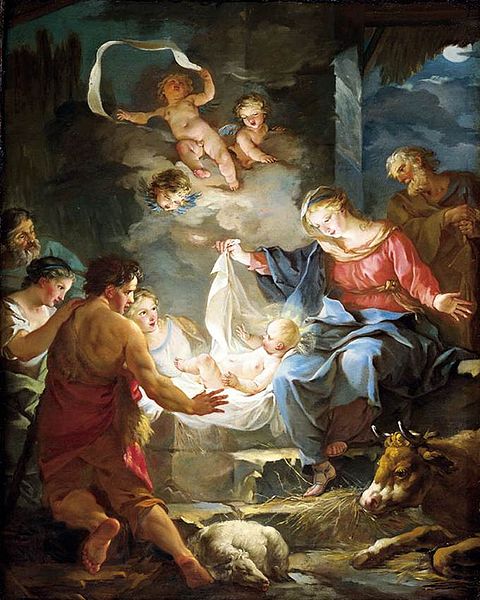
We struggle to realize a kind of independence from any being – natural or supernatural. We strive to gain control of our own destiny – earthly or spiritual. We tussle with time and attempt to govern the passing of minutes, hours and years – looking back into the past and forward into the future while neglecting the precious present. We have need of none of these desires and indeed we expend our energy and creativity uselessly on these false battles . . . for we already have all that we could hope for. We are rescued from darkness. We are ransomed through the love of God. And we are already heirs of a kingdom and fortune too vast to be measured or counted. We have our proof in this small, tiny child.
On this eighth day of Christmas as we stand at the threshold of a new day that marks a new year, let us live in this prized gift of the present that the Father has given to us. Let us give thanks to the Father for all that we have and all that we are. On this day when we begin a new year that we so eagerly await, let us cease our search for the proof of God’s love and let us be convinced – as Christmas people – that what we seek we already possess.
Therefore, gird up the loins of your mind, live soberly, and set your hopes completely on the grace to be brought to you at the revelation of Jesus Christ . . . [and] be holy as he who called you is holy . . . for it is written, “Be holy because I [am] holy”.
Peter understands the importance of living in Christ’s holiness perhaps more than any other apostle. Peter both denied Christ and witnessed that Jesus is the son of the Living God. Peter understands the real cost and gift of suffering. Peter believes in the inheritance he holds in his hands, mind and spirit. Peter comprehends the importance of living in Christ, and the insignificance of the many small problems with which we crowd our days.
God says: Listen to our brother Peter for he has great wisdom for you. Peter understands that real freedom can only be won through obedience to the goodness I have planted in you. Peter understands that straying from my Word is normal and that suffering is unpleasant and painful. Peter also understands that cleaving to my Word can go against your desire for independence . . . but that total and true independence can only be gained through your following in The Way of Christ. There is much more that Peter understands and that he wants to convey to you but for today . . . rest with the idea of obedience. And reflect on when and how and why you have felt most free. Like Peter you will find that the obedience he preaches releases you from the small, petty worries of your days. Like Peter, you will come to more fully understand how obedience releases you from all that constrains and frightens you.
Once we decide to trust God in both large and small matters we free ourselves from energy-sapping anxiety. This is what Peter means by girding our minds and living soberly in the moment. This is the holiness to which Peter calls each of us . . . in the name of Christ.
We visit the book of Jeremiah often in our Noontimereflections; it is a rich and complex prophecy. Jeremiah is so frank, honest, and open about his suffering. Chapter 33 is particularly lovely and holds much promise about healing after punishment.
This prophecy might prove difficult for those among us who are addicted to turmoil and conflict or to the control of others and our surroundings. Jeremiah speaks of reliance on God who loves dearly and intensely, tenderly and passionately. Through Jeremiah, God announces a desire for our own personal freedom so that we might freely choose to be in relationship with God. Whether we suffer or celebrate, God wants to dance in intimacy with us.
Call to me and I will answer you, and will tell you great and hidden things that you have not known.This quiet instruction from God speaks of the closeness and confidence of our relationship. We have only to ask. God will answer. Like the faithful spouse.
Verse 9: Then Jerusalem shall be my joy, my praise, my glory, before all the nations of the earth, as they hear of all the good I will do among them. They shall be in fear and trembling over all the peaceful benefits I will give her.The prophecy of Jeremiah is not only a faithful prediction of what will happen to King Zedekiah, to the city of Jerusalem and the kingdom of Israel, it is a foretelling of the Christ story and it is the story of our own ransom and redemption.
God wants only freedom for us so that we might have the option to choose to love and follow. Christ arrives to bring us this freedom from slavery and darkness. The Holy Spirit abides with us constantly, whispering this promise to us repeatedly.
When we seek freedom from all that haunts us, we only need turn to a forgiving and loving God. This is where real and lasting love lies. This is where eternal sustenance and strength lie. And this is where the undying and sure promise of God’s presence and movement in our lives will always lie. This is the freedom God willingly gives. God’s promise to us is this great. God’s love for us is this persistent and ever-lasting.
Adapted from reflections written on January 1, 2007 and April 28, 2010.
Why do the nations rage and the peoples devise futile plots? The kings of the earth rise up, and the princes conspire together against the Lord and against his Anointed One: “Let us finally break their shackles and cast away their chains from us”.
Jesus came into the world to set us free from all the fears and anxieties that enslave us. He lives and breathes with us that we might believe that we do not need to pay homage to any of the little gods the nations, the peoples and the princes have established. Jesus is the Anointed One who comes to tells us that there is only one law to follow . . . The Law of Love.
God says: As I have said so many times, it is confusing to sort through all the little gods you have chained yourselves to: the god of time, the god of space, the god of power, the god of control, the god of fear, the god of fame, the god of glamour, the god of wealth, the god of status and so many more. There is only one God and I Am that God. There is only one law, The Law of Love. There is only one dominion, the Kingdom I invite you to build with me. I have broken your chains just as I broke the chains of Paul and Silas. Trust in me and put aside your little plans. Allow me to cast away the chains that are too heavy for you to lift.
We need no plots, no schemes, and no tricks to be one with God. We need only surrender, obedience and love. Let us trust the one who forgives endlessly. Let us rely on the one who judges mercifully. And let us follow the one who unlocks all chained and secret places.
Type the word plots or schemes in the blog search bar and examine how we separate ourselves from God . . . and how we might allow God to release us from our personal prison.
To read the story of Paul and Silas’ miraculous release, see Acts 16.
When I read the Book of Leviticus I marvel at how closely these early people monitored their physical, moral and spiritual lives. I try to imagine living at a time when there was no FDA, no FDIC, no AMA, no Magisterium, and I begin to feel the need to formulate rules for everything. Of course, once the rules are set we will want to enforce them. And once we enforce them we will need to judge them. This thinking, in spite of the fact that it seems liberating, has the effect of closing us down. In today’s reading we see what happens when two people get too close to Yahweh in an unauthorized rite. This is not the God of the New Testament who invites us in, who yearns to live in the temple of our souls.
Jesus arrived in the world to set us free. He loosens the bonds of captives. He releases us from addictions, ailments, anxieties and fears. He invites us to open ourselves and to be as vulnerable to the world as he is himself. He invites us to incorporate with him as Light to the world, Hope to the world, Love to the world.
In the chapters following today’s citation we might read about the early Hebrew thinking regarding childbirth, leprosy, personal un-cleanliness, atonement and scapegoating. In the chapters previous we can find all we need to know about what foods to eat and not to eat. Out of necessity for survival, this early Hebrew nation was regulated to the smallest detail – inviting narrowness and judgment. Today, we who live in the Messianic times are free to explore God and to join in the constant renewal of creation. We cannot forget that we have been freed from all that frightens us, and we must act as if we believe the Jesus who stood in Nazareth and read from the scroll of Isaiah saying:
As twenty-first century Christians, we might proclaim the same to one another in Christ’s name. Let us bring glad tidings to the poor, including those among us who are poor in spirit. Let us abide with one another as we free those among us who are held captive by our fears. Let us be light so that others who are blinded might have sight. Let us witness to all kinds of oppression, whatever and wherever it may be. And let us proclaim a time acceptable to the Lord. Amen.
Written on October 7, 2008 and posted today as a Favorite.
Modern CorinthWe have before us today the story of who and what we are, what we believe, and how and why we came into being. This story tells us everything we need to know about why we exist. It is the teaching that Paul received from Christ, and it is the teaching that he preaches constantly, both to the people of his time and to us today. Sometimes I need to re-read the story often, especially at the times when the world tests my stamina. Paul teaches. We are called to believe.
For a capsule view of the teaching Paul repeats so often we can go to Acts 17 and 18 when he is in Athens and about to depart for Corinth. He delivers his message as he always does, telling the marvelous story of how we only need to rely on God, how God has come among us to live and suffer and die and rejoice as one of us, and of how we are all brothers and sisters of this God who has risen and who wishes to have us with him in intimate union. This wonderful message is received in three ways: some scoff, some say they like the idea but are too busy at the moment to hear more, others believe . . . and join Paul in his mission.
We are offered this same opportunity each day as we rise, as we pray, as we work, as we play. We choose whether we want to poke fun, to be lukewarm, or to become fervent in our dedication to this simple yet amazing story.
From the MAGNIFICAT evening reflection on Acts 16:26 when the disciples are freed from shackles by an earthquake: Just as the disciples were delivered from prison, so were all of us delivered from the prison of sin and death by the resurrection of Christ and the gift of the Spirit. In moments of discouragement, let us remember the hope that lights our way to a goal far more wonderful than we can imagine even now.
The other citations all direct us to reflect on what to do when we are discouraged. Psalm 126, along with Baruch 4:22-23(I have trusted in the Eternal God for your welfare, and joy has come to me from the Holy One . . . With mourning and lament I sent you forth, but God will give you back to me with enduring gladness and joy) and Isaiah 55:11(My word shall not return to me void but shall do my will, achieving the end for which I sent it).
When we become discouraged we only need to remember The Teaching: God has come among us to walk with us, to bring us release and peace and even joy.
They go out, they go out, full of tears, carrying seed for the sowing: they come back, they come back, full of song, carrying their sheaves. (Psalm 126:5-6)
Let us join Christ in the song, let us join Paul in the harvest, and let us join one another in peace and joy.
Amen.
Cameron, Peter John. “Prayer for the Evening.” MAGNIFICAT. 20.5 (2009). Print.
 Friday, April 23, 2021


![images[1]](https://thenoontimes.com/wp-content/uploads/2014/02/images1.jpg)
![obedience[1]](https://thenoontimes.com/wp-content/uploads/2013/10/obedience1.png?w=300)
![Jeremiah_33_3[1]](https://thenoontimes.com/wp-content/uploads/2013/09/jeremiah_33_31.jpg?w=300)
![prison2[1]](https://thenoontimes.com/wp-content/uploads/2013/06/prison21.jpg?w=300)

 The Noontimes
