Psalm 121:5-6:The Lord himself watches over you; the Lord is your shade at your right hand, so that the sun shall not strike you by day, nor the moon by night.
How wonderful it is the sun does not scorch us the moon does not lead us astray.
How marvelous it is that we are watched over and protected from the enemy.
How amazing it is that God wants to spend so much time with us!
God says: You are correct. All of this is true. I love to spend time with you and it does not matter what you are doing. I want to be with you in all you do. I delight in your delight. Watching over you is simple for me because beside you is the only place I want to be. How wonderful you are. How marvelous! How amazing!
We ought not shy away from God when God approaches. We must remain open and welcoming. And we must be amazed that we are so well-loved by Jesus, the Lord himself.
2 Corinthians 9:6 – Brothers and sisters: whoever sows sparingly will also reap sparingly, and whoever sows bountifully will also reap bountifully.
God says: I know that there are days when you feel as though I ask too much of you. I understand that there are times when you are too exhausted to take another step in your journey. This is why I have asked you to cast your troubles on my shoulders – for my burden is light and I am ready to carry your worries for you. I see how the world draws you in and I am here to accompany you each day. You have only to call on me.
At times it seems as if the only harvest we reap is anxiety and sadness and we find it difficult to believe the promise of the resurrection. Yet God abides with us in our apprehension. This is the message he wishes to give us – that despite our fears, we are saved. Despite our dread we are redeemed. And despite our wretchedness we are loved. This is the miracle of God’s love. Let us sow the love God gives to us so that we might in turn reap God’s love with the harvest.
Enter the word promise in the blog search box and continue to reflect on the promises God intends to keep.
Matthew 13:16-17 – Blessed are your eyes, because they see, and your ears, because they hear. Amen, I say to you, many prophets and righteous people longed to see what you see but did not see it, and to hear what you hear but did not hear it.
We complicate life until it becomes unrecognizable.
We listen to our own voice and ignore the voice that loves us.
We what for signs of love endlessly and miss the obvious simplicity that God loves us more than we can ever imagine.
God says: I see constant striving and thrashing among my people; they reach out for what they already have. I speak to my children endlessly; yet they turn away from me. It brings me such joy when just one of you pauses in the minutiae you have created for yourselves to think of me. It brings me great happiness when you call my name. I want to do all for you. I want to be with you. Put aside the extraneous activities you create to make yourselves too busy to spend time with me. Sit with me awhile.
Let us turn off the noise and clamor of our day for just five minutes today. And let us spend it with God.
A re-post from August 10, 2012.
For a reflection on spending time with our creator, go to the God Timepage on this blog at: https://thenoontimes.com/god-time/ or type “God’s love” in The Noontimes search box to see where it leads you.
Mark 12:30: Love the Lord your God with all your heart and all your soul with all your mind and with all your strength.
God does not love us partially but fully and completely. Why do we love God in bits and pieces? What is it we fear giving over to God?
God abides with us constantly and always. Why do we come and go in our relationship with God? What is it that distracts us so much from God?
God defends and protects us in ways both seen and unseen. Why do we insist on our own plans in our own time? What is so important to us that we seek to control so vigorously?
God loves us fully even though we love him partially.
God loves us always even though we love him inconstantly.
God loves us dynamically, eternally, and with all God has and is. Let us struggle anew to love God with all that we have and all that we are.
This is what Christ asks of us today and all days.
Enter the words The Shema into the blog search bar and explore how this concept may figure more in our daily activities, thoughts and prayers.
Isaiah 54:10: Though the mountains leave their place and the hills be shaken, my love shall never leave you nor my covenant of peace be shaken, says the Lord, who has mercy on you.
Tuesday, July 21, 2026
Today’s reflection is brief to give us the opportunity to explore the life of Paul Farmer.
It is difficult to imagine that the Alps or the Andes or the Himalayan Mountains might leave their place and yet with God’s mercy they do.
When we place all hope in God, massive obstacles are overcome.
When we move through our days in Christ’s faith, immense disabilities are re-mediated.
When we act in the Spirit’s love, impossible circumstances melt away.
God’s overpowering love moves the mountains in our lives when we act in God’s unlimited mercy. God’s covenant with us is eternal. Let us remain faithful to God and to the promises we make.
Farmer died in 2022. For more on his life, visit https://en.wikipedia.org/wiki/Paul_Farmer or Harvard’s Memorial Minute at: chrome-extension://efaidnbmnnnibpcajpcglclefindmkaj/https://fa.hms.harvard.edu/sites/g/files/omnuum4521/files/2025-05/Memorial%20Minute.Farmer%2C%20Paul%20E._0.pdf
Psalm 17:6 – I call upon you, O God, for you will answer me; incline your ear to me and hear my words.
It is so difficult to hear God’s voice above the clamor of the world. It is so easy to forget that for God all things are possible. We must be persistent in telling God our woes, insistent in letting God know how we feel and what we seek. We must continue to call on God, for God is our only hope.
God says: I see how frustrated you become with the big and little worries of your life; I see how your burdens wear you down. You have called on me and I hear you. I am responding to your plea but you are so worried that you cannot hear my words of peace. You are so anxious that you cannot feel my healing touch. I incline my ear to you . . . I touch your heart . . . just as you touch mine.
God listens to us more than we believe. God speaks to us more than we think. God loves us more than we imagine.
Psalm 30:13 – My heart sings to you without ceasing; O Lord my God, I will give you thanks for ever.
In all circumstances, either sorrowful or joyful, give thanks to the Lord. He has done great things for me; he keeps his promises and fulfills his word.
God says: I do not let you down, I am with you always. I do not change my mind; I am constant love. I do not bully or neglect you; I wait until you move toward me, and then I run to greet you with an overflowing heart and open arms. My love takes you in, washes away anxiety, allays fears and sends away all that threatens you. If you rest in me you need nothing else. Trust me and sing with me.
Hoping that God’s lullabies take away all that terrifies you.
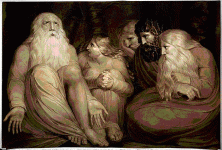
Commentary from La Biblia de América:Job continues in his search for a personal encounter with God, both seeking and fearing him; but the judgment of his companions does not speak to his condition. Job finds himself bereft notbecause he has broken God’s law in any way. His sins do not bring him to this spot of desperation; he suffers innocently from circumstances beyond his control. Yet amid all of this hurt, Job refuses to reject God; indeed, he seeks God all the more with each new wave of pain. Job actually takes refuge in his suffering, frightened and even terrified, waiting for his end. He describes an impotence which we ourselves may feel at a time when we are abandoned and have no recourse. We suffer while the wicked experience success. A victim of bad luck and injustice, Job experiences a reality too awful to be concealed. Further footnotes tell us that verses 18 through 25 have appeared here rather than where they may rightly belong – in a previous chapter – perhaps the copyist could not bear the pain and so thought to bring consolation from another place.
This lament of Job guides any and each of us through a wave of pain so intense that it nearly takes one’s breath away. This level of suffering can only be healed by God, and it is upon God that Job calls.
Today’s reading asks us to think about our desire to see and know God – face to face. Job’s unquenched yearning is void of any wish to exact punishment or revenge on anyone or anything. Job questions. Job fears. Yet Job does not leave God perhaps because he knows that God has not left him.
The imagery today describes a dichotomy of longing accompanied by fear. Job needs to experience God’s presence in his life, and he fears that perhaps he will never escape this place of emptiness where the wicked have full sway. He survives in a twilight world where day and night co-exist, and he fears that the darkness will win out.
As we have observed, perhaps it is for this reason that a later copyist has inserted the words which we know Job believes because they hold truth and because they describe what Job does – he refuses to give up, he holds on to hope and he waits.
To him who rises without assurance of his life he gives safety and support.
When we find ourselves in the pit of misery described by Job, we must remember that the force of our yearning will be met, matched, and exceeded by God’s love, for God islife itself.
To him who rises without assurance of his life he gives safety and support.
A re-post from May 9, 2012.
LA BIBLIA DE LA AMÉRICA. 8th. Madrid: La Casa de la Biblia, 1994. Print.
It is clear that Joshua understands his people when we read today’s Noontime scripture. He has brought them from the edge of the wilderness into the fertile land that God has promised them. He has led their troops, solved their squabbles, and he has kept them faithful to God as they live side by side with pagan peoples. He has one final plea.
We are moving through the opening weeks of the season of Lent, a time for reflection and introspection. Today we have an opportunity to consider that we stand before Joshua, a man who knows our story. Let us listen well.
Strive hard to observe and carry out all that is written in the book of the law of Moses, not straying from it in any way or mingling with these nations while they survive among you. We might recall here the parable of the weeds growing among the wheat in Matthew 13:24-30 that we considered in our Continued ProgressNoontime. God does not call us to wipe out all who oppose or stifle us; rather, God asks that we learn to grow amid those who would pull us from our steady progress toward God. Joshua calls likewise to us today, encouraging us to follow the voice of God, to grow in wisdom. When we allow God’s wisdom to counsel us rather than succumb to our own petty fears and whims, we will have responded to this final plea.
At your approach you have driven our large and small nations, and to this day no one has withstood you. One of you puts to flight a thousand because it is the Lord, your God, himself who fights for you, as he promised you. We so quickly take credit for our successes and blame God for our failures. It seems we cannot withstand the truth of our own existence. When we remember the so many big and little triumphs of our lives in the light of God’s goodness instead of the brightness of our own effort, all anxiety, resentment and envy melt away. We cease to compare our circumstances to those of others; we see our lives for what they are: a continuing response to – or a willful turning away from – God’s call. Joshua asks us today to consider the origin of our security and achievement; and he reminds us that God alone governs all. When we admit that God’s strength and fidelity are gifts we receive without even asking, we will have demonstrated our own willingness to respond to this final plea.
If you ever abandon God and ally yourselves with the remnant of these [pagan] nations while they survive among you, by intermarrying and intermingling with them, know for certain that . . . they will be a snare and a trap for you, a scourge for your sides and thorns for your eyes. Joshua worries, of course, that his people will disappear into the societies that surround and live side by side with them. He knows how easily we can be convinced that daily prayer and faithful worship have little effect upon us. He understands our weaknesses because he has managed the in-fighting and back-stabbing that happens when people come together in a common cause. He also understands our strengths because he has led a stiff-necked and cantankerous people successfully by following God’s counsel rather than the shallow wisdom of oracles; he has deferred to God’s plans and put away his own. Joshua recalls the covenant they have agreed upon with God and that it invokes reward or doom; he reminds his people that God always keeps his promises. When we willingly turn away from the siren call of the idols that clutter our lives, we will give witness to our own commitment to God, and we will have answered this final plea.
This chapter closes with a description of God’s Wrathand before we become frightened by these images let us remember that Christ comes to fulfill the Old Testament Covenant and to replace it with a new Law of Love. When we remember that the God of wrath we see described here is actually the God of Love that Christ shows us. We will have little trouble – and much reward – when we respond to Joshua’s final plea.
Adapted from a reflection posted on December 11, 2011.