We continue with the theme of Captivitytoday – but here we see the epiphany of understanding. We experience the surprise which always springs upon the faithful when they are low. We live the promise of our God who loves us relentlessly, persistently yet gently. God loves us to the extent that he is willing to wait and abide infinitely while we find our way to God’s mercy, justice and joy.
5:7 – God makes all things level. God straightens all paths. God awaits us at every turning of the road.
5:2 – God creates us, names us, calls us his own. God yearns for the intimacy God has foreseen with us.
5:5 – God sends out the universal call. God will not leave a single sheep unbidden.
5:7 – God has in mind for us a place of beauty. God has brought forth life from the desert. God also brings forth life from the desert of our lives.
Look to the east, Jerusalem! Behold the joy that comes to you from God.
God has not forgotten a single hair on our heads.
God has felt each agonizing and joyful step of our journey.
And when we arrive it is God who welcomes us home.
Even with its times of Captivity,the journey is joy. The journey is our most intimate encounter with God.
May Christ’s presence and peace dwell within you.
May God’s Spirit and love abide with you forever.
And may you continue to celebrate your return from Captivity as one of God’s own, as one of God’s called, as one of God’s well-loved Easter Children.
John Everett Millais: JepthahA re-post from Easter Week 2012.
We have sinned against you; we have forsaken our God and have served the Baals.
Did not the Egyptians, the Amorites, the Ammonites, the Philistines, the Sidonians, the Amalekites, and the Midianites oppress you? I saved you from their grasp and still you forsook me and worshiped other gods. I will save you no more. Go and cry out to the gods you have chosen; let them save you now that you are in distress.
We have sinned. Do to us whatever you please. Only save us this day.
The Lord grieved over the misery of Israel.
This dialog between the Creator and the created takes place countless times not only in scripture but in our contemporary lives. We stray from God’s goodness and protection, we become enslaved to some small and ugly god, we cry out for help, and God rescues us. We know this cycle and we wait for the predictable sequence to take place in today’s story but something different happens here. “For the first time, Israel actually repents (10:10, 15-16), but God does not, as at other times, raise up a deliverer in response to Israel’s cry for help. The Gileadite elders appoint Jepthah their leader (11:4-11) and only later does God confirm their choice (11:29).” (Mays 233)
A number of circumstances make Jepthah’ story memorable. He had lived in exile from his tribe having been cast out by jealous half-brothers but he is called forward because of his military acumen and success in battles. As the Gileadite leader he tries diplomacy before war but is unsuccessful. Full of God’s spirit he leads his soldiers into combat, vowing that if they are victorious he will sacrifice the first person who comes to greet him on his return home. When his young daughter, his only child, runs out to meet him he is desolate but follows through with his vow. We cringe at the tragic ending and we search for meaning. Human sacrifice was not an accepted Hebrew custom and was, in fact, condemned (Leviticus 18:21 and Deuteronomy 12:31); yet here is this story that goes against all custom, and we are given no context. We grieve along with this long-ago family and we wonder how and why they and we will manage. And so we remember . . .
The Lord grieved over the misery.
Too many times we sink below what we thought to be our limit, and so we remember in our sorrow . . . The Lord grieved over the misery.
Too many schemes take us further than we had intended to go, and so we remember in our disbelief . . . The Lord grieved over the misery.
Too many friends betray us even as Judas betrayed Jesus, and so we remember in our heartache . . . The Lord grieved over the misery.
Too many good intentions lived for our own satisfaction drive us past blatant warning signs, and so we remember in our incomprehension . . . The Lord grieved over the misery.
Too many well-meant promises lead us down a path we had not meant to trod, and so we remember in our mourning . . . The Lord grieved over the misery.
In yesterday’s Gospel from John (20:11-18) we hear again that Mary Magdalene did not recognize Christ who sought to console her . . . she turned around, saw Jesus there, but did not know it was Jesus.When he speaks, she suddenly comprehends that he was with her during her grief. He had never really disappeared. It is her own perception that has fails her.
We will struggle with today’s story just as we struggle with the heartbreaking events of our lives. We must remember that when we feel the most bereft we are closest to God. When we feel the most empty we are vessels waiting to be filled by the Spirit. And when it seems that all have deserted us and that everything we hold dear is lost, Christ draws us forward away from the horror. We have only to take the offered hand and follow.
Mays, James L., ed. HARPERCOLLINS BIBLE COMMENTARY. New York, New York: HarperCollins Publishers, 1988. 233. Print.
In today’s reading Job agrees to put his hand over his mouth so that he might finally listen to Yahweh. And he says this after having made a full and cogent argument to his maker. I believe that we are meant to wrestle with God. We are created to think, reflect and re-think. We are created to be in relationship with God, and to do this well we must ask questions. So many times we receive an enigmatic answer which requires not intelligence to understand but patience and fidelity. This is how we acquire wisdom: through lengthy days of listening, reflecting and praying.
Ought we to argue with God? Absolutely. Will we receive unusual and even vague answers? Precisely. Is this the path to wisdom and eventual serenity? Without a doubt. And this brings us to the point of this reading: when we assume a proper relationship with God, all else falls into place. When we turn to God only, when we believe in God only, when we act through God only, then we find the peace which is promised to us. In the scope of the universe we are quite small; but even in our smallness, each of us is important to God. We never once hear the Maker say to Job, “I will get back to you in a minute after I finish dealing with a world war, genocide in a number of places, two hurricanes and an earthquake, along with an outbreak of a dread disease and thirteen governments gone bad with corruption.” God does not put us aside or put us on hold. God is attentive and present all through this story. And what we see is God’s constancy, fidelity, and willingness to listen to Job’s complaint. We can be assured that as with Job, when we send our petitions and our cry upward, God will hear, because God is always abiding, and God will answer from the whirlwind. We must summon the courage and the openness to hear what God has to say. Then we must forbear, hope, and be faithful to the promise we and God hold together the promise of rescue, healing and restoration.
Looking forward to the end of Job’s story we have the choice of thinking that Job’s happy ending is the result of fantasy, or we may choose to believe that God abides, and that his promises are kept. This choice is entirely up to us, and I choose to believe that the story is not a fairy tale. I choose to believe that God abides.
Adapted from a reflection written on January 27, 2008.
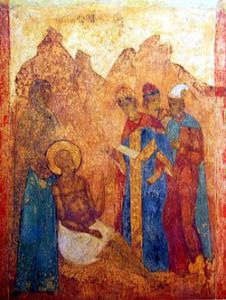
Fresco from the Cathedral of the Annunciation depicting Job and his friends.
Ought we to argue with God? Absolutely. Will we receive unusual and even vague answers? Precisely. Is this the path to wisdom and eventual serenity? Without a doubt. And this brings us to the point of this reading: when we assume a proper relationship with God, all else falls into place. When we turn to God only, when we believe in God only, when we act through God only, then we find the peace promised to us.
In the scope of the universe, we are quite small; but even in our smallness, each of us is important to God. We never once hear the Maker say to Job, “I will get back to you in a minute after I finish dealing with a world war, genocide in a number of places, two hurricanes and an earthquake, along with an outbreak of a dread disease and thirteen governments gone bad with corruption.” God does not put us aside or put us on hold. God is attentive and present all through this story. And what we see is God’s constancy, fidelity, and willingness to listen to Job’s complaint. We can be assured that, like Job, we send our petitions upward. Like Job, we discover that God will hear us because God is always abiding.
When the whirlwind surrounds us, we remember that this is where God speaks most clearly. When the tempest envelops us, we summon the courage and openness to hear what God has to say. When terrors overpower us, we learn how to forbear, hope, and remain faithful to the promise that God and we hold together, the promise of rescue, healing and restoration.
We are always ready to receive joy, always prepared to celebrate. Today we hear from the prophet Zephaniah that there is a reason to rejoice, despite our recalcitrance and resistance to a life of goodness and peace.
The opening verses of this chapter describe a “sewer city” in live a people who refuse to hear the good news that God wants to celebrate goodness with us. We refuse to take correction. Our leaders are rapacious killers. The people have become opportunistic; yet despite this horrible news we hear that God is in the center of the action and knows all we say and do. Despite the damage we visit on one another, God remains. God abides. God persists. God is present, and speaks to us.
You’ve carried those burdens long enough.
I’ll heal the maimed; I’ll bring home the homeless.
In the very countries where they were hated they will be venerated.
As we hear this good news, we sing our song of joy.
God is Israel’s king, in charge at the center.
There’s nothing to fear from evil ever again!
Let us join our voices in this great song.
To compare different versions of these verses, use the scripture link and the drop-down menus.
Don’t secretly hate your neighbor. If you have something against him, get it out into the open; otherwise you are an accomplice in his guilt. Don’t seek revenge or carry a grudge against any of your people. Love your neighbor as yourself. I am God. (MSG)
We have spent time with these verses before but we do well to spend a bit of time with again.
Do not bear a grudge against others, but settle your differences with them, so that you will not commit a sin because of them. Do not take revenge on others or continue to hate them, but love your neighbors as you love yourself. I am theLord. (GNT)
We have reflected before on the importance of loving those who hate and we do well to reflect again.
Youshall not hate yourfellow countryman in your heart; youmay surely reprove your neighbor, but shall not incur sin because of him. You shall not take vengeance,nor bear any grudge against the sons of your people, butyou shall love your neighbor as yourself; I am theLord. (NASB)
God says: I know how difficult my Law of Love can be for you, especially when you have enemies who seek to bring about your end. Especially when others envy, hate, persecute and even kill you. There are times in your lives that are too difficult for you and that is fine. Bring me the injustice that plagues you. Bring me the worries that possess you. Bring me your sadness that threatens to destroy you. And bring me any joy you may have found in our journey over the last days – it does not matter how small it is. And if you have no happiness at all, just bring me yourself. I long to heal you. I long to console you. I long to hold you and call you my own. I long to be one with you.
For millennia the Lord has told us how we are to act when our sisters and brothers hate us.
Do not hate your brother in your heart, but rebuke your neighbor frankly, so that you won’t carry sin because of him.Don’t take vengeance on or bear a grudge against any of your people; rather, love your neighbor as yourself; I amAdonai. (CJB)
For millennia to come the Lord will abide, heal and comfort us, his little children. Let us behave each day as though we believe this to be so.
When we use the scripture link and drop-down menus to explore these words, we begin to understand that God knows how difficult the human life can be; we begin to recognize just how much we are loved; and we begin to find a way to return the great love we are given to a world waiting for healing.
You’re cheating on God. If all you want is your own way, flirting with the world every chance you get, you end up enemies of God and his way.
When James speaks of God’s jealousy, he is not describing God as an envious lover; rather, James describes the limitless, deep, abiding love that God has for each of us.
And do you suppose God doesn’t care? The proverb has it that “he’s a fiercely jealous lover.” And what he gives in love is far better than anything else you’ll find.
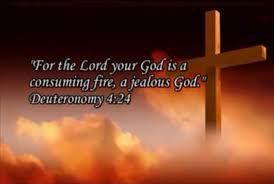
There is a striking difference between envy and jealousy and in Old Testament references to God we often find images of God as a jealous lover. For a deeper explanation about what this means and how it has impact on our lives, we can go to: https://bible.org/seriespage/21-jealous-god. Today, James asks us to consider just what God’s love for us looks like, and how we allow that love to temper our lives.
In his song THROUGH ALL OF IT, Colton Dixon describes how God has accompanied him through all the turmoil life presents. The lyrics begin: There are days I’ve taken more than I can give, and there are choices that I made that I wouldn’t make again. I’ve had my share of laughter, of tears and troubled times. This has been the story of my life . . . and you have been my God through all of it.
Today, let us give ourselves the gift of time to consider the nature of God’s “jealous love” and how this love might change us. We might listen to Dixon’s lyrics and music at: https://www.youtube.com/watch?v=ZnuGXvO_l8w
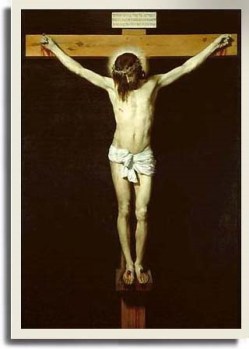
Diego Velázquez: Christ Crucified – The Prado Museum, Madrid
Friday, August 26, 2022
“What is this wisdom that is given to him? What mean such miracles wrought by his hands?” . . . And Jesus marveled at their unbelief. (Douay)
“Where did this man get all this? What kind of wisdom has been given him? What mighty deeds are wrought by his hands?” . . . He was amazed at their lack of faith. (NAB)
“This is the carpenter, surely, the son of Mary, the brother of James and Joseph and Jude and Simon? His sisters, too, are they not here with us?” And they would not accept him. . . . He was amazed at their lack of faith. (Jerusalem Bible)
“Where did he get the things he is teaching?” they said. How can he perform such miracles?” . . . He was amazed at their unwillingness to believe. (William Barclay translation)
When I reflect on the Crucifixion, call to mind the image created by Diego Velázquez that tells us – much like Marks’s Gospel – of the stark reality of the love Jesus, this God-man, has for each of us. It seems to me that Velázquez has captured the unambiguous difference between the healing, merciful Christ and the Jesus of Nazareth who is disbelieved in his own town. The mystical eeriness produced by the floating cross coupled with the universality of Jesus’ half-covered face allow us to personalize this image with our own version of the very human Christ.
I imagine that our own lack of faith proves a heavy obstacle to the performing of miracles and to the healing of bodies and souls; yet Jesus of Nazareth abides. He still performs the impossible.
Let us invite this Jesus into our homes today and every day. Let us open our hearts and minds to the wild possibilities he dares to dream with us. Let us gather together as his resurrected body to bring healing and hope to one another.
Use the scripture link above to explore other translations of these verses.
Here, and also in Nehemiah 11:3-9, we see the litany of names of those taken from Judah to Babylon. We see how their lives change as a result of the new exile status. Those who guarded access to the king now guard the Levite encampment. Their work remains much the same, yet everything has changed.
In the world . . . days go by and others come. No day remains. Even as we speak, the moments pass, the first syllable pressed on by the second that is waiting impatiently to be heard . . . Nothing stands still. Nothing remains firm in time. We must therefore love the one who through whom the times came to be, so that we might be set free from time and become established in eternity, where time and the changes it brings no longer exist. (MAGNIFICAT December 16, 2008, Meditation of the Day – Augustine of Hippo)
Time is a concept we human beings have contrived to measure and mete out as if it were a commodity. Yet for God, time, and space as well, are far more complex than we can understand. We regard it as miracle that Jesus died, rose, returned with his scared and sacred body to abide with his apostles as we establish his Church. We see this reincarnation as impossible, yet testimony that we have heard tells us that this is so it truly happened.
I realize, as I sit and meditate on the Jews going into exile, that each of us experiences separations in our lives: separations from loved ones, from loved places, from loved times. Yet always the memory remains. Nothing tangible remains firm in time . . .except Christ. For this reason it so very important for us to find our way to him, to take and hold him fast once we stumble upon the place where he speaks to us. For this alone is our core. This alone is our seat of authority. This alone is our only reason for being.
And so we pray for all of those who find themselves oppressed by time, oppressed by space, oppressed by forces beyond their control. From today’s MAGNIFICAT intercessions:
Jesus, God, abide with us . . . You will never forsake those who seek you.
For the poor who are oppressed by the commercialism of the season: may they be filled with the liberating power of your gifts. You will never forsake those who seek you.
For all those who are oppressed by the pressures of the season: may they be filled with your peace. You will never forsake those who seek you.
For all those who are oppressed by the prospect of loneliness at this season: may they be filled with the companionship and of your presence. You will never forsake those who seek you.
Nothing stands still. Nothing remains firm in time. We must therefore love the one who through whom the times came to be, so that we might be set free from time and become established in eternity, where time and the changes it brings no longer exist.