Their idols are silver and gold, the work of human hands.
From footnotes, This is “a response to the enemy taunt, ‘Where is your God?’ . . . [I]t ridicules the lifeless idols of the nations, expresses a litany of trust of the various classes of the people in God, invokes God’s blessing on them as they invoke the divine name, and concludes as it began with praise of God”. (Senior 726) True silver and gold are trust in the work of the Lord’s hands. There is no need to exact revenge.
Yesterday’s first reading at Mass was another look at the character of silver and gold. In Wisdom 7:7-11 they are seen as useless as the lust for power and control because all truly good things come from God, and God values our prudence and humility above supremacy. I prayed and prudence was given me; I pleaded and the spirit of wisdom came to me. I preferred her to scepter and throne, and deemed riches as nothing in comparison with her, nor did liken any priceless gem to her; because all gold, in view of her, is a little sand, and before her, silver is to be accounted mire.
When we feel ourselves struggling to gain an upper hand or to mercilessly wield authority that has been vested in us, we must give God thanks for the goodness we have seen; and we must turn to songs like this one that remind us of our proper place in the universe: The heavens belong to the Lord, but the earth is given to us . . . It is we who bless the Lord. Hallelujah!
Amen.
A reflection written on October 12, 2009 and posted today as a Favorite.
Senior, Donald, ed. THE CATHOLIC STUDY BIBLE. New York, Oxford University Press, 1990.726. Print.
The pagan gods and cult idols must be carried about, for they cannot walk . . . but Jesus walks among us.
Like a scarecrow in a cucumber field are they, they cannot speak . . . but our God speaks to us constantly.
Fear them not, they can do no harm, neither is it in their power to do good . . . the Holy Spirit comforts and abides with us always.
No one is like you, O Lord, great are you, great and mighty is your name. Who would not love you . . . for it is your due!
Today we hear a message from Jeremiah affirming all that we know to be true. False shepherds will fall away; the One True Shepherd will gather the lost to bring them home. This King of all carries us on his shoulders – rather than asking us to carry him about. This King of all accompanies us everywhere – even when we feel alone or betrayed, not only when we are happy or joy-filled. This King protects, guides, guards, and loves us – even though we stray, complain and stumble.
This King will never falter, never err, never abandon even one of the flock. This King directs our every step if we only allow it. In his Old Testament frame of mind, Jeremiah asks Yahweh to punish Israel’s enemies. In our New Testament perspective, we pray for those who harm us, we intercede and ask forgiveness. Just as Jesus does. It is when we feel the most alone that we might also most feel God’s presence. If we wish to feel in control of our lives, we must abandon ourselves to Christ. If we wish to feel inspired and passionate about all we do, we must first welcome the Spirit into our hearts to accompany our prayer. If we wish to be treasured, we must first care for those whom no one loves. If we wish to be one with our brother, Christ the King, we must first be sister and brother to our enemies. And we must ask that God show them – and us – mercy.
You know, O Lord, that man is not master of his way; man’s course is not within his choice, nor is it for him to direct his step.
Love us, O Lord, and call those who have wandered far from you. Pour out your grace upon us, so that we might hear you and respond to your call. We ask this in the name of Jesus, the Christ and King, together with the Holy Spirit. Amen.
Adapted from a reflection written on November 21, 2010, the Feast of Christ the King.
In today’s Noontimewe are reminded that we do not have to fight against the obstacles in life’s journey that loom so large. It tells us that when barriers to freedom are gigantic and overwhelming we cannot struggle against them. It says to us that we must turn to God in trust and obedience. We must do as Jesus does even while the naysayers are looking on.
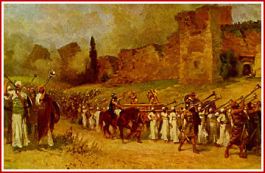
Going into exile was an embarrassment to the “chosen” people. They who had always been miraculously protected by Yahweh now found themselves going into captivity at the hands of the very pagans whom they had previously conquered in battle. The Israelites have discovered that while they fought against the barbarian outside of the city walls, it was the enemy within that doomed them. Corruption and deceit in their own community had decayed their society to the foundation. There is no other outcome to expect than the one they are living . . . they are to pack their baggage in full view of the enemy, and then they are to dig their way through the broken walls of the city to march into captivity. And all of this while the unbelievers are looking on.
So many times we find ourselves living among rebellious people, and we sometimes cannot even tell if we have become one with the idol worshipers. We feel as though the world has gone mad and we are one of the few sane ones who remain. In our Noontime journey we have reflected on how to weather the whirlwind when we see and hear it approaching; today we reflect on how to journey faithfully into captivity . . . while the world is looking on.
There is a remnant left by Yahweh: Yet I will leave a few of them to escape the sword, famine and pestilence so that they may tell of all their abominations among the nations to which they will come; thus they shall know that I am the Lord. This just yet merciful God is always willing, and indeed eager to give his people another door to salvation, another opportunity to return. God will vindicate us even in the darkest and most painful of times even while those who deny us are looking on.
There are occasions when it seems as though we alone are able to see what others cannot. Circumstances and events speak loudly to us while they only whisper to those around us or speak not at all. The prophecy we hear and see and then repeat for others falls on stubborn ears. The world mocks those who live simply so that others may live. Society denies truth so that deception might reign. Many favor the apparent security of tangible comfort while few remain faithful to the Spirit who is willing to abide while those who wish us gone are looking on.
Ezekiel describes a vision today that seems a long way offand yet is present in the Spirit within. Ezekiel says that in a distant time to come there shall no longer be any false visions or deceitful divinationsand yet this word is fulfilled by Christ in us today. Ezekiel tells us of a future in whichnone of God’s words will be delayed any longerand yet this future lives in us today because God loves us so . . . even while the naysayers are looking on.
Let us spend time with this prophecy today. And let us see that, despite the naysayers, Ezekiel’s vision lives in us in this present moment through the promise, the rescue and the love of God.
To read more about weathering the storms on our journey, type the word whirlwindinto the search box on this blog.
The opening paragraphs of today’s Noontime were written on August 12, 2010. Today’s post is an amplification of that reflection.
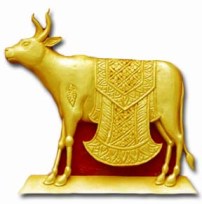
The Golden CalfEven as a child I was impressed with how quickly Aaron slid from one role to another: loyal brother, facilitator of the making of the Golden Calf, loyal brother once again. He appears to get by unscathed and I remember thinking that he must not be very bright, and this is why God let him off so easily.
Some scholars say that Aaron went along with the crowd because it would have been impossible to go against the unhappy throng. Others point out that Aaron presents an argument we hear often even today; You know how prone the people are to evil. They said to me, “Make us a god to be our leader; as for Moses . . . we do not know what has happened to him”. He further argues, “They gave [the gold jewelry] to me, and I threw it into the fire, and this calf came out”. I was amazed, when I first heard this story, that there seemed to be no consequence. Yet Aaron rallies, aligns himself with Moses and the others who want to stand withhim rather than against him, and he escapes the violent death that awaits those who remain against Moses. A coup takes place, blood is spilled, the Hebrews muddle on through the desert.
I am thinking of the many golden calves I have seen erupt from the fires of anger and jealous, fear and anxiety. I am also thinking of how many times I have been asked if I am for or against and how I have answered. I am also thinking of Jesus’ words in Matthew 12:30, Mark 9:40 or Luke 11:23: He who is not with me is against me, and he who does gather with me scatters. And I am grateful for God’s generous mercy.
As a child I knew I lived in the black and white world my parents had created for our family. In that world the most frequent – and most dreaded – punishment for infractions of rules was the dreaded three word sentence, “We will talk”. Sometimes we waited days or even weeks until Dad or Mother would nod and say, “Now”. We would have worried and gnawed over all of the arguments we might present for our innocence and we had thrown out all that were false. We ended up with the unvarnished truth. During the waiting time we would have sorted through the varied outcomes of the impending conversation. And in the end we were so eager to unload our conscience and to confess to our waywardness that we provided our own best castigation. We came to see that we had been wrong. We admitted openly how we had strayed. And we were anxious to enter into and complete any penalty we were to suffer. It was a wonderful form of coming to terms with what it was we had done, why we had done it, and how we ought to be dealt with. My husband and I used similar strategies with our own children when golden calves appeared in our home and we met with the same success in raising ethical, thoughtful, merciful children. God’s generosity and mercy cannot be outdone. God’s love and patience cannot be matched. And for this we ought to give thanks.
Each time I see the adulation that surrounds a golden calf in my family, community or workplace, I pray for the kind of patience my parents taught us. I ask God to bring me wisdom, good timing, and the fortitude to witness to falsehood in a way that will be effective. And I pray for the good counsel and right thinking of the Holy Spirit. When I allow God’s waiting time to pass, I find I have more success than if I lunge forward on my first impulse with my first reaction.
The people we read about today become unhappy about their circumstances and so they create an immediate world of superficial happiness as they revel and play around an idol of their own making. They quickly learn that there is a price to pay for self-centered thinking . . . and that golden calves often leave us standing againstour God.