Constantly, night and day, he was screaming among the tombs and in the mountains, and gashing himself with stones.
In ancient days, epilepsy and psychological ailments were seen as possession by fiends or dark spirits. Spells and incantations murmured by magicians were the only hope of those suffering from mysterious illness. We can understand the suspicion Jesus caused when he cast out these demons and brought joy to common people. The authorities who benefited from the plight of the desperate sought to put an end to Jesus’ constant cures.
No one was able to bind him anymore, even with a chain; because he had often been bound with shackles and chains, and the chains had been torn apart by him and the shackles broken in pieces, and no one was strong enough to subdue him.
Today, science often guides us as we explore disease and look for healing; yet still some of us suffer from unseen – and misunderstood – torment. When we consider the story of the man possessed by an evil he cannot see and does not comprehend, we begin to understand our own hope for consolation when we are beset by troubles large and small. Today as we read this story of the Gerasene, let us run to Christ to fall on our knees as he does. And let us surrender all our troubles to the deep, healing, transforming and abiding consolation of Christ.
He was some distance away when he saw Jesus; so he ran, and fell on his knees before him.
How often do we listen without really hearing? How often do we pass along information we believe to be correct but which is, in fact, not true? In the enormous universe of God’s love, we find that we are given countless opportunities to be open to the voice of God.
Some people brought him a man who was deaf and could hardly speak, and they begged Jesus to place his hands on him.
How often do we believe that we cannot bear to hear the day’s news? How often do we turn away from information we cannot take in? In the infinite presence of Christ’s healing, we discover that we have endless access to understanding.
So Jesus took him off alone, away from the crowd, put his fingers in the man’s ears, spat, and touched the man’s tongue.
How often do we grope to comprehend the purpose of the conflict that surrounds us? How often do we open ourselves to healing and transformation? In the immeasurable gift that is the presence of the Spirit, we encounter consolation that changes us forever.
When we do not feel Christ’s presence in our lives, when we fear that we will not hear God’s voice, when we look for consolation we believe will never arrive, we might offer our deafness to the one who created us, in the Advent hope of the presence of God among us.
When we compare differing translations of these verses, we find that our deafness might be more gift than curse.
May the God who gives us peace make you holy in every way and keep your whole being—spirit, soul, and body free from every fault at the coming of our Lord Jesus Christ. He who calls you will do it, because he is faithful.
God says: You do not need to look for the pieces you believe are missing from your life. All that you believe you lack, you have. You have only to relax into me and you will slowly perceive these missing bits of your persona. You have only to rely on Christ and you will feel the presence of the courage you believe you lack. You have only to rest in the Holy Spirit and you will sense healing and consolation. Reality is not what you see with your eyes, touch with your hands, or hear with your ears. Reality is my full and transforming presence in you that dwells in you since before your conception, and will continue in you long after your temporal death. You can trust my promise. You can trust my action in your life. You can trust my love.
When we compare varying versions of these verses, we discover a new freedom in our wholeness and oneness with God.
Apocalypse, coming from the Greek for revelation, is an announcement of a truth revealed. Apocalyptic literature is full of mystery, is usually veiled in symbolic language and is often interpreted by an angel of God (Senior 425). It deals with the heavenly world, the future, and describes a final judgment in which there are winners and losers. It is sometimes incomprehensible, frightening and misunderstood. The Apocalypse we see today is the fight for Jerusalem which ushers in an era without storm, turmoil or deceit. It brings a time of peace, unity and celebration. It is a day when every libation pot shall be holy to the Lord.
Model of the third Temple
The last chapter of Zechariah’s prophecy makes a momentous revelation or announcement: There will be an end to prophecy. Perhaps this is because with the coming of the Messianic age there is little need to announce the savior who is already among us – perhaps it is because prophets have lost their place of status – perhaps it is because people of all nations, including pagan ones, will now worship the Lord. In any case, according to Zechariah, the fight will be over. There will no longer be merchants in the house of the Lord; false shepherds will have disappeared; the tribes of the world will be reconciled; peace will reign.
The first eight chapters of Zechariah were written about the year 520 B.C.E. to exhort the people to continue the overwhelming task of reformation following their return from exile. The last six chapters of Zechariah were written by an unknown author (or authors) whose oracles describe the Lords’ victory. The exiled have returned from Babylon and so the prize they have been seeking has finally been gained but they have returned to a ruined city. And a great deal of work lies before them. The process of restoration has only just begun and Zechariah speaks to us today to give us a moment to reflect on the meaning of our own return from our personal exile. It gives us a framework in which to put our lives into proper perspective and to give thanks for our salvation. It also gives us an opportunity to gather our forces for the next phase of work.
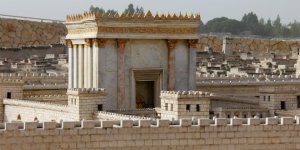
Model of the Temple during the time of Jesus
Return from exile is celebrated and the celebration is taking place amid the ruin of former glory because our newness is more important than what was because we are transformed and made anew. This miracle of redemption that Zechariah describes already exists today in that each of us is the libation bowl poured out for Christ. We are vessels fashioned by God’s hands and brought into existence for God’s purpose. We each are the hope of God to the world.
The fight for Jerusalem is already begun, and we are celebrants in the newness of what is coming onto being. Let us gather ourselves, let us find our places in God’s new city, and let us rejoice and be glad, for we are in the house of the Lord of hosts.
Senior, Donald, ed. THE CATHOLIC STUDY BIBLE. New York, Oxford University Press, 1990. Glossary 445. Print.
Adapted from a reflection written on July 10, 2009.
In a previous post, we reflected on how and why we watch Jesus – on what and when we learn from him – on where we encounter him. Today we reflect on the fact that The Word is not ambiguous. The words of Jesus tell us how we are to act, and what we are to do. Paul tells the Romans – and us – that we are to conform to the world of Jesus rather than the world we see around us. This is as concrete as can be. There is no doubt that we are born to be transformed in and by the Spirit.
Also in this portion of his letter, Paul reminds us that our diversity is pleasing to God. We are to struggle against our desire to see everyone and everything conform to our will. And we are struggle with our ego so that we make room for others in this mystical body we form with Christ. Peace, harmony, service to others, clinging to what is good and avoiding what is not good, blessing our persecutors rather than cursing them – these are the marks of one who ardently follows the Christ. We must put aside thoughts of revenge or even the delight in someone else’s downfall. We are to leave all moral judgment to God.
Do not be overcome by evil, but overcome evil with good.
What a simple and elegant rule to follow. Oh so clear and clean. Oh so difficult to realize.
If we persist in looking for reasons why this rule does not work, we walk away from Jesus. If we continue to exempt ourselves from this rule, we walk away from life. If we persevere in seeing the world as a dark and ugly place, we walk away from the light. If we insist on controlling everything and everyone around us, we walk away from serenity.
Vincent Van Gogh: Wheat Field
When we watch Jesus we see the important lesson that healing and controversy are often entwined. In the Parable of the Weeds (Matthew 13:24-30) we hear that God does not pull up the weeds from the field when they appear because this disrupts the soil and damages the fruit-bearing crop before harvest time. God trusts us to put down deep roots into the rich soil of our lives, and to lift strong arms to the sun in order that we bear fruit – no matter the circumstance of our planting. So let us trust God to tend to the weeds in our own hearts and the weeds among as we struggle to grow, for God is trustworthy. God is capable. God is loving, generous, just and kind.
Rather than becoming overcome by the evil with which our lives are entwined, let us allow God to overcome evil through us – by doing good.
I’m telling you the most solemn and sober truth now: Whoever believes in me has real life, eternal life. I am the Bread of Life.
We have explored Trinity as oasis, Trinity as relationship, Trinity as diversity and creation. We have examined the importance of the three-legged triad and how it generates divine energy. Yesterday we reflected on how everything is holy – even our shortcomings and sins – when we bring them to the Trinity of Father, Son and Spirit. In return we find God’s gift of uncreated grace.
“You can’t manufacture [uncreated grace] by any right conduct. You can’t make God love you one ounce more than God already loves you right now. You can’t. You can go to church every day for the rest of your life. God isn’t going to love you any more than God loves you right now. You cannot make God love you any less, either – not an ounce less . . . We can’t diminish God’s love for us. What we cando, however; is learn how to believe it, receive it, trust it, allow it, and celebrate it, accepting Trinity’s whirling invitation to join in the cosmic dance”. (Rohr and Morrell 193)
Today we celebrate the gift of Jesus’ sacrifice of self for us. Christ’s return to and for us as the embodiment of God among us. As we move through our day, let us consider how we bring into expression God’s fierce fidelity, the Spirit’s passion and Christ’s gift of uncreated grace in the elaborate yet simple divine dance of transformation.
I’m telling you the most solemn and sober truth now: Whoever believes in me has real life, eternal life. I am the Bread of Life.
When we compare varying translation of these verses from THE MESSAGE, we open ourselves to uncreated grace, to the divine energy of transformation.
To more fully understand the eternal dance of love, we might want to spend more time with Rohr’s and Morrell’s description of this dance in THE DIVINE DANCE: THE TRINITY AND YOUR TRANSFORMATION. New Kensington, PA: Whitaker House, 2016. Print.
We have seen the Christ crucified and buried, now we await his return. Are we ready to receive him? Are we prepared to believe?
From the Letter of Paul to Titus: It wasn’t so long ago that we ourselves were stupid and stubborn, dupes of sin, ordered every which way by our glands, going around with a chip on our shoulder, hated and hating back. (MSG)
Father Alfred Delp, S.. was hanged for high treason against Hitler’s Nazi Reich just a few months before the end of WW II. Hitler hoped to erase Delp from history by ordering that his body be cremated and his ashes scattered; but despite this effort, Delp and his words are remembered today. We might take them in as part of our Lenten journey. From Prison Writings,
Toil, heat, and grief express fundamental conditions of human nature which always make themselves felt as long as one is on one’s journey through life. They are not always so abnormally prevalent as they are today but they are nevertheless an indispensable part of our existence. And only when we fail to go through life in partnership with God do these things get the upper hand, bursting all bounds and overwhelming us with trouble of all kinds.
Can we imagine ourselves in partnership with God? What is it like to have an intimate relationship with one who is capable of great authority and great love?
Paul to Titus: But when God, our kind and loving Savior God, stepped in, God saved us from all that. It was all God’s doing; we had nothing to do with it. God gave us a good bath, and we came out of it new people, washed inside and out by the Holy Spirit.
How might we use these verses in our journey toward Easter peace?
Michelangelo: Creation of Adam – Detail
More from Delp:I am not concerned here with the material needs of humankind but with our own degeneration, our blunted faculties and spiritual poverty – all the burdens in fact which the kind of existence one leads have introduced into one’s life and which have now become characteristic of one’s nature. Just as there are virtues that can be acquired so also there are faults that result from repetition such as habitual unawareness of individuality, perpetual relinquishment of powers of decision, permanent weakening of the sense of reality, and so on. Faced with these shortcomings we find ourselves under a terrible strain and utterly helpless.
Do we see Delp’s description of his society reflected in our own? Are there any parallels to discern or lessons to learn? What do we do when we feel helpless or under great strain? Whose counsel do we seek? What transformation do we hope to experience?
Delp:One must accept responsibility for the misuse of one’s free will. Being prone to such errors of judgment the only thing one can do is to turn again and again to God praying earnestly that the Holy Spirit may take pity on one’s failings and let the healing current flow freely through one’s life.
Where do we turn when we are overwhelmed by our own shortcomings or those of others? What are the prayers we offer to God? How often do we allow the Spirit’s healing current to flow freely through our lives?
Both Delp and Paul remind us of the great partnership we are offered, and the consequences of this gift.
Paul to Titus: God’s gift has restored our relationship with him and given us back our lives. And there’s more life to come—an eternity of life! You can count on this.
Partnership with God is the eternal transformation we seek. It is the gift we already hold. We are even now beloved children in God’s kingdom of mercy, forgiveness, redemption and love. Let us move forward in our Lenten journey, and forward into the world, transformed in this belief. Let us behave as if we hold these truths in our hearts. And let us be eager to share with others the promise and goodness of God’s love.
For more on Michelangelo, the Italian Renaissance, and his paintings in the Sistine Chapel, click: http://www.italianrenaissance.org/a-closer-look-michelangelos-painting-of-the-sistine-chapel-ceiling/
Cameron, Peter John. “Meditation of the Day.” MAGNIFICAT. 17.3 (2017): 260-261. Print.
John the Baptist was imprisoned and when hegot wind of what Jesus was doing, he sent his own disciples to ask, “Are you the One we’ve been expecting, or are we still waiting?” (MSG) This week we are given an opportunity to give our own testimony.
Jesus knows that once we decide to follow him, we will encounter hatred; and he also knows that we may be tempted to hate in return. So Jesus said, “If you find the godless world is hating you, remember it got its start hating me. If you lived on the world’s terms, the world would love you as one of its own. But since I picked you to live on God’s terms and no longer on the world’s terms, the world is going to hate you”. (MSG)
Jesus knows that we will need strategies to construct a life that reflects his teachings; and he also knows that we will struggle to follow in his Way.
“When that happens, remember this: Servants don’t get better treatment than their masters. If they beat on me, they will certainly beat on you. If they did what I told them, they will do what you tell them. (MSG)
Jesus knows that the logic of the world will challenge the wisdom of the world; and he also knows that we will need the wisdom that only God can provide.
Hate me, hate my Father—it’s all the same. If I hadn’t done what I have done among them, works no one has ever done, they wouldn’t be to blame. But they saw the God-signs and hated anyway, both me and my Father. Interesting—they have verified the truth of their own Scriptures where it is written, ‘They hated me for no good reason.’” (MSG)
Jesus knows that we will need a companion to console and guide us; and he also knows that this companion must bring us healing, truth and light.
“When the Friend I plan to send you from the Father comes – the Spirit of Truth issuing from the Father – he will confirm everything about me. You, too, from your side must give your confirming evidence, since you are in this with me from the start.” (MSG)
Jesus knows that love will transform the world; and he also knows that each of us has the capacity to heal the hatred we find in ourselves and in those around us. Let us consider how we might best join him in his work.
When we use the scripture link and drop-down menus to read other translations of these verses, we discover how much God wants to heal the world’s hatred.