Intellectually we know that the gifts of silver and gold are fleeting; the profits of the world do not go with us and do not last beyond this life; yet we often yearn for the comfort and independence of wealth, fame and power. Proverbs bring us a different perspective, reminding us wisdom is more precious thancoral . . . her paths are peace . . . she is a tree of life.
Wisdom’s advice and counsel are imperative if we expect to live in harmony with others and with creation. Do we hope to live securely, handling our frustrations, overcoming hurdles? Then Proverbs direct us. When we wear advice and counsel as an adornment around our necks, we go securely on our way, our feet never stumbling. When we lie down, we need not fear. When we rest, our sleep will be sweet. Honor is our inheritance and we never know shame.
Wisdom is the perfect companion and is the only true wealth we need pursue.
When we compare various translations of these verses, we have the opportunity to discover, and appreciate, our true wealth.
The writer of the opening Chapters of Proverbs treats us as a close associate.
Good friend, don’t forget all I’ve taught you; take to heart my commands.
They’ll help you live a long, long time, a long life lived full and well.
We are warned to keep our feet on the ground and our hearts open.
Don’t lose your grip on Love and Loyalty. Tie them around your neck; carve their initials on your heart.
Earn a reputation for living well in God’s eyes and the eyes of the people.
A close relationship with God is paramount for one who wants to be eternally at peace.
Trust God from the bottom of your heart; don’t try to figure out everything on your own.
Listen for God’s voice in everything you do, everywhere you go; God’s the one who will keep you on track.
Humility is a trait we will want to nurture.
Don’t assume that you know it all. Run to God! Run from evil!
Your body will glow with health, your very bones will vibrate with life!
The rewards of a trusting relationship with God go beyond our spiritual health.
Honor God with everything you own; give him the first and the best.
Your barns will burst, your wine vats will brim over.
The rewards of practicing fidelity are greater and more powerful than we have imagined.
But don’t, dear friend, resent God’s discipline; don’t sulk under God’s loving correction.
It’s the child God loves that God corrects; a parent’s delight is behind all this.
God’s loving presence in our lives may at times be difficult . . . but it will also be gratifying, enlightening, and transforming. When we consider these words, we recognize that in truth we have much to learn. No matter our status, power or wealth, we do not know all.
When we spend time with other translations of these verses, we gain understand the power of humility, fidelity and love.
A shield guarding the paths of justice. In our current world climate, we can surely use a defense against the onslaught of too much dark news.
Awe of God and an appreciation of God’s knowledge. In our present day, we eagerly welcome God’s power and enlightenment.
Righteousness, justice and equity.In our present circumstances, we look with hope for God’s compassion and mercy.
The writer of Proverbs shows us loose women as temptresses who lead young men astray; but he uses this image as a metaphor for any alluring idea, object or person who would lead us away from the path God lays out for us and The Way Jesus shows us. Today we might ask also about the handlers and users of these women who take advantage of God’s creation for fiscal and physical power and domination, and the role they play in the corruption of God’s creation.
And so, we reckon with God’s presence and assess the value of God’s influence in our lives, and we take stock of all that detracts, and all that brings us value. Where else might we find a safeguard that protects us against every ill wind? Where else might we discover such a deep well of awareness that keeps us eternally secure? And where else might we discern the bottomless empathy, kindness and love of the Lord? The writer of Proverbs opens wisdom for us today.
Other translations of this chapter title are The Value of Wisdom, The Rewards of Wisdom, Make Insight your Priority.When we compare different versions of these verses, we might see more clearly the worth, insight and blessings of the time we spend with Lady Wisdom.
How is it that we constantly seek wisdom and feel that we have not found her? The writer of Proverbs tells us that hatred of knowledge and the choice to reject God are the characteristics of the one who lives outside of wisdom.
In city streets and squares, we find wisdom not in obvious leaders or well-heeled citizens, but in the lives of the marginalized.
At the busiest corners and at the city gates, we bump into wisdom not in the beautiful or powerful people but in the homeless.
Wisdom calls, wisdom holds out her hand to us, and in these verses wisdom will mock those who have ignored her and later find themselves facing calamity. But, Jesus brings us another version of wisdom. Through the Beatitudes, Jesus points out that we find peace and serenity when we go to the edges of society to interact with the poor and disadvantaged. The practice of compassion mends wounded hearts. Constant prayer and attention to God’s voice open our minds to the wisdom we seek, to the wisdom that is already standing before us.
When we compare different versions of these verses, we discover that Wisdom appears to us in person each day in many ways. These words remind us that Wisdom calls us to petition her assistance.
The writer of these verses is clear and explicit about the wiles of those who might entice us to lie in wait for the honest man or woman who sets our teeth on edge, or who stirs our yearning for some thing or some quality we do not have but want. The writer wants us to remain alert for those who delight in setting traps for the innocent in their search for wealth and power. The wily ones are always looking for new members to swell their ranks.
Walk not in the way with them . . .it may be difficult to see that actions appearing harmless can lead us to dark paths we want to avoid. And so we must be watchful.
These lie in wait for their own blood . . . it may be difficult to see that family, friends or colleagues engage in activities that lead too easily to the ways of violence. And so we must be prudent.
These set a trap for their own lives . . . it is worth more than we can say to step away from plots and schemes that bring down the innocent for our own gain. And so we must be faithful to God.
This is the fate of everyone greedy for loot . . . it is worth more than we can judge to live a life that is void of even the beginning stirrings of envy or greed. And so we must be compassionate and loving.
These are words meant to instruct and warn us. These are verses meant to steer us into The Way Jesus later lays out so clearly. Are these words we can trust? Can we put aside our anxieties when we realize that for millennia traps have been laid for the innocent? Can we hand over our anger to God even as we pray for our enemies? Might we quiet our fears and tame our anxieties while we wait in joyful anticipation of God’s justice? Might we step away from the violence that grows from our human greed, and follow The Way of Christ?
When we compare different versions of these verses, we discover new truth about the violence of greed and the holiness of the innocents who trust in God.
A riddle of the wise: The path of wisdom begins with awe of the LORD.
To instruct the young, and to encourage the wise. These are the goals of the Book of Proverbs. Over the next days, we will explore this didactic poetry whose primary our purpose is to teach wisdom. We notice specific words and phrases.
Wisdom and discipline – Do we notice that those who are wise live a disciplined life. They pray regularly and consult God before drawing conclusions or making decisions.
Words of intelligence – Do we see that those who are intelligent willingly consult God as a primary resource?
What is right, just and honest – Can we define these qualities or are we willing to allow God to unfold these talents in us?
Resourcefulness– Do we think of wisdom as a source of our own creativity?
Knowledge and discretion– How well do we handle the emotions and feelings of others? What do we do with the information that comes our way?
Sound guidance – God gives us constant direction, even when we do not hear or see it. Are we open to the presence of the Spirit in all ways and on all days?
Proverb and parable – We open ourselves to the great wealth the proverbs bring to us; and we realize that our lives are living parables to others. Do we live each day as if we believe this?
Riddles of the wise – The mystery of God’s wisdom rests in the words of sacred scripture and in the healing presence of Jesus among us. Are we willing to trust the riddle of wisdom that lives in our hearts?
Awe of the LORD is the beginning of knowledge; wisdom and instruction fools despise . . . Are these words we can believe? Can we allow our actions each day to rise from the wisdom God has planted in us? Do we hope to be numbered among the wise, or are we content to find company with fools?
When we compare different versions of these verses, we find wisdom awaiting us with open arms.
The prophet Isaiah relays to us words from the creator, describing his presence as silent as the dew during harvest. A sustaining force that does not boast or bluster, but faithfully nourishes in the quiet morning hours.
For here’s whatGod told me:
“I’m not going to say anything, but simply look on from where I live,
Quiet as warmth that comes from the sun, silent as dew during harvest.”
And then, just before harvest, after the blossom has turned into a maturing grape,
He’ll step in and prune back the new shoots, ruthlessly hack off all the growing branches.
He’ll leave them piled on the ground for birds and animals to feed on—
Fodder for the summering birds, fodder for the wintering animals”.
The prophet Hosea reminds us that God is faithful not as the brilliant sun, but with the softness of the dewfall.
The prophet Zechariah tells us that heaven’s peace arrives each morning not with a rush of wind, but with the quietness of the dewfall.
For there will be a sowing of peace: the vine will yield its fruit, the land will yield its crops, and the heavens will yield their dew. I will give all these things to the remnant of this people to possess. (Zechariah 8:12)
These prophets remind us that God’s persistent and nourishing presence is not always loud and overpowering . . . but is often quiet and perhaps even silent as is the morning dew.
When we compare more translations of these verses by using the scripture links and the drop-down menus, we find that God’s presence is penetrating, like the dewfall.
I’m telling you the most solemn and sober truth now: Whoever believes in me has real life, eternal life. I am the Bread of Life.
We have explored Trinity as oasis, Trinity as relationship, Trinity as diversity and creation. We have examined the importance of the three-legged triad and how it generates divine energy. Yesterday we reflected on how everything is holy – even our shortcomings and sins – when we bring them to the Trinity of Father, Son and Spirit. In return we find God’s gift of uncreated grace.
“You can’t manufacture [uncreated grace] by any right conduct. You can’t make God love you one ounce more than God already loves you right now. You can’t. You can go to church every day for the rest of your life. God isn’t going to love you any more than God loves you right now. You cannot make God love you any less, either – not an ounce less . . . We can’t diminish God’s love for us. What we cando, however; is learn how to believe it, receive it, trust it, allow it, and celebrate it, accepting Trinity’s whirling invitation to join in the cosmic dance”. (Rohr and Morrell 193)
Today we celebrate the gift of Jesus’ sacrifice of self for us. Christ’s return to and for us as the embodiment of God among us. As we move through our day, let us consider how we bring into expression God’s fierce fidelity, the Spirit’s passion and Christ’s gift of uncreated grace in the elaborate yet simple divine dance of transformation.
I’m telling you the most solemn and sober truth now: Whoever believes in me has real life, eternal life. I am the Bread of Life.
When we compare varying translation of these verses from THE MESSAGE, we open ourselves to uncreated grace, to the divine energy of transformation.
To more fully understand the eternal dance of love, we might want to spend more time with Rohr’s and Morrell’s description of this dance in THE DIVINE DANCE: THE TRINITY AND YOUR TRANSFORMATION. New Kensington, PA: Whitaker House, 2016. Print.
“Once you learn to take your place inside the circle of praise and mutual deference, all meaningful distinctions between secular and sacred, natural and supernatural, fall away. In the Divine Economy, all is useable, even our mistakes and our sin. This message shouts from the cross, and we still did not hear it! Everything is holy now. And the only resistance to that divine flow of holiness and wholeness is human refusal to see, to enjoy, and to participate”. (Rohr and Morrell 189-190)
Whatever God has promised gets stamped with the Yes of Jesus. In him, this is what we preach and pray, the great Amen, God’s Yes and our Yes together, gloriously evident.
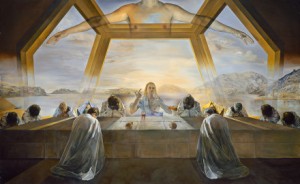
In Salvador Dali’s depiction of the Last Supper, we see the Trinity. The outstretched arms of the Father take in the holy newness of the meal; the good and faithful Son offers himself in the bread and wine; and the Holy Spirit nestles between Jesus’ right hand and cheek. We may need to enlarge and move the image in order to better see this small white dove. In the National Gallery in Washington, D.C. where this painting hangs, visitors are free to step forward and backward in order to bring the Spirit into focus, an exercise that reminds us that although we may not always feel a part of this mystery, it is nevertheless there. We also find that all twelve apostles are present, meaning that Judas Iscariot – who later betrays his friend with a kiss – is also present. Which figure is he? We have no way of knowing. Another mystery that Dali presents to us.
God affirms us, making us a sure thing in Christ, putting his Yes within us. By the Spirit God has stamped us with God’s eternal pledge—a sure beginning of what he is destined to complete.
“What it comes down to is that we are each a transmitter station, a relay station . . . Once I was able to move from pyramid thinking, by reason of the Trinity – ah! Then my mind let go of its own defenses and stopped refusing the universal dance”. (Rohr and Morrell 190)
We’re not in charge of how you live out the faith, looking over your shoulders, suspiciously critical. We’re partners, working alongside you, joyfully expectant. I know that you stand by your own faith, not by ours.
“The love in you – which is the Spirit in you – always show says yes. Love is not something you do; love is someone you are. It is your True Self. Love is where you came from and love is where you’re going. It’s not something you can buy. It’s not something you can attain. It is the presence of God with you, called the Holy Spirit”. (Rohr and Morrell 193)
Rohr, Morrell, and Dali tell us that everything belongs, and everything is holy, even our sins and failures. Rohr, Morrell, and Dali also remind us we are part of this sacred triad. We also kneel as Christ blesses us. We also are swept into the enormous arms of God. We have only to be open to this divine energy in the holy now.
When we compare varying translation of these verses from THE MESSAGE, we begin to sense the reality of God’s pledge that everything is holy. Tomorrow, Corpus Christi and uncreated grace.







 The Noontimes