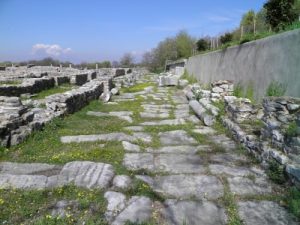
Samaria is located in the northern kingdom of Israel, not in the southern kingdom of Judah. In Jesus’ day, the Samaritans were considered unclean because they intermarried with the northern tribes who invaded to cart away the Jewish nation. They worshipped the pagan gods of these northern people, and so they were no longer true worshipers of Yahweh. Jesus turned the “purist, separatist” convention on its head. He spoke and interacted with Samaritans, and one of his parables compared a Samaritan with a Levite priest who was on his way to the temple and so wanted to remain clean, and so did not stop to help his neighbor who lay gravely wounded in a ditch. This action and these words confounded the people who loyally followed the Mosaic Law. They might confound us today if we are not watchful.
Samaria is the capital of Ephraim, a tribal area in the northern kingdom. According to the notes in the NAB it was “built upon a hill, suggestive of a majestic garland adorning the head of the drunken kingdom.” An interesting image, as are the ones that follow in this chapter. We might be the people who have made a covenant with death, who have made lies their refuge, thinking that “in falsehood we have found a hiding place”(verse 15). Or we might turn to the image of life that Isaiah offers, and Jesus proclaims.
Before we leave the story of Esther, we re-visit a Favorite from May of 2007. Today we consider the nature of our repentance as we move closer to the season of Lent; and we commit to enacting the fidelity, hope, and love we profess.
From the introduction in the New American Bible, “The book was intended as a consolation for Israel, a reminder that God’s providence continually watches over sincererepentance.” We have been hearing about sincerity versus insincerity in recent weeks. And again we see it today.
Yesterday’s first reading is from Sirach 17:24: “But the Lord will allow those who repent to return to him. He always gives encouragement to those who are losing hope.”And yesterday’s morning Psalm was 130:“My soul is waiting for the Lord, I count on his word. . . Because with the Lord there is mercy and fullness of redemption, Israel indeed he will redeem from all its iniquity”.
There is hope for all; yet, how do we show our gratitude for redemption? By being doers of the word and not hearers or sayers only. We show our sincerity before the Lord by not deluding ourselves.
This morning’s reading is one of my favorites from James, “Be doers of the word and not hearers only, deluding yourselves. For if anyone is a hearer of the word and not a doer, he is like a man who looks at his own face in a mirror. He sees himself, then goes off and promptly forgets what he looked like. But the one who peers into the perfect law of freedom and perseveres, and is not a hearer who forgets but a doer who acts, such a one shall be blessed in what he does.” (James 1:22-25)
May we be hearers, sayers, and doers of the Word. May we persevere in our doing. And may we, like Esther, live up to our potential in order that we too may save nations.
The book of Esther, with all of its additions and amendments, is a wonderful story. We must read it when we can.
To learn more about the festival of Purim, click on this image or visit http://www.chabad.org
Monday, February 17, 2025
The jolly festival of Purim is celebrated every year on the 14th of the Hebrew month of Adar (late winter/early spring). It commemorates the salvation of the Jewish people in ancient Persia from Haman’s plot “to destroy, kill and annihilate all the Jews, young and old, infants and women, in a single day,” as recorded in the Megillah (book of Esther). (www.chabad.org)
In our Old Testament thinking, we celebrate victory over plotters who schemed to annihilate us. In our New Testament thinking, we ask God to soften the hearts of our enemies. In our Old Testament thinking, we commemorate the destruction of those who would harm us. In our New Testament thinking, we celebrate their transformation. In our Old Testament thinking, we rejoice with Purim in the month of Adar. In our New Testament thinking, we ask for God’s mercy each day.
We first reflected on this citation in June of 2013. Today, as we seek to soften our own hearts, we remember that just as reversal is always possible for our enemies, it is always possible for us. For this reason, we give thanks for our modern Purim.
Tomorrow, quiet patience and courage.
For a prayer, enter the word Reversalinto the blog search bar and explore.
We have learned from the story of Job that God interacts with us when we argue as easily as when we petition or praise. As we near the feast of Purim, we consider the story of Esther.
Notes and commentaries will help us unravel the confusion of the chapters in this book, and it will be a worthwhile task – for this story is one of the most uplifting in the Old Testament. It reminds us of the fear all humans feel when they see a task looming before them which causes them to faint away. It also reminds us of the surprising gentleness we will find in the heart of an awesome, fear-inspiring king. And it finally reminds us of the courage we receive as grace when we place ourselves in the hands of this king.
Life is difficult. It is threatening, it is sometimes over-powering. Where do we go when we feel panic, anxiety, abandonment, a sense of uselessness or futility? Like Esther, we discard our penitential garments and don our vestments of royal attire. As adopted sisters and brothers of Christ, we take ourselves before our king, we lay our life in his hands, and we petition, even though we may faint away from the effort.
Spending time with this story we remember and reflect on some of its essential elements: we must respond when we are called (4:14), God saves us from the power of the wicked (C:29), those who plot our downfall end by suffering the punishment they would have inflicted on the faithful (6:8-11), hopeless situations can be reversed because with God all things are possible (9:1).
When terror looms before us on the narrow path we follow closely in this journey home, we might cry out like Mordecai: Do not spurn your portion, which you redeemed for yourself out of Egypt. Hear my prayer; have pity on your inheritance and turn our sorrow into joy; thus we shall live to sing praise to your name, O Lord. Do not silence those who praise you. (C:9-10)
And like Esther: MyLord, our King, you alone are God. Help me, who am alone and have no help but you, for I am taking my life in my hand. (C:14-15)
To these prayers let us add our own . . . Amen!
Tomorrow, Mordecai’s Dream.
The citations with the letter C indicate verses from the Greek additions. (Senior 536-537)
Senior, Donald, ed. THE CATHOLIC STUDY BIBLE. New York, Oxford University Press, 1990.536-537. Print.
Job’s “friend” in today’s Noontime lives by absolute, simplistic thinking. Eliphaz tells Job that once he admits his sins, his pain and suffering will cease. We know – because we have looked at this story many times and have paused to ponder the wisdom held within, that Job suffers innocently. His goodness surfaces in a conversation between God and Satan. The devil tells the Almighty that the only reason Job is so devout is because God cares for this servant so well. It is true that for Job, life is good; yet God knows the depth of this man’s love for his creator. And so God tells Satan that he may do anything he likes to Job except terminate his life. God believes that they will see deep fidelity from this servant; he knows that Job will remain faithful. The devil delights in this bargain, believing that humans cannot suffer well, and so Job loses all: his family, his resources, his health. His wife tells him to curse God and die. His three “friends” sit with him and offer the kind of advice we read about today. Job counters repeatedly, never giving in to the temptation to curse God and capitulate. He never loses faith in God. He never loses hope that all will be revealed. He never loses the love engendered in him. He questions God, he defends himself against the poor advice from his “friends” and he waits. He is supremely patient. And he is ultimately rewarded for his fidelity.
Job has the freedom to choose how he will react to the circumstances in which he finds himself. Eliphaz baits him – much like the devil baits Jesus in today’s Gospel (Luke 4:1-13). Jailed, and later executed by the Nazis, Fr. Alfred Delp understands this kind of suffering. He writes . . . During these long weeks of confinement I have learned by personal experience that a person is truly lost, is the victim of circumstances and oppression only when he is incapable of a great inner sense of depth and freedom. Anyone whose natural element is not an atmosphere of freedom, unassailable and unshakable whatever force may be put on it, is already lost; but such a person is not really a human being anymore; he is merely an object, a number, a voting paper. And the inner freedom can only be attained of widening our own horizons. We must progress and grow, we must mount above our own limitations. It can be done; the driving force is the inner urge to conquer whose very existence shows that human nature is fundamentally designed for thisexpansion.
Tomorrow, the freedom to suffer, and final words from Father Delp.
Cameron, Peter John. “Meditation of the Day.” MAGNIFICAT. 21.2 (2010). Print.
Adapted from a reflection written on February 21, 2010.
When you make a decision, it shall succeed for you, and upon your ways the light shall shine.
The Book of Job speaks to those who suffer innocently; and thus it prepares us to better understand the great sacrifice that Christ made on our behalf. Today we read the words of Eliphaz who urges Job to admit guilt so that he may prosper, and we understand that Job’s true freedom comes not from avoiding his calamity, but through going beyond human limits, by turning to God in the midst of this personal cataclysm.
Many times we witness God’s hand in turning harm into goodness. We see those who walk in pride fall by their own hands. We listen attentively to the stories people tell of having been saved, converted or transformed. Through these stories, it is easy to fall into the thinking that those who suffer must have somehow brought the negative consequences they endure upon themselves. We have heard – or we have thought – if the poor would only work they would not be poor, if that woman had not worn that dress she would not have been raped, if the people in that country would choose good leaders they would not experience famine, if people would just behave there would be no genocide. This is simplistic, black/white, off/on, binary thinking. Situations are either good or bad; decisions are either yes or no. With this kind of absolutism, there is no room for the in-between-ness that is the reality of human existence. Nor is there much of a reason to invite Christ into our lives because this kind of living follows a rulebook of regulations and checklists that lead us to see life as best lived by following rules; and this stiffness leads us to think of ourselves first. Christ calls us to liberate ourselves from this bondage and it is this kind of “setting free” that is addressed in yesterday’s MAGNIFICAT Meditation from the writings of Father Delp. He died in 1945, condemned to death in a wave of frenzy in Germany during World War II. He writes about the freedom Jesus offers to Levi, the tax collector, in Matthew 5:27-32. Humans need freedom. As slaves, fettered and confined, they are bound to deteriorate. We have spent a great deal of thought and time on external freedom; we have made serious efforts to secure our personal liberty and yet we have lost it again and again. The worst thing is that eventually humans come to accept this kind of bondage – it becomes habitual and they hardly notice it. The most abject slaves can be made to believe that the condition in which they are held is actually freedom.
Tomorrow, Job’s goodness amidst evil, and more from Father Delp.
Adapted from a reflection written on February 21, 2010.
Cameron, Peter John. “Meditation of the Day.” MAGNIFICAT. 21.2 (2010). Print.
We cannot leave this book of wisdom without pausing to confront the evil that sets this story into motion. If we have time today, we will want to listen to an On Being conversation hosted by Krista Tippet with Rabbi Sarah Bassin, and Imam Abdullah Antepli. The discussion is entitled Holy Envy, and it opens a method for confronting evil in our world.
Once again the sons of God came to present themselves before the Lord, and Satan also came with them.
The image of evil hiding among faithful servants is an unsettling thought. We go about our work or we rest in fallow time, trusting that all will be well, hoping to be children of light rather than the dark. The image of Satan lurking among the holy ones might unnerve us enough to re-examine the opening chapters of this story so that we might see a few details we have previously ignored. Satan reports that he has been patrolling his domain – – – the earth; yet God expresses confidence in the faithful, patient Job.
We do not like to think about evil, and we too often turn away when it enters the comfort zone we have carefully set up for ourselves. Usually we believe that we must avoid evil at all costs, or we believe it is a force that only God can handle. Because we feel powerless, we may not spend much time thinking about what evil is or where it comes from. Yet we must take it seriously while at the same time not allowing it to paralyze us.
Several summers ago, I read a fascinating novel about how the devil takes up residence in our hearts almost without our noticing. The Angels’ Gameis a remarkable story and well worth reading. The author, Carlos Luis Zafón, deftly weaves a tale that at once terrifies and holds us in dreadful yet delicious anticipation of what we know the end to be when we align with malignancy. The story is terrifying in that the reader does not feel God’s presence specifically; rather the reader finds goodness in individual people and from literature itself. In Zafón’s tale, God is found in books and stories, and there is a spell-binding quality to the plot. As I closed the last page, I gave thanks for being in a well-loved vacation place with well-loved and loving people. The force of goodness and God-ness through them put my mind at ease. And it is this goodness and God-ness that Job brings to us today. Job’s fidelity and faith not only make him a target of the envious devil, they also save him. And so we are left to reflect . . .
Once again the sons of God came to present themselves before the Lord, and Satan also came with them.
God is so good that God does not banish Satan from his presence.
God is so good that God does not allow Satan to have the last word.
God is so good that God rescues, saves, heals and restores.
Job puts all of his trust in this God.
Job refuses to bow to social pressure and to pretend that he is guilty of something he has not done.
Job speaks directly to God, and argues with God, asking for answers.
Once again the sons of God came to present themselves before the Lord, and Satan also came with them.
We must not fret about evil, yet we must not forget its presence. When we find ourselves up against one who is a fallen angel, we cannot think that we, on our own, can win against the overwhelming power of Satan. We must place all of our faith, all of our hope, and all of our trust in the Lord. Only this one has the power to convert the aftermath of evil into the goodness of love. Only this one has the compassion to love us beyond the arguing.
Adapted from a reflection written on July 22, 2009.
I once heard a homily on Job 1:6 in which we discover that Satan/Lucifer has to “cover himself” with light. He sneaks into the midst of the holy people in order to be in God’s presence. Yet, God sees him there and asks him where he has been and what he has been doing. Satan replies that he has been on earth, roaming and patrolling. The homilist pointed out that we, God’s adopted children, can come freely into God’s presence but that Lucifer, also known as the Morning Star, has to sneak in when the holy people enter. In other words, the homilist tells us, Satan is going to hang out with people who are clearly doing God’s work and who have free and ample access to the Lord.
Satan brings woes upon Job and for a while, Job is stunned because he does not understand this punishment. His wife tells him to curse God and die; his friends advise him to confess his wrongdoing so that the evil will leave him. Still puzzled, Job feels alone, and these beautiful words in 23:10 describe how we might also feel as we struggle with unwarranted suffering. “I would learn the words with which [God] would answer and understand what [God] would reply to me . . . yet [God] knows my way; if [God] proved me I would come forth gold.”
Still, Satan does not give up and he tries to dupe Job into cursing God. Job thinks that he is no longer in God’s presence; but God has never left him, just as God never abandons us. Satan, in his arrogance and conceit, finally leaves Job alone and goes off to bother someone else. Job continues to worship God from his lonely place, and he continues to make the case with his friends that he is innocent – which he is.
Job is finally rewarded for his argument with the Almighty when God speaks. And like Jesus, The Word Among Us, God replies to our cry for help with questions rather than answers. “Where you there when I created the earth? Are you going to be my critic?”We might think this a cruel response to one in deep pain; but on reflection, we see God’s goodness. It is impossible for Job – or for us – to comprehend creation’s enormous plan. It is alarming for Job – or for us – to see the enormity of our complex universe. It is a colossal challenge for Job – or for us – to react to evil as God does, with an open, forgiving heart.
When we argue with the Almighty as Job does, we – like Job – will want to reply to our living God, “I know that you can do all things, and that no purpose of yours can be hindered.” (42:2) God rewards Job – and us – mightily for being the good and faithful servant who asks questions and argues from a clean heart. With this reward comes fresh hope, new wisdom, and the courage to come forth gold. This a story we will want to ponder, a story we will want to share, a story we will want to argue once again with the Almighty.
Adapted from a reflection written on February 6, 2007.
Looking forward to the end of Job’s story we have the choice of thinking that Job’s happy ending is the result of fantasy, or we may choose to believe that God abides and keeps promises. This choice to believe or doubt is entirely up to us; and I choose to believe that the story is not a fairy tale. I choose to believe that God abides.
THE MESSAGE translation of Job 40 begins with words from God, “I run the universe”. After we struggle with Job through his long story of loss and pain, we understand that although he – and we – long for specific answers to our specific questions, we must be content to rely on God’s goodness and love for us. We must be content to depend on God’s gift of hope and covenant. And we must be content to trust God’s steadfastness and mercy.
How do we do this? We have a model in Job whose fidelity through deep travail brings us a pearl of wisdom that we might employ to see our worries and anxieties through a lens of patience. Job’s persistence, as he journeys through the obstacle course of woe visited on him by Satan, gives us new eyes to refocus our own worldview.
When we spend time with Job 40, we have a fresh appreciation of his steadfastness; and we have a transformative moment to argue with the Almighty that opens us to the possibility of resurrection.
Today we use the scripture links and drop-down menus to help us argue with the Almighty.