Elamiat captives and Assyrian officer. Relief from Ashurpanibal Palace in Nineveh, Iraq
Capture
Thus was Judah exiled from her land . . .
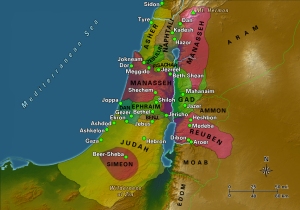
On January 15, 588 B.C.E. (Senior 1016) Jerusalem falls and the people of Judah are captured. History tells us that this people later returns to Jerusalem to restore the Temple and the city – and history also tells us all will be lost again. The human way is cyclical with valleys and peaks. It is an inconsistent wandering of the soul in search of what it already has. The Way that Isaiah announces, The Way we might live each day, is the constant journey of singing and rejoicing in the presence of God, a presence that is already with us.
When the enemy threatens, a highway will be there.
When capture is imminent, a holy way will be there.
When all seems lost, no lion will be there.
When darkness falls, no beast of prey will be there.
When it appears that there is no hope, there is a journey to make, and on it the redeemed will walk.
When we know that we have strayed from The Way, all we need do is be open to change, and we will find that . . .
A highway will be there, called the holy way . . . No lion will be there . . . nor beast of prey . . . It is for those with a journey to make, and on it the redeemed will walk . . . and they will be singing, crowned with everlasting joy . . . they will meet with joy and gladness . . . sorrow and mourning will flee. (Isaiah 35:2-10)
Let us join hearts and hands and souls to journey together along The Way.
Jewish captives with camel and baggage on their way into exile. Detail of the Assyrian conquest of the Jewish fortified town of Lachish (battle 701 BCE) Part of a relief from the palace of Sennacherib at Nineveh, Mesopotamia (Iraq)
Capture
Thus was Judah exiled from her land . . .
In this last Chapter of Jeremiah’s prophecy, we see the capture of mind, soul and body that results from enduring neglect and refusal to do what God asks of us. And we understand that we cannot sustain life when we practice this kind of internal death. We may want to renew ourselves with solutions we think palatable and we may believe that we know the best way to bring goodness out of evil, but we are children playing at being grown up when we prefer our ways to God’s.
Yesterday’s MAGNIFICAT Morning Prayer included a canticle from Isaiah (35:2-4, 8-10): [The faithful] will see the glory of the Lord, the splendor of our God. Strengthen the hands that are feeble, make firm the knees that are weak, say to those whose hearts are frightened: Be strong, fear not! Here is your God, he comes with vindication; with divine recompense he comes to save you. A highway will be there, called the holy way; no one unclean may pass over it. No lion will be there, nor beast of prey go up to be met on it. It is for those with a journey to make, and on it the redeemed will walk. Those whom the Lord has ransomed will return and enter Zion singing, crowned with everlasting joy; they will meet with joy and gladness, sorrow and mourning will flee.
We have a simple lesson here about how to live in a world that constantly runs counter to what the Lord asks of us. The people of Judah are vanquished, their leaders captured, their possessions taken. They become disenfranchised from all that identifies them. They are slaves to another culture. This capture is seen as something bleak and stark, a life without promise; but Isaiah reminds them that – as with all things involving the Living God – what appears to be loss is gain, and what seems to be gain is loss. It is precisely when all that we have and know is taken from us that we are given the opportunity to turn to the font of life. When we are and have little or nothing, there is only God.
Isaiah tells us that in this new life into which we have stepped there is not darkness but rather light. God will announce God’s self with reversals; and a Way will open up before us that we will only see once we have replaced our pride with humility and our desire to be independent from the Lord with a desire to be one with God. Nothing can threaten us when we walk along this Way for it is holy, and once we throw off the values that the darkness of the world has to offer, we will be holy, too. Our step will be quick, our burden light for we will be carried by God. We will also understand that we have a journey to make, a journey of redemption itself.
We, the ransomed, travel not towardthe very one who has ransomed us but withthe Lord. During Advent and the Christmastide we heard Isaiah’s prophecy read out in which the prophet announces The One who is The Way. We have revisited the results of capture and the road beyond that imprisonment. Today we Christ followers know our savior’s name as Jesus. The ancient Judeans could only dream about Christ’s coming. How fortunate are we to travel this highway with him.
Tomorrow, beyond the highway of capture.
Adapted from a reflection written on June 4, 2011.
This Favorite was written during Eastertide on May 3, 2011. We post it today as a reflection on Christ’s inverted transformation of the world, as an offering of peace in a time of trouble.
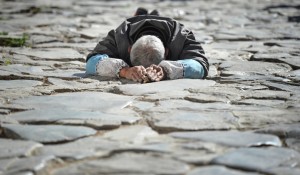
These are such sad verses; the images of the inconsolable one suffering intensely are so very difficult to sit with. We want to rush past them as we sometimes rush past those who are in pain or those who bear the visible scars of their suffering. Yet this is where Christ dwells, with the dispossessed, the broken, and those in the captivity of their addictions. We want our world to be a beautiful and ordered place. We want happy endings and bright, new beginnings. We want perfection and comfort. We look away quickly from pain and suffering. We do not want to be the least uncomfortable. We want all things in neat rows and nice packages, but life is not as tidy as we wish. And yet, when we pause to reflect, we realize that it is.
When we allow pain to convert us, as it will, when we allow God’s hands to heal us, as they will, we see that life is about reversal, inversion, irony and paradox. What appears to be lost is actually found; what we think has gone yet resides within.
Give heed to my groaning . . .
Matthew 19:30: Many who are first will be last and many who are last will be first.
There is no one to console me . . .
Psalm 126:5: Those who sow in tears will reap with cries of joy.
All my enemies rejoice at my misfortune . . .
Psalm 126:6: Those who go forth weeping, carrying sacks of seed, will return with cries of joy, carrying their bundles of sheaves.
My groans are many, I am sick at heart . . .
We are called today to give heed to the message of lamentations, to our own cries and to the cries of the bereft. We are called to take courage in the face of opposition, to the obstacles we put in front of ourselves and to those placed there by others. We are called to give heed to the sadness we experience ourselves and to the sadness we see in others for all lamentation will be transformed into happiness. Of this we can be certain, for this is the Easter message delivered by Christ.
Psalm 30:11-12: You turned my wailing into dancing; you removed my sackcloth and clothed me with joy that my heart may sing to you and not be silent. O Lord my God, I will give you thanks forever.
These are such beautiful verses; the images of a God so loving that all is forgiven, all are blessed. They are so wonderful to sit with. We want to rush toward them as we rush toward the Living God.
Adapted from a Favorite written on December 29, 2009.
Refuge in the Temple
If we go to an Internet search engine and type in the key words “seek refuge in a church,” we may be amazed to see how many articles pop up instantly from places around the globe. Today is the feast day of Thomas Becket, an early British Archbishop murdered in the cathedral of Canterbury. Through ages, humans seek physical, emotional and spiritual shelter in a structure built by human hands. Today’s psalm, commentary informs us, is the lament of an individual unjustly attacked who has taken refuge in a temple. “Confident of being found innocent, the psalmist cries out for God’s just judgment (1-5) and requests divine help against enemies (6-9a). Those ravenous lions (9b-12) should be punished (13-14). The psalm ends with a serene statement of praise (15)”. (Senior 657)
I call upon you; answer me, O God. Turn your ear to me; hear my prayer.
B. Child: Thomas Becket
We might seek refuge from our own terrors by looking inward to that place in which Christ dwells in each of us, by searching for and finding that quiet temple within, by being still so that we might hear the words of comfort that will settle our fears.
Turn your ear to me; hear my prayer.
Jean Vanier
From yesterday’s MAGNIFICAT Meditation of the Day by Jean Vanier who sees Christ identify with the poor when he is born into the world to Mary and Joseph: How can God who is all powerful, all beautiful, and all glorious become so powerless, so little so weak? The logic of love is different from the logic of reason and power. When you love someone, you use her language to be close to her. When you love a child, you speak and play with him as a child. That is how God relates to us. God becomes little so that we will not be frightened of him, so that we can enter into a heart-to-heart relationship of love and communion.
The logic of the world tells us to fight, to beat others out, to be the first, the best, or the brightest. Our culture rarely tells us to take a deep breath and think before we buy, speak, or accuse.
My ravenous enemies press upon me; they close their hearts, fill their mouths with proud roaring.
The logic of love tells us to act for others who are marginalized, to witness, and to take refuge in the temple when we are persecuted. Then we will be filled with God’s presence so that we might better face the challenges before us.
When I awake, let me be filled with your presence.
When we are troubled, when we are accused, when we are anxious in any way, we might turn to the temple for refuge. There we will find a child who embodies the inversion of all that assails us. It will be this child who will show us the way to serenity amid turmoil. It will be this one who will bind up our wounds. It will be this one who fills us with a presence that is more powerful and more loving than any other we can ever know.
So let us begin the new year by packing up our woes, and taking refuge in the temple of God’s vulnerable love.
Adapted from a Favorite written onDecember 4, 2009.
The Presence
Today’s reading gives us the core of Jesus’ message: Resist evil and take no revenge; love our enemies . . . intercede for those who do us harm. This is a difficult teaching, a complex lesson that unfolds to us as we live each day. When we unwrap the bundle of fear and anxiety we feel, we begin to understand pain and suffering and because we might be consumed by it, we want to step away, but we cannot. We must open ourselves to transformation by our willingness to be vulnerable just as Jesus does.
It struck me this morning as Mass began that of course God comes to us an infant needing our care and attention. He submits himself to our ministrations – no matter how adequate or inadequate – and by this example he shows us how we too, are to live. And if we allow him to subsume our entire being, we will realize that this presence of Christ in us is The Presencewe continually seek.
From this morning’s mini-reflection in MAGNIFICAT: The lowly will find joy and the pure rejoice. Why? Because of a Presence that even a blind man can sense . . . because it is the Presence we have been waiting for all our life.
Because Christ brings us a message of inversion, he comes to us as an extraordinarily powerful sovereign and creator in the form of a human infant. This is a revolutionary idea. It is an existence that challenges all that has gone before. It is in this humble form that Jesus first draws us in to later invite us to intimacy withhim.
It is this intimacy, this presence, that we know we are missing – and that we try to fill with immediate pleasure and satisfaction.
It is this communion, this presence, that we constantly seek in all of the places that we will not find in the emptiness of success, money and power.
It is this love, this presence, that manifests itself – and that asks us to manifest our own selves – by praying and by acting on behalf of our enemies.
I have read the prophet Isaiah many times and yet this morning as I read out the first reading at Mass, I was struck by this verse (29:24): And those who err in spirit will acquire understanding, and those who find fault will receive instruction. Learning about Christ and learning how to live in Christ is a continual process into which we are always welcome to enter – at any time – in any circumstance. Even those of us who come late to the lesson, or those of us who come with unwilling heart will eventually arrive at accepting the message we do not want to hear which is: We save ourselves by loosing ourselves to Christ; we fill ourselves by emptying ourselves of all that is worldly; and we find The Presence we have always been seeking when we rest and act in the love that is Christ.
Cameron, Peter John, Rev., ed. “Mini-Reflection.” MAGNIFICAT. 4 December 2009. Print.
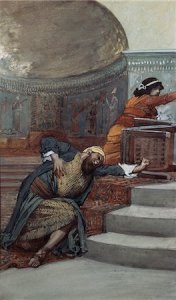
Jacob Willemsz de Wet the Elder: The Meeting of David and Abigail
Yesterday we spent time with David, Saul, Nabal and Abigail. Today we examine the life of Jesus and how or if it influences our own inverted lives.
Jesus comes to tell us that when we lose, we win, and when we win, we lose. St. Paul reminds us that when we are weak, we are strong and when we are strong, we are weak. Intellectually we might come to understand that when we die we live and we live we die, but it takes spiritual fortitude to live a life of inversion. If we can stand back, let God operate, listen for God’s voice, we are able to cooperate with God. As we pray, wait and communicate with God. We achieve God’s purpose in us.
Julius Kronberg: David and Saul
We can take a lesson from Nabal, Abigail, David and Saul. We see different courses of action open to us in the lives of these four people. And if we are honest, we can see that we have the same options. We can choose to reject God for the sake of self, or to abandon self in order to do God’s will. As we see today, each of us is free to opt in or out of God’s plan.
So this is all that God asks of us: to act only in God’s interest rather than our own, to do only God’s justice rather than take revenge or hold grudges, to bring hope to the hopeless rather than succumb to despair, and to love as God loves. God asks that we do this with compassion instead of leniency, with mercy and understanding rather that possessive control and manipulation.
So what does God’s inverted kingdom offer and how do these stories show us God’s hope in us? God wants only our best, our purest, our humblest selves. God wants only to share hope with us. And God wants us to be completely free to choose this marvelous plan of inversion and love.
Today and tomorrow we remember this Favorite from October of 2007 as we explore how the story of David, Saul, Nabal and Abigail presage the coming of Christ’s inverted kingdom.
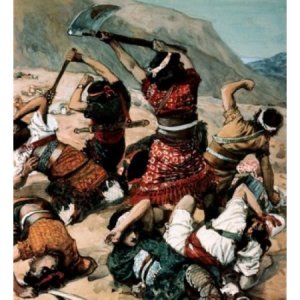
Reading closely, we see that Saul fears David because he sees how closely David follows God. This obedience threatens King Saul and even stirs envy. He knows that despite the favor God has shown him, he struggles to obey.
For his part, David refuses to kill Saul, even when he has been presented with opportunities to do so. David understands that God has anointed bothmen as present and future king. He also understands that God’s plan is the ultimate plan and, unlike Saul, David does not succumb to the sin of “pride of self.” David understands that his authority comes from God, not from his own cleverness, good works or talent.
This interplay infuriates Saul who attacks David and then ostracizes him. In the ensuing battles, David repeatedly spares Saul’s life – which angers Saul even further. We might see these same dynamics playing out in our own lives. If so, let us see where we stand and who we are. The loyal and vulnerable David or the troubled, envious Saul?
Joseph Schonmann: David and Abigail
In today’s story, we read about Abigail, an intelligent, reverent, patient woman, married to an alcoholic. She does not succumb to the twisted world of co-dependence and she understands that she is powerless in the face of certain “givens” of ancient times. She has little influence in the affairs of her husband; yet she lives her invisible life in a visible way. She must take sustenance from her confidence in God, act in a way that does not enrage an already angry master, and she must address injustice as best she can. Throughout this ordeal, we see that she continues to rely on God.
We also see the loyalty of Abigail’s servants. Knowing of the struggle between Saul and David, they realize that their entire household is naked against the band of David’s rebels. They are also keenly aware that their master is wealthy but a drunkard; and that his churlishness has placed them in a dangerous situation. They go to Abigail who takes action in a calm, quiet and respectful manner. She wins their safety, and then waits until the morning when her husband is sober to let him know what she has done – that she has saved them. The hand of God acts to seal their safety as we see the results of Nabal’s courage.
As we reflect on these ancient tales and see the lessons of inversion – where the strong are weak and the weak are strong – and we anticipate their unfolding in the New Testament story of Jesus of Nazareth.
We have reflected on the marvels God worked for Ezra and the Israelites who returned from exile. We have considered the marvels God works in our lives, and the miracles Jesus brings to us. We have deliberated on the nature of the Holy Spirit who dwells in the newtemple of our hearts. Today we turn to a well-known story from the New Testament as we also consider the human deeds at which Jesus himself marvels. And we celebrate the great gifts God gives us freely. Rebirth. Renewal. Rejuvenation. Restoration.
James Tissot: Jesus Raising the Son of the Widow at Nain
This is the message of today’s reading of the two stories TheHealing of a Centurion’s Slave and The Raising of the Widow’s Son. A pagan master who is more giving, loving, hope-filled and faithful than the people of Israel stirs the Messiah to act with compassion. A woman whose only son dies moves the Teacher with pity. So too can we move the Christ and be moved by him. When we read these stories we understand fully how much God forgives, how much God yearns for union, how much God wants our trust, how much God is present to us . . . constantly.
From today’s MAGNIFICAT:
You are faithful in your forgiveness: strengthen in trust all who fear to approach you in the sacrament of penance.
You are gracious to all who come to you: make gracious all who represent you in the presence of sin and suffering.
You are merciful to all who turn to you for help: enlighten in wisdom all who have the opportunity to encourage others in prayer.
You forgive every human failing: preserve us from the temptation to trap others in their sins by passing on small-minded gossip.
So wide is God’s mercy that no sin is too great or too small for forgiveness. So much narrower is our charity that we often find the small annoyances the hardest to forgive. The more we turn in prayer to the all-forgiving God, the more we will become like him in extending the hand of pardon to others in every daily circumstance.
God is not afraid of sin. We are. God does not take revenge. We do. God wants perfect union with us. And we are invited in to perfect union with Christ.
God does more than sustain and nourish. God is constantly present. God heals. God renews. God will even resuscitate. We demonstrate our belief in all of this when we take our small and large problems to God. And we demonstrate our love God when we act in deep and abiding trust – even as we marvel at God’s great work in us.
Adapted from a Favorite written on September 19, 2008.
Cameron, Peter John. “Prayer for the Morning.” MAGNIFICAT. 19.9 (2008). Print.
We have recently lived through another cycle in which a few believe that not only are they beyond any human measure, they are also beyond the need of divine marvels. We might look at these modern-day versions of corruption and believe ourselves removed. We may look at the Israelites of Ezra’s day who return to their burned out city to work for its restoration and think that we would not have erred as they did. We watch as they promise that never again will they forget the gift of Passoverwhich they have received, and we will also watch as we read the New Testament story in yesterday’s Gospel in Luke 13:10-17 as we see the leader of the synagogue complain because Jesus cures a woman on the Sabbath. On that day the whole crowd rejoiced at the splendid deeds done by him.
We ask ourselves the following questions. How easily do we forget our pattern of looking out for self rather than the group? How often do we place ourselves beyond the norm and sometimes attribute gifts to ourselves which rightly belong to God? Why, when we read about these exiles, do we look away from the Levites who fall into the same corruption for which this tribe now repents?
Reflecting on all of this, can we see that the best safety and surety we can seek is not the amount of money or power we can amass; but rather our relationship with God? Can we acknowledge that it is God who comforts and God who is present in every minute of our lives? Our cleanliness and lack of corruption do not stem from any rituals we perform or any friends we might have; but rather, we sleep peacefully, we work willingly, we play joyfully and we love openly when we remember well the marvels the Lord has done for us.
For more reflections on the marvels God has worked for us, explore posts in the Miraclescategory or on the Miracles page in this blog.