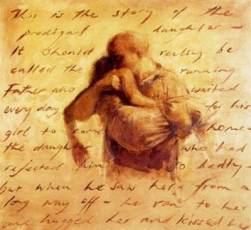
“Hosea was instructed to take Gomerback, redeeming her from her paramours. On condition of her amendment, she will be restored to her former position of wife. This in turn signifies God’s enduring love for his people. He will put the people through a period of trial – the dissolution of the kingdom – in order that they may return to him wholeheartedly”. (Senior 1111)
So he bought her for fifteen pieces of silver and about ten and a half bushels of barley. Then he said to her . . . “I in turn will wait for you”.
It is only a fully good and gracious God who can take back one who has sunk so low as to have given herself to swine.
It is only a faithful and patient God who can take back one who has scoffed and scorned a love fully and freely given.
It is only a hopeful and healing God who can redeem and restore one who has sinned so egregiously.
We shall come trembling to the Lord and to his bounty . . .
We shall be like grains of sand of the sea, which can neither be measured or counted . . .
We shall be called “Children of the Living God” . . .
Castor and PolluxWhen reading this chapter with footnotes, we will understand that calling a piece of wood here is a reference to the custom of calling upon the twin gods of Castor and Polluxfor safety at sea. “St. Elmo’s fire, the electric discharge from the ship’s mast during a thunderstorm, was regarded as their corporeal epiphany”. According to Cyril of Alexandria (commenting on Acts 28:11), it was especially an Alexandrian custom to have pictures of the twins to right and left of the ship’s prow”. (Meeks 1519) The opening of this chapter reminds us of how foolish we are to pray to gods who do not exist when we will be wiser to appeal directly to God’s providence. [I]t is your providence, O Father, that steers its course, because you have given it a path in the sea, and a safe way through the waves, showing that you can save from every danger, so that even a person who lacks skill may put to sea.
I am thinking of the image of each of us as we put to sea each morning when we rise, to sail through the waters of the day, hoping to return to safe harbor at night. Some of us are more skilled than others at navigating the waves of life, but when the storm clouds brew above us and the sea churns beneath us . . . who among us is not tempted to reach for a personal talisman as a security blanket to see us through? When we sail with God, our expertise does not matter because even a person who lacks skill may put to sea.
Notes tell us that verses 6 and 7 refer to the Ark of Noah and the wood of Christ’s cross: For even in the beginning when arrogant giants were perishing, the hope of the world took refuge on a raft, and guided by your hand left to the world the seed of a new generation. For blessed is the wood by which righteousness comes. These wooden objects save, because they are instruments of salvation that come directly from the Father.
John Peter Glover: St. Elmo’s FireThe rest of this chapter tells us that the idea of statue-making and idol worship is an invention of man when turning away from God. We might smile when a friend or relative confesses an addiction to a pet superstition. And we can understand the comfort that this panacea may bring . . . but the relief from anxiety is temporary . . . and lacking divinity . . . and eventually leading us to a destructive end.
It is difficult to give up our folk customs which give an immediate but false sense of security. It may be frightening to put away old habits that lead to a temporary reprieve from worry; but then is it not even more frightening to embark on life’s tide each day without the master pilot in our ship? Is it better to appeal to these short-lived superstitions . . . or turn to God who upholds us infinitely?
Psalm 107 – Some sailed to the sea in ships . . . They reeled like drunken men, for all their skill was gone.
The Morning StarStepping out on our own is impossible, even with a million potions, sayings and powers in our hands. Setting sail in a boat fashioned by the master shipbuilder’s hands, with sails sewn by his angels, with charts, sextant and compass as gifts from God . . . setting our course by the Morning Star. . . this is the wisdom that always leads us home.
Meeks, Wayne A., Gen. Ed. HARPERCOLLINS STUDY BIBLE (NRSV). New York, New York: HarperCollins Publishers, 1989. Print. (Meeks)
The nameless woman returns to her city and as her foot touches the threshold . . .This is a story which tells of the two kings of the split kingdom of David – Israel with her king Jeroboam in the north and Judah with her king Rehoboamin the south. Notes, websites and histories can give us a visual of the lineages and a few are listed below.
What we miss when we read history without scripture is the detail, and we have it in abundance in this short chapter. There is the child, Abijah, the two kings, the wife who is not named and Naamah, the mother who is. There are other ancillary characters. http://bible.cc/1_kings/14-1.htm
We can put ourselves in the timeline and in the space to try to see, hear, smell and hear these sights and these people . . . but what strikes me is this . . . this is a story which might happen to any one of us. And who am I?
Am I the nameless wife and mother who fears the death of her child? Am I married to the son of Solomon who finds his kingdom split? Am I the besieged king or the aggressor, the shield maker, the guard, the prophet, the chronicler? Do I have a loyalty to the north or south? Do I believe Jeroboam to be maligned or do I know him to worship idols? Do I follow Rehoboam blindly or do I question? In this vivid picture . . . Where am I? Who am I? What am I doing?
We know that Jeroboam feared re-unification of these split kingdoms because he would no longer collect the temple worship taxes which he now did since setting up his own capital. We know that Rehoboam, son of Solomon, scrambled to keep these two territories united, fearing invasion from Assyria, Persia, Egypt and others. We know that one king was buried with honor and the other was not. And we know why.
I have such empathy for the nameless woman in this story. She dies as she is bidden yet she is powerless before these men and apparently before her God. She moves like a shadow.
I also have empathy for the woman Naamah whose son leads Judah to do evil in the sight of the Lord. What does she think of the cult prostitutes the leadership has encouraged? Does she agree that they are a means to worshiping God? Does she dare to speak if she disagrees?
What do these women think? What do they say? What do they hold dear?
Today’s story calls us to think of our journey . . . do we travel light . . . do we travel alone . . . where do we stop along the way . . . what waters and feeds us?
The nameless woman in today’s story is told that her child will pass away as she returns home . . . so in that moment she knows that she will not see him again. What does she feel?
The nameless woman in today’s story returns to her city and as her foot touches the threshold . . . her child dies. What does she say?
The nameless woman in today’s story sees her child buried . . . with all of Israel mourning. What does she pray?
Oh, Father in heaven, spare us from the tragedies which are too hard to bear. Save us from the people from whom we might suffer irreparable damage. Keep us always close to you. Protect the ones we love. Save us from harm. Feed us. Nourish us. Be our column of smoke and fire and protect us on our way as you did the Israelites who journeyed out of slavery and into freedom with you always guiding. Alert us to the dangers. The noise of this world is sometimes so overwhelming. Sound the alarm when we stray. Hold us closely. You are our rock and our refuge. We give thanks to you, our awesome God. Amen.
Written on January 13, 2008 and posted today as a Favorite.
“I was still occupied with this prayer when Gabriel came to me in rapid flight”.“A pressing theological question asserts itself. Does the writer of Daniel think God’s purpose in bringing history to its end can be changed merely by uttering human prayers?” (Mays 631-632) Commentary will enlighten this passage for us further but if time is brief today we might reflect on this one question: How do we react when we discover that a period of trial will last longer than we had first believed? How do we manage pain that endures not seventy years but seven times that number? Do we reject God in anger or do we go to God in faith? Do we sink into private despair or do we turn to God in universal hope? Do we lash out against those who bring us truth or do we react in love . . . even toward our enemies? What do we do when we find out that our seventy years of pain are seven times that number? How do we endure?
Daniel provides us with a model, a plan, a pattern we can follow when we receive the news that life is a string of trials interspersed with little triumphs. Chapter 9 lays out a simple map.
I turned to the Lord, pleading an earnest prayer . . . We turn to God and pour our fears into God’s ear. We tell him our worries with honesty. We do not hide any of the details for God already knows them.
With fasting, sackcloth, and ashes . . .We make an outward sign to our inward selves that we have given over all control to God. We put aside all pride. We place ourselves fully into God’s hands for God already holds us firmly.
I prayed to the Lord my God, and confessed . . .We enter into an open and straightforward dialog with God. We say all that is on our minds, all that weighs down our hearts. We admit that we have erred and have sometimes adored false idols.
And we can turn to God because God is good. We can be truthful with God because God is forgiving. We can put away our fears, our defenses and our weapons because God is love.
Know and understand this . . . Jerusalem was to be rebuilt . . .
When we discover that our suffering will not be ending when we first believed it would . . . we can follow Daniel’s model and remember that God always loves, God is always present, God always forgives and welcomes his tired ones home. God does, indeed, respond to human prayer . . . and he sends his messenger to bring us the news that God is with us.
More notes on Daniel9: “The prophet Jeremiah(25,11; 29,10) prophesied a Babylonian captivity of seventy years, a round number signifying the complete passing away of the existing generation. Jeremiah’s prophecy was fulfilled in the capture of Babylon by Cyrusand the subsequent return of the Jews to Palestine. However, the author of Daniel, living during the persecution of Antiochus, sees the conditions of the exile still existing; therefore in his mediation, he extends Jeremiah’s number to seventy weeks of years (v 24); i.e., seven times seventy years, to characterize the Jewish victory over the Seleucidsas the ultimate fulfillment of the prophecy”. (Senior cf. 2, 1100-1101)
To re-visit our reflections on other portions of Daniel 9: We begin with Daniel seeking Ultimate Fulfillmentin God; Daniel intones a Prayer in the Desert; then suddenly Gabriel Comes to Daniel in rapid flight. A vision ensues through which Daniel understands that an end will come to the anguish he and his exiled nation suffer . . . but this end is further off than anticipated.
Tissot: Michal Despises DavidYesterday we spent time with the opening portion of this chapter; today we focus on the rest of the story. Just as we are given an opportunity to see the realities of life in the story of Uzzah, we are given the chance to see our own reality in the story of Michal.
It has been noted that Michal is the only woman in scripture described as loving a man who does not love her in return. As with many women in scripture she is used by a pawn. In this case it is her father and husband who exploit Michal . . . the two men closest to her . . . the two men charged with her protection. Again as a child I saw her circumstances as out of her own control and I saw her life as one of deepest betrayal. As with the tale of Uzzah, we turn to commentary to ask why in 1 Samuel 19 to find that David and Michal had pagan statues in their household and we might nod smugly and knowingly and comment that perhaps she suffered for bringing idol-worship into her home. If we spend time reading the scattered fragments of Michal’s story we pull together the threads of her life. As a child I saw her as a victim; as an adult I understand that there are far too many circumstances beyond Michal’s control and I watch as she sees all her dreams melt away into nothing. I begin to understand how her passion becomes loathing.
As we grow in God’s love begin to understand that with mercy there are no bounds; we see that justice is best delivered in God’s time and according to God’s plan; we know that love carries with it the dark potential to become great hatred unless it is founded in God. As with the story of Uzzah yesterday, we see that life defies description. Again we learn that what looks correct may not always be correct. And we feel the full force of the lesson that we cannot make events occur nor can we prevent circumstances from overtaking us. We can rest only in the surety that God is in us, that we are in God, and that our relationship with God is the only eternal and permanent promise that matters.
Uzzah, Michal and David teach us much. Their stories might embolden or frighten us. Their circumstances may cheer us or depress us. Their lives may dissolve or transform us. But in all of this, as we examine the lives of Uzzah, Michal and David . . . we have much to think about today.
Scholars will tell us if Jesus here (and in Mark 9:42-48) is referring only to children when he speaks of the little ones or if he means those who have faith as a child does. In either case the warning is clear: We must beware of ever leading the innocent and trusting astray for the consequences are great.
In speaking with friends recently I have shared my thought that God is so generous and so magnanimous and so loving that he gives us an infinite number of opportunities to come to him and to behave as the very children he seeks to protect in this reading. Hell, in this scenario then, is the endless returning to conversion for those who refuse to enter God’s plan. It seems a just consequence to me that those who abuse others might finally submit to the infinite kindness and mercy they have so often thrown off and this is surely their Gehenna.
The Wedding BanquetWe have also spoken about the language of heaven that is spoken by those who understand and enact the words of love that God lavishes on us. For those who will not enact the plan of discipleship God has given us, there will be no way of communicating with others when we pass into the next life. Hell, in this scenario, is being present – but completely invisible – at a marvelous party. In this case those who refuse to prepare for The Wedding Feast as Jesus warns in his parables of the Ten Virgins and The Wedding Garment will not have the tools needed to be visible in this new world of joy, compassion, and loss of self in the service to others. And this is surely a version of Gehenna.
The Virgin Preparing Her Lamp at MidnightIn both of these cases, those who deceive, deny, manipulate, defraud, slander, steal and reject life in this world will have no calculus to understand the celebration they see in the next. They will have only honed their own dark instruments of death and so they will have no mechanism to understand or to enter into God’s joy. This then is Gehenna. It is a shadow world that they, and we, hope to avoid.
How difficult is it then, to prepare our own wedding garment? What does it cost us to be good stewards of the oil in our lamps so that we are ready for the bridegroom when he arrives? What is the true price of neglecting Jesus’ charge to treat the little ones well?
We will want to spend time with these questions today.
We might take time today to pause and reflect on the marvelous stories we find in this first Book of the Bible; we see humanity with all foibles and glories. Today’s Noontime is no exception to this for today we read about Isaac, the precious son of Abraham and Sarah, and we anticipate that we will hear only good of him then we will have miscalculated God and his plan for us. We will have missed the valuable lesson that the patriarchs and their families who established and passed on the covenant with the Living God are to be seen as ordinary people who make ordinary mistakes in their ordinary lives. These people about whom we read are us.
When we allow ourselves to spend time with a commentary as we sift through the details of this story, we will see that the players in this drama behave much as we do today when faced with moral, physical and political dilemmas. They weigh odds and consequences. They make decisions. They have regrets, experience deep suffering and great joy. They find that life holds no guarantees as they duplicate the labor of previous generations by re-digging Abraham’s wells. They plan and execute deceptions and endanger their tribe. They work toward and achieve success and so become objects of envy; and they are eventually sent away from the place they have made their home. They are persecuted, separated and marginalized, and they watch all that they have gained through labor move into the hands of others. Their prosperity has become their curse. Isaac, Rebekah, Abimelechand the others live out their lives struggling against their shifting circumstances and as they do they teach us much.
There was a famine . . . We too, suffer from famines and dry times in our lives, asking God what we are to do and how we are to do it.
So Isaac settled in Gerar . . . We too, make decisions about our families, our health, our jobs, hoping that we have not missed an important detail.
Isaac was afraid that if the men of the place would kill him on account of Rebekah because she was very beautiful . . . We too, enter into deception impelled by our fears.
Isaac sowed a crop and reaped a hundredfold that same year and the Philistines became envious of him . . . We too, experience prosperity that can bring problems of its own.
Isaac went up to Beer-sheba . . .We too, move house, change jobs, enter into and leave relationships as life pushes and pulls at the details of our living.
And all the while, as we are re-digging the wells first begun by our ancestors and as we call and count on God, others watch us to see what holds us up through struggling, what brings us peace in turmoil, what sustains us in desperate times. And we might pray that despite our deceptions, and despite our fears we will have lived a life worth watching. We may pray that our own Abimelech will come to us to ask: We are convinced that the Lord is with you, so we propose that there be a sworn agreement between our two sides – between you and us. Let us make a pact with you.
And when Abimelech offers this tangible sign of peace, let us also pray that we will be generous in our reply as Isaac is. And let us hope that we too, prepare a feast of celebration that God has been with us and that despite our weaknesses . . . we have witnessed to the goodness of God.
Your precepts become my songs wherever I make my home.
We move to a new home, we change our telephone number . . . yet God is always with us.
Your decrees are the theme of my songs wherever I lodge.
We lose contact with long-ago companions, we form new social connections . . . yet God is always in our circle of friends.
Your statutes have been like songs to me wherever I have lived like a stranger.
We experience the loss of someone dear to us, death arrives too early or too late . . . yet God is constantly beside us.
Your laws have become like songs to me in this place where I am a foreigner.
We find ourselves in conflict with our colleagues, a familiar face in the workplace is suddenly gone . . . yet God shares our load of work each day.
Your statutes have been my songs of praise wherever I have lived as an immigrant.
We discover that our norms have become old-fashioned; our habits are the subject of ridicule . . . yet God walks with us as we find our new way.
Your laws have been my songs in the house of my pilgrimage.
We realize that with every sudden change and with each new turmoil we have one place of comfort that will remain the same. We have one sure, steady hand. We have one eternal, constant heart . . . the heart of God who is faithful.
Your precepts become my songs wherever I make my home.
It is in the heart of God where we might best make our constant home.
Hot Springs and Arena in Ancient TyreTyre is a city off the southern coast of present day Lebanon and it is linked to the mainland by a causeway, or siege ramp, built by Alexander the Great at the end of the fourth BCE. It consists of both a mainland city and an island, has two harbors and most likely because of its vantage point, it was the leading city of Phoenicia in the millennium before Christ. One can read about the early kings of Tyre in the works of the Jewish historian Josephus but it becomes important for scripture readers when Hiram, the king of Tyre, provides pine and the renowned tall cedars to David and Solomon for use in the construction of the Jerusalem palace and temple. Tyre is eventually invaded and destroyed by the Babylonians.
Tyre is also famous as the hometown of Jezebel, the wife of Ahab, who convinced her husband to take over the vineyards of the peaceful man Naboth, who persecuted prophets, lured her husband into worshiping the gods of the Baals, and who came to an ugly death . . . just as had been predicted by prophets. (1 Kings Chapters 16, 18, 19, 21 and 2 Kings 9) Hers is a fascinating story of meteoric beauty, power and fame. She was a princess of Tyre, rising and falling in a quick but dramatic arc across ancient history.
In today’s reading we read a lament for Tyre and a prediction of her downfall, with the wreck of the ship and all she carries as allegory. The HARPER COLLINS COMMENTARY describes this oracle as beautifully crafted, and Ezekiel laments the anticipated destruction of Tyre at the hands of the Babylonians. This perfect, proud and stately beauty is lost to the storm and settles forever at the bottom of the sea. Thou art brought to nothing, and thou shalt never be anymore.
So much pride lost, so much sorrow experienced, so much pain endured. Yet in today’s MAGNIFICAT Meditation we read: The heart of man, so deep for misery, is deeper far for happiness! Misery comes to him from accident, happiness from his nature and his predestination. Father Henri-Dominique Lacordaire
We are creatures meant for joy, not for sorrow. We are children meant for resurrection, not for darkness. We brothers and sisters of the same father meant for life, not for death.
Written on April 12, 2008 and posted today as a Favorite.
 Hosea 3: Triumph of Love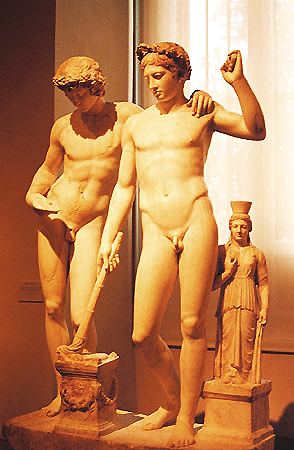






 The Noontimes