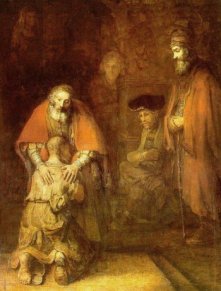
Rembrandt: Saul and DavidSeveral weeks ago, we reflected on celebrating escape from something or someone who would have brought us great ruin or harm. Yesterday’s Gospel gave us the opportunity to examine how Jesus is able to escape the traps laid for him by those who hated him. Today we take a look at a small portion of the story of David, the young man who is designated as King of Israel by Samuel but who waits his turn as leader of God’s chosen people by resisting the temptation to fight against Saul. David does not deny that he has been chosen King, nor does he murder Saul in order to take what is his; rather, he abides in God’s will and God’s time. And he takes the routes of escape that God offers while he actively waits on the fulfillment of God’s plan.
Today we read the story of how God saved his imperfect yet faithful servant and we are no less than David.
Today we read the story of how David relied on his God’s constancy and he did not allow fear to turn him toward revenge or cowardice.
In yesterday’s Gospel (Matthew 22:15-21) we read the story of how Jesus confronted prejudice and hatred and we do well to follow his example.
In yesterday’s Gospel we were given a road map for how to escape manipulation and scheming. We must rely on God always, remain faithful to the covenant God shares with us, and always act inlove and forlove of God. In this way we will always know escape from anything danger or evil that hopes to overtake us.
And so we pray . . .
When the call to do God’s work pulls us into alien and dangerous territory, we must rely on God’s wisdom and not our own.
When the hand of God heals us and then sends us out to do God’s work, we must rely on God’s fidelity and nurture our own.
When the voice of God urges us to work in fields are that unfamiliar to us and that sap our energy, we must rely on God’s strength and conserve our own.
When the heart of God sends us to work with those who would do us harm, we must rely on God’s love and hope for redemption. Amen.
Soord: Lost SheepWe have read about Jeremiah in the dungeon (Chapter 37) and Jeremiah in the miry cistern (Chapter 38); now we read about his capture and that he remained among the people. Just yesterday I spoke with a friend about her reluctance to do something that would cause her great pain. I said that rather than focus on the suffering that an experience was bound to bring her, she might just want to focus on tending to God’s lost sheep. This was something she said she could do. I had heard the Jeremiah in her anticipate the lack of understanding she was about to meet. I heard her fear of her own unpredictable emotions rising. We spoke about patience, persistence and witnessing. And we spoke about how we cannot control people or events, of how we can barely sometimes control ourselves. Life brings us these difficult lessons to learn. Life also brings us unmeasurable reward, if we only learn to remain among the people.
Yesterday’s Gospel reminded us of something we may want to carry with us everywhere and it is this: When we are fearful of something we must do we are likely relying on ourselves too much. And we are likely forgetting to rely on God. Jesus tells his disciples in Luke 12:8-12 that we need not worry about our circumstances – even when they are dire – if we remain in him, in God. When we allow the Spirit to direct us, we cannot fail. When they take you before synagogues and before rulers and authorities, do not worry about how or what your defense will be or about what you are to say. For the Holy Spirit will teach you at the moment what you should say. Jesus may be remembering the words from Isaiah 30:21: From behind, a voice will sound in your ears: “This is the way; walk in it,” when you would turn to the right or to the left. Both the Old and New Testament remind us that when we live in the Spirit, we cannot falter. When we remain with God’s people, we will not go wrong. When we follow Christ, we may suffer but we will never be lost.
We are often reminded to witness, watch and wait on the Lord and so we pray from Psalm 5 in today’s MAGNIFICAT Morning Prayer: It is you whom I invoke, O Lord. In the morning you hear me; in the morning I offer you my prayer, watching and waiting. You are no God who loves evil; no sinner is your guest. The boastful shall not stand their ground before your face. But I through the greatness of your love have access to your house. I bow down before your holy temple, filled with awe. All those you protect shall be glad and ring out their joy. You shelter them; in you they rejoice, those who knew your name. It is you who bless the just one, Lord: you surround the just one as with a shield.
I asked my friend to see herself as a shepherd who gathers lambs to bring them into the fold at night. I asked that she put all her worry into prayer. And I asked that she rely on God to bring goodness out of harm.
In the end, Jesus reminds us, God is all there is. In the end, we do not want to wait on anyone or anything else. In the end, all that is asked of us is that we witness, watch and wait. Rather than succumb to the familiar fears that govern us poorly and use us badly, we will want to remember to gather ourselves and to gather lost sheep even as we remain among God’s people.For it is in, and of and through Christ that we are saved and brought back to God. It is in, and of and through the Spirit that we are consoled. And it is in, and of and through God that we are made whole. And in the end – when we can manage to remain with God’s people – we remember well that . . . God is all there is.
Cameron, Peter John. “Prayer for the Morning.” MAGNIFICAT. 16.10 (2011): 239. Print.
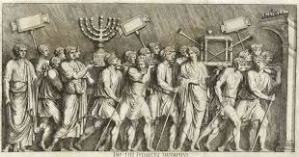
Francesco Hayez: The Destruction of the Temple of Jerusalem
The first 40 chapters of this prophesy are written predicting the doom and fall of Jerusalem; and Ezekiel was mocked for believing that the impregnable Jerusalem – jealously guarded by Yahweh – would fall to the pagans. History reminds us that in 597 B.C.E. Nebuchadnezzar and his troops swarmed into the city and violated the temple, sacking it, killing the Jewish soldiers, taking Jewish captives and carting off all that had value to Babylon. The Jewish nation had lived too long in false security, thinking for too long that they were unbeatable as a kingdom, invincible as a nation, indestructible as a people. They had not understood that it was their own actions that threatened their safety rather than the foreign troops. Their refusal to adhere to the spirit and the letter of the Mosaic Law had left them vulnerable.
It is too often true that as humans we do not realize our lack of understanding until we lose what we hold most dear; and this is why there is something recognizable in the eyes of a fellow mourner that tells us when our sadness is truly felt by another. It is impossible to counterfeit soul-wrenching mourning. Nothing deceives those who have lost, those who have grieved. Like the witnesses to Ezekiel’s dumbness and numbness, we cannot empathize with grief or sorrow until we ourselves have experienced deep loss. This is human nature, for it is not until we exit from mourning that we find ourselves immutably changed. After exile, we forever recognize honest grieving when we see it. We do not fully and totally take in the fugitive until we are bereft of all we know.
In today’s reading, we see Ezekiel’s stalwart attempt to obey Yahweh. We watch his effort to hide his grief. We cannot take our eyes from the drama of his transformation because somehow we understand that from this day forward the Diaspora will believe his predictions, will begin to heed his words, will try to put away their pride and anger, will learn to leave themselves open to the healing redemption of their God.
Ezekiel is eventually vindicated, but not until the nation has begun their northward journey into the unknown. Ezekiel suffers great loss, but in so doing he opens himself to his mourning people. And accompanies them into exile.
When we find ourselves on our knees with no where lower to sink, we must listen for the voice that says to us . . . All sanctuaries are desecrated . . . yet you are my favored one . . . the one I send to my people . . . to accompany them in their exile.
God turns all harm to good. God heals, saves, and redeems. The Lord asks us to enter into the miracle of transforming the destruction with God, to join in the healing. When God calls us, we must respond. When we are sent as ministers to God’s flock, we must go. When the walls of the city are impregnated and the temple gold is taken, rather than wrapping ourselves in deep mourning, let us keep our sandals on our feet, leave our turbans on our heads, and leave behind the pride of our hearts. We are called to enter into a fugitive life to live for a time in which we find our sole sustenance in God. For by this sign, the lost sheep will know that God is with them.
I love this story and I can never read it enough for it is the tale of healing, fidelity, and joy. It is a story with an ending we all wish for ourselves and our loved ones. It is even a story we might wish for our enemies.
Commentary tells us that this story harbingers the miracles of the New Testament and even prepares us for miracles in our own lives. In this homeward journey, everyone is happy with their new in-laws, cataracts are removed, a family rejoices. The reader senses that all the characters will live happily ever after, and so pushes on toward the end of the tale in delicious anticipation of the revelation of the angel Raphael’s identity. This is the ideal ending to a perfect bed-time story. The loyal but harried young couple meets, overcomes odds, weds and returns home. Goodness comes out of evil and illness – even in exile. Our journey home has its reward.
Today’s first reading at Mass is from Hebrews 13:1-8 and it reminds us that we never know when the stranger beside us may be an angel: Let brotherly love continue. Do not neglect hospitality, for through it some have unknowingly entertained angels. Be mindful of prisoners as if sharing their imprisonment, and of the ill-treated as of yourselves, for you are also in the body. Let marriage be honored among all and the marriage bed be kept undefiled . . . Let your life be free from love of money but be content with what you have, for he has said, ‘I will never forsake or abandon you’. Thus we may say with confidence: ‘The Lord is my helper, and I will not be afraid. What can anyone do to me?’ Remember your leaders who spoke the word of God to you. Consider the outcome of their way of life and imitate their faith. Jesus Christ is the same yesterday, today, and forever.
When we feel as though the journey behind us has been too arduous, or the journey before us will be too difficult, let us remember how Tobias and Sarah overcame fear to journey home.
When it seems that the present leg of our journey offers no hope and little comfort, let us remember that healing angels accompany us in the guise of fellow travelers.
When we find ourselves distracted in our journey by the many tempting way stations, let us remember that Holy Spirit accompanies us, the Father calls us, and Jesus Christ heals us.
Let us remember, and let us rejoice as we join one another in the journey homeward.
Written on June 6 and posted today as a Favorite . . .
This may be the most difficult challenge we have before us – the stepping away from judgmental thoughts, words and actions. It is soeasy for us to remind ourselves and others that only God can really know what is in our hearts and minds while at the same time thinking that weknow more than God knows. There is something in our human nature that assesses the faults in others more readily than in ourselves. We have a way of explaining away or excusing our own behavior while at the same time criticizing that of others.
Jesus is recorded as giving us this advice in this Gospel and in Luke 6:37-42 where Jesus shows how well he knows us. We want to remove specks from others’ eyes while ignoring the planks in our own.
From the CATHOLIC STUDY BIBLE notes (Senior 17): “This is not a prohibition against recognizing the faults of others, which would hardly be compatible with vv 5 and 6, but against passing judgment in a spirit of arrogance, forgetful of one’s own faults. Hypocrite: the designation previously given to the scribes and Pharisees is here given to the Christian disciple who is concerned with the faults of others and ignores his own more serious offenses.”
Humility is the characteristic we most need to refine in ourselves if we hope to overcome “the spirit of arrogance.” Christ himself exhibits this to a remarkable degree when we consider that he comes as God yet acts as a human. He is able to calm storms on the sea and also gather the small children to himself. He watches over the marginalized: widows and orphans, the blind and lame, the poor. admonishes those who take advantage of the underclass. He calls all of us to service and justice.
Stop judging, that you might not be judged . . . The measure that you measure with is measured out to you.
How do we hope to be measured? Do we stand up to our own scrutiny? And in the moments of judgment that we experience, how do we measure up?
A re-post from October 13, 2011.
Senior, Donald, ed. THE CATHOLIC STUDY BIBLE. New York, Oxford University Press, 1990.17. Print.
Written on June 1 and posted today as Favorite. Sunday’s Gospel reading was the story of the wedding guest who appeared without a wedding garment . . .
The Parable of the Wedding GarmentThis story frightened me as a child. So much violence, so much anger. Weddings were enormous family celebrations for us; just inviting aunts, uncles, cousins and grandparents was automatically a guest list of at least two hundred. My parents were from large families, and these families valued and celebrated life, and they accepted all – even the various black sheep. On the Sunday this parable was read we five had lots of questions for Mother and Dad: Why did this guy invite people who did not want to come? Who would miss a wedding and a chance to gather the clan in the first place? Why did this guy kill people who made him mad? Why did he invite people and not tell them there was a dress code? When we were young Mother and Dad would patiently explain that those who were invited should have gone, that the images here are dire because Jesus is making a point, that in those days everyone had “a wedding garment” that was worn when one was invited to a wedding. When we were older it was explained that this story was more about the presence of the kingdom here and now, and about the “wedding garment” being our own conversion of heart. Our “wedding garment,” they explained, cannot be bought or borrowed from another. It cannot be feigned or imagined. God has a specific measure and infinite mercy. God calls each of us. God has a plan in mind which Jesus shows us and the Spirit nurtures. Our proper response to this invitation is to follow Jesus’ model, and to allow the Spirit to live within in order that we discover true repentance, so that we cultivate an honest softening of the heart and a willing obedience to do as God asks. When we receive the invitation to the feast, which happens frequently – in case we hadn’t noticed – we are to go, and we will need to be prepared. We understood this since the traditions of scouting and the military life were woven through everything we did as a family: One needs to always be prepared for any eventuality, we learned. This was only prudent. This was wise. This was wearing how one wore the “wedding garment.”
I am amazed at the haphazard way in which so many people live, bouncing from one problem to another like a pin ball – or from one thrill to another, from one addiction to another – without much investment in discovering how to stop any insanity in their lives. I understand when I read this story today that the ejected guest is the colleague I work with who complains but does not want to solve the problem, or the family member who persists in unhealthy behavior and refuses to move down a path that brings clarity and resolution to a worrying problem. Mother and Dad were right. This story is not about the nit-picking God who invites all to come to the banquet of life. It is really about the stubborn creatures who have heard a message and refuse to believe it. Once seen in this light, the parable makes sense and it is something to be taken seriously.
For today we might pause to reflect and ask ourselves . . . Do we have a wedding garment prepared to wear when we receive invitations to wedding feasts – are we ready to do God’s work when called in the Spirit and as Jesus does? Do we know where our garment is, does it need mending, does it need cleaning up – when was the last time we examined it carefully? Do we know what this wedding garment signifies – are we ready to say to the God who created us . . . “We have worked hard on ourselves to soften our hearts and bend our stiff necks. We have discarded our wide phylacteries and long tassels to put on the simple garment of Christ. We have come to labor in the vineyard to do the work you need rather than the work we want.”
In the Christian Baptismal Rite, a white garment is often bestowed on the baptized child. Many infants wear a special white baptismal dress. We later see white fabrics used in First Communion dresses and suits, in confirmation and graduation robes and dresses, and even in wedding gowns. With all of this imagery to remind us, let us dig out our own wedding garmentfrom the closet or chest where we have stored it for a special day. Let us clean it, repair it, refurbish it, for every day is Banquet Day in the Kingdom and we have need of it often. Do we act as if this is this something we know?
Any time I begin to become a little full of myself, I try to remember Jesus’ words about wide phylacteries and long tassels. In Jesus’ day, a Jewish man’s status might be shown by the width of the small leather boxes worn on the forehead and left arm containing scripture verses, and by the length of the tassels on his outer garments. The word rabbiwas reserved for honored teachers.
Jesus cautions his followers – and he cautions us – to be wary of flamboyant leaders who do little or nothing to be certain that their own actions match their words. Jesus calls us to integrity away from hypocrisy. He calls us to sincerity, constancy, and honesty. He reminds us of the inversion that governs his kingdom . . . those who exalt themselves will be humbled, and those who humble themselves will be exalted.
We condemn ourselves, or save ourselves, by the choices we make. Today Jesus condemns false leaders who burden the little people. Today Jesus calls us to love.
Antonio Ciseri: Ecce homoToday’s Gospel (Luke 24:35-48) is the second half of the Emmaus story. The disciples who fled Jerusalem in order to escape chaos return to share their story of the Risen Christ. They want to tell their beleaguered friends that the one who stood accused before Pilate had returned anew. The plot of Judas and the church leaders that had once looked so successful now seemed a failure. The world had turned upside down – just as Jesus had predicted – and the grief they had felt had now turned to joy. As they tell their story, Jesus enters their midst as if to verify their incredible words: the one who stood before Pilate not only lives but he eats and breathes and wants to calm their fears. His first words to them are: Peace be with you.And then the story continues: But they were startled and terrified and thought that they were seeing a ghost. Then he said to them, “Why are you troubled? And why do questions arise in your hearts? Look at my hands and my feet, that it is I myself. Touch me and see, because a ghost does not have flesh and bones as you can see I have.” And as he said this, he showed them his hands and his feet. While they were still incredulous for joy and were amazed, he asked them, “Have you anything here to eat?” They gave him a piece of baked fish; he took it and ate it in front of them.
This was no ghost. Jesus was not conjured up from their hysteria or imagination. This was real. The one who appeared to fail had overcome. He still bore the marks of his terrible death; yet this death had no effect upon him. The builder’s stone that had been rejected was now a strong foundation. And this same conversion and redemption are offered to each of us, Jesus’ sisters and brothers.
I am thinking of how difficult it must have been to stand before Pilate as Jesus did to suffer and die for someone else’s sake. I am thinking of how joyful it must have been a few short days later to enter into a room of dear friends to assure them that all was well.
When we are faced with difficult decisions we do not want to make, we must remember Jesus standing before Pilate.
When we are the lone witness to injustice and violence, we must remember Jesus standing before Pilate.
When we feel abandoned by family and friends, we must remember Jesus standing before Pilate.
When everything in us wants to run, wants to defend, wants to go to any means to survive, we must remember Jesus standing before Pilate.
On this day if we ask: Are we willing to stand before Pilate as Jesus does? What will be our response?
A favorite from Easter Thursday, April 28, 2011, re-posted on October 10, 2011.
When Moses sees the people worshiping a golden calf they have fashioned for themselves (Exodus 32:19) he smashes the tablets containing the Ten Commandments in a fit of wrath. In today’s Noontimewe read of the renewal of these tablets. Even in the face of a willful turning away, God shows his chosen people kindness and mercy. And God shows us this same gentleness and compassion today.
Murillo: The Good ShepherdToday’s readings are centered on God as the Good Shepherd, the patient night-watcher, the constant day-herder, the wise and loving one who knows us from the womb until our last breath.
Paul writes to the Colossians (3:12-14) and to us: Put on then, as God’s chosen ones, holy and beloved, heartfelt compassion, kindness, humility, gentleness, and patience, bearing with one another and forgiving one another, if one has a grievance against another; as the Lord has forgiven you, so must you also do. And over all these put on love, that is, the bond of perfection.
Moses describes God as merciful and gracious, slow to anger and rich in kindness and fidelity, continuing his kindness for a thousand generations, and forgiving wickedness and crime and sin. Moses also speaks of how God chastises us – all the while loving us as a loving parent wishing the best for his child.
The Psalm in the Morning Prayer today is Psalm 36:6-10 and it reminds us of the depth and breadth of God’s love. It also reminds us that God will be painfully truthful with us in order that we also grow in mercy and goodness and truth and justice and light: Your love, Lord, reaches to heaven; your truth to the skies. Your justice is like God’s mountain, your judgments like the deep. To both man and beast you give protection, O Lord, how precious is your love. My God, the sons of men find refuge in the shelter of your wings. They feast on the riches of your house; they drink from the stream of your delight. In you is the source of life and in your light we see light.
The MAGNIFICAT mini-reflection (Cameron 132-133) helps us to understand why we gather to celebrate Eucharist as often as possible: Through the mystery of Jesus Christ’s death and resurrection, God has destroyed death forever by transforming it from the end of our story to a passageway into eternal life. In the Eucharistic feast, we taste the promise of the fulfilled. It is in and with and through Christ that come we come to know the fullness of God’s love, that he gives his own child so that we might live. Such is the richness of God. Such is his gift of light and life to us.
Toward the end of exodus 34 we read about how Moses’ face is so transformed into light that he puts a veil over his face. God’s radiance is reflected in Moses’ face. All of this goodness is nearly too much to bear.
The MAGNIFICAT Morning Intercessions help us to make the connection between God’s feeding of the Hebrews in the desert with God’s abiding love for us in the 21st century. They let us know that God’s eternal message of peace that made Moses’ face radiant in joy is the same message God has for us today. When we cry out in sorrow, God nourishes us. When we wander in the darkness, God brings us the gift of eternal life.
God feeds us with the finest wheat: our Lord Jesus Christ, source of our life. And so we pray . . .
You feed us at the table of your word: nourish the thoughts of our heart.
You feed us with the bread of life: grant that we may live in the spirit of self-giving love.
You feed us with the pledge of eternal life: grant that we may receive our daily bread with gratitude.
God of life, you invite all peoples to the feast of life in your kingdom. Forgive us when, in our foolishness, we refuse your invitation to pursue other interests, and bring us back to your table that we may continue to grow in the life of Jesus Christ, your Son and our Lord for ever. Amen.
God is the Good Shepherd of all creation; he is the patient night-watcher and the constant day-herder. God is the wise and loving one who knows us from the womb until our last breath. God nourishes and feeds; he rescues and saves. God always calls us to return. For God is rich in kindness and mercy, quick to forgive, slow to anger, always calling us home.
A re-post from October 9, 2011.
Cameron, Peter John, Rev., ed. “Mini-Reflection and Prayer for the Morning.” MAGNIFICAT. 9 October 2011: 251. Print.