Have mercy on me, oh God, according to your unfailing love; according to your great compassion blot out my transgressions.
One of the most famous stories in scripture is that of David’s complicated sin of lust, adultery and murder. The most intriguing portion of this story is the way in which the prophet Nathan carefully, but firmly, points out to his king that a grave breech of the covenant with Yahweh has been made. David is far too intelligent and too spiritual to walk away from the opportunity that Nathan offers, the opportunity to admit to transgression, to see the multiple sins he has committed, to ask forgiveness, and to repent with sincerity. This is what makes David truly great. He is so human that when he sins, he tries to cover up these willful acts, and we can identify with this. But when confronted by the truth, he admits his guilt and seeks forgiveness. This may be the difficult part for us, asking forgiveness for those things which hide so deeply in our depths that we may not even recognize that they are there.
Enter the name Nathanin the blog search bar to discover more about this prophet and to consider what he might have to say to us today.
Tomorrow, more thoughts on David as we explore Jesus’ parables.
Adapted from a reflection written on February 13, 2008.
This scene may be familiar to us since it is replicated on Palm Sunday when Jesus rides into Jerusalem as king and paschal sacrifice. Jesus’ crowning by the marginalized people whom he cured and healed fulfills the hope which Solomon brings to the throne of Israel. David’s last instructions serve his son and his people. Solomon’s crowning bring his people hope for security and peace. Jesus’ last instructions bring rescue and redemption that last an eternity.
1 Kings 2 begins with David’s death discourse and we find that it has a familiar ring. David hands on his kingdom to Solomon in 970 B.C.E. and several hundred years later, Jesus comes to fulfill David’s and Solomon’s hope.
What does Solomon’s crowning mean for us today? We see the foreshadowing of Jesus, the true king who “keep[s] the mandate of the Lord . . . following his ways and observing his statutes, commands, ordinances and decrees as they are written in the law of Moses, that you may succeed in whatever you do, wherever you turn.”
We so easily forget this when life offers us an easy road and we feel confident. Our small egos take over and tell us that we do not need God. Then trouble strikes and we turn back to God whom we have forgotten and we find that God is there waiting to accompany us through any tragedy or pain. David’s last instructions, a call to live in the Law of Moses, presage the Law of Love which Jesus brings.
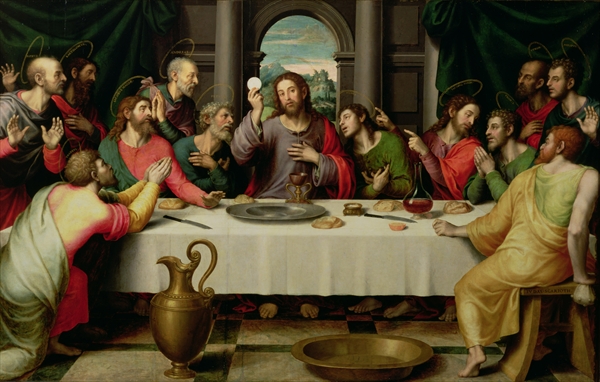
Vicente Juan Macip: The Last Supper
The apostle John tells us of Jesus’ last words to his followers. They are so simple and also so beautiful. Do not let your hearts be troubled . . . I will not leave you orphans . . . I am the true vine, and my Father is the vine grower. Remain in me as I remain in you . . . It was not you who chose me but I who chose you . . . I have more to tell you but you cannot bear it now . . . In the world you will have trouble, but take courage, Ihave conquered the world.These familiar words lay out the simple tenets of Jesus Law of Love which comes down to one lasting commandment: Love God, love one another.
This is such a simple instruction and yet so easily forgotten.
As David lies dying he gathers his last resources to leave final instructions to those he loves so well. Solomon is crowned and David’s words are passed on for generations.
As Jesus enters Jerusalem he gathers his strength for the harrowing road that lies ahead. He calls his apostles together, breaks bread and shares wine, and he leaves last instructions for those he loves so dearly. Do not let your hearts be troubled . . . Jesus’ words are passed down through an eternity.
As we confront any obstacle that falls to us in our journey, we might find wisdom and consolation in these last words which we so easily forget. And so we ask God’s help and we pray . . .
Faithful and forgiving God, abide with us as we journey through life forgetting, or perhaps not believing, that you are with us.
Constant and faithful God, sustain us with the hope so often predicted and so lovingly brought to us by your son.
Healing and loving God, fill us with the consolation and peace of your Holy Spirit, remembering that we are your own dear creations who long to be with you.
All of our works tell of our relationship with God. All of our campaigns speak of our reverence for God. All of our gestures tell of our constancy in discipleship to God.
Thus the Lord made David victorious in all his campaigns.
If only we might remember this. It is the Lord who makes all our campaigns victorious; not our cleverness, or looks, wealth or power. It is the Lord.
David took the golden shields that were carried by Hadadezer’s attendants and brought them to Jerusalem.
We need to return all the spoils of our campaigns to God. They are the Lord’s.
He likewise took away . . . large quantities of bronze, which Solomon later used to make the bronze sea and the pillars and the vessels of bronze.
We must dedicate all that we have to the one who provided it for us. All that we have belongs to God.
Hadadezar . . . sent David gold, silver and bronze utensils of every sort. These also King David consecrated to the Lord along with all the silver and gold that he had taken from the nations.
We are wise to consecrate all that we are to the Lord for our origin and our existence are from God. All that we are belongs to God.
As we wage our daily campaigns with family, friends and colleagues at home, in our communities and in the workplace, we must keep our focus on what God is asking that we do . . . rather than on what we want to do.
As we gather the booty and measure the value of our successes, we must remind ourselves that our victories are due both to God’s credit and our willingness to obey God’s call. In this act of giving back to God what is God’s we can claim our divinity . . . in and with God.
Thus the Lord makes us victorious in all his campaigns.
When we meet failure rather than success we do well to look to ourselves and ask . . . Do we strive to hurdle some barrier because we will ourselves to do so? Are we setting our own priorities rather than God’s? Are we backing away from some request God makes of us rather than trusting God’s wisdom because we fear our inadequacy or vulnerability?
Are the campaigns into which we enter of God . . . or of us? And how do we know?
We shall know by our lives that we dedicate to God. We shall know by the works that we consecrate to the Lord. We shall know by the abundance of fruit that we bear back to God for . . .
Thus the Lord makes us victorious in all his campaigns.
Tomorrow, another gift of discipleship . . . honesty . . .
If we remain constant and in constant dialog with God we are continually surprised by God’s goodness. When God’s is the first advice we seek, we cannot go wrong; our daily battles will be upheld, and we will stand in awe of God’s generosity.
The Levite hymn of praise that appears in this chapter is thought, by some scholars, to have been added later; other experts believe that it so reflects The Chronicler’s style that it must have always been included in this part of David’s story. That discussion aside, we can see that David, at this point in his life, makes no decisions without God’s input. The years he spent on the run avoiding Saul’s troops and making his little guerrilla strikes, have prepared him well for this. We see here someone who understands that even those close to us, those to whom we have pledged our loyalty and love, can and will betray us, someone who understands the importance of fidelity, perseverance and thanksgiving. The David we see today has come through fire and understands his place in God’s plan, and he understands and accepts his ministry as his vocation.
When we read David’s entire story, we also see that David slips into separation from God. He is never, nor are we, a finished product. He is in process with God and his faith journey will take him many places before it ends in old age. Even at his death, David is embroiled in the argument of which son will rule after him and the death of his beloved Absalom will bring him deep sadness in his final days; yet David continues to commune with God, to listen and to daily dialog, and to live out his ministry as a faithful servant.
Each of us has a ministry we hope to fulfill. I admit to struggling with my own vocation. It would be so much easier, I say to God regularly, if I did not have to do all that God asks, if I might pick and choose my own works as I see them suiting my talents. The reply alwaysreturns with an accompanying chuckle: God knows that the path is full of obstacles, and God knows how we tire. It is for this reason that God abides constantly, never leaving our side. God knows well the plans God has in mind for us, as the prophet Jeremiah tells us (29:11), and God desires to surprise us at every turn with an encouraging smile, a loving caress, a kiss that does not betray. God’s constancy and goodness and wisdom are tools lent to us in order that we perform our ministry. God also provides us with little respites at oases that suddenly and surprisingly appear. Those are the moments in which we might raise our own hymns of praise just as the Levites do in today’s reading.
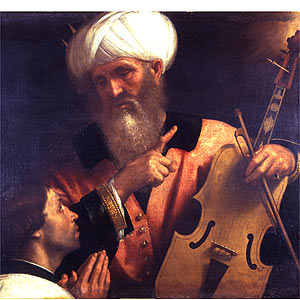
As we remain constant, we remain close to God. As we remain close, we commune with God. As we commune, we worship. Let us lift our voices together in a paean of praise.
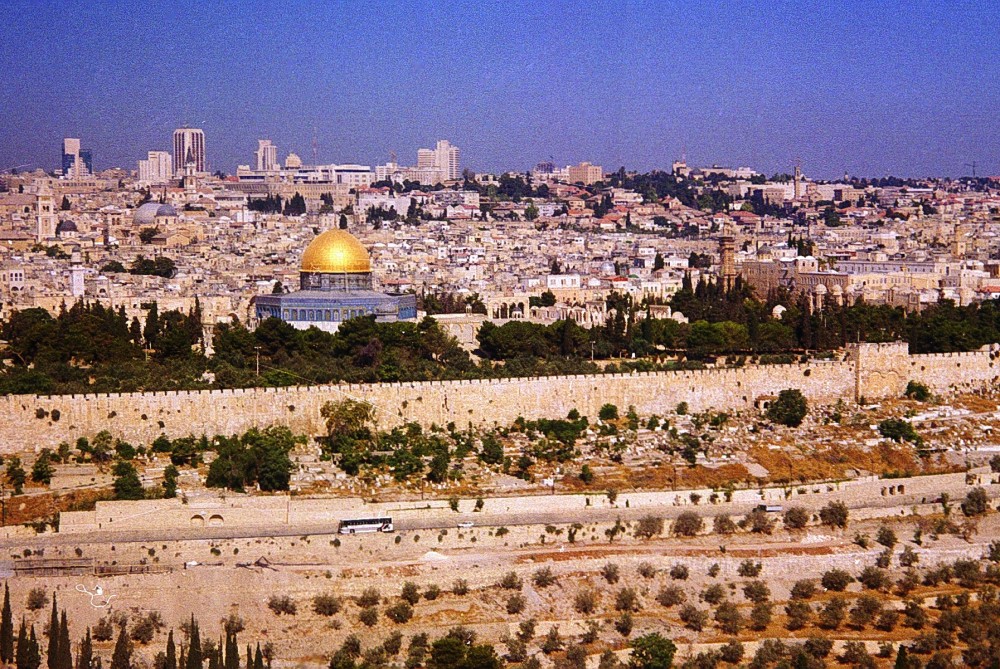
When people gathered in on a western hilltop above the Jordan Riversometime between the years 4300 to 3300 B.C.E., the city of Jerusalem came into being; her early artisans were known for their stone and copper work. During the Middle Bronze Era (3300-2100 B.C.E.) the people fortified the city then known as Jebusand her people in the surrounding hills, known as the Jebusites (1 Chronicles 11) began to form a confederation with other peoples in the area. It was this tribe that fought against Joshuaand the Israelites (Joshua 9).
In the Late Bronze and Iron Ages (1600-332 B.C.E.) Jerusalem’s people increased the city walls and size that changed only slightly and remained until the time of Nehemiah (about 445 B.C.E.) The city was a 12 acre site just south of today’s Temple mount bordered by the Kidron and Tyropoeon Valleyswhen captured by David; King Solomonnearly tripled the city to an area of about 32 acres when the temple-palace complex was built over a converted threshing floor. Jerusalem’s city and Temple become a center of worship, trade, culture and power until she was taken by the Babylonians and many of her people sent into exile. Re-built by Nehemiahshe struggled to return to her former fame but was taken by Alexander the Greatin 333 B.C.E. and later by the Romans. She was again destroyed in the year 70 C.E.
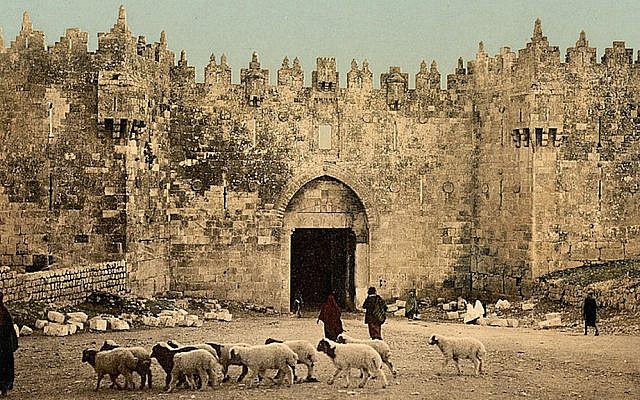
Jerusalem: The Damascus Gate
Western history records the centuries of struggle between Christians and Muslims for control of Jerusalem until 1948 when the state of Israel is formed and the Jewish people are called “home,” but Jerusalem today still remains a city in conflict, divided and troubled yet also united and renowned.
As we move through the Lenten season, we are invited to visit with Jerusalem for a short time each noon to explore her days of glory, her times of trial, her humiliations and her celebrations. In so many ways her history might be ours. Born out of a desire to flourish, nurtured by a hope for the eternal, and struggling through faith and doubt, Jerusalem offers us a tour of her life; she brings us her story full and open. Last week we prayed as we went upto Jerusalem. Now that we are within God’s holy precinct, let us offer our own lives back to the Creator. Let us spend time with God as we examine the life of Jerusalem as our own life in macrocosm. And let us return to God honestly, fully and openly . . . to examine the story of our own lives.
Solomonis a well-known figure in scripture. At a fairly young age he is given a unified kingdom by his father, David. When asked what he wishes to have in this world he asks for Wisdom. We are told that he receives this and more . . . all the wealth, power and status he had not asked for. He seems destined for greatness and so he is.
Rulers from all parts journey to visit him, to see the beautiful palace and temple he builds, and to experience at close range how this singular king loves and is loved by his singular God. Even the remarkable Queen of Shebarequests and is granted a special visit. Later in his story, we are told that he loved many foreign women and married several. It is likely that in this way he meant to secure alliances with potential enemies; yet these enemies defeat him in a quiet and insidious way. The writer of 1 Kings tells us: When Solomon was old his wives had turned his heart to strange gods, and his heart was not entirely with the Lord, his God, as the heart of his father David had been. (1 Kings 11:4) After this, the kingdom comes tumbling down.
Today we spend time with Solomon’s Prayer which can also read in 1 Kings 8 and we speculate what it was that drew him away from God into the world. We picture what lured him to foreign gods and extravagant women. We can imagine what and who convinced him that authority and influence were more important than fidelity to Yahweh. When we reflect on Solomon’s Prayer, we might want to make it our own and pray it often . . . resisting the lure of self-deceit and warding off the siren song of the material world. And so we pray to the God of Solomon, the Living God.
Give me Wisdom, the attendant at your throne . . . For alone I cannot manage my days and nights sensibly.
Reject me not from among your children . . . I will make mistakes and I know that you will pardon me.
You have bid me build a temple on your holy mountain, an altar in the city that is your dwelling place, a copy of the holy tabernacle you had established of old . . . I will do my best to act as you ask, to answer as you call, to praise as you create.
Send forth Wisdom from your holy heavens that she may be with me and work with me . . . I really cannot do this without your voice in my ear.
For who knows God’s counsel, who can conceive what the Lord intends? I cannot conceive of that you see, all that you know, all that you do. I only understand that your are goodness and therefore do only good.
Piero della Francesca: Legend of the Cross – The Queen of Sheba Meeting with Solomon
Thus were the paths of those on earth made straight, and we learned what was your pleasure, and were saved by Wisdom.So abide with me that you might bring goodness out of any action I take may harm another. Remain with me that I might remain in you. Love me always that I might always love others.
Tissot: Michal Despises DavidYesterday we spent time with the opening portion of this chapter; today we focus on the rest of the story. Just as we are given an opportunity to see the realities of life in the story of Uzzah, we are given the chance to see our own reality in the story of Michal.
It has been noted that Michal is the only woman in scripture described as loving a man who does not love her in return. As with many women in scripture she is used by a pawn. In this case it is her father and husband who exploit Michal . . . the two men closest to her . . . the two men charged with her protection. Again as a child I saw her circumstances as out of her own control and I saw her life as one of deepest betrayal. As with the tale of Uzzah, we turn to commentary to ask why in 1 Samuel 19 to find that David and Michal had pagan statues in their household and we might nod smugly and knowingly and comment that perhaps she suffered for bringing idol-worship into her home. If we spend time reading the scattered fragments of Michal’s story we pull together the threads of her life. As a child I saw her as a victim; as an adult I understand that there are far too many circumstances beyond Michal’s control and I watch as she sees all her dreams melt away into nothing. I begin to understand how her passion becomes loathing.
As we grow in God’s love begin to understand that with mercy there are no bounds; we see that justice is best delivered in God’s time and according to God’s plan; we know that love carries with it the dark potential to become great hatred unless it is founded in God. As with the story of Uzzah yesterday, we see that life defies description. Again we learn that what looks correct may not always be correct. And we feel the full force of the lesson that we cannot make events occur nor can we prevent circumstances from overtaking us. We can rest only in the surety that God is in us, that we are in God, and that our relationship with God is the only eternal and permanent promise that matters.
Uzzah, Michal and David teach us much. Their stories might embolden or frighten us. Their circumstances may cheer us or depress us. Their lives may dissolve or transform us. But in all of this, as we examine the lives of Uzzah, Michal and David . . . we have much to think about today.
In several places, this chapter calls us to pause for reflection: We watch as Uzzahis struck down by the Lord, and we witness the turning of Michal’s love for her husband David turn to hatred. Commentary will guide us through these puzzles but we are left with the lingering thought that there are always many ways to read the story of David.
We know that David’s life is full of ups and downs – just like our own. We know that David feels the call of God and the call of the world – just like our own. And we know that David is both strong and vulnerable – just as are we. We might learn something about ourselves once we spend time with this story today.
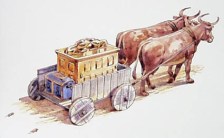
Scholars explain the punishment of Uzzah saying that he had become too familiar with the ark since it had remained in his father’s house for some time. Others say that he did not trust the Lord to rescue his own dwelling place, the Ark. Some say that we must learn from this incident that we are to never question the clear authority of God. And yet others say that we are to learn that we must practice acting in due time, listening for God’s call, and living in God’s plan.
I remember hearing this story as a child and thinking that it may have been possible that Uzzah had misunderstood God. Perhaps he thought God asked him to reach out to steady the ark when in fact he had said that Uzzah ought not touch the cart. In my child’s mind the world was black and white: we do what our elders tell us and all goes well. In my adult life I know that life is much more complicated than this. As we grown in God we learn that obeying rules does not keep us safe. We discover that life does not follow guidelines and that it defies logic. We understand that we must be grateful for all that goes well; we know that there are no guarantees; and we see that the innocent will often suffer unjustly. We come to understand that rules and laws do not save us . . . that God is the only safety net we can trust.
David and Uzzah teach us all of this today when we allow this story to speak to us.
Hot Springs and Arena in Ancient TyreTyre is a city off the southern coast of present day Lebanon and it is linked to the mainland by a causeway, or siege ramp, built by Alexander the Great at the end of the fourth BCE. It consists of both a mainland city and an island, has two harbors and most likely because of its vantage point, it was the leading city of Phoenicia in the millennium before Christ. One can read about the early kings of Tyre in the works of the Jewish historian Josephus but it becomes important for scripture readers when Hiram, the king of Tyre, provides pine and the renowned tall cedars to David and Solomon for use in the construction of the Jerusalem palace and temple. Tyre is eventually invaded and destroyed by the Babylonians.
Tyre is also famous as the hometown of Jezebel, the wife of Ahab, who convinced her husband to take over the vineyards of the peaceful man Naboth, who persecuted prophets, lured her husband into worshiping the gods of the Baals, and who came to an ugly death . . . just as had been predicted by prophets. (1 Kings Chapters 16, 18, 19, 21 and 2 Kings 9) Hers is a fascinating story of meteoric beauty, power and fame. She was a princess of Tyre, rising and falling in a quick but dramatic arc across ancient history.
In today’s reading we read a lament for Tyre and a prediction of her downfall, with the wreck of the ship and all she carries as allegory. The HARPER COLLINS COMMENTARY describes this oracle as beautifully crafted, and Ezekiel laments the anticipated destruction of Tyre at the hands of the Babylonians. This perfect, proud and stately beauty is lost to the storm and settles forever at the bottom of the sea. Thou art brought to nothing, and thou shalt never be anymore.
So much pride lost, so much sorrow experienced, so much pain endured. Yet in today’s MAGNIFICAT Meditation we read: The heart of man, so deep for misery, is deeper far for happiness! Misery comes to him from accident, happiness from his nature and his predestination. Father Henri-Dominique Lacordaire
We are creatures meant for joy, not for sorrow. We are children meant for resurrection, not for darkness. We brothers and sisters of the same father meant for life, not for death.
Written on April 12, 2008 and posted today as a Favorite.
![david-and-nathan[1]](https://thenoontimes.com/wp-content/uploads/2013/11/david-and-nathan1.jpg?w=450&h=387) 2 Samuel 11 and 12 and Psalm 51
2 Samuel 11 and 12 and Psalm 51![king solomon[1]](https://thenoontimes.com/wp-content/uploads/2013/10/king-solomon1.jpg)
![Psalms1[1]](https://thenoontimes.com/wp-content/uploads/2013/05/psalms11.jpg?w=300&h=225)
![SolomonsPrayer[1]](https://thenoontimes.com/wp-content/uploads/2013/01/solomonsprayer1.jpg?w=300&h=134)



 The Noontimes