As we prepare for the celebration of Easter, we return to some Christmastide meditations from 2011 and we reflect on how the Passion and Easter stories begin in a stable in Bethlehem.
This is the perfect time of year to think about our relationship with God – this God who comes into our lives as one of us in such a humble way that his family must beg for shelter, and within days of the child’s delivery they must flee into exile. The Messiah’s family life is one of constant dichotomy and this is fitting for it reflects our own lives of surprises, disappointments, and promises both fulfilled and unfulfilled. Our days are a series of hills and valleys, of ups and downs that make us anxious and fearful – we wish everything to be settled and determined. These highs and lows show us our mortality and make us uncomfortable – we prefer a life in which we are in total control.
From the very beginning of Jesus’ story, we see his family’s split reality; they are welcomed and gifted by both shepherds and magi, and they are hunted by Herod’s soldiers. (Matthew 2:1-18) In today’s Noontimewe go back to the time when the people of Israel have come home to Jerusalem after exile. They too, live lives of dichotomy, lives full of fear and hope for they know that the nation’s disobedience and errant ways have separated them from God; yet they hope for a return to their special status before God.
Tomorrow, the Israelites, Ezra, flight, and return.
This reflection was written upon the death of a friend’s father and is shared today as a Favorite.
Much of life is lived in a confusion of fear and thanksgiving and we find a jumble of these emotions in Psalms 7 though 18. Looking at just the New American Bible titles of these poems gives us a series of jubilant prayers mixed with sorrow-filled ones. It is in this way that these poems bring us a faultless reflection of life.
The fusion of worlds present in the human made in the image of God is a dichotomy which we can either unite our id, ego and superego . . . or it can split us into child and adult separated by a chasm of fear. Fear of what? Fear of suffering. Fear of humiliation. Fear of loss. Fear of abandonment. Fear of loneliness. Fear of knowing that we err. Fear of rejection. Fear of death. And when I think of this litany of pain, I realize that each of these woes is accompanied by a restorative. Joy in celebration. Joy in exaltation. Joy in gain. Joy in companionship. Joy in intimacy. Joy in knowing that we are doing the right thing. Joy in perfect, trust-filled union with another. Joy in life. Our fear-filled humanity struggles with our covenant-honoring divinity.
Psalm 8 brings us dichotomous images announced in the title: Divine Majesty and Human Dignity. We find more in the psalm: earth and heaven, babes and foes, enemy and avenger. The verses that tell all that we really need to know: What are humans that you [God] are mindful of them, mere mortals that you care for them? Yet you have made them little less than a god, crowned them with glory and honor. You have given them rule over the works of your hands, put all things at their feet . . . O Lord, our Lord, how awesome is your name through all the earth!
What a wonderful God we have who loves us to the extent that he creates us, visits with us, loves and comforts us, feeds, houses and clothes us, heals and tends to us, listens to us, blesses us . . . always . . . with constancy . . . with fidelity . . . with dignity . . . with patience . . . through eternity.
We often feel closer in death to the ones we love than we did when these dear ones were yet in this life. These loved ones speak to us constantly now that the physical distances of this world no longer separate us. They bring us the very real presence of the next world with their constant visitation. We cannot see them because of the limiting time and space of this globe but still their existence is real.
We are human. We are divine. And we feel the constant struggle of reconciling these two worlds of self. A human death brings us up short because we are forced to consider if we believe that we are created as gift. We pause to think again about the Resurrection, the forgiveness of sin, life everlasting. We cannot help but reflect on how we have treated this departed one: with the dignity deserved no matter the situation? With the witness of divine majesty? Did we salute the gift of this person while they were still in this life? Did we honor this person while still with us as well as we will honor them in death?
The ones we love who have died linger among us. We love that much. They still laugh when we laugh, cry when we cry. We cannot see them with the eyes of this world, or hear them with these ears. But they are here with us nonetheless. As we are with them. They hold us close. They have not disappeared. Their presence is still felt . . . and it will be . . . forever and ever. Amen.
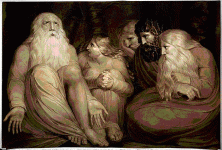
Commentary from La Biblia de América:Job continues in his search for a personal encounter with God, both seeking and fearing him; but the judgment of his companions does not speak to his condition. Job finds himself bereft not because he has broken God’s law in any way. His sins do not bring him to this spot of desperation; he suffers innocently from circumstances beyond his control. Yet amid all of this hurt, Job refuses to reject God; indeed, he seeks God all the more with each new wave of pain. Job actually takes refuge in his suffering, frightened and even terrified, waiting for his end. He describes an impotence which we ourselves may feel at a time when we are abandoned and have no recourse. We suffer while the wicked experience success. A victim of bad luck and injustice, Job experiences a reality too awful to be concealed. Further footnotes tell us that verses 18 through 25 have appeared here rather than where they may rightly belong – in a previous chapter – perhaps the copyist could not bear the pain and so thought to bring consolation from another place.
This lament of Job guides any and each of us through a wave of pain so intense that it nearly takes one’s breath away. This level of suffering can only be healed by God . . . and it is upon God that Job calls.
Today’s reading asks us to think about our desire to see and know God . . . face to face. Job’s unquenched yearning is void of any wish to exact punishment or revenge on anyone or anything. Job questions. Job fears. Yet Job does not leave God perhaps because he knows that God has not left him.
The imagery today describes a dichotomy of longing accompanied by fear. Job needs to experience God’s presence in his life . . . and he fears that perhaps he will never escape this place of emptiness where the wicked have full sway. He survives in a twilight world where day and night co-exist, and he fears that the darkness will win out.
As we have observed, perhaps it is for this reason that a later copyist has inserted the words which we know Job believes because they hold truth and because they describe what Job does . . . he refuses to give up, he holds on to hope and he waits.
To him who rises without assurance of his life he gives safety and support.
When we find ourselves in the pit of misery described by Job, we must remember that the force of our yearning will be met, matched, and exceeded by God’s love . . . for he is life itself.
To him who rises without assurance of his life he gives safety and support.
A re-post from May 9, 2012.
LA BIBLIA DE LA AMÉRICA. 8th. Madrid: La Casa de la Biblia, 1994. Print.


 The Noontimes