Psalm 33:11 – The Lord’s will stands fast forever, and the designs of his heart from age to age.
God’s economy and mystery are difficult for the human mind to grasp . . . yet still they are what they are . . . an eternal, inscrutable plan. We humans struggle . . . we reach for our potential . . . and find it only through Christ. We make our own plans . . . only to see that God has a better design. We plan for a day, a month, a year . . . God plans for eternity. His design is here and now. His design is always . . . for God plans from a heart that is good and whole and full.
God says: Just because you say you cannot see me does not mean that I am not with you. Just because you believe you cannot hear me does mean that I do not speak. Just because you feel alone does not mean that I do not carry you through the peril of your days. I love you still, no matter what you have done or not done. I love you always, no matter who you are or who you are not. I love you enough to have created you, to watch over you, to save you, to free you. For now and forever.
Wishing you the plans of God’s heart . . . for today and all days.
Rembrandt: Ahauserus and Haman at Esther’s FeastWe cannot determine God’s timeline and when we watch how his plans unfold in our space and time we see that God has refined the shepherding of billions of souls to a mysterious art. And it is something that he practices well. Life is complicated. God knows that rewarding one creature stirs envy in another. This is the story of Satan and the fallen angels who succumb to their jealousy. God knows that giving his creatures the choice to opt for darkness or light means that some of them will fall; but God also knows that his loving compassion leaves many opportunities for reform and changes in outlooks, and so he leaves his plans open . . . in order to work with the creations he so loves.
God is fully aware that his show of mercy stirs jealousy in the hearts of others, and so he prepares plans for these contingences. We have seen and we have been told and we have experienced the fact that God will always turn harm to good. The extremity or numbers or layers in any given situation are never too much for God to handle. He is more than up to the challenge . . . for he is the creator of all we see and experience.
Today’s reading – another of my favorites – takes us to the beginning of another story of how a woman saves a nation. It takes us to the place in the narrative where we see how the seed of envy blooms into a fully-blown narcissistic tantrum which in the end brings down the initiator rather than the intended victim. Mordecai, a Jewish man living in the Persian court of King Xerxes(or Ahauserus), and his niece Esther, who is married to this King, have submitted their plea for justice. The King has responded and now we await the sentence he will deliver. As the king struggles with the plots that surround him and the information which has been brought to him, he goes back to a former event – a time when Mordecai saved his life by warning him of an assassination plot. When we read today, we see how the evil plotted against goodness has a way – in God’s plan and in God’s timeline – of returning to visit itself upon the perpetrator. What happens next to Haman is the very consequence he had wished to deliver to Mordecai and Esther – it is a punishment born out of the darkness of envy, and it goes home to exterminate its originator.
If you have time today, read this story through. Different Bibles have different methods of presenting the material that was later inserted to flesh out the story but it is worth the trouble of sorting through all of this. The story of Esther who would rather hide than confront evil with goodness and truth is its own reward. Today’s lesson that we cannot understand how things will unravel around us is a story to carry in our hearts. It both cautions us against entertaining ideas of revenge and it bolsters us in our hope that ultimately the light will overcome the darkness. All is revealed. All accounts are paid. In full. And this is what we have the opportunity to ponder today.
Reward often carries with it the fact that some human beings will covet the good fortune of others. Some human beings will wish destruction for those who receive gifts from the king. It remains with us to wait patiently for the ultimate outcome which the just king always delivers. Those who plot in the darkness are done in by the very mechanism they set into motion. This is divine justice at its best. It is for the follower of Christ to discern his or her place in God’s plan, to be patient as events unfold, and to pray for the redemption of those who delight in the darkness.
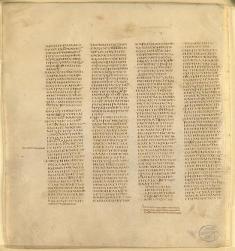
A page from The Book of Jeremiah: St. Catherine Monastery Bible, Egypt
We have spent a good deal of time lately thinking about exile and captivity. Here is a Favorite from August 12, 2007 which we post it today as a letter to all those in captivity of any kind. It is a reminder that God is constantly sending us love letters . . . we must be willing to open them.
Many believe that our existence here on earth is a Babylon.
We love God, we worship him, we are in a covenant relationship with him, yet we are brought here to live a life physically apart from God, a life which does its best to distract us from God and from the promises we have made to him and him to us. If we are so loved, why does God not snatch us up immediately and take us to him? Because he created us to be like him, and we are given the choice to try to behave as he does or to go off on our own. This Babylon is our classroom, and we are to bloom where we have been planted. How do we know this? God has written us a letter, through Jeremiah, to tell us so.
Look at verses 5 through 7: Build houses to dwell in; plant gardens and eat their fruits. Take wives and beget sons and daughters; find wives for your sons and give your daughters husbands, so that they may bear sons and daughters. There you must increase in number, not decrease. Promote the welfare of the city to which I have exiled you; pray for it to the Lord, for upon its welfare depends your own.
And my favorite in this chapter is verse 11: For I know well the plans I have in mind for you, says the Lord, plans for your welfare, not for woe! Plans to give you a future full of hope.
But continue with verses 12 to 15: When you call me, when you go to pray to me, I will listen to you. When you look for me, you will find me. Yes, when you seek me with all your heart, you will find me with you, says the Lord, and I will change your lot; I will gather you together from all the nations and all the places to which I have banished you, says the Lord, and bring you back to the place from which I have exiled you.
I remind myself of another Jeremiah citation by which I live: 42:10-22. When I am most thinking that I need to pull up stakes and move off to begin a whole new life, I remember the words that the Lord God spoke to the remnant: If you remain quietly in this land I will build you up, and not tear you down; I will plant you, not uproot you; for I regret the evil I have done you . . . If you are determined to go to Egypt [another place – to make a new beginning]; the hunger you dread shall cling to you no less in Egypt, and there you shall die.
And so we pray: Compassionate God, remind me daily that “this vale of tears” is only a pathway to you. As I build my house and settle into this land, remain near. As I promote the welfare of my exile city, be my hands and feet. My only wish is that you increase and not decrease. Abide with me, your remnant. Hold me ever close to you. Amen.
Wednesday, November 19, 2008 – Proverbs 16 – Plans of the Heart
Today is a day when we traditionally make resolutions or new plans for the future. For that reason we post as a Favorite this reflection written on November 19, 2008 . . .
Man may make plans in his heart, but what the tongue utters is from the Lord. All the ways of man may be pure in his own eyes, but it is the Lord who proves the spirit. Entrust your works to the Lord, and your plans will succeed. The Lord has made everything for his own ends, even the wicked for the evil day . . . In his mind a man plans his course, but the Lord directs his steps.
Humans have a fertile imagination; and weaving a story about ourselves is part of what we do as we form our self-concept. We are often anxious about the future: What am I to do? Where am I to go? What am I to say? How am I to act? We may worry about the past: Why was I so blind? How did I miss what they were saying? And all the time we worry . . . we are missing the blessed present . . . with its opportunity to open our hearts to God’s economy. The writer of Proverbs reminds us that the best plans are those guided by God. Trusting in divine providence is so very difficult . . . yet so essential to serene living.
Better a little with virtue, than a large income with injustice . . . How much better to acquire wisdom than gold! To acquire understanding is more desirable than silver . . . A patient man is better than a warrior, and he who rules his temper, than he who takes a city.
Wisdom is our best instructor. Living a life characterized by prudence and temperance is difficult in a society which values the supersize in everything. It is easy to overdo: too much food, too much drink, too much money spent on heat or air conditioning, too much television, too many movies, too many books, too many people making claims on our time, too much aloneness, too much neglect, too much fuss. Is there such a thing as too much justice? Too much hope? Too much faith or hope? Too much love? Finding moderation and balance is a challenge; but our model is the Christ, who interchanged periods of heavy activity with times of prayer and retreat . . . leaving his sacred heart open to God’s plan.
By kindness and piety guilt is expiated, and by fear [love] of the Lord man avoids evil.
It is never too late to be open to a conversion of the heart. There is always time to enter through the narrow gate, to step onto the narrow road, to sow peace rather than discord. It is never too late to open the door and windows of the mind . . . to allow the master planner to enter the heart . . . to move us through our days . . . to guide us in our thoughts . . . to thaw our stiffened necks . . . to melt our hardened hearts.
Let us vow today to open ourselves . . . to the mind of God . . . that we might receive our plans from his own sacred heart.
 Psalm 33:11 – The Lord’s will stands fast forever, and the designs of his heart from age to age.


 The Noontimes