Consider it a sheer gift, friends, when tests and challenges come at you from all sides. You know that under pressure, your faith-life is forced into the open and shows its true colors. So don’t try to get out of anything prematurely. Let it do its work so you become mature and well-developed, not deficient in any way.
Steadfastness is a gift freely given by God.
God says: I know how difficult it is for you to remain in me when so many tribulations beset you. I also know how you struggle to remain faithful and persistent. Know that I see this in you and know that your determination to follow The Way gives me great delight. Rather than dwell on where you go wrong, reflect instead on all that you do well. For your works are abundant in the million little ways you honor me in your hectic lives. When you feel anxious, abandoned, worried or lost . . . remember that when tests and challenges plague you, in am also there in the trial. These times are my sheer gift to you as you grow and live in me with your well-earned steadfastness.
Steadfastness is a gift freely given by God . . . it is a gift already given and received. Let us rest in this gift and reflect on its power to bring us hope.
Enter the word steadfastness in the blog search bar and explore other posts that open this concept for us.
What are we to make of James’ letter to us? How does he frame his closing remarks?
If you know people who have wandered off from God’s truth . . .
And surely we must know someone who is broken or abandoned. And just as surely we will know someone who is full of pride and over-confident.
Don’t write them off . . .
This may be difficult. James has asked us to find a way to communicate with those whose anxiety or pride have put them out of our reach; yet James admonishes us.
Go after them . . .
We have no excuses. James wants to see our faith played out in our works.
Get them back . . .
James wants to see us as wounded healers, as a light in the darkness, as salt for the earth.
And you will have rescued precious lives from destruction . . .
James urges us to bring hope to and out of those who despair and those who shun God.
And you will have prevented an epidemic of wandering away from God . . .
James urges us to look for God’s image in others. He asks that we continue to commit our work and our prayer to God as we struggle to unlock the goodness waiting to rise from so many wounded souls. He asks us to participate fully in God’s outrageous and daring harvest of hope.
Tomorrow, a prayer for harvesting hope.
Use the scripture link to find other versions of these verses from THE MESSAGE.
Ezekiel 37: From Dry Bones to Restoration – Part V
Sunday, September 18, 2022
If we cannot believe in restoration after the desert, let us at least begin by asking God to strengthen our gift of faith. Just as a mariner trusts that the lighthouse will guide ships past rocky shores, let us trust the Gospel story of Jesus. The writer of the letter to Hebrews shows us the way. From Hebrews 11.
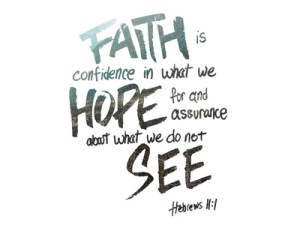
Faith is the confidence that what we hope for will actually happen; it gives us assurance about things we cannot see.
If we do not have confidence, let us ask God for this gift of sureness.
By faith we understand that the entire universe was formed at God’s command, that what we now see did not come from anything that can be seen.
If we do not have understanding, let us ask God for the gift of wisdom.
It was by this faith that Abraham obeyed when God called him to leave home and go to another land that God would give him as his inheritance. He went without knowing where he was going.
If we do not have fidelity, let us ask God for the gift of certainty.
And even when Abraham reached the land God promised him, he lived there by faith – for he was like a foreigner, living in tents. And so did Isaac and Jacob, who inherited the same promise.
If we do not see or believe in God’s promise in our lives, let us ask God for the gift of hope.
For Abraham was looking for a city with eternal foundations, a city whose architect and builder was God.
If we do not feel or comprehend God’s power in our lives, let us ask God for the gift of fortitude. And let us pray.
Good and loving God, your fidelity lives in us although we may not perceive it. Being your creatures we are made of love for love; yet we might not believe this. Breathe new life into those who are discouraged or unbelieving. Bring new strength to those who falter. And shower us with your hope and encouragement so that we might come to fully know, and feel and understand that your only wish for us is our restoration in and for you. We ask this in Jesus’ name, in unity with the Holy Spirit. Amen.
Tomorrow, laying a foundation for restoration . . .
Yesterday we reflected on the introduction of our story that announces to the world who we are in the manner in which we live out our response to God’s call. We may want to catalog the goodness we have offered as building blocks for the kingdom. Perhaps we want to recount the stories of the obstacles we have overcome, the rejections we have endured, the apologies we have made and accepted. We may even want to imagine what words will be said about us among those who remain when we depart this life. In some way and at some time, we have imagined how we are viewed by others. We have dreamt our story.
As we read the opening words of the Christ’s story, we see his birth, the visits of shepherds and kings, the circumcision and presentation, the flight to Egypt and return to Nazareth, and the finding of the boy Jesus in the Jerusalem temple. All of this brings us to the time of John the Baptist who announces the arrival of the Savior, and Luke tells this story well – with just enough detail so that we might imagine the joys, turmoil and uncertainty of our own early years for we are all human, and we are all adopted sisters and brothers of Christ.
As our friends and enemies turn the pages of our lives, let us envision the impediments we have overcome and the miracles we have allowed to grow in us. And let us thank our creator, redeemer and comforter who sustain us, save us and speak to us as we envision the story of our lives.
Spending time with these verses today, we imagine the hopes and dreams our parents have for us. We imagine what potential for goodness in the world has been delivered through us. And we imagine what miracles God has worked in us, and will work in others through us. In thanksgiving, let us determine to surrender the impediments and complications of our lives to God, for it is through them, and with God’s help, that we live out the hope of our story. It is through them, and through God’s help, that return God’s goodness and hope to the world.
Adapted from a reflection written on June 21, 2010.
Our story is told through the whole of scripture as the story of Christ. Today we reflect on the traces of this story that we find in our own lives from the first words of Genesis . . . In the beginning . . . to the last words of Revelation . . . The grace of the Lord Jesus be with all.What has been our beginning? What do our lives reveal?
From the Torah and narratives, through the books of wisdom and prophets, and finally with the gospels, letters and final oracles, we read the story of Jesus who is predicted and promised, and who comes to fulfill that covenant promise. What is our prediction? What potential of hope has God placed within us? What is the promise our lives disclose?
The scripture stories fit together, notching closely as a mosaic to form the Mystical Body of Christ. What sort of image of God do we speak to the world with our lives? How do the stories we play out speak of our relationship with God?
Christ’s story can be our own not in that we live perfect lives as Jesus did, but in that we strive for this perfect love that Jesus teaches us daily. Today, we look at the words that begin his story as a human . . .In those days a decree went out from Caesar Augustus that the whole world should be enrolled . . . and we take the opportunity to consider once again how our own story might begin . . . In those days a war erupted between . . . In those days there was great political, economic and social unrest . . . In those days peace had come upon the land . . . In those days there was much to celebrate . . . We might enumerate our family lineage as Matthew does in his Gospel. We might wade immediately into our story as Mark does; or we might allow poetry to take over as does John . . . In the beginning was The Word, and the Word was with God, and the Word was God. Our own New Testament might begin . . . In the beginning there was Fury . . . there was Peace . . . there was Confusion . . . there was Joy.
Today we spend time reflecting on the introduction of our story. The introduction of our hope. The introduction of the love we bring to the world as our response to God’s call.
Tomorrow, our stories of obstacles and rejections.
Adapted from a reflection written on August 9, 2007 and posted today as a message about God’s glory, an experience offered to each of us.
Jesus said to her, “Mary!”
The love between Jesus and his disciples is palpable, and when Jesus speaks to the Magdalene in verse 20:16, it is clear that this man had a very human relationship with the friends who surround himself. And it is this same relationship that is offered to us, a relationship of healing love, truth and light. This is why it is so important for us to surround ourselves with people who will nurture the growth of Jesus’ truth and light and life, people who speak with their ears and live with their hearts, people who touch one another in the manner that Christ touched his followers, people who heal.
Today’s lesson on Glory: As we explore the varying versions of the importance of Mary Magdalene in the life of Jesus and the early church, we find that this young woman calls to each of us today by her example of steadfast love and witness.
We are all called to be healers to one another; and as adopted sisters and brothers of Christ we have the power to heal one another not only in a medical way but emotionally and spiritually as well. When we listen for God’s Word to speak, when we exercise patience and persistence, when we live out our faith in God, our hope in Christ and our love in the Spirit, we meet Christ. We heal and we are healed.
And so we pray, as Mary Magdalene may have prayed . . .
Precious God, keep me mindful of this your promise, to set us prisoners free from all that binds us, to raise us to the great hope you have placed in us, to send your Spirit into our temples to abide with us forever. In Jesus’ name we pray. Amen.
The chief priests paid Judas 30 pieces of silver to hand Jesus over (Matthew 26:14-16)
We continue to explore the mystery of Christ’s power found in humility, his love encountered in emptiness, and his leadership seen in his service. John, The Beloved Apostle, faithfully recorded Jesus’ last words and actions for his loyal and frightened followers. John leaves this recording for us that we might discover Christ’s presence among us today, Christ’s glory that lives with us still . . . even after two millennia.
Today’s lesson on Glory:We often find Jesus in the disappointments, in the betrayals, in the denials, and in the rejections, we experience in life.
To each disappointment, Jesus says: Like you, I have been betrayed. My beloved apostle John records these words for you. Consider them today and decide to give me your pain and sorrow.
Jesus was deeply troubled and testified, “Amen, amen, I say to you, one of you will betray me . . . What you are going to do, do quickly”.
When Jesus is betrayed he decides to love his enemy into goodness. Judas’ betrayal ends in his suicide (Matthew 27:5). Today we consider the possibility of redemption God offers Judas.
To Peter’s denial of him, Jesus says: Where I am going, you cannot follow me now, though you will follow later.
Gerrit Van Honthorst: The Denial of St. Peter
When Jesus is denied he replies with mercy and compassion. Peter’s denial is later followed by an opportunity for redemption (John 21). Today we consider the contrast between these two apostles, Judas and Peter, and look for our own behavior to their reactions of despair and hope. We look for our own experience of Jesus’ glorious forgiveness and healing.
In today’s Noontimewe hear Jesus say to us, his disciples:I give you a new commandment: love one another. As I have loved you, so you also should love one another. This is how all will know that you are my disciples, if you have love for one another.These words are so true and they remind us that all disappointment can be healed by Christ.
When we find the place where Christ speaks and we consider if we respond to Christ with hope or despair, we can also pray,
Loving God, forgive us our denials and betrayals of your goodness. Hear our requests for healing transformation. Make your home in us. Bring us hope against despair. Hear our petitions and transform our neediness into generous love. You promised us your hope. Send it to us today and all days as we come to you with our brokenness, and as we ask for our conversion. We ask this in your name. Amen.
Find time today to write out Jesus’ words on a slip of paper and use it as a bookmark that you will encounter often. Before bedtime today, give over an act of betrayal or denial to Christ and ask for transformation in God’s glory.
This is good news for us indeed. When we want to confront our enemies with outrage and violence, we will want to look at how God always provides a way back to unity and wholeness.
God encourages those who are losing hope . . .
This is certainly good news for us since we so easily and so frequently lose confidence. God always has hope in abundance for us and sends us a multitude of small and enormous signs. We must be open to the little miracles God sends us each day.
God chooses for them the lot of truth . . .
This is absolutely good news for us. Like a loving parent whose child has chosen dessert rather than a substantial meal, God is always steering us in the direction of nurturing relationships, nourishing habits and loving communities. Sometimes we are disappointed when we discover that the people, places and customs in our lives shows signs of weakness or even corruption. This is when we must remember that God’s love can achieve all impossibilities.
Jesus says: For humans it is impossible, but not for God. All things are possible for God. (Mark 10:27)
Further on in this reading, Ben Sirach describes God as hating and loathing the unjust and ungodly. Use the scripture link to read other versions of these verses and contemplate the idea that what Ben Sirach describes as “hatred” is an intense and impassioned perseverance in calling one who has left the sheepfold. Let us contemplate the idea that God’s “loathing” is an intense and relentless persistence to love our enemies into goodness. When we view God’s word in this way, we discover that the yawning gaps and deep sorrows in our lives suddenly have new life in kingdom justice.
And so we pray to the loving Trinity that we will celebrate this coming Sunday . . .
God provides a way back . . . and so must we provide a bridge to those who have wounded us. Loving God, help us to allow you to convert all harm to good.
God encourages the hopeless with outrageous hope . . . and so must we bring confidence to those in despair. Hopeful God, fill us with your Spirit of peace and serenity.
God chooses for us the path of truth when we have strayed . . . and so must we bring Christ’s light to a world hungering for justice and compassion. Saving God, bring us Jesus’ understanding, courage and wisdom.
We know that for us much of this impossible . . . but for you all things are possible. Shelter us in your truth, nourish us in your hope, and transform us in your loving care.
We ask for help but too often doubt the hand that God offers.
Jesus says: Let it be done for you according to your faith.
God says: When my son says these words he is not threatening or punishing you for your waywardness; rather, he is calling you to union with him and with me. He is calling you to be one with us in the Spirit. He is saying that your blindness can involve more than your physical sight. Sometimes you are emotionally blind. You refuse to feel what others feel because it pains you too much. Sometimes you are mentally blind. You reject options and ideas that others offer because you are determined that your plan is better than any other. Allow my Spirit to live in you and your blindness will be healed. When you feel the pain and sorrow of others, you will also feel my joy in you when you help the least among you. When you panic because you may not be able to follow the plan that you have laid out for yourself, you will alsocelebrate the enormity of my love that comes to you when you make a way for others to join in your plans rather than dictating to them. Trust in me as I trust in you. Have faith in me even as I place my faith in you. Hope in my promise for it is true. I believe and know that you want to be one with me. Believe and know that I am in you this day and all days . . . healing your blindness.
Enter the word blindnessinto the blog search bar and examine the ways of human blindness.

 God says: I know how difficult it is for you to remain in me when so many tribulations beset you. I also know how you struggle to remain faithful and persistent. Know that I see this in you and know that your determination to follow The Way gives me great delight. Rather than dwell on where you go wrong, reflect instead on all that you do well. For your works are abundant in the million little ways you honor me in your hectic lives. When you feel anxious, abandoned, worried or lost . . . remember that when tests and challenges plague you, in am also there in the trial. These times are my sheer gift to you as you grow and live in me with your well-earned steadfastness.







 The Noontimes