MosesYesterday we considered our Lenten Journey and how we might create for ourselves and our loved ones a physical sign of this promise of fidelity to the Living God who is Alive Among Us. Today we spend time with Moses’ words as he calls the Israelites to conversion and urges them to consider a change of heart and habit. Moses calls his people, and he calls us, to a love that will endure forever. He calls us to love as God loves.
From commentary: In the style of the great prophets, the speaker is often God himself. The whole song is a poetic sermon, having for its theme God’s benefits to Israel (vv 1-14) and Israel’s ingratitude and idolatry in turning to the gods of the pagans, which sins will be punished by the pagans themselves (vv 15-29); in turn, the foolish pride of the pagans will be punished, and the Lord’s honor will be vindicated (vv 30-43). (Senior 222)
Who are these gods of the pagans to whom we turn? Our obsession with immediate and empty gratification? Our desire to put ourselves first and others last?
Jesus reminds us that in the Kingdom the world is turned on its head. The meek will inherit, the first will be last, what is empty will be full.
Where do we see our own foolish pride? In the pumping up of self? In the building of self rather than the building of Kingdom?
Jesus lays out for us the life and work of his disciples so that we might see that we are to act in servant leadership with salvific love.
How is this foolish life punished? The unwise are destined to become enslaved by the chains they put on others. The reckless eventually find themselves enveloped in the same dangerous plots they weave for others.
Jesus shows us that forgiveness and compassion are the tools he uses to engender a love that endures forever and cannot be outdone.
Moses makes a final appeal to the people, asking that theytake to heart all the warning. Let us too, take up the counsel to root out our foolish pride and banish false gods. Let us climb our own Mount Horto see the Promised Land from a distance, and then let us ask the Living God for safe passage in this journey of conversion of the heart.
A re-post from March 19, 2012. Senior, Donald, ed. THE CATHOLIC STUDY BIBLE. New York, Oxford University Press, 1990.222. Print.
We have spent the past few days looking at how the Israelites struggle to remain faithful to Yahweh, the Living God who led them from slavery to freedom, from the desert to a land of promise. We can see ourselves in these stiff-necked people as we turn to and away from God as the season suits us. We read the story of how an unassailable enemy eventually falls once the Israelites turn themselves over to Yahweh’s ways. And we can see ourselves being delivered from adversaries we once thought unbeatable. The Israelites are such simple and predictable people that Moses knows they will fall away from the covenant they have entered into; and so he tries to prepare them for the days when they will yield to temptation. We too, know that we will be lured by the many attractions the world holds for us, and so in our Lenten journey we may want to spend a bit of time reflecting on how to best cleave to the promises we make to this amazing God who persists in loving us into goodness.
Take this scroll of the law and put it beside the ark of the covenant of the Lord, your God, that there it may be a witness against you.The Law of the New Covenant, the New Testament, is not complicated. It is brief, universal and compelling: Love one another as I have loved you. Perhaps this weekend we can write out a simple promise to love God by loving others – even and especially our enemies – and put it in a special place that we will see each day as a reminder, a witness to ourselves. A new ark of a new promise made in a new hope of conversion.
I already know how rebellious and stiff-necked you will be. And the Living God loves us despite these faults.
Even now, while I am alive among you, you have been rebels against the Lord! And the Living God who loves us so fiercely has returned as the Christ to save us.
Assemble all your tribal elders and your officials before me, that I may speak these words for them to hear, and so may call heaven and earth to witness against you. Perhaps we can gather our family or a group of trusted friends and agree together to turn ourselves toward the goal of living the law of love. Perhaps we can support one another in our hope of softening our stiff necks, in our Lenten journey of conversion.
We are blessed to have the Lord always among us each day, all day. As New Testament people we experience Eucharist with Christ, the indwelling of the Spirit, and the abiding protection and love of the Living God. Let us take a moment today to think about the passage we make from Ash Wednesday to Easter Sunday, the passage that we call Lent. And let us pause to give thanks to the God who loves us so well, and who is always alive among us.
It is clear that Joshua understands his people when we read today’s Noontime scripture. He has brought them from the edge of the wilderness into the fertile land that God has promised them. He has led their troops, solved their squabbles, and he has kept them faithful to God as they live side by side with pagan peoples. He has one final plea.
We are moving through the opening weeks of the season of Lent, a time for reflection and introspection. Today we have an opportunity to consider that we stand before Joshua, a man who knows our story. Let us listen well.
Strive hard to observe and carry out all that is written in the book of the law of Moses, not straying from it in any way or mingling with these nations while they survive among you. We might recall here the parable of the weeds growing among the wheat in Matthew 13:24-30 that we considered in our Continued ProgressNoontime. God does not call us to wipe out all who oppose or stifle us; rather, God asks that we learn to grow amid those who would pull us from our steady progress toward God. Joshua calls likewise to us today, encouraging us to follow the voice of God, to grow in wisdom. When we allow God’s wisdom to counsel us rather than succumb to our own petty fears and whims, we will have responded to this final plea.
At your approach you have driven our large and small nations, and to this day no one has withstood you. One of you puts to flight a thousand because it is the Lord, your God, himself who fights for you, as he promised you. We so quickly take credit for our successes and blame God for our failures. It seems we cannot withstand the truth of our own existence. When we remember the so many big and little triumphs of our lives in the light of God’s goodness instead of the brightness of our own effort, all anxiety, resentment and envy melt away. We cease to compare our circumstances to those of others; we see our lives for what they are: a continuing response to – or a willful turning away from – God’s call. Joshua asks us today to consider the origin of our security and achievement; and he reminds us that God alone governs all. When we admit that God’s strength and fidelity are gifts we receive without even asking, we will have demonstrated our own willingness to respond to this final plea.
If you ever abandon God and ally yourselves with the remnant of these [pagan] nations while they survive among you, by intermarrying and intermingling with them, know for certain that . . . they will be a snare and a trap for you, a scourge for your sides and thorns for your eyes. Joshua worries, of course, that his people will disappear into the societies that surround and live side by side with them. He knows how easily we can be convinced that daily prayer and faithful worship have little effect upon us. He understands our weaknesses because he has managed the in-fighting and back-stabbing that happens when people come together in a common cause. He also understands our strengths because he has led a stiff-necked and cantankerous people successfully by following God’s counsel rather than the shallow wisdom of oracles; he has deferred to God’s plans and put away his own. Joshua recalls the covenant they have agreed upon with God and that it invokes reward or doom; he reminds his people that God always keeps his promises. When we willingly turn away from the siren call of the idols that clutter our lives, we will give witness to our own commitment to God, and we will have answered this final plea.
This chapter closes with a description of God’s Wrathand before we become frightened by these images let us remember that Christ comes to fulfill the Old Testament Covenant and to replace it with a new Law of Love. When we remember that the God of wrath we see described here is actually the God of Love that Christ shows us. We will have little trouble – and much reward – when we respond to Joshua’s final plea.
Adapted from a reflection posted on December 11, 2011.
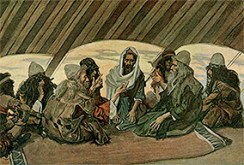
James Tissot: Jethro and MosesYou are not acting wisely. You will surely wear yourself out, and not only yourself but these people with you; you cannot do it alone.
We do not hear much about Jethro, Moses’ father-in-law, but what we do hear makes much sense. Only God is able to serve everyone all of the time; yet some of us act as if we are God. We behave as if we have limitless energy and infinite empathy; and we forget that we must recharge ourselves. We neglect our own spiritual, mental and physical heath in the service of others and we are surprised when our body, mind or spirit stalls.
Now, listen to me, and I will give you some advice, that God may be with you.
Some of us may have learned this lesson early in life or perhaps we have always had the knack for pacing ourselves. Still, there are times when woes or sorrows or circumstances overtake us; and without our knowing how we sink into sadness or even depression. When we ask more of ourselves than God does we will find ourselves undone.
We have often heard the phrase that God does not give us something we cannot handle and I have quietly disagreed with that, thinking of those among us who take our own lives. The level of desperation is enormous for the besieged spirit that finds it can battle no longer. There are tasks too heavy for us to take upon ourselves, and when this happens our only route of escape is the door that opens to Christ.
Come to me all you who are weary and burdened and I will give you rest. Take my yoke upon you and learn from me, for I am gentle and humble in heart, and you will find rest for your souls. For my yoke is easy and my burden is light. (Matthew 11:28-30)
Once I was recovering from surgery and my neighbor came across the yard to bring me a dinner in a baking dish for my family and me. When I politely said that she should not have gone to the trouble – knowing that she had her own family to feed with chores and work to tend to, she wisely replied: “You must allow me to do something for you otherwise you deprive me of my chance to do the right thing.” I remember her words every time I begin to say that I have a job handled, that I need no help, that I can go it alone. And now we have the words of Jethro as well.
Why do you sit alone?
In the days that run up to a holiday, we can overwhelm ourselves with too many tasks that weary the soul and increase our burden. When we celebrate a special day, we hope to experience hope and light; yet when we clutter our days with details that take away from the celebration we not only miss the rejoicing, we also sap our own energy.
The task is too heavy for you; you cannot do it alone.
When we wake up tired or cannot sleep because we have over-taxed ourselves, we need to ask why we think we must work alone. Do we find ourselves better than others? Worse than others? Outside of our comfort zone? Overly concerned about details? Unimpressed with the work of others? Advent is a time to consider who we are, where we are, what we are doing and how we interact with God and others. Today we have the opportunity to examine the tasks we have taken on to determine if some of them might be shared with others or with God – lest we find ourselves crushed by the weight of a task too heavy.
Written on January 18 and posted today as a Favorite . . .
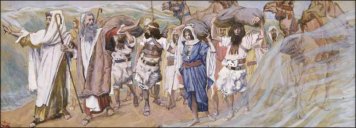
Moses Pleading With Israel“Moses manifested God’s power through miracles, God’s authority through the promulgation of the commandments and the law, and God’s mercy through the intimacy granted him by the Lord for his own faithfulness and meekness. The very personification of the old covenant, Moses was also a type of Christ, the Prophet and Legislator of the new. God’s honor devolved upon him: Moses was actually God’s substitute in dealing with Pharaoh, hence God entrusted his own honor to Moses”. (Senior 867-868)
Power, authority, mercy, intimacy, faithfulness and meekness. Here is a valuable lesson for us.
The sort of meekness that is the gracious humility shown by Christ is also the meekness that Moses demonstrated. This meekness leads to faithfulness.
Jesus Teaching in the TempleThe sort of faithfulness that is constant and intentional is the fidelity shown by Christ to the father and to his flock. This faithfulness leads to intimacy.
The sort of intimacy that shares and does not control is lived by Christ in every story we read about him. This intimacy leads to mercy.
The sort of mercy that is compassion is personified by Christ. This mercy leads to authority.
The sort of authority vested in Christ is the same authority we are granted when we follow Christ. This authority leads to power.
This power is everlasting. It comes from the father, is explained to us by the prophets, and is lived for us by Christ.
Moses is a personification of the Old Covenant, Jesus is the New. God entrusts Christ’s honor to those who are meek, merciful and in intimate relationship with him.
Here is a valuable lesson for us. Let us take it in today, and let us ponder it.
A re-post from November 1, 2011.
Senior, Donald, ed. THE CATHOLIC STUDY BIBLE. New York, Oxford University Press, 1990.867-868. Print.
Fear of abandonment is a horror that grips many and as a result lovers jilt one another so as not to be left by the other, parents abuse their children so as to not be disappointed, colleagues betray one another in order to keep a job, supervisors coerce workers in order to maintain complete control, friends disappear from relationships rather than work through conflict. We can imagine how the kingdom might bloom if we were to fully comprehend one single fact – we are never alone, God is with us always and so there is no need to allow the terror of rejection to govern us.
Christ brings us a message of inversion, as we have said in many Noontimes. He tells us that what is up in our physical world is actually down in his. The poor and the humble inherit, those who mourn rejoice, the hungry and thirsty are sated, and those who suffer persecution because of this belief reign. When any of my siblings or I complained of an injustice – perceived or real – my mother would remind us easily and with a smile: The first will be last . . . the master is the servant.
So if we are to live as if we believe in this first is last kingdom-building, we perceive abandonment as its inverted companion. Union. Christ is with us to remind us that the jilted are his special loves, the lost children his particular darlings, and the oppressed his best and closest friends. In today’s Noontime, God shows the Hebrew people how much they are loved. God tells them that they are not alone. God reminds them that they are unique and chosen loved ones; yet they do not understand. Across the millennia we hear their cry, see their pain, and we ask as the Hebrews did: Why do we suffer? Why do things like this happen? How are we to go on? We are still God’s stiff-necked people.
Water springing from a rock, manna and quail in the desert: God knows that there are hidden gifts in hard, dry places; God knows that manna gathers itself like dew in the desert morning; God knows that great flocks of quail migrate over the wilderness and come to ground to rest; yet we persist in disbelief. We continue to ask as the Hebrews ask: Is the Lord in our midst or not?
In verses 8 through 13 we watch Joshua defeat the army of Amalek as long as Moses keeps his hands raised. This story fascinated me as a child and I spent days lurking behind my brothers and sisters willing them to do things I wanted when I raised my hands to heaven. God in great wisdom did not answer those requests; but God has answered many more as God accompanies me on my journey.
After the defeat of the Amalekites, the Lord says to Moses: Write this down in a document as something to be remembered, and recite it in the ears of Joshua. In Old Testament language, the Lord tells the people that God will always be among them to defend them; God will not allow them to be wiped out. God tells them that they are not alone, and that God will bring goodness out of evil. Always.
We are never alone. We are constantly loved. We are rescued, comforted, healed and held. Always. Without fail. There are no circumstances and no people we need ever fear. The parched desert and the brutality of the Amalekites in our lives need not send us into panic because God is in our midst.
And so we too, can write this down . . . We have nothing to fear becausethe Lord will war against our enemies. Throughout the centuries.
We are familiar with the elements of this story: the birth of Moses, the call from the burning bush, the killing plagues, crossing the Red Sea, wandering in the desert, and finally a glimpse of the Promised Land. This is Moses’ story, it is Jesus’ story, it is the story of the faithful servant, and it is our own.
From DAILY REFLECTIONS FOR LENT: NOT BY BREAD ALONE 2018 written by Michelle Francl-Donnay. Exodus reminds us we are not to settle into our pews, to watch events unfold like an epic movie in which the hero rises in the very last scene, only to pour back out into the lobby at intermission, tossing our crumpled worship aids into the recycling bins. No, sit on the edge of your seats, and be ready to fly forth with only what you have in hand”.(Francl-Donnay 92-93)
Francl-Donnay reminds us that as faithful servants, we must be ready for flight.
The Eucharist is fast food, trail food. This is not a private feast, a family dinner to be lingered over, however reverent, and beautiful the liturgy is. This is a public meal, food for those in flight, food for those about to be dispatched on a mission. (Francl-Donnay 92-93)
James Tissot: The Last Supper
Francl-Donnay reminds us that as faithful servants, we must be prepared to receive God’s promise in the person of Jesus.
Tonight we will do as Jesus commanded at the Last Supper. We will wash each other’s feet, to show each other in the presence of the faithful what we have vowed to do. (Francl-Donnay 92-93)
Francl-Donnay reminds us that as faithful servants, we must go into the world with words and acts of peace.
So now we wrap Christ around us, and kneel before the hungry child, the homeless mother, the refugee whose shoes are worn through, to care tenderly for what the world would trample underfoot. (Francl-Donnay 92-93)
Francl-Donnay reminds us that as faithful servants – and no matter the sorrow or pain we suffer – we must make our exodus into the world with words and acts of joy.
James Tissot: The Mess of Pottage – Jacob and Esau
This reflection continues thoughts posed in the Revenge and Forgivenessposts on this blog.
Obadiah, one of the Minor Prophets, offers us ideas we will want to examine further.
From the ARCHEOLOGICAL STUDY BIBLE we discover themes. We learn that Obadiah’s name means “servant of Yahweh,” and many scholars believe that his brief prophecy was written between 586 and 553 B.C.E. We know that Obadiah does not specify that his prophecy is meant for any particular king or event; yet he indicates that a major calamity has occurred in Judah and that the Edomites have capitalized on this event. In general, scholars believe that there was a post-exilic setback for the Israelites, and most believe it to be the fall of Jerusalem to the Babylonians in 586 B.C.E. They also remind us that Edom itself fell to this same empire in 553 B.C.E. All of this sets up a story of intense tribalism, payback, and retaliation. We look a little further.
Who are the Edomites and where is their land? These people descended from Esau, the son of Issac, who was cheated of his heritage by his brother Jacob and his mother. Obadiah writes to the people of Judah (the descendants of Jacob) condemning the Edomites for their treachery and violence toward the people of Judah. He also rails against the people for their sins of arroganceand indifference toward God. So this prophecy harkens back to the conflict between these two brothers. Judah feels that the hostility shown to them when they are at a low point by the people of Edom is crueland unjustified.Edom’s arrogance was founded in its nearly impregnable mountain strongholds where the Edomites safeguarded their wealth (gained from trade) in rock vaults. Obadiah teaches that God is sovereign over allnations. (Zondervan 1464-1465)
James Tissot: The Meeting of Esau and Jacob
So much of what we read here reminds us of the story we live each day; our modern world is occupied with ancient themes: indifference to a higher authority, arrogance of the ego, injustice of systems and structures, and the use of cruelty as a fair means to any end. The rivalries in this prophecy echo the petty rivalries we set up early in life and, as we grow older, carefully nurture.
Turning to today’s reading, we see these familiar words in verse 18: “Vengeance is mine; I will repay.” Yet, despite our recognition of the truth these words bring to us, we need more urging. The prophet, knows that despite enlightenment we will have setbacks, and so he lays them out for us to examine in ourselves: the malignant hope for revenge, the overpowering force of hubris, the willingness to use any means to achieve our ends, the animal-instinctive fear of others. Obadiah asks us examine the suffering of our daily experience as we reflect on his prophecy.
As New Testament believers, we want to be poised for Jesus’ coming into our lives and receptive to the Spirit that lives among us. Feeling Christ’s call to our highest goodness, we might look at Hebrews 11 and determine to follow the example of the faithful lived by the Patriarchs: Adam, Enoch, Abraham, Sarah, Isaac, Jacob, Joseph, Moses, Rahab, and the Judges . . . “all these . . . approved by the testimony of faith”. We might look to these people as models of how and what we are to do, how and why we are to overcome our lust for revenge, how and why we are to practice love. When we study their individual stories, we see that these ancestors do not lead perfect lives; but they strive for that perfection in their loyalty to Yahweh. They listen, they obey, and they bear their trials well.
In the name of Jesus, let us call out our best selves to serve God, to fulfill his hope in us. Let us be good and loyal servants who want nothing more than to discern our mission and to complete it well. We ask this in the name of Jesus, the one who dwells among us to lead us, to heal us, to restore us, to be one with us.
Amen.
Adapted from a Favorite written on October 27, 2007.
Read the brief prophecy of Obadiah and compare varying translations to better understand our tendency to seek revenge . . . and our need to rely on God’s wisdom rather than our own.
ARCHAEOLOGICAL STUDY BIBLE (NIV). Grand Rapids, Michigan: Zondervan, 2005. 1464-1465. Print.
This chapter of Exodus tells us the story of Moses in much the same way that folktales of that era recounted the origin of a hero, especially of Sargon of Akkad in the late eighth century before Christ (Meeks 80). Today’s story ends in an interesting way in the NEW AMERICAN BIBLE: [God] saw the Israelites and knew . . .
Notes from the HARPERCOLLINS STUDY BIBLE point out that the meaning of the Greek word know can have various connotations just as in English. We can know something and care about it, we can know it and be indifferent, or we can know something and then act upon what we know. The NEW AMERICAN version with the ending ellipsis leaves us with something to ponder. [God] saw the Israelites and knew . . .
God – being God – knows all. God knows all before it happens, God knows all presently, God knows all there will ever be to know, and God knows it eternally. God certainly heard and understood the plight of the Hebrew people who had gone to Egypt with Joseph, and later Jacob, the rest of his sons, and all of their families. God knew and comprehended their circumstances. So when the enslaved people groaned and cried out, God heard, understood. God knew they were suffering and God chose to act upon this knowledge. God knows all people in this way. God knows us in this way now.
God saw the people and knew . . .
Tomorrow, knowing God and acting.
Meeks, Wayne A., Gen. Ed. HARPERCOLLINS STUDY BIBLE (NRSV). New York, New York: HarperCollins Publishers, 1989. Print.
Adapted from a reflection written on February 24, 2010.
Image from https://commons.wikimedia.org/wiki/File:Tissot_Moses_Laid_Amid_the_Flags.jpg


.jpg "Moses_Pleading_with_Israel_(crop)[1]")




 The Noontimes