Today’s verses for reflection describe the famous “Dry Bones” of Ezekiel, a metaphor for the reunion of our own body and soul at our resurrection. Ezekiel brings us a panoply of images that help us to understand that the oasis mirages of the desert are possible. Ezekiel tells us that restoration after great downfall can happen – not because of our own good works, but because of God’s infinite and ever-abiding compassion.
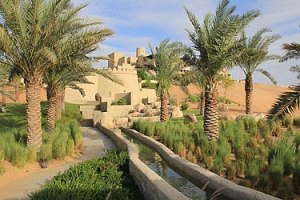
A falaj in Qasr al Sarab, Liwa Oasis
In the desert there is a quiet but sudden blooming that takes place after a rain. Tiny, delicate yet sturdy flowers pop up over night after a scattering of dew but they disappear with the heavy noon sun. The constant cycle of arrival and departure reflects our own comings and goings with God. We receive the morning dew and rise hopeful. The heat of the day beats us down and we retreat in disappointment. Yet, through God’s loving care we return to bloom again with the next morning’s new scattering of condensation. The cold night has brought sustenance that we did not expect.
And so it is with us. Each day we are offered the gift of God’s loving, patient care. Each day, despite the dryness of our bones, we rise to respond. Each day we sink in weariness and yet . . . even in the most vast of deserts God provides oases to sustain us.
Tomorrow, we consider our own dry bones . . . and our own restoration.
There has been a lot said about “the desert of love”. Love seeks the desert because the desert is where man is handed over to God, stripped bare of his country, his friends, his fields, his home. In the desert, a person neither possesses what he loves, nor is he possessed by those who love him; he is totally submitted to God in an immense and intimate encounter. That is why in every age the Holy Spirit has compelled all lovers to seek the desert. (MAGNIFICAT Meditation, December 6, 2009 – Madeleine Delbrêl)
The desert is a place for us to confront our fears – knowing that we are alone and that no one but God is watching. It is difficult to see these many blessings until we have been in the desert. When catastrophe strikes, we are given the opportunity to reap bounty from the crisis.
The prophet Joelreminds us that we need not fear anything or anyone. He reminds us that there are mountains of blessings lifting us up daily, rivers of blessings cleansing us each day. The scourge of locusts is healed. Our storehouses overflow. Everything we were lacking has been fulfilled . . . and more. The Lord walks among us . . . as one of us.
When we go to the desert, we are alone with God and those God sends to minister to us. This is where God finally has our total attention. So rather than fear the arid places and times of dryness, let us listen for the messengers who harbinger good news. Let us allow ourselves to rest fully and totally in God’s great arms. nd let us remember that it is in the desert that find our greatest, deepest and most abundant blessings.
May God’s peace and blessings be upon each of you.\
At that time I will bring you home, and at that time I will gather you; for I will give you renown and praise, among all the peoples of the earth, when I bring about your restoration before your very eyes, says the Lord.
We yearn to go back to a place and time of innocence. We miss the elders who peopled our childhood years. We look for comfort in old, familiar places. Zephaniah reminds us today that all of these dreams are already fulfilled.
God says: Rather than see the world around you as chaos, come to me so that I might give you rest. Rather than look at what is missing in your lives, consider all that you are and have. Rather than look for consolation, turn to others who need your consolation. This is the gathering Zephaniah describes to you. This is the restoration he proclaims. It is the healing I bring to each of you when you decide to live and think and act in me. You do not have to wait for the death of your body to experience this coming home to me . . . you are already there. Put aside your chores and your worried for a little time . . . and come to me. I have much I wish to give you.
Time, people and places. We feel nostalgia as we recall good memories and ward off the bad. We re-create in our mind’s eye the faces of loved ones we can no longer see or touch. We close our eyes and conjure up the scents and aromas of those places we thought we had lost but that we now somehow find in an old reminiscence. God’s time is eternal; God brings all of us together in the Mystical Body of Christ; God is in all places at all times. When we join this great coming home . . . all of time, all the faithful, and all places come together in union with this God who loves us so much that he chooses to live among us. Zephaniah tells us that when we come home to God we are already there in those times and places we miss, we are already there with all of our beloved.
In this last week of Advent when the day of Jesus’ birth nears, let us consider for a time the renown and praise that we are already given by God. Let us consider the renewal this season brings to us. And let us go gladly to take part in this gathering up and this coming home.
For more reflections on the words of the prophet Zephaniah, enter his name into the blog search bar and explore.
When we pray the Liturgy of the Hours we participate in the rhythmic repetition of the morning and evening canticles that we find here in Luke. They – along with the presentation of petition, glorification and thanksgiving through the psalms – give our days and nights a deep sense of tranquility. These times of meditation and contemplation create the pathways through which God speaks. The heart, in this way, willingly readies the soul in hospitality for the reception of the Holy Spirit and the presence of Christ. Prayer cleanses the mind, prepares the spirit and animates the heart for the reception of God’s revelation to us. Nothing can be more important for it is our intentional and incidental prayers that bring us sanity and serenity. These canticles of praise help us to travel through our days, our years, our lives.
No one experiences life without feeling distress and anxiety, and it is when we turn to God – the source of all that is good – that we are healed, lifted up, salvaged and restored. When we allow harm to transform us through our grieving and our trust in God, we find the joy expressed in the canticles we read today. We also find reason to celebrate God’s salvific love.
Champaigne: Visitation The Canticle of Mary or the Magnificat
These canticles sung by Zechariah who finds his voice after the loss of speech, and by Mary, who anticipated greatest joy and greatest sorrow, are meant to carry us from sun up to sun down continually. The canticle of Simeon, which the Liturgy of the Hours designates as part of the Night Prayer, is an anthem of gratitude, and together these songs can bracket our goings and our comings, they can guide our days and nights, they can fill us with hope and trust in God.
When we sit with Jeremiah 20:10-13, Psalm 18, and John 10:31-42we can see how we too might sing canticles of praise for God’s providence as we move from dread to joy.
I hear the whisperings of many: “Terror on every side! Denounce! let us denounce him!” All those who were my friends are on the watch for any misstep of mine . . . In my time of distress I called upon the Lord, and he heard my voice . . . From his temple he heard my voice, and my cry to him reached his ears . . . The Jews picked up rocks to stone Jesus. Jesus answered them . . . “If I do not perform my Father’s works, do not believe me; but if I perform them, even if you do not believe me, believe the works, so you may realize and understand that the Father is in me and I am in the Father”. Then they tried again to arrest him; but he escaped from their power.
The Prophets Simeon and Anna with the Christ Child
And so we pray . . .
God is in his temple and he hears my voice, it reaches his ears . . . we are the temple in which God resides, Father, Son and Holy Spirit.
They tried again to arrest him; but he escaped from their power . . .we have nothing to fear when we walk in the way which is lighted by the light of Christ.
Sing to the Lord, praise the Lord! For He has delivered the soul of the needy one . . .we have everything to gain when we live in God.
As we begin our Advent journey, let us sing these canticles at dawn, at the setting of the sun, and when we lie down to rest. And as we escape from the power of terror’s grip and watch it melt away, let us turn to God in all things, in all ways, at all times . . . and let us sing our canticle of joy. Amen.
Adapted from a reflection written on April 3, 2009.
To explore these songs of praise and what they can mean to us, click on the images above or go to The Liturgy of the Hourspage on this blog.
Cleanse me with hyssop and I will be clean; wash me, and I will be whiter than snow.
I always wonder about Bathsheba. e might see her as one dimensional, a figure standing for beauty and grace, a woman-object, a child-bearer. Yet she endures in David’s court. And while she shares in David’s act, no mention is made of her grief or guilt, most likely because she is a female, chattel in these ancient times. We can imagine how much she may have suffered. She continues to appear in Kings and in Chronicles and is revered as Solomon’s mother, yet she is a quiet back-figure in this long-running story of sin and parable.
Let me hear joy and gladness, let the bones you have crushed rejoice.
It is appropriate that this story come to us as we near the end of the Liturgical year and prepare for Advent. The beautiful psalm of repentance, Psalm 51, was written when Nathan came to David after having committed adultery.
Oh Lord, open my lips and my mouth will declare your praise.
When we sing this song of repentance we are repeating the words of one who has lusted, one who has slept with another’s beloved, one who has arranged murder. This is fitting, for in some way we all transgress on those around us when we covet, take or tear down something or someone. And there are many small ways in which we end a life beyond the physical act of murder. We might destroy someone emotionally, professionally, psychologically or spiritually. et, there is always mercy to be sought . . . and granted.
Then I will teach transgressors your ways and sinners will turn back to you.
There is much to be heard in this story. There is much to be lived, much to be sung. David takes something he wants. David destroys. Nathan speaks. Nathan restores. Relationships cannot be put back as they had been, time cannot be reversed, and although Uriah cannot return, some quality, some relationship reappears. Bridges can be built. Pride can be put aside. Transgressions can be brought to light. Forgiveness can be sought and given. Restoration can happen.
Miracles can take place . . . souls can be saved.
Restore to me the joy of your salvation and grant me a willing spirit, to sustain me.
What do we do when Nathan stands before us? How do we react? When confronted by big sin, we need a big spirit. We need constant relationships which help us to develop rather than comfortable friends who discourage us from growth or who encourage us to wallow. We need a steadfast spirit, a renewed heart, an eager soul. We need God. And these we have all been given. We need only take them up and commit ourselves to them.
Create in me a pure heart, oh God, and renew a steadfast spirit within me. Create in me an open willingness to listen. Renew in me a faithful heart that takes in the world.
I am weary with crying out; my throat is parched. My eyes have failed, looking for my God. More numerous than the hairs of my head are those who hate me without cause. Too many for my strength are my treacherous enemies. Must I now restore what I did not steal?
When life’s extremes weigh us down and wear us out there is only one place to go for restoration. When too many lies evil and too much denial tax us beyond our reserves there is only one path to take for transformation. When all roads close, when too much is asked of us there is only one person who understands our experience of extremes.
God says: I never intend for you to go beyond your limits; pushing you too far is a sure sentence of death. Your voice has disappeared from too much crying, your eyes are weary from so much looking. You are outnumbered and overdrawn. You are beyond weary; you are spent. When your body fails and your mental powers ebb, place your heart in my hands. I will not let you vanish into dust. I will champion you against your foes. I will restore even that which has been taken from you.
Also visit the Noontime reflection Without Cause by entering the words into the blog search bar.
The whole of Israel used to give the cantors and gatekeepers their due portion for each day.
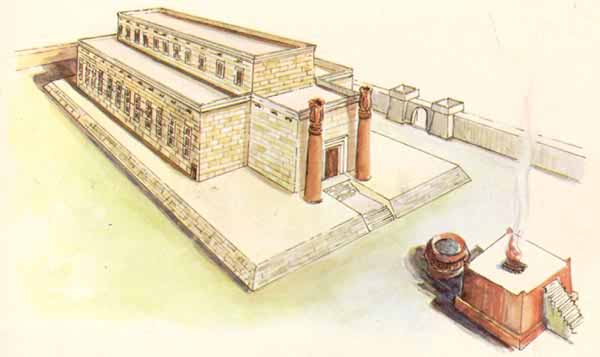
Nehemiah describes not only the restoration of the Temple when the exiles return from their place of deportation; Nehemiah also explains that the rites and rituals were also restored. All those who officiate at liturgies are to receive their due portion. In return, the Levites, the sons of Aaron and all those who make liturgy possible are to perform their duties. Nehemiah not only rebuilt walls and external structures, he rebuilt internal structures as well.
Nehemiah’s Temple
God says: Each of you deserves your due portion. When you insist on having less or more you upset your natural balance. When you take more than your share you deny others of the goodness I have in store for them. When you take less, you deny the gift you are to the world. When you corrupt yourself or others you corrupt the vessel that contains hope for the world. When you deny yourself or others you also deny me. Carry out the task shown to you. Fulfill the hope planted in you. Come to me with your questions and concerns. Rather than take more or less than is meant for you, rather than fill your barns to bursting or depleting your energies until you are fully spent . . . receive your due portion and remain in the truth. This is where your true treasure lies.
Jesus reminds us that the measure we measure with is measured out to us. (Luke 6:38) He also reminds us that where our heart lies, there will be our treasure. (Luke 12:34)
During Gottlieb Schumacher’s expedition of Megiddo, a rare seal was found with the inscription: “To Shema slave of Jeroboam”. This may be King Jeroboam II from 750BC.
Amos does not mince his words or couch them in easy metaphors; we can see why he was rejected. His message struck too quickly and too closely to the heart of those who by their actions did not live out the Mosaic Law of honoring the one true God. Amos lived during the reign of Jeroboam II (786-746 B.C.E.) and he pronounced his prophecy at the cult center of Bethel until the priest who was in charge of that royal sanctuary expelled him.
At this time, the northern kingdom of Israel had separated from the southern one of Judea and when we read closely we can see that the priests and the wealthy had succumbed to the lure of the power and control which their office as sacred ministers and leaders afforded them. Stated bluntly, they abused the gift and power given to them. They were more concerned about maintaining their control on the temple income derived from the people who brought their offerings as a part of their attempt to seek penance and union with God. The priests of Israel (the northern kingdom, also Samaria) had separated from Jerusalem (the southern seat of power and worship) and loved their position of wealth, plenty and power. Amos rebukes these fat, contented people just as Jesus did when he ejected the moneychangers from the temple.
Amos always understands that this perversion of the law is not permanent . . . as much as those in power may wish it to be. Amos knows that Yahweh will use this harm that the corrupt inflict on those over whom they have control . . . and he knows that Yahweh will turn this harm to good, just as he does with all things that are corrupting. Yahweh will use these stubborn acts of blindness and perversity to bring about restoration and ultimate union with God.
As with all prophets, Amos is reluctant to speak when called by God . . . yet speak he does . . . and oh, so beautifully. “His style is blunt and even offensive”. (Senior RG 362) He begins chapter 4 by calling the wealthy women cows, the wife of the priest, Amaziah, a harlot. “He is a prophet in the mold of Elijah, whose denunciations come close to cursing”. He saw himself as a poor shepherd and farmer with no influence and therefore saw no need to speak softly . . . as he did not expect to be heard. Amos pronounces doom on those who do not hear and those who are blind to their own actions, and then he goes back to his sheep and sycamores.
Amos’ offer of hope springs not from the idea that this doom and catastrophe for the controlling classes can be avoided, for it is clear that disaster is looming and in fact it does arrive in the form of the Assyrian invasion. No, the hope that Amos offers lies in the fallen hut of David, the Messiah who is to come . . . Jesus. Amos tells and foretells those who have ears to listen that we rebuke those who live in flagrant violation of the covenant and then we watch in hopeful waiting for the one who will come to deliver the justice that is so desperately needed. We wait in joyful expectation the kingdom where compassion and mercy merge with justice and righteousness, where we both rebuke and remain open to wonderful possibilities that can come only with tremendous hope.
I will bring about the restoration of my people Israel; they shall rebuild and inhabit their ruined cities, plant vineyards and drink the wine, set out gardens and eat the fruits. I will plant them upon their own ground; never again shall they be plucked from the land I have given them, say I, the Lord, your God.
Evidence and judgment, words and woes, threats and promises, visions of locusts, fire, the plummet, and the fruit basket, condemnation of priests and leaders, prophecy against greed and corruption, the final vision before the altar and then the winnowing sieve. This prophecy is too much to bear yet just as we are about to put aside forever its dark images and frightening premonition of doom . . . Amos leads us to the place he was always leading us. Amos brings us to the Christ, the Messiah.
God says: You most often find me in the dark valleys of your life for it is the failures, the betrayals, and corruption that bring you swiftly to my side. Just so does my prophet Amos warn you that my little ones must be shepherded. My lambs must be tended, my sheep must be led. Through the suffering, pain and sorrow I am with you. I have created you and you are mine. I have loved you and I will never leave you. I have already rescued you and placed you within the protective walls of my vineyard. You have been planted upon your own ground and you will never again be plucked from the place I have given you. Yours is the place of honor in my own sacred heart. This I have promised. This is the raising up you have been seeking. This is your raising up that is my gift to you this day.
How does the prophet Amos speak to us today? What foreshadowing does he share? What hope does he bring? What is his promise of raising up for you? When we consider our world today, many will say that we need the words of Amos more than ever. When we contemplate our surroundings, many will say that it is time to heed the prophecy that reminds us God is always raising us up.
Use your own commentary or one of the links below to learn a bit more about his prophecy.