Psalm 18:26-27: With the faithful you show yourself faithful, O God; with the forthright you show yourself forthright. With the pure you show yourself pure, but with the wicked you are wily.
God is greater than any evil we encounter in our lives. God is more forgiving than any compassion we may be shown. God is more gentle, more kind, more persevering and forgiving than we can imagine. God endures. God does not give up or give in.
God says: Do you find it difficult to think of me as wily when I deal with the wicked? I am prudent with them just as I ask you to be. I know that the wicked believe in themselves more than they believe in me. I know that many of the wicked are fearful and so I call them to serenity just as I call you. I have created all of humanity and my hope is that each of you will rise to the fidelity, the purity, the forthrightness and holiness that calls you. When you meet the wicked and do not know how to handle them . . . call on me. My wiliness is far greater than their evil.
The practices of the wicked lead us away from life eternal.
The practices of fidelity lead us to a life of purity.
The practice of forthrightness leads us to a life of honesty.
The practice of prudence leads us always back to God.
1 Corinthians 2:10: The Spirit scrutinizes everything, even the depths of God.
When a political, social or religious structure prohibits us from asking questions we need to be wary.
When friends, relatives or colleagues tell us to keep secrets we must not go along with the group.
When we are tempted to conceal truth, to fog reality or look the other way we are obliged to seek clarity and advocate for openness.
God says: Do not be afraid to scrutinize your surroundings; honest questions bring you to the truth. Many will attempt to keep you far from me and away from the light but I can and do permeate all space. I am present in all times. I penetrate closed doors and I enter hard hearts. I soften stiff necks and I convert the most twisted sinner. So do not fear inquiry; it becomes you. Do not be afraid to allow your doubts to generate questions that will free you from fear. I am open to each of you. I have told you who I am and how I am. I know all about you for I have created you in my image. Scrutinize everything, even me. I long to hold you within my own heart.
For more reflections, type the word Ask Godor Asking God into the blog search box to see where the Spirit leads you.
This is a powerful story about how King Ahaband his wife Jezebel collude with scoundrels to trump up charges against the good man Nabothin order to take a vineyard which they coveted. It is dreadful in its deep deception; it is horrendous in its horrible depiction of the violent frenzy of a plotting, conniving perseverance of evil. It is human interaction in its basest form.
The prophet Elijah responds to God’s call but fears for his life when Ahab and Jezebel conduct a campaign with the goal of annihilating all prophets who speak with God’s voice; and in Chapter 19 Elijah even tries to run from the whispering voice of Yahweh. In Chapter 20 we see how Yahweh brings success to the Israelites and favors them in battle. Then Ahab wants something which Naboth has, a lovely beautiful vineyard. Jezebel and Ahab conspire to attain it . . . so the innocent Naboth must die.
Yahweh steps in and we watch as he vindicates the faithful. We also watch as he delivers punishing blows to the wicked ones. Ahab repents, and Yahweh softens the sentence he is about to deliver. Jezebel does not . . . and if we read a bit further we discover Jezebel’s evil end.
Dear God, protect me from family and friends who would lead me to destruction as Jezebel did. Remind me that repentance heals the mind and soul. Bring me contentment rather than envy, humility rather than pride, love rather than hatred, restoration rather than destruction, and reaping of blessings rather than an arid life of self-gratification. Surround me with holy people, God-fearing people, people who do not hide the light of the lampstand, people who honor, as Naboth did, their ancestral heritage.
Keep us from pride which inverts to shame. Keep us from anger which turns inward to become melancholy. Keep us from deception which leads to delusion. Keep us from coveting Naboth’s Vineyard.
Bring us peace, bring us joy, bring us hope, bring us your Spirit. Amen.
First written on September 7, 2007 , re-writtten and posted today as a Favorite.
Ruins of SamariaKing Omriwas successful in his political career and for this reason he appears in the ancient documents of several cultures. He wielded his military power well, winning battles, capturing cities, and establishing the new capital of Samaria. It seemed that anything he put his hand to was bound to do well, and yet . . . “Omri was an enormously famous and successful king, yet the Bible pays him virtually no attention. Political success, the eyes of the Biblical writers, counted for very little if an individual had turned away from God”. (Zondervan 512) We might remember Omri more if we paused to remember that he fathered the man often considered the wickedest king in Israel history, Ahab. The legacy of Omri then is this . . . he founded a major city that came to symbolize corruption, and his son numbered with the vilest of men. We may want to reflect on this a bit today.
We humans focus too often on controlling the story we hope will be told of us once we have left this earth.
We humans put too much energy in building monuments to ourselves that will eventually crumble.
We humans expend our energy and talent gathering fortune and fame while we neglect the nurturing of heart and soul.
When we consider the legacy of King Omri, founder of Samaria and father of Ahab, we see that he has a great deal to teach us from the grave.
Do not store up for yourselves treasures on earth, where moth and decay will destroy, and thieves break in and steal. For where your treasure is, there also will your heart be. (Matthew 6:19-21)
Jesus reminds his apostles – and he reminds us – that there is no point in gathering wealth and power; there is nothing eternal about building memorials to ourselves. The testimonials that are everlasting are the many small acts we commit as we love our enemies and help one another to reach the fulfillment of our true potential – our potential in Christ.
No one can serve two masters. He will either hate one and love the other, or be devoted to one and despise the other. You cannot serve God and Mammon. (Matthew 6:24)
Jesus reminds his followers – and he reminds us – that we cannot try to live in both worlds. We cannot be “just a little dishonest”. We cannot turn a blind eye to corruption. We cannot tell “just one little lie” for once we begin our journey into the world of Omri the lure of false success is too strong. The end of that journey will be the monument we build to ourselves – an evil dwelling and wicked offspring.
Seek first the kingdom of God and all things will be given to you besides. (Matthew 6:33)
Once we learn to rely on God rather than the world of reputation and affluence . . . we will have taken the first steps in securing a legacy that will serve us forever.
Sirach 51:11:I will ever praise your name and be constant in my prayers to you.
When we celebrate, let us remember to thank God.
God says: I am happy to help you when you call on me. I love to rush to your side when you are in need. But I especially love to dance and rejoice with you when your news is good. Remember me in joy even as you remember in sorrow. Call on me in happiness even as you call on me in sadness. And love me in your grief even as you love me in your exultation.
God remains ever constant in us . . . let us try to remain ever constant in God.
Psalm 121:5-6:The Lord himself watches over you; the Lord is your shade at your right hand, so that the sun shall not strike you by day, nor the moon by night.
How wonderful it is the sun does not scorch us the moon does not lead us astray.
How marvelous it is that we are watched over and protected from the enemy.
How amazing it is that God wants to spend so much time with us!
God says: You are correct. All of this is true. I love to spend time with you and it does not matter what you are doing. I want to be with you in all you do. I delight in your delight. Watching over you is simple for me because beside you is the only place I want to be. How wonderful you are. How marvelous . . . how amazing!
We ought not shy away from God when he approaches. We must remain open . . . and welcoming. And we must be amazed . . . that we are so well-loved by the Lord himself.
Living in an era that signals change in many of our beliefs, we look for a call that brings us to our senses. Like a small child throwing a temper tantrum, we open eyes swollen from crying to see the reality of our anger, and we come to our senses. Like a partner who walks away from commitments, we witness to the destruction our egocentric actions leave in their wake, and we come to our senses. Like leaders who see their reflection in the unexpected mirror of events spiraling beyond their feeble predictions, we pause, take stock, and with hope . . . we come to our senses. The danger is, of course, that our rampage will take us beyond a place from which we cannot return, a demolition from which we cannot recover. The stories we hear in Luke 15 bring us courage as we come to our senses.
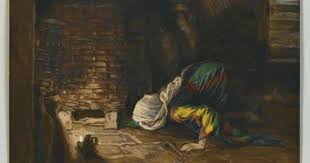
James Tissot: The Lost Drachma
The shepherd goes out in search of the one lost sheep. Christ continues to search for us no matter how deeply we burrow into our self-satisfaction. Rejoice with me for I have found my lost sheep.
The woman finds lost coins after putting aside her daily tasks. The Spirit abides with us despite our thinking that we are alone. Rejoice with me because I have found the coin that I have lost.
The loving father forgives the prodigal son. The Creator is more generous than we can imagine. Rejoice with me because your brother was dead and has come to life again; he was lost and has been found.
Luke recalls Jesus’ stories of loss and return, of deep sorrow and unbounding joy, of profound envy and immeasurable. The pivotal elements in each of these parables are dual: the central figures come to their senses, and the plentiful, compassionate, and generous love of the Creator has no limit.
Bartolomé Esteban Murillo: The Return of the Prodigal Son
When we open our eyes and ears each morning to headlines that unsettle and even disturb us, let us come to our senses and turn to our tender God as we go out into the world.
When we pause in our day to orient ourselves in the rush of information and demands, let us come to our senses as we rely on our courageous Christ to show us the way.
When we return to the quiet of our hearts at the end of our day, let us come to our senses and give over all our pains and sorrows to our healing Spirit who binds all wounds and heals all scars.
Rejoice with me because we have drifted with the winds of the time and now we are found; we have been lost and now are found; we have been dead and now are in full and abundant life again.
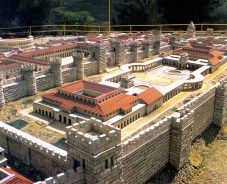
Herod’s PalaceWhat do my faerie castles look like? How thick are the walls of the fortresses I build to keep the world out? How many rooms do my palaces have? What are the furnishings? Whom do I bring home to my safe havens? How do I spend the precious gifts of time and space that God has given to me? Where, and when, and how and why do I construct my palaces?
Are these spaces and times meant to keep the world out or to invite the world in? Have they become oases on the road of life or have they devolved into chaotic and jarring experiences? Are they God-absent or God-centered? Am I relying on myself, my skills as an architect and designer . . . or am I trusting God completely?
Look at the birds in the sky; they do not sow or reap, they gather nothing into barns, yet your heavenly Father feeds them. Are not you more important than they? Can any of you by worrying add a single moment to your life-span? Why are you anxious about clothes? Learn from the way the wild flowers grow. They do not work or spin. But I tell you not even Solomon in all his splendor was clothed like one of them. If God so clothes the grass of the field, which grows today and is thrown into the oven tomorrow, will he not much more provide for you, O you of little faith? (Matthew 6:26-30).
Why do we worry? Why do we spend so much time building barriers when we ought to be disentangling ourselves from enabling relationships? Ought not we spend more time bringing The Word to one another and building bridges? Imagine a world in which we are free from anxiety and fear, a world in which we trust God completely with our needs. Does he not know them better than anyone else? Ought we not to go to him for our shelter and our shade? Why do we build so many palaces when God has a dwelling place already fashioned for us?
From last evening’s and this morning’s MAGNIFICAT intercessions:
God is our promised shelter and our shade. To him we pray: Protect us from all harm.
In the midst of life’s tribulations, strengthen our hope in your promised kingdom. Protect us from all harm.
In the midst of physical ailments, grant us trust in your healing power. Protect us from all harm.
In the midst of worry and distress, send us peace of heart. Protect us from all harm.
With trust in the love our heavenly Father has for us, we pray: You are our life, O Lord!
You care for the works of your hands: teach us to help and not to hinder your loving providence. You are our life, O Lord!
You feed and clothe all of your children: forgive us the greediness that seeks to deprive others for your own benefit. You are our life, O Lord!
You provide for all the earth: grant us the wisdom to see and to serve your purposes. You are our life, O Lord!
What need of we of palaces . . . when our God provides us all?
We have visited with this book several times during our Noontime reflections and we know that it, along with the book of Ezra, describes the restoration time of the Jewish nation. We know that Nehemiahwas the administrator who is credited with the rebuilding of the temple and walls while his friend Ezra, the priest, rebuilt the religious traditions of the Jewish people. Together these men led their community to recovery through work, prayer and a close connection with their God.
The survivors of the captivity there in the province are in great distress and under reproach.
We constantly bump into people who are in great distress and under reproach.There are times when we ourselves are the victim of abuse of one kind or another, times when we too, suffer greatly in that we are separated from some one, some thing or some tradition which used to comfort us and bring us peace. When we find ourselves in exile . . . and we yearn for reconciliation . . . the best remedy for this affliction is to do as Nehemiah did: I prayed: O Lord, God of heaven, great and awesome God, you who preserve your covenant of mercy towards those who love you and keep your commandments, may your ear be attentive, may your eyes be open, to heed the prayer which I, your servant, now offer in your presence day and night for your servants the Israelites, confessing the sins which we of Israel have committed against you, I and my father’s house included.
This was Nehemiah’s vocation, that he call together a buffeted and distracted people to bring them home to Yahweh where they might be healed and restored. It is our vocation as well, for as Christians we too are called to help in the gathering, fishing and harvesting work of God’s kingdom. To this we are called. For this we are made. Let us pray with Nehemiah . . .
O Lord, may your ear be attentive to my prayer and that of your willing servants who revere your name. Grant success to your servant this day . . . and all days.
Our vocation is to build and rebuild, to restore, to bring unity out of chaos, to bring light into the darkness, to bring hope to the desperate. And we are never alone in this work. We are constantly accompanied by the one who is the light, the hope, the joy of the world. We ask this in Jesus’, name. Amen.
Written on September 12, 2008 and posted today as a Favorite.
 Psalm 18:26-27: With the faithful you show yourself faithful, O God; with the forthright you show yourself forthright. With the pure you show yourself pure, but with the wicked you are wily.







 The Noontimes