We have reflected on God’s home and God’s foolish message. We have watched Paul and Barnabas use sinew and muscle to share the good news of God’s mercy. Today we consider how God’s goodness and love nurture and shepherd us.
Adapted from a Favorite written on April 5, 2008.
Today some of my children have gathered to help me with the chores that are too much for me to accomplish on my own, and I know that my parents are happy about this. I also know that Mother and Dad are here in spirit, continuing to shepherd from the next world, even as they shepherded in this one. They loved to call together “work parties” with the ostensible purpose of accomplishing some task, but which always resulted in more bonding than any of us could have imagined.
Shepherds protect and guard in many fashions. My parents led us to the nourishing springs Ezekiel describes that rejuvenate even dead bones. How do we lead others? How do our actions speak to others? How do we demonstrate our willingness to love as Jesus loves?
For my part, I will allow God to call me and mine as God sees fit . . . and I rejoice to see my children and their children live lives that are happy not because they are satisfying themselves, but because they are doing what they know to be the work of God.
In good times and in bad, in celebration and in sorrow, it is my constant prayer that my children, grandchildren and I might continue helping one another to keep our eyes fixed on the the one shepherd who cares for his sheep so well.
As for me and my house, we will serve the Lord. (Joshua 24:15)
Images from:
Click on the shepherd image above, or enter the word shepherd into the blog search bar to further explore how God leads, supports, and loves us.
Pope Francis shared thoughts on the family and the Joy of Love (Amoris Laetitia); his thoughts drew both praise and scorn as we might imagine. Today as I read commentary, I am drawn back to a favorite reading from 2 Timothy. Thinking about sound doctrine, I found this reflection and post it today as a Favorite.
This reading has special meaning for me as it was the first reading at my Dad’s funeral, and my son Thomas was the lector. These verses embody, for me, the lessons I was taught by my parents – and it is my hope that my own children believe that I too, teach sound doctrine. I know that many times we have “itching ears,” that often we “heap up teachers according to our lusts,” and that we “turn away [our] hearing from the truth and turn aside rather to fables.” These are the struggles we have with the little messages that constantly bombard us in this world. But I hope and pray to “be watchful in all things, bear with tribulation patiently, work as a preacher of the gospel, fulfill [my] ministry.” Every day as my students pass before me, I try to keep these things in mind while I attempt to “fight the good fight.” In the end, the children are watching us as we watched our elders. I did not miss much as a child or as a student, neither do my children or the young scholars who come into my classroom each day. These children constantly call me to my vocation of listening, learning, teaching, watching, hoping, waiting, believing, seeking and loving.
Pope Francis calls us to sound doctrine not only in his letters but in his every action. I pray that my own life might be an example of such fidelity, authenticity, joy and love.
As we continue to study the Gospel of Mark, we are struck again by his immediacy and precision; and we see how Jesus turns stark divisions into unifying calls.
The widow we meet today who gives from her poverty is seen in sharp contrast to the scribes who give from their surplus. Jesus as the son of God is also juxtaposed against those who would be servants but who are more enamored of status, money and place. The obvious lesson here is understood quickly, even by children. The widow’s contribution – small as it is – is worth as much and perhaps even more than the large amount given by others from their surplus; and the widow herself is as valuable, or more, as those who profess great learning and experience. We can see that this portion of Mark’s Gospel asks us to take a deep look to examine our own status, our own motivations, our own spiritual life in Christ. The more obscure lesson is this: We ought not to worry if we only have two cents when come forward to add to God’s treasury . . . God is counting on this small gift to appear and God has a plan for this small gift which we cannot see from where we stand.
My dad, the oldest of eleven, always used to say that when we compare ourselves to others we will always come up way short of some and way ahead of others. He would encourage us to compare what we have done in a day to what we mighthave done on a good day. He asked that we measure ourselves against our own potential. He directed us to steer well clear of comparing ourselves to others in any way with the words: You have no way of knowing what God knows.And when he himself became frustrated with life and with what he believed to be his own weaknesses, he would often murmur repeatedly in low words: God only knows. Only God knows. God only knows. Only God knows.
My mother, born the seventh of eleven, was fond of telling us – when we balked at going somewhere we thought we might be bored – Did you ever stop to think that God might have need of you today? Did it ever occur to you that your presence has a purpose even when you do not see it? Maybe you are being asked to bring something you do not realize you have. Go and find out what it is. And so we would go . . . and we always found out that yes, we had two cents, and they belonged in God’s treasury.
When we believe that the efforts we make are puny in attempting to answer God’s call, we might remember the contributions of the scribes and the widow.
When we fear that we have erred in responding to God’s call, we might remember that Jesus sees all of us, knows our worth and values our gifts accordingly.
When we feel that we have somehow gotten things wrong, that we have misunderstood the instructions we think we hear, we might remember that with God, our two cents are worth worlds . . . because we have come to God, trusted God and loved God.
And so we pray.
Precious God, We know that we often misunderstand messages. We sometimes doubt our ability to hear you clearly. We also know that we ought to be wary of those wearing robes for the sake of show. We sometimes become enamored of the robes ourselves. We always know that when you destroy temples you also rebuild them in days . . . deep within our hearts. Continue to guide us as we filter through the pageantry of life to find that which is worth more than the mere two-cent value it appears to have at first glance. Help us to compare ourselves to our own work rather than to the work of others. Lead us to your way of seeing and thinking. Lead us to your way of trusting and believing. Lead us always back to you. Amen.
He came home. Again the crowd gathered, making it impossible for them even to eat.
As I was growing up and moving into womanhood, my oldest brother – twelve years my senior – would come home from college, visit us when he had military leave, and then brought his family to visit from places across oceans. When he did, the clan would gather to celebrate. My sisters – both older than I but younger than this brother – came home often, and they brought their families from places nearby. They believed that the celebrations for my brother were more enthusiastic than those for their own families. Perhaps they were. I do not remember seeing the difference. My younger brother and I watched this curious mixture of disappointment and love, feeling that push and pull of family dynamics and understanding that this was how family functioned. A dichotomy of conflict and acceptance, worry and love. I suspect that each of us has similar family experiences.
In today’s Noontimewe see Jesus return home from a pilgrimage of healing and transforming others, and so many gathered that it was impossible for them even to eat. Jesus’ family, worries that he will come under scrutiny by the officials, declares that he is out of his mind. The scribes, worry about losing influence with the people, decide that Jesus is possessed by the devil. This is a confusing, jumbled juxtaposition of celebration and dangerous plotting.
Life is never a simple picture. Reality is always a combination of highs and lows, positives and negatives, sorrows and joys. Today’s Noontime, much like my own family memories, presents us with a picture of sadness mixed with delight, celebration with worry. And this is as it should be. For this is how families are. And this family of Jesus that we read about today is very much like our own families.
All of this makes sense when we watch Jesus return home and we consider that he is, after all, our brother.
Tomorrow, Jesus of Nazareth.
Adapted from a reflection written on August 31, 2010.
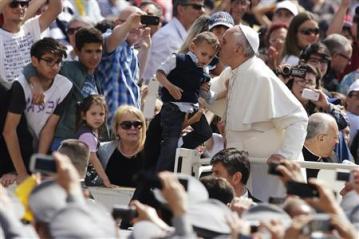
Pope Francis kisses a child as he arrives to lead his Wednesday general audience in Saint Peter’s Square at the Vatican June 5, 2013. REUTERS/Max Rossi
Monday, August 1, 2022
When I was a child and company arrived unexpectedly on a warm summer afternoon, my mother would whisper to my older sisters, “Go peel another pound of potatoes, and squeeze more lemons for another batch of lemonade”. The main course would stretch, she knew; the other side dishes and desserts were ample. It was the sustaining starch and the refreshing fruit drink that our surprise summer visitors would need for their journey onward.
Each time I read about the manna and quail in the dessert I think of my mother and the trust she placed in God as she and my dad raised their large family in unpredictable times. And when I hear the story of Elisha read out during liturgy as it was last week, I pledge to affirm the faith of my parents, knowing that they understood the power of good stewardship and the gift of conserving what was left over.
“Wasting food is like stealing from the poor,” Pope Francis has told us, and it was is this spirit that I was raised. It is this spirit I have tried to pass on to my children and grandchildren. Offering food and drink to the wayfarer, my parents showed us, extending hospitality to all is a way of life worth fostering; it is a tradition we find in both the Old and New Testaments. Honoring the sudden guest is our affirmation that God always gives us enough. Inviting the lost into a safe refuge is our demonstration of belief in the mercy of God. Husbanding all that is left over is our response to God’s call that we treasure all we are given by a generous and loving God.
Over the next few days we will look at stories from scripture, both old and new, to explore God’s message about sustenance, hospitality, and something left over. Today, we read Pope Francis’ words about food and we use a search engine to find an agency that provides a means for the poor to gain a permanent food supply, and we consider giving something of our wealth left over – even if it is only a few barley loaves and fish – to this cause.
Tomorrow, bread from heaven.
You might begin your search with these organizations, or you might conduct your own search of global or local agencies.
In Numbers 9 we see the Hebrews put all of their trust in God. May we learn to be faithful to the Lord in our daily wandering rather than be lured by little gods.
In the Exodus story we know that the Hebrews stumbled in their journey of fidelity. May we turn back to God in all of our drifting and forgive others as God forgives us.
In Numbers 9 we see the Hebrews do the Lord’s bidding when the Fiery Cloud settles into the desert sand to rest; we see them rise to follow the pillar of smoke and flame when it is time to journey. May we place all trust in the Lord rather than resort to our own schemes and small plans.
In the Exodus story we know that the Hebrews grumbled about God’s care of them in their journey of transformation. May we always seek counsel in the Lord and share the Word we hear with fellow pilgrims.
In Numbers 9 the Cloud tarries for days or rises after only one evening’s rest so the Hebrews are unable to predict God’s movement in their lives; yet they know that the Lord is with them in the Fiery Cloud. May we learn patience in the Lord and give thanks for the many surprises that await us.
In the Exodus story we know that the Hebrews grew impatient with God’s timeline and grumbled about God’s provisions. May we keep in mind how great is God’s generosity and share God’s love with others.
As a child, I loved to hear my Mother read out the chronicle of the people who wandered in darkness for generations, doing God’s bidding despite their frustration. Somehow I knew that there were great lessons to be learned in this long story of turnings. Mother’s calm and steady voice would rise up to give emphasis to the peril the Hebrews endured; it would fall to a low and gentle register to underscore God’s constant presence and encouragement to the people. Closing my eyes, I stored those reassuring sounds and images for unknown times in my future. As I grew I began to encounter my first overwhelming obstacles and remembering the comfort and safety of those drowsy evenings with Mother reading about the Fiery Cloud that served as guide and guard, I drew on those stored images. When fear threatened to paralyze me or lead me in the wrong direction, I allowed that pillar of fire and smoke to draw me toward God. Even today when I meet with an obstacle that threatens my physical, mental or spiritual life, I move toward the Fiery Cloud to step inside. And there I find a sanctuary that none can penetrate. I find a peace that none can rattle. I find a floating solidness that both sustains and carries me toward God. And in God all problems both great and petty melt away.
In a few short weeks we celebrate the season of Lent, a time of God’s sacrifice for us as Jesus walks among us. It is a celebration of Sacrificial Love, of Hope against Desperation, of surety in a world that offers only turmoil. Let us turn to the story of the people who once walked in darkness(Isaiah 9), let us follow the Fiery Cloud as we wander through the dangers of the desert, and let us step into the pillar of smoke and light when the chaos of life menaces. For there is no better sanctuary than God. There is no better hope than Christ. And there is no better peace than the serenity we find in the Spirit.
And so, we pray . . .
Let us rise as the Hebrews rise to do the bidding of the Lord. Let us rest as the Hebrews rest to await the wisdom of the Lord. Let us follow as the Hebrews follow . . . to do the bidding of the Lord. Amen.
Adapted from a reflection first written in December of 2011.
The story of Ruth, Naomi and Boaz is a tale about family, integrity, honor, honesty and fidelity. It is also about God’s providence and love; and it is about returning to the covenant relationship we have with God that is marked by “loyalty of faithfulness arising from commitment” which in the Hebrew community is known as chesed. (Meeks 408) If there is time this weekend, read this story from beginning to end. It will warm your heart.
“The book contains a beautiful example of filial piety . . . Its aim is to demonstrate the divine reward for such piety even when practiced by a stranger . . . [Ruth] became the ancestress of David and of Christ. In this, the universality of the messianic salvation is foreshadowed”. (Senior 278)
Today we enter the drama at the point where Ruth, the stranger in this land of the one living God, goes for the first time to glean what she can so that she and her mother-in-law might survive. It is when she is in the field gathering the leftovers that she meets Boaz for the first time. Keeping in mind that a widow in ancient society was considered a burden rather than an asset, we see how well Boaz treats her. He does not take advantage of her diminished status; rather, he seeks to support and protect her from the impure, unwanted – yet legal – advances of others. He cautions her to glean only in hisfields, and he warns off the men who work for him, making certain – as much as he is able – that Ruth might gather enough to support herself and her mother-in-law. He even allows her to glean among the sheaves themselves rather than just the edges of the field. It is clear that he is taken by Ruth yet he does not take advantage of her. In subsequent chapters Boaz fulfills all honor obligations so that he might marry Ruth according to the law and tradition of the time. So we see that “Ruth’s piety . . . her spirit of self-sacrifice, and her moral integrity were favored by God with the gift of faith and an illustrious marriage”. (Senior 278) But first she was widowed, followed her widowed mother-in-law to a new land, and set about doing what she might so that they both might survive.
Ruth does what she must, given what she is given. Ruth gleans where God sends her and in so doing, she harvests more than the ephahs of barley that she takes home to Naomi; she becomes the mother of Obed, the father of Jesse, the father of David, king of the Jews. Ruth appears in Jesus’ genealogy: Boaz became the father of Obed, whose mother was Ruth. (Matthew 1:5).
In the times when we feel widowed, abandoned or alone . . .
In the times when we feel the overpowering burden of providing for self or others . . .
In the times when we feel that we have arrived in a foreign land with new traditions and customs . . .
In the times that we feel exhausted from the gleaning we have done for endless days . . .
Let us remember the goodness and wisdom of Naomi . . .
Let us remember the integrity and protection of Boaz . . .
Let us remember the piety and self-sacrifice of Ruth . . .
And let us remember the merciful justice, the guidance, and the love of the Lord. For these are the things that save.
Meeks, Wayne A., Gen. Ed. HARPERCOLLINS STUDY BIBLE (NRSV). New York, New York: HarperCollins Publishers, 1989. 404. Print.
Senior, Donald, ed. THE CATHOLIC STUDY BIBLE. New York, Oxford University Press, 1990.278. Print.
Adapted from a reflection written on May 18, 2010.
Some of us have a great deal of information about who is in our family tree; others of us have less. Our family history – whether or not we have the details – is certainly filled with characters and incidents that read much like the stories in sacred scripture. We are all human beneath the skin and our stories vary, but they carry the common themes of suffering and joy. Perhaps we stick to a lineage of names and dates with little else attached because we are afraid of who and what we might find once we begin the digging. We are afraid that the pain far outweighs the celebration.
The Chronicler, as we have investigated in other Noontimes, originally compiled both books of Chronicles along with the books of Nehemiah and Ezra in one historical work. This bore the Greek title of Paraleipomena meaning “things omitted, or passed over (in Samuel and Kings)”. We learn, when we further examine notes, that “sacred history” is not so much an exact accounting of events in the past as it is the story of how the living God moves and acts in “the affairs of men”. The Chronicler’s first concern is to bring to his reader “the divine or supernatural dimension of history”. (Senior 408)
I am imagining how our lives might be different if we had access to the history of how God has moved in our family tree, how he brought ancestors safely across oceans and through hardships, answered prayers, abided with love. If we knew more about how God has moved in the lives of our elders, we might be less fearful about the future. Once we heard a story or two of the miracles we know live in our history, we might ask for them in our present, and we might be hopeful about the future.
As we move through the days we are given, we might think about recording some of the ways God has blessed us so that those who follow will have a better understanding of the importance of God’s presence and grace in our human existence. Our descendants will recognize that our one true home is God, that our one true hope is Christ, that our one true comforter is the Spirit.
Perhaps we hesitate in this search because we are not certain about what to set down or what to omit. If this is so, all we need do is to begin . . . and trust Christ to complete the tale, for he is the one who told his followers as recorded in John 16:33: In the world you will have trouble, but take courage, I have conquered the world.
How can we go wrong when we allow Christ to be the author of our personal Paraleipomena?
Senior, Donald, ed. THE CATHOLIC STUDY BIBLE. New York, Oxford University Press, 1990.408. Print.
A Favorite Noontime from May 17, 2010.
Go to the Family Album page on this blog and consider sharing a story from your own Paraleipomena as a comment.
As a child I learned to use a plumb bob while helping my Dad lay the foundation for a new wing he was adding to our home. He taught us the importance of walls being plumb and angles being square. he better the foundation, the better the building. Today, Amos describes the Lord, standing by a wall, holding up a plumb line. What does the Lord see?
God says: Each time you see that you are out of alignment, you need not panic. I hold up the plumb line that always accompanies you. It was established in the moment of your creation. You need not fear this simple measure for it measures you against your potential. When you listen for my voice, when you receive my message, you will find that you are as plumb and square as you need be. You will find that you are a good and sturdy foundation on which I can build my kingdom. When you become distant and turn away, the plumb line fades, and you waver. None of this is difficult to understand. The plummet is not really difficult to see. This measure is quite simple once you agree to look.
How and why are we to be measured? My Dad always assured us that when we measure ourselves against the potential God places in us, we need not worry. As we continue our Lenten journey, let us pause to reflect, to listen, and to open our eyes to the measure of the plummet.
Tomorrow, Amos and Amaziah . . .
Enter the word Prudence into the blog search bar and explore. What does the virtue does Prudence dangle in her hand?