Pierre Antoine de Machy: Place de la Révolution Exécution Capitale
Terror
I hear the whisperings of many: “Terror on every side! Denounce! Let us denounce her!” All those who were my friends are on the watch for any misstep of mine. “Perhaps she will be trapped, then we can prevail, and take our vengeance on her”.
So much that we do – or fail to do – stems from fear. Fear that we will err, that we will be left alone, that we will be too foolish, too prickly, too slow, too something, too anything or too nothing.
God says: You do not need to afflict yourself with these terrors. Does not my prophet also say to you, “But the Lord is with me, like a mighty champion: my persecutors will stumble, they will not triumph. In their failure they will be put to utter shame’ to lasting, unforgettable confusion.” This utter and endless confusion comes upon your enemies through the very plots they lay out to entrap you. Always remember that you are not alone. Always remember that you are always guided and protected. Always remember that you are well loved. In that way, these terrors that grip you will fall away. These terrors that your enemies plot against you will vanish into nothing-ness.
Jesus tells us endlessly: Do not be afraid. Let us consider how fear operates in our lives and let us determine to remind one another that when we live in and through, and with God, there is nothing and no one we need fear.
Enter the word fearor terrorinto the blog search bar and reflect on who or what motivates us.
Let every man return home, for what has occurred I have brought about . . .
Civil War is averted for a time when the sons of Solomon, Jeroboam andRehoboam, divide their father’s kingdom in two: the tribes of Judah and Benjamin in the south still loyal to Jerusalem and Yahweh, the other ten tribes to the north fashioning idol gods and leaving the covenant. The Levite priests and others who wish to remain with Yahweh leave their assigned places in the north to move south. Rehoboam amasses his troops, but does not strike at the north because God requires that they all return home. When we read chapters 12 and 13 we see what happens to Rehoboam. Despite the fact that here he listens to Yahweh, he later strays. This all seems a ridiculous plan for Yahweh to have designed; yet, is it? Psalm 55 provides us with a food for thoughts about splits among friends as Intimate Civil Wars, and Internal Schisms.
Other useful citations are John 13:21 when Jesus declares that one of the twelve will betray him, when the prophet Jeremiah describes terror on every side in 20:10, and when Job declares in 19:19 that, All my intimate friends hold me in horror; those whom I loved have turned against me! Psalm 27 verse 12 cries out, False witnesses have stood up against me, and my enemies threaten violence; Lord do not surrender me into their power!
All of this reminds us that there will be deep and seemingly insurmountable schisms even in our most intimate relationships, often caused by those whom we have trusted and loved beyond measure. It is at these times of deepest burden that we have the opportunity to grow even closer to God, for when we offer our pain and suffering that flows from a terrible betrayal to intimacy or to a severe blow to our confidence, we realize that there is nowhere else to turn but to God. These readings today are a reminder that everyone must return home . . . for perhaps what has occurred God has brought about.
We do not suggest here that God causes suffering, yet we notice from sacred scripture that we find God most quickly in our pain. We have no way of telling, of course, if the damage done to us by others will lead to a conversion through the petition and granting of forgiveness. Nor do we know if a betrayal committed will lead to our salvation or the salvation of one who has wounded us deeply. But this is what we do know: that in all circumstances, both joy and sorrow, we must return home. We must take both our wailing and our singing to that place which understands and heals all pain. And so we pray at a time of year when we often gather for family reunions.
Where do we find the strength to go on when we are spent? . . . We return home.
Where do we find the courage to take up the task laid before us? . . . We return home.
Where do we find the heart to forgive one whose betrayal cuts more deeply and sharply than any other? . . . We return home.
Where do we find the love to ask forgiveness and to forgive? . . . We return home.
Where do find the life that lasts for time everlasting? . . . We return home.
On this holy summer Sabbath, let us turn our steps toward Jerusalem like those who wished to remain near Yahweh despite the civil and personal conflict, let us join one another in pilgrimage . . . and let us return home together. Amen.
What does it mean to lay our sacrifices upon God’s altar? What good does takes place when we lay our lives upon the Lord’s altar when we see little or no good coming from our sacrifice? Today’s Gospel reading tells us the answers to these questions. We do not need to fully comprehend God’s plan in order to do well in this plan, we only need to follow the one who goes before us. The Christ tells us how to find ourselves in God.
Jesus . . . did not wish to travel in Judea, because the Jews were trying to kill him.
“I did not come on my own, but the one who sent me, whom you do not know, is true”.
So they tried to arrest him, but no one laid a hand upon him, because his hour had not yet come.
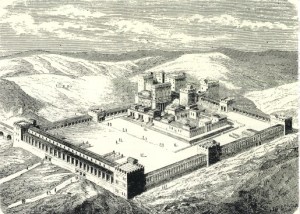
In our Noontimejourney we have reflected on Ezekiel 43 and the construction of the altar in the New Temple in the New Jerusalem. Today we read about the actual altar built in the temple completed by Solomon in 960 B.C.E. The following sites show us a picture and give us an idea of the enormity of this task.
When we think of how much time we spend in building our physical world – the clothes we wear, the house we live in, the food we buy and consume, the car we drive, the acquisitions with which we fill our lives – we see that we invest a great deal of time in what surrounds us.
When we think of the family we form, the friends we gather, the work colleagues with whom we interact – we can see the importance we place on the people in our lives and the influences we allow ourselves to experience.
When we think of how much thought we give to the formation of our prayer life, the sincerity with which we enter into our promises, the fashioning of our devotion to God, we can see how much we bring back to God, how much energy and thought we devote to the building of the altar on which we lay our true lives.
From the HARPERCOLLINS STUDY BIBLE (633): “At this point2 Samuel 11.2-12.25 tells the story of David, Bathsheba, Uriah, and the prophetic condemnation by Nathan before reporting the conclusion of the battle with theAmmonites. Since Chronicles idealizes David’s and Solomon’s work for the temple and its ritual life, it would not have served its purposes to rehearse the sins of the United Monarchy. We may be sure that the Chronicler and his readers were well aware of these negative incidents”.
Evil sneaks up on us when things are going well, when we are most confident and assured and most likely to have left God for a time. God accompanies us in our good times and bad. We may not feel God’s presence but God is with us all the same.
Thoughts from Scripture . . .
John 15:18: If the world hates you, realize that it hated me first.
Wisdom 2:12: Let us beset the just one, because he is obnoxious to us; he sets himself against our doings, reproaches us for transgressions of the law and charges us with violations of our training.
Jeremiah 18:18: The people of Judah and the citizens of Jerusalem said, “Come, let us contrive a plot against Jeremiah”.
Matthew 20:26:Whoever wishes to be great among you shall be you servant; whoever wishes to be first among you shall be your slave.
Matthew 20:22: Can you drink the chalice that I am going to drink?
The Chronicler knows, as we read in our notes, that David has sinned. So have we all.
Jesus tells his apostles that leading is serving. This Message we have heard many times.
Jeremiah witnesses to the treachery that lies in wait for the faithful. This reality we have lived.
Jesus reminds us that the world hates goodness. This rejection we have felt.
Jesus asks us if we can drink from his chalice. This question we have heard within ourselves.
Judging. Not judging. It is difficult for us to refrain from forming ideas for or against individuals or groups but it is essential for us to refrain from judging. We know that the measure that we measure is measured out to us. Ultimately, we have only this to ask ourselves: Can we live up to the harsh yardstick against which we measure others?
Meeks, Wayne A., Gen. Ed. HARPERCOLLINS STUDY BIBLE (NRSV). New York, New York: HarperCollins Publishers, 1989. 633. Print. (Meeks)
Here, and also in Nehemiah 11:3-9, we see the litany of names of those taken from Judah to Babylon. We see how their lives change as a result of the new exile status. Those who guarded access to the king now guard the Levite encampment. Their work remains much the same, yet everything has changed.
In the world . . . days go by and others come. No day remains. Even as we speak, the moments pass, the first syllable pressed on by the second that is waiting impatiently to be heard . . . Nothing stands still. Nothing remains firm in time. We must therefore love the one who through whom the times came to be, so that we might be set free from time and become established in eternity, where time and the changes it brings no longer exist. (MAGNIFICAT December 16, 2008, Meditation of the Day – Augustine of Hippo)
Time is a concept we human beings have contrived to measure and mete out as if it were a commodity. Yet for God, time, and space as well, are far more complex than we can understand. We regard it as miracle that Jesus died, rose, returned with his scared and sacred body to abide with his apostles as we establish his Church. We see this reincarnation as impossible, yet testimony that we have heard tells us that this is so it truly happened.
I realize, as I sit and meditate on the Jews going into exile, that each of us experiences separations in our lives: separations from loved ones, from loved places, from loved times. Yet always the memory remains. Nothing tangible remains firm in time . . .except Christ. For this reason it so very important for us to find our way to him, to take and hold him fast once we stumble upon the place where he speaks to us. For this alone is our core. This alone is our seat of authority. This alone is our only reason for being.
And so we pray for all of those who find themselves oppressed by time, oppressed by space, oppressed by forces beyond their control. From today’s MAGNIFICAT intercessions:
Jesus, God, abide with us . . . You will never forsake those who seek you.
For the poor who are oppressed by the commercialism of the season: may they be filled with the liberating power of your gifts. You will never forsake those who seek you.
For all those who are oppressed by the pressures of the season: may they be filled with your peace. You will never forsake those who seek you.
For all those who are oppressed by the prospect of loneliness at this season: may they be filled with the companionship and of your presence. You will never forsake those who seek you.
Nothing stands still. Nothing remains firm in time. We must therefore love the one who through whom the times came to be, so that we might be set free from time and become established in eternity, where time and the changes it brings no longer exist.
The Ark of the Covenant was an itinerant house for Yahweh. It was the traveling temple which housed the God who dwelt with his chosen people. In today’s reading we see something happen which can be frightening to us . . . if we see ourselves as Uzzah.
One week in our scripture class we held a lively discussion about this reading. After studying commentaries and listening to scholars, we decided that we understood what had happened to Uzzah, but that it seemed to be a harsh consequence. Perhaps the real lessons here are that sometimes our well-intended actions miss the mark, that we must be prepared to be misunderstood, that sometimes the consequences of our actions will be the reverse of what we expected and that ultimately, these consequences may be brutal and irredeemable.
Footnotes will point out that this unsuccessful transfer is balanced by the successful one in 15:1-16:6. They will also tell us that the Chronicler (the writer of this Book) wishes to describe this event as a religious one in order to contrast it with its description in 2 Samuel 6:1-11 where it is seen as a military incident. In either case, one thing is clear: Uzzah intends one goal. The outcome, for him, is another and it is a stark outcome. Even the brave king David is shaken, and the ark goes not to its intended place but to a temporary stop on its journey.
We have no way of knowing what ripples our actions set into motion, ripples that bound and rebound off of countless obstacles. Sometimes these ripples come back to disturb us and to lift our little boats a bit to knock against the pier where we are harbored. Other times they go off into what seems like a limitless universe. But one thing is certain, each time we speak, each time we move toward another our words and our gestures are open to interpretation. And for this interpretation, we will want to prepare.
The establishment of the tribes of Israel in the Promised Land is described in this portion of 1 Chronicles. All of this sorting and sifting of names and places looks like a census report we might stumble upon as we research our own roots; or we may be reminded of a ship’s manifest in which we delight to see a grandparent’s name. What we read about today is Reuben, Gad and East Manasseh whose family trees are described; and in this section of the history we see the tribe of Gad struggling to establish a secure dwelling place. They do this with God’s help. For during the battle they called on God, and he heard them because they put their trust in him . . . Many had fallen in battle, for victory is from God; and they took over their dwelling place until the time of exile.In anticipation of later events, the Chronicler tells us that in the beginning the people of Gad led God-centered lives and so were successful. We know that later these warrior people join David in his fugitive life under King Saul and that they are eventually deported by the Babylonians. More information can be found at . . . http://www.chabad.org/library/article_cdo/aid/112386/jewish/Gad-and-His-Tribe.htm
We watch the news coming to us from around the world and we pray that people will be able to put aside their tribal differences in order to affect change that will bring unity once they move beyond tyranny. We watch the national and local news to see legislatures and communities fall apart that at one time came together in distress. There is something in human nature that calls us to smallness once we are comfortable and to greatness when we are oppressed.
USA 1910 Census Document
Who are we when we struggle to keep our heads above water? Who are we when our lives are going well? Who are we when we feel that God is in our corner? Who are we when life goes wrong?
Although we may not feel God’s presence, he is always with us. Although we may not hear God’s voice, he is always speaking. God remains constant, we are the unpredictable ones.
When we write the story of our lives we will want to keep in mind that God is always present in both big and little ways. Whether or not we feel that he is with us, God is here as our constant, faithful redeemer. When we feel that no one is looking . . . who are we?
Adapted from a reflection written on February 26, 2011.
In today’s reading we are witnesses to a moment in human history that is difficult to match. David forfeits the building of a temple that would surely bring him worldly fame. He does this in order that he might obey God above all others, even above his own desires.
Yes, David hands all of his plans over to his son Solomon and this son will carry out those plans in a grand scale; but David steps back from his own desire.
Yes, David’s plans are meticulous in nature and we may consider that he wants to control his son from the distance; but David conveys the desires of God rather than self.
Yes, David sins and fails as he moves through his life and we may believe ourselves better than he; but David repents and returns to God, keeping in mind who is Lord of all.
What I like most in this reading is the ending of the chapter with the verses David speaks to his son. We might all offer these words to the generations who follow us and, indeed, to one another: Be firm and steadfast; go to work without fear or discouragement, for the Lord God, my God, is with you. He will not fail you or abandon you before you have completed all the work for the service of the house of the Lord.
And the people reply . . . Amen!
Adapted from a reflection written on Wednesday, May 18, 2011.
How do we see the story of Cain and Abel through the lens of Johannine thought? The keeper of flocks contrasted with the tiller of soil. The favored first-born versus the overlooked second. The key to the story, as we are constantly told, lies in verse 3: Through the course of time Cain brought an offering to the Lord from the fruit of the soil, while Abel, for his part, brought one of the firstlings of his flock.
Cain, the eldest and sower of crops, is described as crestfallen and greatly resentful when God favors the loving offering brought by Abel but God does not leave Cain alone with his anger, fear and envy. God asks Cain why he feels these negative emotions. No reply is recorded from Cain but further words from God are: If you do well, you can hold up your head.God warns Cain of sin and describes it as a demon lurkingat the door: his urge is toward you, yet you can be his master.As we read this story we hope that Cain can resist the power of envy because we want to resist this green devil ourselves; yet we know the story too well. Cain goes out to speak with Abel and unable to resist the skills of the demon, he kills his brother. Several verses later Cain asks God to allow him to be killed as he wanders the earth but God refuses this request. So Cain finally settles east of Eden in the land of nomads, Nod.
When we consider this story through the perspective of the writings of the Apostle John, we might spend time today considering three points.
God is honestwith both Cain and Abel, acknowledging Abel’s true love of God and Cain’s more egocentric self. God does not pamper us by avoiding the truth. We see this same honesty in Jesus as John tells the story of the woman caught in adultery. (John 8:1-11)
God does not abandon Cain in his sadness and grief. He abides with him, yet continues to present him with truth. God allows Cain the freedom to choose his own path. We see this same fidelity in Jesus when John retells his words about the Good Shepherd. (John 10:1-21)
God does not create an easy exit for Cain but rather allows him to experience the consequence of listening to the demon who lurks at the door. God offers Cain transformation through suffering. We see this same love in Jesus with every story John tells of the Resurrected Christ. (John 20 and 21)
And we also experience this same love from Jesus each day of our lives when, as true children of God, we take our cares and worries, our joys and delights to God.
Tomorrow, considering holiness and a prayer for true children.