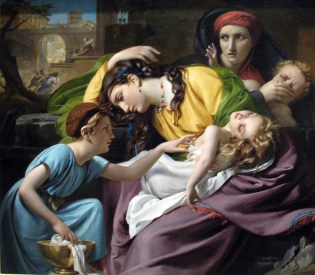
Thereupon the princes and all of the people said to the priests and the prophets, “This man does not deserve death, it is in the name of the Lord, our God, that he speaks to us”.
Each of us has likely experienced loss of friendship and perhaps even ridicule in either a private or public way. If we have not, it is likely that we know someone who has. Today we pause to reflect on the consequence of keeping silent when we know a lie is spoken as truth. Whistleblowers from all cultures and walks of life will recognize this story. Let us explore Jeremiah the man to see what his persistent, compelling love for God brings to us millennia after his words were recorded.
Jeremiah has been ridiculed, punished, mocked and finally condemned to death. Scholars tell us that we are uncertain as to his fate and you may want to visit one of the sites listed below to explore the mystery of this man.
The princes and the people versus the priests and the prophets. How do we see this drama played out today in our own families, in our own neighborhoods, in our own workplaces? Who are the factions and for what, of whom, do they stand? Take a bit of time and explore the story of Jeremiah. You may find that it is very like your own.
Click on the image above for a post entitled “Are We Too Negative?” by Dave Hunt, or go to: http://acrookedpath.com/2012/08/14/are-we-too-negative-by-dave-hunt-part-i/
Visit the sites below to explore the Jeremiah in each of us.
From Bible footnotes: “Jeremiah, like Ezekiel, saw that no good could be expected from the people who had been left in Judah under Zedekiah or who had fled into Egypt; good was to be hoped for only from those who would pass through the purifying experience of the exile to form the new Israel.” (Senior 980)
If there is time in your day, read a bit about Jeconiahand the Chaldeans(Babylonians). If there is not much time, let us at least think about what God is asking of us when we experience exile, a time apart from places, persons or even events that are precious to us. God assures us that there is always an opportunity for distillation when we are apart. God reminds us that we experience the abiding presence of the Spirit when we are away from what we love. God tells us that those who are left behind, or sent away, are not the juicy first figs of the season; rather, they are the poor fruit that will not grace the banquet table. They are poor fruit that are loved by God nonetheless. God is the faithful, persistent harvester who nurses fruit from struggling plants. God is the hopeful, healing shepherd, going out to find the one sheep while leaving the ninety-nine behind. God is the patient, able silversmith heating metal to drain away the detritus and keeping watch that the precious ore is not poured away. God is the potter working the clay of our lives in hands that know us better than we know ourselves. As always with God, it is the inverse that proves true: those left behind are those redeemed; those sent away are the rescued. And here in these verses of Chapter 24, Jeremiah brings us the imagery of two baskets of figs . . . one with first fruits, the other with rotten offerings.
Yahweh says:I will look after them for their good, and bring them back to this land, to build them up, not to tear them down; to plant them, not to pluck them out.
And so we pray . . .
Good and precious God, we know that you are with us always, even when we must be apart undergoing transformation. We know that we are clay in your hands that you mold with intent and great care. Help us to abide with you as you abide with us. Guide us to hope in you as you hope in us. Teach us to love the world with you even as you love us. We know that true transformation comes with suffering, and that suffering is the path your son strode before us. But because the darkness sometimes feels too permanent, we ask that you guide us. Because the light sometimes seems as though it will never return, we ask that you lead us. Because the figs we bear are sometimes bitter, we ask that you carry us. Because the journey you ask us to walk is sometimes too perilous, we ask that you be us. For all of this we pray. Amen.
Senior, Donald, ed. THE CATHOLIC STUDY BIBLE. New York, Oxford University Press, 1990.980. Print.
Adapted from a reflection written on June 14, 2007.
Oh the depths of the riches and wisdom and knowledge of God! How inscrutable God’s judgments and how unsearchable God’s ways!
God says: I know that many of you do not worry about the details of your day, that you rely on me entirely, and that you rest in riches. I know that some of you are too frightened to rely on my wisdom and knowledge and that others of you want to understand every detail of every circumstance and challenge me to demonstrate my love for you in some tangible sign of your choosing.
For who has known the mind of the Lord or who has been God’s counselor? Or who has given the Lord anything that may be repaid?
God says:If I present to you the complexities of the universe and you struggle with that . . . how will you comprehend all the details you demand? If my prophet Jeremiah tires you . . . take heart. I am with you always.
For from God and through God and for God are all things. To God be glory forever. Amen.
God says: I love more than all my riches, more than all my wisdom, more than all I know. If my ways are inscrutable to you, be patient. Once you have quieted your fear it will cease to control you. Once you have rested in me you will begin to feel my peace. Once you rely on me, you too will hold in your hands the depths of my riches.
For more on God’s Wisdom, enter the words in the blog search bar and explore.
Woe to him who builds his house on wrong; his terraces on injustice, who works his neighbor without pay, and gives him no wages.
Jeremiah also presents us with a messianic vision, the promise of a good and honest shepherd who fulfills the promise of bringing the faithful home.
I will raise up a righteous shoot to David; as king he shall reign and govern wisely, he shall do what is just and right in the land.
Jeremiah shows us the dichotomy of evil and goodness in which we live. He gives us mirror in which we might discover our own ungodliness.
God says: You need not tremble when you read about the terrible leaders who lead my faithful away from me and to the hungry, demanding little gods of Baal. You need not fear for your life if you live in me. You need not hide or bury yourself away when danger threatens. You need only rest in me. Allow my peace to give you a quiet place of rest. Let the freedom I give you prove the depth of my love, the strength of my fidelity, and the healing power of my hope.
False and true leaders, false and true prophets, false and true shepherds. Jeremiah draws clear pictures of what we may see in ourselves and others as he warns us of the danger of ungodliness.
Descendants of Ammon, a son of Lot, the Ammoniteslived in a territory of Ammon that extended from the Arnonto the Jabbokand Jordan. But during Mosestime they had been driven to the east by the Amorites. Moses was not allowed to attack them (Deuteronomy 2:19) despite the fact that they worshiped idols, especially Molech, or the god Saturn.
Cursed by Yahweh’s prophets, this tribe had a long history of conflict with the Israelites. Today we see Saul gather three hundred thousand men from Israel and seventy thousand from Judah before he announces that he will deliver the people of Jabesh-gilead who have been overtaken by Nahash, the Ammonite. And when the messengers came and reported this to the inhabitants of Jabesh, who were jubilant, [they] said to Nahash, “Tomorrow we will surrender to you, and you may do whatever you please with us”.They likely recognized that freedom from the enemy was upon them.
Conflict in this part of the world continues today; lessons in this ancient land reinforce division more than unity. Jeremiah’s words of prophecy pierce hearts but convert too few. Walking in hardness and obstinacy have become an engrained way of living; the day without remedy is infinite; the imagery of the potter’s flask and Topheth lie meaningless. And yet the Lord is near.
In New Testament hope we recall the words of the apostle Paul: For through faith you are all children of God in Christ Jesus . . . There is neither Jew nor Greek, there is neither slave nor free person, there is not male and female; for you are all one in Christ Jesus. And if you belong to Christ, you are Abraham’s descendant, heirs according to the promise. (Galatians 3:26-29)
Would that each of us might give over our interior conflict and place our hope in God. Would that each of us might surrender to Christ and the promise given to Abraham just as the people of Jabesh surrender in jubilation their trust in God.
For more on the story of Jabesh and how they showed their gratitude to King Saul, click on the image above or go to: http://lukedockery.blogspot.com/2007/11/gratitude-men-of-jabesh-gilead.html
We are all human. None of us is immune from our tendency to stray from truth. Each of us is from time to time fascinated by the darkness that ebbs beyond the circle of light in which we stand. Physically, we press the limits of the body to find our weak spots and our strengths. Psychologically, we tinker with the places in life which lure us into wrong-doing – all the better to know what we might become if we allow ourselves to grow. Spiritually, we wander into the places where doubt blossoms – for as much as we doubt, so also do we believe.
Miguel de Unamuno, a 20th Century Spanish existentialist, wrote a sonnet entitled Prayer of an Atheistin which he explores the pendulum swing of faith and doubt, hope and despair. He also wrote a beautiful poem, In the Hand of God, in which he juxtaposes images to create the gentle rocking back and forth we feel of our movement between God’s two hands, our movement to and from God’s breast. We are well-loved. We are constantly tended. We consistently stray. We are always offered the opportunity for reconciliation and restoration by a loving and giving God. We may always open our hearts to those who wound us.
In his book The Sacred Heart of the World: Restoring Mystical Devotion to Our Spiritual Life, David Richo describes a four-fold devotion to the Sacred Heart with which we may join others in healing the world. Today we pause to think about the impossibility that God may make possible . . . if we but ask.
First, we extend our prayer life to include others in anything we ask for ourselves, and thus we seek the Christ in each human being.
Second, we pray for those who persecute us, and thus we convert insult to prayer.
Third, we commit to ceasing engagement in retaliation, and thus we return blessing for hurt. This does not mean that we ask to be humiliated; rather, we protect ourselves and our personal boundaries while in the meantime we . . .
Fourth, pray for the universe, for we are all corrupt in one way or another.
Richo includes prayers of mystics which we might use, and here is one from Saint Teresa of Ávila: I shape my heart like that of others that I meet and theirs like mine.
Imagine what goodness we might bring about if we might only pray earnestly in this way.
Imagine what beauty we might bring about if only we might see our universal corruption . . . if only we might pray earnestly in unison . . . if only we might join in bringing about the kingdom . . . if only we might believe that the impossible is possible . . . if only we might act in our hope for the world.
Footnotes tell us that the watching tree in verse 11 refers to the almond tree; “the first to bloom in the springtime as though it had not slept. The Hebrew name contains a play on words with ‘I am watching’.” The opening lines here tell us of Jeremiah’s office as prophet. We are given his credentials, so that we might hear and heed the words here offered, so that we might not be afraid, so that we might remember to turn to God in times of turmoil, and so that we might shun the false idols that offer themselves in place of God.
Jeremiah protests that he is too young to serve God as prophet but the Lord says to him: Have no fear . . . because I am with you to deliver you . . . It is I this day who have made you a fortified city, a pillar of iron, a wall of brass . . . they will fight against you, but not prevail over you, for I am with you to deliver you.
These are words of warning to a people who had turned away from Yahweh and back to the Baalgods. They are also words of encouragement to us. History tells us that the oracles predicted here by Jeremiah unfolded as truth; therefore, the opening words of this prophecy can serve to comfort us as we struggle to understand our role as followers of Christ. God’s words through Jeremiah are meant to console us while we remain thewatching trees that remind others of the hope Christ brings, of the trust we must place in God, and of the danger in worshiping false and feeble gods.
I remember the devotion of your youth, the Lord tells us, Sacred to the Lord was Israel, the first fruits of the harvest; should anyone presume to partake of them, evil would befall him, says the Lord. As watching trees, we must have our eyes and hearts open to those who would deceive us, we must announce with a flurry of white blossoming the advent of a time of renewal and rebirth so those who have strayed may yet return. And we need not have any fear about our work of watching, for with God all things are possible. God always delivers the faithful.
When storms destroy all that we hold sacred, there is yet hope.
When trials sap our courage, there is yet strength.
When betrayals blind us to the possibility of a love that knows no bounds, there is yet God.
When suffering swallows our days, there is a place to go and there is something to be done. We are called to be watching treesthat announce the hope of the human race. We are created to be watching trees that trust only their maker. We come to fruition as watching trees that offer first fruits back to God and produce good fruit in due season.
We are called by our creator to witness as we watch and wait. When pain and sorrow take over, or in gladness and celebration, let us keep watch as if we have not slept, let us be the first to burst into flower and witness to the hint of spring. And while we wait on the Lord, let us offer our work to the God who made us, God who delivers us, and God who loves us.
No matter our circumstances, sorrow or joy, let us take up our task as watching trees and announce the goodness of God.
Adapted from a reflection written on June 12, 2010.
As we have mentioned earlier this week, the people in this story are part of Jesus’ family tree, and as always with Scripture, we see God in the daily living of these ordinary lives lived in an extraordinary way. The message is clear if we might only look and listen: if something is bound to happen, no one can intervene, and if something is notgoing to take place, no one can causeit to take place . . . except God. God is in charge.
I like this story because it shows the proper covenant relationship between God the creator and us, God’s creatures. God is always present; it is we who struggle to perceive this presence. When we pause to reflect and to look more closely, we might watch God take action through people who respond to God’s call. In this way then, we can say that we mediate God’s actions.
This story shows how tragedy can be transformed by allowing God’s love to move through us, and allowing God’s love to be actualized through us. Are we not constantly surprised by the inverted way in which God works in our lives?
Jeff Cavins writes, “The story of Ruth is almost a story of Judges in reverse: she is a woman from a pagan nation whose people were hostile to Israel (it was Moabite women who seduced Israel to worshipBaalatPeor, and Moab’s kingBalakwho summonedBaalamto curse Israel back in Numbers 22-25). But Ruth forsakes the gods ofMoabto faithfully serve Yahweh. That chapter 4 recognizes Ruth as an ancestress of David, and that Matthew includes her in the genealogy of Jesus helps us remember that God’s ultimate plan was to include all nations in His family. Ruth is in many ways what Israel was called to be.”
Today’s citation is early in Ruth’s story and follows the famous “Whither thou goest” line in verses 16 and 17. The women return to Bethlehem at the start of the barley harvest, a harvest which plays an important part in the story that is unfolding. The town celebrates this return as do we.
Recalling that women without men held little value in these ancient times, we can only stand in awe of Ruth and Naomi’s courage in the face of tragedy. We can only hope to see these ordinary lives as extraordinary models for us to follow. We can only believe that God works with us through our own tragedies and joys . . . so let us be open to God’s word in us today.
Jeff Cavins, Sarah Christmeyer and Tim Gray, THE GREAT ADVENTURE: A JOURNEY THROUGH THE BIBLE. Ascension Press, 2007.
Adapted from a Favorite written on August 14, 2007.
The story of Ruth, Naomi and Boaz is a tale about family, integrity, honor, honesty and fidelity. It is also about God’s providence and love; and it is about returning to the covenant relationship we have with God that is marked by “loyalty of faithfulness arising from commitment” which in the Hebrew community is known as chesed. (Meeks 408) If there is time this weekend, read this story from beginning to end. It will warm your heart.
“The book contains a beautiful example of filial piety . . . Its aim is to demonstrate the divine reward for such piety even when practiced by a stranger . . . [Ruth] became the ancestress of David and of Christ. In this, the universality of the messianic salvation is foreshadowed”. (Senior 278)
Today we enter the drama at the point where Ruth, the stranger in this land of the one living God, goes for the first time to glean what she can so that she and her mother-in-law might survive. It is when she is in the field gathering the leftovers that she meets Boaz for the first time. Keeping in mind that a widow in ancient society was considered a burden rather than an asset, we see how well Boaz treats her. He does not take advantage of her diminished status; rather, he seeks to support and protect her from the impure, unwanted – yet legal – advances of others. He cautions her to glean only in hisfields, and he warns off the men who work for him, making certain – as much as he is able – that Ruth might gather enough to support herself and her mother-in-law. He even allows her to glean among the sheaves themselves rather than just the edges of the field. It is clear that he is taken by Ruth yet he does not take advantage of her. In subsequent chapters Boaz fulfills all honor obligations so that he might marry Ruth according to the law and tradition of the time. So we see that “Ruth’s piety . . . her spirit of self-sacrifice, and her moral integrity were favored by God with the gift of faith and an illustrious marriage”. (Senior 278) But first she was widowed, followed her widowed mother-in-law to a new land, and set about doing what she might so that they both might survive.
Ruth does what she must, given what she is given. Ruth gleans where God sends her and in so doing, she harvests more than the ephahs of barley that she takes home to Naomi; she becomes the mother of Obed, the father of Jesse, the father of David, king of the Jews. Ruth appears in Jesus’ genealogy: Boaz became the father of Obed, whose mother was Ruth. (Matthew 1:5).
In the times when we feel widowed, abandoned or alone . . .
In the times when we feel the overpowering burden of providing for self or others . . .
In the times when we feel that we have arrived in a foreign land with new traditions and customs . . .
In the times that we feel exhausted from the gleaning we have done for endless days . . .
Let us remember the goodness and wisdom of Naomi . . .
Let us remember the integrity and protection of Boaz . . .
Let us remember the piety and self-sacrifice of Ruth . . .
And let us remember the merciful justice, the guidance, and the love of the Lord. For these are the things that save.
Meeks, Wayne A., Gen. Ed. HARPERCOLLINS STUDY BIBLE (NRSV). New York, New York: HarperCollins Publishers, 1989. 404. Print.
Senior, Donald, ed. THE CATHOLIC STUDY BIBLE. New York, Oxford University Press, 1990.278. Print.
Adapted from a reflection written on May 18, 2010.