Over the next few weeks we will be away from easy internet access, but we will be pausing to read scripture and to pray and reflect at noon, keeping those in The Noontime Circle in mid-day prayer. You may want to click on theConnecting at Noonpage on this blog at:https://thenoontimes.com/connecting-at-noon/In these posts, we will have the opportunity to reflect on a scripture verse and an artist’s rendition of that event. Wishing you grace and love and peace in Christ Jesus.
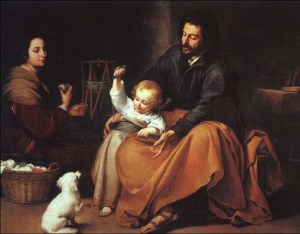
Esteban Murillo: The Holy Family with a Little Bird
Simeon blessed them and said to Mary, his mother, “This child is chosen by God for the destruction and the salvation of many in Israel. He will be a sign from God which many people will speak againstand so reveal their secret thoughts. And sorrow, like a sharp sword, will break your own heart.” (Luke 2:34-35)
Like Simeon, we wait for the coming of salvation. Like Simeon, let us acknowledge the grief and joy that visits each of us. Like Simeon, let us announce Jesus’ healing presence in our own lives.
Over the next few weeks we will be away from easy internet access, but we will be pausing to read scripture and to pray and reflect at noon, keeping those in The Noontime Circle in mid-day prayer. You may want to click on the Connecting at Noon page on this blog at: https://thenoontimes.com/connecting-at-noon/ In these posts, we will have the opportunity to reflect on a scripture verse and an artist’s rendition of that event. Wishing you grace and love and peace in Christ Jesus.
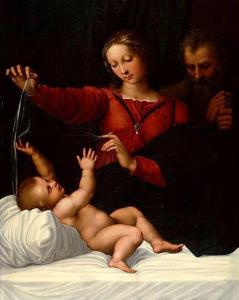
And the child continued to grow and to become strong in spirit . . . (Luke 1:80)
As we watch this couple nurture their child who has come to redeem all of us, we reflect on how we might allow the playful child in each of us to interact with the world. And let us allow ourselves to nurture the child within each person created by God.
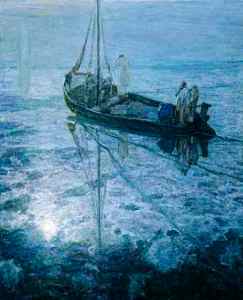
Henry Ossawa Tanner. The Disciples See Christ Walking on Water
When it was evening, the boat was far out on the sea . . .
Night is about to fall and as darkness overtakes us, the once gentle waves rise above the sides of our boat. We worry about the unseen future, fret about the present and hope to remember the lessons of the past. Hold on, we say to ourselves and one another. The light will come again.
He saw that they were tossed about while rowing, for the wind was against them . . .
We strain against the current that runs too swiftly for our tiny oars to guide us to shore. We cannot possibly go on,we say to ourselves and to one another. This looks like the end.
He came to them, walking on the sea; and he intended to pass them by . . .
The promise of salvation flickers before us as our oars stutter over the chop and waves breech our little boat. Our rescue is here, we begin to think. But is it? Are we expected to save ourselves against this overwhelming wind?
They supposed he was a ghost and began to cry out . . . they were terrified . . .
Jesus understands us far better than we understand ourselves. His presence is both soothing and alarming. We are doomed! We say to one another. There is no way out of this.
But immediately he spoke to them, “Take courage; it is I, do not be afraid . . .”
This cannot be real, we say. Who walks on water? Who calms the sea and wind? Who cares enough about us to risk a relationship of fidelity and hope with us?
Tanner: Christ and his Mother studying Scriptures
Learning at his mother’s knee and listening to the Spirit within, Jesus knows how to respond to every hope and every fear that pulls us down into negativity in the moment of its burgeoning.
Then he got intothe boat with them, and the wind stopped; and they were utterly astonished . . .
Jesus does not abandon or betray us, even when we falter or stumble.
Forthey had not gained any insight from theincident ofthe loaves, but their hearts were hardened . . .
Jesus accompanies us even when we refuse to enact the gift of grace and peace he offers. Jesus is with us when we find ourselves rowing against the tide. Might we come together to help one another as we struggle to reach the shore against the wind?
Use the scripture link above to compare other versions of these verses. Or read this story in Matthew 14:22-26 and John 6:16-21 to reflect on Jesus’ presence and power in our lives.
We have examined the construct of deception and how envy and hope show us divergent journeys through life. We have spent time with the prophet Micah who speaks to both fraudulent leaders and God’s vulnerable, faithful followers. With Micah, we have examined the true path to perfection and celebrated the promise of restoration offered us each day by the Creator.
Today’s Gospel from Matthew 10:26-33 reminds us that we cannot be intimidated or bluffed into silence by bullies. These words seem unusually appropriate for us today.
“With burning eloquence [Micah] attacked the rich exploiters of the poor, fraudulent merchants, venal judges, corrupt priests and prophets”. (Senior 1140) The prophet’s testimony foreshadows Jesus’ words. Do we believe that God comes to live among us? And what does God’s presence look like? And how will we recognize this consoling presence?
Through Micah, God says: Woe to those who plan iniquity, and work our evil on their couches.” (2:1)
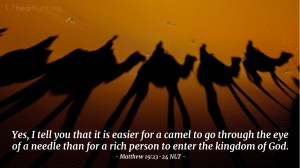
In the Gospel of Matthew, Jesus says: Again I tell you, it is easier for a camel to go through the eye of a needle than for someone who is rich to enter the kingdom of God. (Matthew 19:24)
Through Micah, God says:I will assemble all the remnant of Israel; I will group them like a flock in the fold, like a herd in the midst of the corral; they shall not be thrown I to a panic by men. With a leader to break the path they will burst open the gate and go out through it; their king shall go through before them, and the Lord at their head”. (2:12-13)
In the Gospel of John, Jesus says: Let me set this before you as plainly as I can. If a person climbs over or through the fence of a sheep pen instead of going through the gate, you know he’s up to no good – a sheep rustler! The shepherd walks right up to the gate. The gatekeeper opens the gate to him and the sheep recognize his voice. He calls his own sheep by name and leads them out. When he gets them all out, he leads them and they follow because they are familiar with his voice. They won’t follow a stranger’s voice but willscatter because they aren’t used to the sound of it. (John 10:1-6)
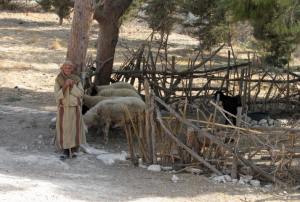
An ancient sheepfold
Those who were listening to Jesus’ voice: had no idea what he was talking about. So he tried again. “I’ll be explicit, then. I am the Gate for the sheep. All those others are up to no good – sheep stealers, every one of them. But the sheep didn’t listen to them. I am the Gate. Anyone who goes through me will be cared for – will freely go in and out, and find pasture. A thief is only there to steal and kill and destroy. I came so they can have real and eternal life, more and better life than they ever dreamed of. ( John 10:7-10)
The Creator speaks to us through the prophet Micah. The Creator visits us in the person of Jesus. The Creator lives in us as the healing presence of the Holy Spirit. Let us listen to the promise given us this day; let us share this gift of hope and redemption with others; and let us persist in listening for and following the voice of the genuine shepherd.
Here again is the image of the shepherd brought to us by the prophet Micah. God gathers his scattered people and guides them to safety. Just as Yahweh sent Moses to shepherd the people from Egypt, through the desert, and eventually to the Promised Land, so too, does Jesus arrive in Bethlehem to shepherd us to our own promise. And this is what Micah predicts. He tells of the one who comes to rebuke nations yet to teach us his ways and paths. Micah warns of the coming persecution, but from that persecution and suffering come redemption and restoration. There will be universal peace.
These are comforting words. These are words we need to hear.
Adapted from a reflection written on April 1, 2007.
As we continue to move through difficult times, we return to a Favorite written on June 16, 2009. Yesterday we considered false prophets and false leaders; today we reflect on who and what and how a true leader is and how her or his leadership impacts the world.
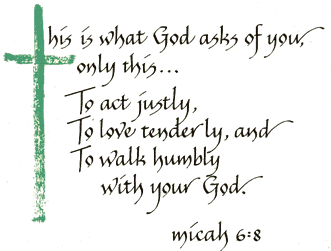
Is this coincidence that here I am on an SSND retreat and for the first time as a Noontime reflection this citation of Micah 6:8 appears? I do not know. These words that stand high on the cafeteria wall above the statue of the Blessed Mother regulate the small detains and the big events of our lives at NDP. They are words that are important to anyone who believes that God is the creator of all good. They are words to live by.
Micah speaks to those who turn their gaze away from social injustice and in this chapter we hear the Lord ask: My people, how have I offended you? I who took you out of Egypt and slavery, I who gave to you as guides Moses, Aaron and Miriam, I who saved you from pagan nations, what have I done that you ignore me?
Today’s Gospel is Matthew 5:43-48 and I am thinking about today’s MAGNIFICAT Meditation by Fr. Alfred Delp, a priest condemned to death in Germany in 1945. He wrote about the path to perfection which Micah foretells and which Jesus describes. The essential requirement is that humanity must wake up to the truth about itself. We must rouse our consciousness to our own worth and dignity, of the divine and human potentialities within ourselves, and at the same time we must master the undisciplined passions and forces which, in our name and by bemusing us with delight in our own ego, have made us what we are . . . Humans want to be happy and it is right that they should. But by thinking only in terms of self we destroy ourselves for it is a limited concept and has no room for anything stronger than the human order. Left entirely to themselves humans are unhappy and intrinsically insincere. We need other people to give us a sense of completeness; we need the community. We need the world and the duty of serving it. We need eternity, or rather, we need the eternal, the infinite.
The people to whom the prophet Micah spoke were not much different from us today in that these were people of means who sought to enjoy the gifts of life. What they forgot – and what we may also forget if we do not remind ourselves – is this: We are made by God, in God’s image to bring our diverse expressions of God together into one body, the body of Christ. When troubles assail us, as they always do and are meant to do, we might smile as we step into them, seeing them as opportunities to serve God rather than as obstacles to pleasure. Life and its turmoil is our playground where we are given the chance to interact justly, wisely and humbly with God guiding and speaking to us constantly, telling us how to go and where to go.
This is the mystery we are offered. It is the mystery we might share for eternity if first we remember to respect good, to love with fidelity, and to obey humbly. We are not asked to be perfect by God for this is an impossibility; but it is true that God asks us to seek perfection in our search of God, and in our desire to be God’s instrument. In this way we dobecome perfect. If this is our path, the humble, loving and wise path described by Micah, then we cannot misstep. It is in this kind of journey that we find true, deep and ever-living happiness through our perfect desire to be with and follow God lovingly, justly, wisely, humbly.
Cameron, Peter John, ed. “Meditation of the Day.” MAGNIFICAT. 16.6 (20o9). Print.
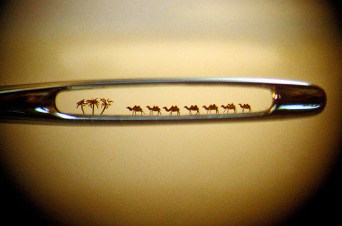
This Favorite from May 18, 2007 seems appropriate in our present social, spiritual and political times. So many themes in scripture are universal and eternal. Let us enter into conversation with others to look for best ways to come together. Let us enter into conversation with God to look for guidance, connection and peace that is lasting. As we reflect today, we remember Jesus’ words recorded inMatthew 19:23-24 about the ease of fitting a camel through the eye of a needle.
From the NAB footnotes: “Here Micah accuses them [the false prophets] of prophesying for venal motives and determining the prophecy by the price that is paid them; he contrasts his own disinterested preaching of the word of God.” Micah calls us to evaluate our own motives.
I am reflecting on the “flip-flop” tendency of human beings to self-serve. So many of us say and do what results best for us in the short run while neglecting what is best for the greater good in the long run. So many of us close our eyes to the truth, to the obvious. We “strain out gnats and swallow camels” like the false leaders we hear about in Matthew (23:24). We even manage to twist God’s goodness to make it suit our own desires rather than his.
LORD above all, keep us close to you every day, in every way. Steer us away from venal motives. Guide us with your merciful hand. Touch our hearts and our lives. Call us to our greater good, our greater potential. Be the pillar of fire of smoke which both leads and protects. Abide with us. Comfort us. Heal us. Save us. Restore us.
Amen.
For more reflections on false leaders, enter the word Downfallinto the blog search bar and explore.
In days when we experience doubt and uncertainty, we return to a Favorite from October 17, 2010.
Teresa of Ávila and Catherine of Siena
I cannot understand what it is that makes people afraid of setting out on the road to perfection. May the Lord, because of who he is, give us understanding of how wretched is the security that lies in such manifest dangers as following the crowd and how true security lies in striving to make progress on the road of God. Let them turn their eyes to him and not fear the setting of this Sun of Justice, nor, if we don’t first abandon him, will he allow us to walk at night and go astray. Teresa of Ávila, MAGNIFICAT Meditation for October 15, 2010.
This past Friday was the feast day of Teresa of Ávila and on that day the readings focused on the fact that we are chosen by God, that God loves us more than we can imagine, and that nothing we think or say or do is secret from him. Today’s readings are about how we are to be persistent in prayer, just as were Teresa of Ávila and Catherine of Siena, two women who have been named Doctors of the Church, two women who did not let their fear of anything earthly keep them from doing as God asked them – even when it involved great risk to themselves and to all they struggled to do in God’s name.
Following is an excerpt from today’s MAGNIFICAT Day by Day reflection taken from one of Catherine of Siena’s letters.You know full well, most holy Father, that when you accepted holy Church as your bride you agreed also to work hard for her. You expected all these contrary winds of pain and difficulty to confront you in battle over her. So confront these dangerous winds like a brave man, with strength and patience and enduring perseverance. Never turn back because of pain or discouragement or slavish fear, but persevere, and rejoice in the storms and struggles. Let your heart rejoice, for in the many contrary things that have happened or will yet happen the deeds of God are surely being done, nor have they ever been done in any other way.
Catherine of Siena
Both of these women remind us that we are called to perfection and that perfection lies in our persistence to do God’s will despite the inconveniences and risks we meet along the way because God will never let God’s work go undone. In today’s Noontime we read that woe befalls those who plot iniquity, those who lie on ivory couches to lay schemes and plots, those who covet what others have and are, those who cheat others out of what they are due.
Today’s readings (Exodus 17:8-13, Psalm 121, 2 Timothy 3:14-4:2, and Luke 18:1-8) remind us that Moses and the Israelites, Paul, Timothy, the nameless Persistent Widow, and Jesus himself did not abandon the work given them by God – even in the face of great odds and overwhelming fear. All of this reminds us that when we are doing the work of the Gospel we will encounter unforgiving and dangerous head winds. We will experience great darkness and be tempted to undo our walk of perfection and persistence. All of this reminds us that in the midst of the greatest suffering and distress we do not find agony alone, there also do we find our God, and other who would do God’s will.
We have witnessed the dishonesty of corrupt rulers; we have seen the fidelity of fearful but courageous prophets. If we wonder how or when the faithful might be rewarded, we do not have far to look.
Consolation Foreseen
A Favorite from July 26, 2010.
I will gather the lame, and I will assemble the outcasts, and those whom I have afflicted. I will make of the lame a remnant, and of those driven far off a strong nation; and the Lord shall be king over them on Mount Zion, from now on forever.
We are reminded by the prophet Micah that we are to be restored through the Messiah who will gather up the broken and the broken-hearted. When we become discouraged, when we believe that even God does not listen to our plight, when we become confused and forget that God’s call to perfection in us is about persistence and not about living a life without flaw, then we might turn to Micah who reminds us that the best and only true hope is the Messiah, the Christ. Infinite restoration, abounding rejuvenation, eternal redemption and limitless salvation are the gift he brings us each day. If only we might persist long enough to ask for the strength to rise to this timeless hope.
Fr. Bede Jarrett
Most of the difficulties of life come because man is so prone to lose heart . . . His faltering attempts at perfection disconcert him from any very persistent or long-continued service . . . He has given up hope; he is disheartened; he is too discouraged to go on. He is very human; oh yes, but he is very foolish also: for when hope is gone, all is over. Failure counts for nothing; defeat, disappointment – these matter nothing at all, so long as only hope sits patiently, stirring the embers, watching and tending the fire, coaxing the flame, never despairing and never leaving the wind to work its will. That the clouds should come up over the sky, or that darkness should encircle the earth, brings no real terrors, for we are sure that the dawn will come out again and that the sun will break through with its golden glory.
Father Jarrett – a British Dominican known for his preaching
MAGNIFICAT, July 26, 2010, Meditation of the Day
We are reminded by the prophet Micah that we are to be restored through the Messiah who will gather up the broken and the broken-hearted. If today we have lost courage and strength, let us call on this only One who will restore us . . . so that we might coax the flame of our lives rather than leave our work to the wind.
Cameron, Peter John. “Meditation of the Day.” MAGNIFICAT. 26.7 (2010). Print.