Here today we see the words which are so familiar to us that perhaps they cease to penetrate our consciousness. Yes, yes, we say as we nod and read, I know what this means because I have heard this before. But here it is anew for us to examine again.
What perfection does God ask of us? God asks for our persistence and our willingness to become weak in Christ.
Reading the footnotes helps us to understand that our full potential is realized through suffering and that the transformation which Jesus models for us is both individual and apostolic. It is the potential which God has planted in us. It is the fullness the Spirit expects of us. This transformation will take place when we strive for it, and will occur in others all the more quickly when we take this redemptive message to them through our action in Christ.
As we struggle to become ever better and ever more faithful servants, this transformation becomes visible and even audible in all of creation that surrounds us. As we open ourselves to the will of God, we become weak so that the strength of Christ may enter into us. By becoming small in our ego, we make room for Christ to become one with us. By giving over our petty worldly power to an unending, perfect and intimate union and communion with God, we become one with the Spirit. How easy all this all is, if we only trust God.
Adapted from a reflection written on August 10, 2007.
For a better understanding of how we become strong in our weakness, visit the Mystery of Wisdom reflections posted in The Noontimes by using the blog search bar.
Paul contrasts apostles of the light with those of the dark in today’s reading. As we have before in our Noontimejourney, we know that evil is everywhere, present in the many small and big ways that we allow division to happen within ourselves and within our communities. Wherever difference occurs, demons and their works flourish. Using the most insidious of methods, false prophets take on the guise of protection and guidance but they deliver deception and manipulation. We can feel Paul’s frustration in his words today.
For a detailed commentary we can look at notes; as an overview we might consider these words from yesterday’s Evening Prayer in MAGNIFICAT, and we might use them in a prayer offering to God this evening. The mini-reflection: We can use our treasured capacity for speech to offer prayer as fragrant as incense before God or to offer hurt to another. Psalm 19:15: May the spoken words of my mouth, the thoughts of my heart, win favor in your sight, O Lord. Psalm 141: I have called to you, Lord; hasten to help me! Hear my voice when I cry to you. Let my prayer arise before you like incense, the raising of my hands like an evening oblation. Set, O Lord, a guard over my mouth; keep watch at the door of my lips! Do not turn my heart to things that are wrong, to evil deeds with men who are sinners. Never allow me to share in their feasting. If a good man strikes or reproves me it is kindness; but let the oil of the wicked not anoint my head. To you, Lord God, my eyes are turned: in you I take refuge.
Both the psalmist and Paul recognize the power of words, those which we say and those we hear. They also recognize our human need to be in society, to share meals, time, problems and prayer. They know that evil and goodness live side by side and that it is often difficult to discern the difference between the two.
As we struggle to determine if the apostles we follow are true or false, as we struggle to remain faithful apostles of Christ rather than the false apostles Paul describes for us today, we pray.
Loving and patient God, we lift our prayer to you like incense in the night. May our prayers be pleasing to you.
Knowing and persistent God, we struggle to discern the difference between false and true leaders. May our eyes see with your wisdom and love.
Faithful and just God, we abide with and in your Spirit. May our hearts be always open to you.
Strong and compassionate Christ, we look to you as a model of how we are to act in the world. May our hands and feet be willing followers of your Way.
We ask this today and all days. Amen.
In different versions, Psalm 19 has a varying number of verses. Use the link above go to the last verse in this psalm for other translations.
Cameron, Peter John. “Prayer for the Evening.” MAGNIFICAT. 21.10(2009). Print.
Adapted from a reflection written on October 21, 2009.
Explore THE MESSAGE version of these verses at the scripture link and compare it to other versions to allow Paul’s message to open in us more fully.
Can we apply Paul’s words to our lives today? Do they describe our world of social media and connectivity?
I hear that I’m being painted as cringing and wishy-washy when I’m with you, but harsh and demanding when at a safe distance writing letters.
Can we see our world in Paul’s words today? What do we consider to be the tools of our trade and how do we use them?
The world is unprincipled. It’s dog-eat-dog out there! The world doesn’t fight fair. But we don’t live or fight our battles that way—never have and never will. The tools of our trade aren’t for marketing or manipulation, but they are for demolishing that entire massively corrupt culture.
Do Paul’s assertions call us to God or send us away? Do we affirm or deny their truth?
What you say about yourself means nothing in God’s work. It’s what God says about you that makes the difference.
God says: When my servant Paul speaks of an unprincipled world, he does not mean to frighten you into obedience to me. No. He knows that the faithful respond best to love rather than fear. Yet, I understand that his words may seem harsh, strident or bitter to you. I do not hear them this way. No. What I hear is his deep devotion to living life in and through Christ. And I hear his earnest desire that all experience the warm and loving bond with me that he shares. So this is what I ask of you today and all days, and these are the tools I ask you to use. Walk with me humbly and willingly. If you do not want to be by my side, go apart for a while. I am always here when you are ready to be with me. I also that you love others gently and mercifully. It is my hope that you will live in me as I live in you, and that you will show this love to the world. And finally, I ask that you act justly. Rather than simper or berate, intercede for those who need my help. Ask forgiveness, pardon others, and act prudently and compassionately so that my justice will roll from your hands and hearts. Turn away from what you see is corrupt. Use the modern tools you have at your hands, but use my ancient ones as well for all else is meaningless. All else holds empty promise and false hope. All else is useless. Remain in my mercy, enact my justice, and live in my humble love. Become my tools in the world you experience in and around you today.
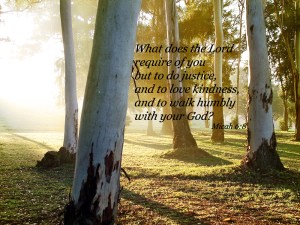
Spend time with Micah 6:8. Consider how the prophet’s words are pertinent to our modern world, and consider how we might better become mercy, wisdom, humility, justice and love as we go through our days.
Consider this: whoever sows sparingly will also reap sparingly, and whoever sows bountifully will also reap bountifully. Each must do as already determined, without sadness or compulsion, for God loves a cheerful giver.
These are St. Paul’s words in today’s reading and we come upon them as we continue to reflect on the mysteries of our relationship with God, and the paradoxical nature of sowing and reaping. Paul writes about service to the holy ones in reference to the collection he has taken up in his far-flung churches, a gathering of funds that will go to the church in Jerusalem to sustain its work and ministers. Today Paul calls us to consider the joy we reap when we serve others, reminding us that the reward is great when our generosity is great.
You are being enriched in every way for all generosity, which through us produces thanksgiving to God.
A number of years ago I shared a portion of a poem by Philip Appleman with the Noontime Circle entitled Birthday Card for my Mother. It had been sent to me as part of a birthday greeting from my own daughter at a time my resources were low. Appleman’s words amplify Paul’s when we realize that it is in the very act of giving that we ward off bitterness and anger. It is through the act of giving that we find sustenance, new energy and grace.
You have survived it all,
come through wreckage and triumph hard
at the center but spreading
gentleness around you – nowhere
by your bright hearth has the dust
of bitterness lain unswept;
today, thinking back, thinking ahead
to other birthdays, I lean upon your courage
and sign this card as always,
with love . . .
As we give to others we find that it is we ourselves who are immensely enriched, and that we can in turn pass this blessing on to others. As we give to others we find that bitterness and anger melt away, and that joy and peace arrive in their stead. Let us consider this gift of harvesting as we say with Paul: Thanks be to God for his indescribable gift!
Consider surprising a friend or family member who needs encouragement and send Appleman’s on to them. We need not wait for a birthday to celebrate God’s indescribable gift of generosity.
Adapted from a reflection written on December 9, 2007.
Frequent arguments arise about how to create social and political policy for the common good and this is natural. There will always be those among us who take advantage of generosity hearts. This incontrovertible fact causes worry and suspicion. It creates a feeling of ill will toward those who need the help of the fortunate. There will always be suspicion and bias in human relationships but this does not mean that we cannot practice Christ’s example in our small, everyday dealings with one another.
Though Christ was rich, for your sake he became poor . . .
Once we discover how we our sharing of wealth can be managed prudently, we might begin to offer more of our abundance to others.
By Christ’s poverty you might become rich . . .
As Jesus so often tells us, our treasure must lie in our actions rather than the goods, property and fame we have stored up in this world.
Not that others should have relief while you are burdened, but that as a matter of equality your abundance at the present time should supply their needs, so that their abundance may also supply your needs, that there may be equality.
Paul reminds his readers that God dealt with the Israelites in the desert with generosity and grace by providing water from rock, and quail and manna from the sky. The real miracle in this story is not so much that sustenance appeared out of nowhere, but that there was enough for all.
Whoever had much did not have more, and whoever had little did not have less. (Exodus 16:18)
This generosity and plenty will again be seen when Jesus feeds thousands with a few fish and loaves offered by a child. (Matthew 14, Mark 6, Luke 9 and John 6)
There is a lad here who has five barley loaves and two fish, but what are these for so many people? So they gathered them up, and filled twelve baskets with fragments from the five barley loaves which were left over by those who had eaten (John 6:9 and 13)
And so Paul sends us this message: Brothers and sisters: As you excel in every respect, in faith, discourse, knowledge, all earnestness, and in the love we have for you, may you excel in this gracious act also.
All that have and all that we are is gift from God. Jesus himself, although he is divine, tells us that he does the will of the creator. How then can we refuse to imitate Christ in his generosity for us? How then can we reject the idea of sharing the abundance we have at this present time?
As we meditate on this reading today, let us consider where our wealth lies. It may be physical in that we own much and we may have worked quite diligently for this abundance. Yet is it not God who gives us this plenty and how can we not share it?
Our wealth may be spiritual or psychological. Again, was it not God who blessed us with this equanimity? How can we not share the benefit of stable mind and heart when God has given this sense of balance to us in the first place?
As we spend time with these verses and compare varying versions of these stories by clicking on the scripture links, let us also pledge to share our wealth in some way with those who have less. And let us commit to sharing a portion of this plenty with those who have far less than the gifts we have received from God.
If you find yourself without a cause to which you might devote yourself, click on the words Social Justice in the category cloud in the right hand column of this blog. Or enter the words Social Justice into the blog search bar and explore. If you already have a favorite cause, enter that information into the comment bar below and share it with others. In this way we come together in our reply to Christ’s invitation to share God’s gifts as a matter of equality.
Israel splits from Judah and sets up a new capital in Bethelto rival the city of Jerusalem but in this temple Jeroboamplaced a golden calf. All of this mocks the beautiful covenant established between Yahweh and the faithful but, as the people will discover when the Assyrians invade, it is impossible to replace Yahweh’s fidelity and love with a mere golden calf. We might well ask what the followers of this idol were thinking when they centered their lives on the false hope of an inanimate statue. And when we do, we also ask ourselves where we might find golden calves in our own lives.
Hosea predicts ruin and destruction for the followers of the calf. He points out the ways and places that wickedness, perversity and falsehood are cultivated in this false spirituality. He also describes the folly of relying on the power of chariots and warriors and the turmoil of the tribes when superior forces overrun their cities.
Hosea reminds his readers that they are called to sow justice but instead of reaping fruitful crops the bitter wormwood plant which, because of its bitterness, cannot serve as fodder or animals or birds. In the hope of reaping rich harvest, those who are lured by false promises and false gods will instead gather in the bitterness they themselves have sown.
Hosea asks each of us to examine what it is we sow, and what it is we hope to harvest. Is it fertile and bountiful goodness, or the bitter fruit of wormwood? Only we can know.
I will destroy the wisdom of the wise, and the cleverness of the clever I will set aside.
God says: My servant Paul writes about how the foolishness of the cross becomes the wisdom of the rescued and he does this well. He recalls the words of Psalm 49 that remind you of the durability of my kingdom and the strength of my love. Spend time with these old and new verses today and my wisdom will flourish within you. Allow these words to seep into your bone and sinew and my Spirit will bring you understanding and peace where before there was confusion and sorrow. Paul will also remind you that when you demand signs you may be disappointed for my wisdom does not arrive in that way. He will recall that when you look for wisdom as an entity you will find only emptiness. Paul hands to you the key to understanding my wisdom which is . . . you must trust the mystery of my wisdom. You must trust that the more you rely on me the wiser you become while the more you rely on yourself the more foolish you will be.
Paul tells us that God’s wisdom lies in the paradox of the cross. When we spend time with Psalm 49 and this letter to the Corinthians, the mystery of God’s wisdom blooms within, giving us the key to understanding God’s peace and joy.
We have examined the concept of wisdom not as a body of knowledge but as a way of living. We have explored the idea that wisdom blossoms from strong relationships both with God and with others. And we have reflected on the knowledge that wisdom can be found in God’s promises and grace. Today we spend time with words from Jesus himself so that we might discover how God’s wisdom might be manifested in us.
For I will give you utterance and wisdom which none of your opponents will be able to resist or refute.
In this portion of Luke’s story, Jesus has been sharing parables with his followers, describing the kingdom of God and the confusion we experience when we begin to understand its inverted nature. The mighty will be weak while the weak will be strong. The poor in spirit will rejoice and the humble will inherit the earth. The small offering of the widow is worth more than the wealth of kings and emperors. Jesus’ followers ask for clarity and Jesus assures them that the wisdom they will need to enter into and to participate in this kingdom, this wisdom that is eternal and all-encompassing, comes only from God.
When we spend time with this chapter of Luke’s story today and compare varying versions of these verses, we ourselves will grow in this mysterious wisdom that eludes definition – but which saves, redeems and transforms.
If we want to explore more of Jesus’ wisdom, we might read the parables he tells, consider the questions he asks, watch the actions he takes as he moves through adoring crowds and confronts scheming enemies. We may need a good commentary to help us unravel these words and these actions. We may need quiet time to meditate on this amazing life. We may need to read a different version of these verses. Or we may need a mentor or guide to help us in our own wisdom journey. No matter the tools we use, we must take up the invitation to move forward in our understanding of this mystery . . . for this mystery is the essence of life itself, Jesus the Christ.
I willlead the blind by a way they do not know . . .
God says: Never doubt that I am with you.
In paths they do not know I will guide them . . .
God says: I know that anxiety and fear too often govern you.
I willmake darkness into light before them . . .
God says: Believe it or not, I love you and will not let you go astray.
Andrugged places into plains . . .
God says: What look like insurmountable obstacles are opportunities to draw close to me.
These are the things I will do . . .
God says: I always keep my promises. This trust I ask of you may at first seem foolish, but in the eternity of my wisdom it is prudent and wise.
And I will not leave them undone . . .
God says: Of this you can be certain. This is the mystery of wisdom. Trust it, and you will flourish.
Tomorrow, wisdom from Jesus.
Use the scripture link to explore this verse in other versions of the Bible. Or enter the words God’s promisesor trustinto the blog search bar and reflect on the mystery of wisdom and promises.
Click on the image above for another reflection on Isaiah 42:16.