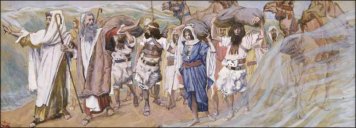
To learn more about the festival of Purim, click on this image or visit http://www.chabad.org
Monday, February 17, 2025
The jolly festival of Purim is celebrated every year on the 14th of the Hebrew month of Adar (late winter/early spring). It commemorates the salvation of the Jewish people in ancient Persia from Haman’s plot “to destroy, kill and annihilate all the Jews, young and old, infants and women, in a single day,” as recorded in the Megillah (book of Esther). (www.chabad.org)
In our Old Testament thinking, we celebrate victory over plotters who schemed to annihilate us. In our New Testament thinking, we ask God to soften the hearts of our enemies. In our Old Testament thinking, we commemorate the destruction of those who would harm us. In our New Testament thinking, we celebrate their transformation. In our Old Testament thinking, we rejoice with Purim in the month of Adar. In our New Testament thinking, we ask for God’s mercy each day.
We first reflected on this citation in June of 2013. Today, as we seek to soften our own hearts, we remember that just as reversal is always possible for our enemies, it is always possible for us. For this reason, we give thanks for our modern Purim.
Tomorrow, quiet patience and courage.
For a prayer, enter the word Reversalinto the blog search bar and explore.
Esther 7 concludes abruptly with the hanging of Haman. We have perhaps looked for this outcome, hoping for the justice we desire in our own lives. We suspected that inversion will take place and that the plotter will suffer the fate he planned for others; but these outcomes have not halted the plot to annihilate the Jewish nation. Today we watch as Esther and Mordecai take steps to stop the impending slaughter.
With New Testament thinking, we shrink from the violence of fighting back. Revenge has no place in the Pax Christi kingdom of Jesus where we forgive, and even intervene for our enemies. So it is with sadness that we read this chapter’s closing verse.
In fact, many other people became Jews, because they were afraid of them now.
On this first Sunday of Lent, we take time to reflect on the power of egocentric living. Experts tell us that when we acquiesce to narcissists, we give them power; and that the key to escaping one like Haman is to detach, observe, protect ourselves, and plan an escape. Esther and Mordecai stand quietly against injustice; yet they leave their own trail of bloodshed, as we will see tomorrow. Rather than establish peace for all, the envy and narcissism that haunt Esther and Mordecai continue to nurture division, suspicion, and old hatred. They may have escaped the power of the narcissist, but the power of unilateral thinking remains. The murder of the Jewish nation is averted, but slaughter nonetheless takes place.
Tomorrow, our modern Purim.
When we compare translations of this chapter, we look for ways to undo the bloodshed that happens too frequently in our lives.
Yesterday we assessed the narcissism we might discover in ourselves and how unilateral listening governs our world circumstances. Today we reflect on how Esther and Mordecai operate in their world – and what we might learn from them.
It is clear that Haman is consumed by envy of Mordecai and while we cannot analyze this character from a Biblical story, we can certainly learn from his actions. It is also clear that Esther – as a woman but especially as a Jewish woman in a non-Jewish court – fears for her life, and the life of her nation. The kingdom of Xerxes is an ancient one in which individual rights are denied to most. We might believe that we as a species have evolved and it is true that in general, we have. However, many peoples in our modern society have no benefit of personal rights. When this happens, we might speculate, it is often the result of someone, or some group, behaving in a narcissistic manner. Navigating these troubling conditions is difficult at best. What does the story of Esther have to tell us?
Queen Esther answered, “If it please Your Majesty to grant my humble request, my wish is that I may live and that my people may live”.
Humility is usually an ineffective tool against brutality; it seems to encourage even more violence. Yet, here we see that despite her humble behavior and words, Esther acts in order to save a people.
“If you keep quiet at a time like this, help will come from heaven to the Jews, and they will be saved, but you will die and your father’s family will come to an end. Yet who knows—maybe it was for a time like this that you were made queen!” (Esther 4:14)
On Wednesday when we explored Chapter 4, we considered Martin Neimöller’s advice that if we do not speak against evil and injustice, we guarantee not our safety, but our sure demise. Despite their fear, Esther and Mordecai form a solidarity of two as they begin a quiet, patient assertion of justice and truth.
An article from Psychology Today gives us guidelines to manage the effects of narcissism. These experts advise that we evaluate both our surroundings and the narcissist to look for context, that we maintain a firm sense of purpose along with a sense of humor, and that we remain realistic about how much we can accomplish when working with the self-centered. If we are in dangerous surroundings, controlled by a persecutor as Esther and Mordecai are, we begin by turning to God and finding others with whom to form solidarity. We move forward with patience, reliance on the Creator, persisting in hope, and acting in mercy.
Tomorrow, fighting back.
When we read varying translations of this story by using the scripture link and the drop-down menus, we find an opportunity to transform a world beset by narcissism.
Our current national stage, with its cast of actors, asks us to explore the concept of narcissism. Unless we are professional in the field of psychoanalysis, we must consult those who have expertise and experience in discovering and handling those among us who suffer from this disorder of unilateral listening. For the layperson, an article fromPsychology Todayoutlines six signs of narcissism, contains a quiz with which readers might assess themselves, and offers strategies to become less self-centered. Today’s reading from Esther gives us another template with which to measure ourselves.
Have royal robes brought for this man—robes that you yourself wear.
Are we able to use the criticism we receive in a positive manner? Are we willing to see that we are sometimes wrong?
Have a royal ornament put on your own horse.
Can we see that a world exists beyond our person? Do we believe that others hold truths that are, at the least, equal to our own?
Then have one of your highest noblemen dress the man in these robes and lead him, mounted on the horse, through the city square.
Are we willing to abide by the guidelines set by the group? Do we see ourselves as so special that rules do not apply to us?
Have the nobleman announce as they go: “See how the king rewards someone he wishes to honor!”
Are we willing to give others the praise we wish to have ourselves? Are we comfortable when others receive praise we seek?
Haman hurried home, covering his face in embarrassment.
Are we quick to anger? What do we do with our negative feelings? How do we manage resentment and bitterness?
Haman, his family and friends have much to teach us about ourselves; our current national and local politics ask much of us. As we move through these opening days of Lent, are we willing to explore the concept of narcissism, and how it affects us personally and collectively?
Tomorrow, dealing with the narcissists in our lives.
When we read varying translations of this story by using the scripture link and the drop-down menus, we offer ourselves an opportunity to move away from our own narcissism.
We must take care to observe what schemes we enter, knowingly or unknowingly. In today’s reflection, a parade of characters brings us an invitation to explore our own motivations and actions.
Queen Esther waits beyond the throne room, knowing that entrance without permission results in death. Does she know that she will need more courage than she believes she possesses?
King Xerxes offers half his kingdom in a magnanimous gesture. Does he know what price he will actually pay for this promise?
Haman wells over with envy and anger. Does he understand what happens to plotters and schemers?
Haman’s wife Zeresh urges her husband to build an execution scaffold. Does she understand who will eventually stand on its trapdoor?
Mordecai insists on worshipping no other god before Yahweh. Does he know that the LORD will protect him?
Haman, Zeresh, and Friends
These characters invite us to explore what gallows we build for ourselves and others. They call us to examine our goals and incentives. They ask us to open ourselves to the possibility of conversion and mercy.
We use the scripture link and the drop down menus to compare varying translations of these verses. We explore more about the lives of the characters in this story today.
Today we hear a portion of Esther’s story that resonates with humans in every age. Mordecai puts on sackcloth and ashes as he mourns an impending holocaust. He warns Esther that her future is in danger whether she takes action or not. He reminds her that her thinking that there is safety for her in the palace is a false one. And he suggests that perhaps she is queen for precisely this moment in history. His words force her into action once she realizes that inertia only invites evil. Apathy or disinterest are no protection against malicious intent.
Do not think that in the king’s palace you will escape any more than all the other Jews. For if you keep silence at such a time as this, relief and deliverance will rise for the Jews from another quarter, but you and your father’s family will perish. Who knows? Perhaps you have come to royal dignity for just such a time as this.
We will celebrate Ash Wednesday in a few weeks when we will wear ashen crosses on our foreheads at the beginning of the season of Lent. As we move toward that day and time, we will explore our own role in human history, and we will examine our own fears and hopes. We pause in our journey through Esther to reflect on words from the 20th Century.
From the Holocaust Encyclopedia site: “Martin Niemöller (1892–1984) was a prominent Protestant pastor who emerged as an outspoken public foe of Adolf Hitler and spent the last seven years of Nazi rule in concentration camps”.
First they came for the Socialists, and I did not speak out—
Because I was not a Socialist.
Then they came for the Trade Unionists, and I did not speak out— Because I was not a Trade Unionist.
Then they came for the Jews, and I did not speak out— Because I was not a Jew.
Then they came for me—and there was no one left to speak for me.
A Catholic nun uses ash to mark a cross on the forehead of a child in observance of Ash Wednesday at The Redemptorist Church at suburban Paranaque city south of Manila, Philippines Wednesday, Feb. 18, 2015. Ash Wednesday marks the start of the Lent, a season of prayer and fasting before Easter. (AP Photo/Bullit Marquez)
Both Mordecai and Niemöller invite us to examine our hearts. Esther invites us to consider our response to God’s call.
Tomorrow, an invitation.
Who celebrates Ash Wednesday? Click on the image of the woman and child receiving ashes to learn more.
Visit the United States Holocaust Memorial Museum to learn how Niemöller dealt with his own anti-semitism: https://www.ushmm.org/
At Christmas time several years ago, we reflected on Esther 3 as a preamble to the Jesus story. The coming of light. A voice asking for mercy. Justice amidst corruption. The presence of simplicity in a complicated world. Plots and schemes returning to haunt their authors.
As the story unfolds, we see our own modern headlines in the verses. Millennia later, what have we learned?
Bulletins were sent out by couriers to all the king’s provinces with orders to massacre, kill, and eliminate all the Jews—youngsters and old men, women and babies—on a single day, the thirteenth day of the twelfth month, the month Adar, and to plunder their goods.
We sift into groups that exclude. We gather words and weapons to assault “the other”. Millenia later, where do we invest our resources?
There is an odd set of people scattered through the provinces of your kingdom who don’t fit in. Their customs and ways are different from those of everybody else. Worse, they disregard the king’s laws. They’re an affront; the king shouldn’t put up with them. If it please the king, let orders be given that they be destroyed. I’ll pay for it myself. I’ll deposit 375 tons of silver in the royal bank to finance the operation.
We shrink from corruption. We turn away because we believe we have no power. Millennia later, how many Hamans stalk the innocent?
At the king’s command, the couriers took off; the order was also posted in the palace complex of Susa. The king and Haman sat back and had a drink while the city of Susa reeled from the news.
We gather in solidarity. We welcome and heal. Millennia later, what is our story?
Tomorrow, one small woman.
When we compare varying versions of these verses, we open ourselves to seeing “the other”.
To read three posts on Esther 3, enter the word Preamble into the search bar and explore.
Johannes Spilberg the Younger: The Feast of Esther
Monday, February 10, 2025
What do we do when we have possession of information about a harmful plot? This is the question posed by today’s reading. Esther comes to the attention of King Xerxes, and the king gave a great banquet to all his officials and ministers—“Esther’s banquet.” He also granted a holiday to the provinces, and gave gifts with royal liberality.
Amidst this celebration, Mordecai reports a plot to assassinate the king not to the king directly, but through his cousin Esther. We might pause to ask ourselves what we do with information that comes to us that indicates danger to others or ourselves.
On this day, with Mordecai sitting at the King’s Gate, Bigthana and Teresh, two of the king’s eunuchs who guarded the entrance, had it in for the king and were making plans to kill King Xerxes. But Mordecai learned of the plot and told Queen Esther, who then told King Xerxes, giving credit to Mordecai. When the thing was investigated and confirmed as true, the two men were hanged on a gallows.
God says: When you stumble across a plot that threatens harm, bring your tension and worry to me, and listen for my counsel. Always remain faithful to a life of compassion, hope and mercy. Always forgive those who harm you while asking me to transform hardened hearts and stiff shoulders. Always be wary of associates who draw you into grumbling, hoping to bring you into the schemes they weave. Remember that Jesus instructed you to “render to the emperor what belongs to the emperor and to God what belongs to God”. (Matthew 22:21) Remember to align yourself with me for I have great plans in mind for you.
It is tempting to complain about the corruption around us without acknowledging our part in a corrupt structure. It is comfortable to be silent while others wage war around us.
What do we do when we have possession of information about a plot that does harm? Today Esther and Mordecai give us insight. Today we reflect on the plots we discover. And we reflect on what we are to do.
Through the last several hundred years, numerous thinkers, writers, spiritual and political leaders have reminded us that evil grows quickly when good people remain silent. We may want to explore some of these quotes at: https://quoteinvestigator.com/2010/12/04/good-men-do/
Over the next few days, we will explore the story of Esther, a recounting of how a brave young woman saves a nation of people by mustering the courage to respond to God’s call. Polar forces place her in grave danger; yet Esther survives to rejoice in God’s guidance and protection. As we accompany her on this journey from fear to joy, we move from ordinary time through Ash Wednesday to Lent to discover the potential for transformation. Esther invites us to move away from typical days of activity into a more quiet life of introspection. Like Esther, we examine our relationship with God to see how fear manipulates us. And like Esther, we arrive at a new level of understanding of God’s love.
This is the story of something that happened in the time of Xerxes, the Xerxes who ruled from India to Ethiopia – 127 provinces in all. King Xerxes ruled from his royal throne in the palace complex of Susa.
UNESCO has declared Susa a World Heritage Site as one of the oldest cities in the world. Rebuilt by the Persian King Darius, inhabited by the monarch Xerxes in the Book of Esther, and later conquered by Alexander the Great, Susa represented a city where many cultures and peoples came together.
In this opening chapter of Esther’s story, we learn about Xerxes’ court. As a soldier and builder, he made his mark in the ancient world, and his famous Tukta banquets were reknown. It is at one of these feasts that our story begins.
The king gave for all the people present in the citadel of Susa, both great and small, a banquet lasting for seven days, in the court of the garden of the king’s palace. There were white cotton curtains and blue hangings tied with cords of fine linen and purple to silver rings and marble pillars. There were couches of gold and silver on a mosaic pavement of porphyry, marble, mother-of-pearl, and colored stones. Drinks were served in golden goblets, goblets of different kinds, and the royal wine was lavished according to the bounty of the king. Drinking was by flagons, without restraint; for the king had given orders to all the officials of his palace to do as each one desired. Furthermore, Queen Vashti gave a banquet for the women in the palace of King Ahasuerus.
Queen Vashti refuses to do as King Xerxes asks and so is banished from court. Into this scenario steps the innocent, beautiful young Jewish woman, Esther. We observe the wealthy and famous in this ancient world and we reflect on our world today. Celebrities and sports figures hold our interest, while the lower classes serve as the invisible support to a lavish life. The powerful command while the powerless live on the margins of society. What questions come to us as we reflect on this opening chapter of Esther’s story?