We hear more today about winnowing time and the importance of repentance.
It is interesting to look at this citation beside today’s Gospel of Luke 4:38-44. There is a similar theme – Jesus tells us that he comes to proclaim to as many as possible the Good News that redemption is now available to anyone who has faith and is willing to feel sorrow.
Jesus retires to “a deserted place.” John the Baptist “appeared, preaching in the desert of Judea.”
We tend to shy away from the many desert places in our lives, but it is in these deserts that we encounter God most intensely. We ought not fear the emptiness or dryness because the nurturing goodness of God never leaves us alone or without hope. We are never fully in the darkness for there is always a the light of Christ that cannot be held back. From this morning’s prayer in MAGNIFICAT: The bright light of the risen, Jesus Christ, shines to all parts of the earth. Let us walk in his light and follow in his way, that, reflecting his brightness, we may enlighten the eyes of the blind with faith and hope.
As People of Hope, let us intone this prayer together today.
Amen.
Cameron, Peter John. “Prayer for the Morning.” MAGNIFICAT. 5,9 (2007). Print.
In the beginning was the Word, and the Word was with God, and the Word was God. He was in the beginning with God. (NRSV)
No matter how often we read these words they bring us new beauty.
Footnotes tell us that the writer lays out the themes that develop as the Gospel continues: life, light, truth, the world, testimony, the pre-existence of Jesus, the incarnate Logos who is God’s revelation and the expression of God’s love for us. When we think of the stories we hear and read in this Gospel, we know for a certainty that God is calling us to be diverse, to tend to that diversity and to place our hope in this diversity – because it is in this diversity that the Spirit manifests itself best.
The Word was first,
the Word present to God, God present to the Word.
The Word was God, in readiness for God from day one.(MSG)
God calls us to intimacy, and Jesus calls out this same petition in his brief life. God asks us to commune with one another in a way we think impossible, and we can only do this if we rely on Wisdom. This morning’s first reading was from Wisdom 3:1-12, The Hidden Counsels of God on Suffering.Looking at verse four of that reading we are reminded that our hope is what makes us immortal. This hidden counsel of God manifests itself in Jesus, the world’s only true hope.
In the beginning the Word already existed; the Word was with God, and the Word was God. From the very beginning the Word was with God. (GNT)
Jesus, the Suffering Servant, comes to us to serve – not to be served. And so must we serve rather than be served. No one has ever seen God except through Jesus Christ, the apostle John tells us; yet God speaks to each of us through Jesus. It is fitting that Jesus represents this hope of God. It is correct that we awake and rise each day to look to Jesus. It is right that we act and live in hope, for it is this hope that makes us immortal.
Adapted from a reflection written on September 20, 2007.
Nehemiah reminds us that God accompanies us in the deserts of our lives when we experience anguish and fear. Jesus also tells us that we need not be afraid.
Nehemiah repeats the well-known story.
By day you led them with a Pillar of Cloud, and by night with a Pillar of Fire
To show them the way they were to travel.
More than any other demand or request, Jesus reminds, “Do not be afraid”. In one Gospel alone, Jesus repeats this soothing entreaty.
“So do not be afraid; you are worth more than many sparrows”. (Matthew 10:13)
At once [Jesus] spoke to them, “Take courage, it is I; do not be afraid”. (Matthew 14:27)
Jesus came and touched them, saying, “Rise, and do not be afraid”. (Matthew 17:7)
Jesus said to them, “Do not be afraid. Go tell my brothers to go to Galilee, and there they will see me”. (Matthew 28:10)
Nehemiah reminds us of the ancient link we have with the Living God.
You came down onto Mount Sinai, you spoke to them out of heaven;
You gave them instructions on how to live well, true teaching, sound rules and commands.
Nehemiah tells us again that the Living God will sustain us.
You gave bread from heaven for their hunger, you sent water from the rock for their thirst.
You told them to enter and take the land, which you promised to give them.
Nehemiah and Jesus, if we are able to listen carefully, describe the Living God’s fidelity. We might consider how we will respond today.
When we consider multiple translations of these verses, we begin to remember the many wonders and signs God has worked in and for us.
For a reflection on Nehemiah 9, enter the word Confession into the blog sear bar and reflect.
In a previous post, we reflected on how and why we watch Jesus – on what and when we learn from him – on where we encounter him. Today we reflect on the fact that The Word is not ambiguous. The words of Jesus tell us how we are to act, and what we are to do. Paul tells the Romans – and us – that we are to conform to the world of Jesus rather than the world we see around us. This is as concrete as can be. There is no doubt that we are born to be transformed in and by the Spirit.
Also in this portion of his letter, Paul reminds us that our diversity is pleasing to God. We are to struggle against our desire to see everyone and everything conform to our will. And we are struggle with our ego so that we make room for others in this mystical body we form with Christ. Peace, harmony, service to others, clinging to what is good and avoiding what is not good, blessing our persecutors rather than cursing them – these are the marks of one who ardently follows the Christ. We must put aside thoughts of revenge or even the delight in someone else’s downfall. We are to leave all moral judgment to God.
Do not be overcome by evil, but overcome evil with good.
What a simple and elegant rule to follow. Oh so clear and clean. Oh so difficult to realize.
If we persist in looking for reasons why this rule does not work, we walk away from Jesus. If we continue to exempt ourselves from this rule, we walk away from life. If we persevere in seeing the world as a dark and ugly place, we walk away from the light. If we insist on controlling everything and everyone around us, we walk away from serenity.
Vincent Van Gogh: Wheat Field
When we watch Jesus we see the important lesson that healing and controversy are often entwined. In the Parable of the Weeds (Matthew 13:24-30) we hear that God does not pull up the weeds from the field when they appear because this disrupts the soil and damages the fruit-bearing crop before harvest time. God trusts us to put down deep roots into the rich soil of our lives, and to lift strong arms to the sun in order that we bear fruit – no matter the circumstance of our planting. So let us trust God to tend to the weeds in our own hearts and the weeds among as we struggle to grow, for God is trustworthy. God is capable. God is loving, generous, just and kind.
Rather than becoming overcome by the evil with which our lives are entwined, let us allow God to overcome evil through us – by doing good.
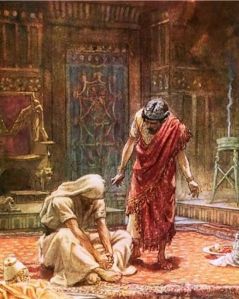
Ahab is an unscrupulous leader who does anything to gain advantage, and today we watch him violate a ban on war – an action for which he will later pay with his life. In Chapter 21 is the famous story of his seizure of Naboth’s vineyard. In Chapter 22 he will die in battle. Ben-hadad, one of several men of this name in the Old Testament, attacks Samaria several times, is victorious once, but more frequently suffers defeat.
Reading through the ups and downs of the fortunes of individual men, we see a picture that is much like our own lives. Things go well for a while among nations, and then they sour. Leaders agree in principle to a concept, later they back away. Promises once looked to for hopeful solutions to grave problems become lost in pride and greed.
We might become caught up in the drama and tragedy of lives spent so quickly and thoughtlessly.
We might become despondent when we watch good ideas wither from neglect.
We might become pessimistic or even cynical when we see goodness overtaken by evil.
We might become hopeless as we witness continual injustice.
This will happen when we see as humans see . . . and this will not happen when we see as God sees.
Thomas Matthews Rooke: Elijah Prophesises to Ahab and Jezebel their End
When we see as humans see, we take today’s story and see a series of military and political victories and losses. When we see as God sees we are cognizant of the many lives caught up in the machine of battle in which leaders engage coolly, moving war equipment and troops as if they were pieces on a chessboard.
When we see as humans see, we regard each day as a series of battles to be fought and won: getting to work on time through traffic, battling with colleagues for agendas, making certain that our perspective is the one seen by friends or colleagues.
When we see as God sees, we regard each day as a gift through which we experience many interchanges with family, friends, colleagues, and even strangers. We see the wisdom in coming to consensus, of standing in solidarity, of witnessing to injustice and of handing over our problems to God. These are the victories that nourish. These are the victories that give life.
When we see as humans see, time and location are often stumbling blocks. When we see as God sees, they are gifts to be received, shared and returned in gratitude to the one who gives us life. These are the many small victories that build up as our treasure. These are the victories that cannot be taken away, that cannot be reversed. These are the victories that will last an eternity.
We are always ready to receive joy, always prepared to celebrate. Today we hear from the prophet Zephaniah that there is a reason to rejoice, despite our recalcitrance and resistance to a life of goodness and peace.
The opening verses of this chapter describe a “sewer city” in live a people who refuse to hear the good news that God wants to celebrate goodness with us. We refuse to take correction. Our leaders are rapacious killers. The people have become opportunistic; yet despite this horrible news we hear that God is in the center of the action and knows all we say and do. Despite the damage we visit on one another, God remains. God abides. God persists. God is present, and speaks to us.
You’ve carried those burdens long enough.
I’ll heal the maimed; I’ll bring home the homeless.
In the very countries where they were hated they will be venerated.
As we hear this good news, we sing our song of joy.
God is Israel’s king, in charge at the center.
There’s nothing to fear from evil ever again!
Let us join our voices in this great song.
To compare different versions of these verses, use the scripture link and the drop-down menus.
We hear and use so many words. We speak so often and express so much, hoping that our actions match the thoughts we offer in glib language. Paul advises us today to keep watch over what we say and how we say it.
Watch the way you talk. Let nothing foul or dirty come out of your mouth. Say only what helps, each word a gift.
Just last week in my workplace, colleagues and friends decided to make the upcoming year one in which we promote peace. How easy this sounds. How difficult this is. How necessary and important is the work of watching what we say and how we say it. Gossip is an open pit that ensnares many of us; but in this time of harsh words that stir up harsh deeds, we must take this work seriously.
Make a clean break with all cutting, backbiting, profane talk. Be gentle with one another, sensitive. Forgive one another as quickly and thoroughly as God in Christ forgave you.
In the days to come, we will work at saying only what helps, measuring each syllable as a gift. In the months ahead, we will be kind to one another, forgive and heal breaches. In years that yawn before us, we will lapse from time to time but we must return to a place of mutual respect and peace. We must make a clean break with the casual, off-handed words we let slip so quickly from the tongue and lips. We must watch our ways. We must remove harmful words and actions from our lives for in so doing, we live in the hope that we might live more gently. We live in the love of Christ generously showered on us. We live in the Creator’s fidelity, blooming with the promise of our own creation.
When we compare various translations of these words, we open ourselves to the great turning from harm to love.
Keep silence before me, O coastlands; you peoples, wait for my words!
This is good news indeed. The Liberator is arriving to free us from all that entangles and ensnares us, from all that does not allow our spirit to flourish.
Who has stirred up from the East the champion of justice?
God sends this Liberator, this Son of Man, this Messiah to call us back from this world to follow him into the kingdom he is building for and with us.
Fear not, I am with you; be not dismayed: I am your God.
The journey away from this world and on to the next will be frightening because we will have to drop along the wayside all of the comfortable old habits. The traveling will feel unfamiliar, even alarming at times; yet we cannot hesitate to respond to the Voice that Calls.
I will strengthen you, and help you, and uphold you with my right hand of justice.
We must rely on God to fortify us for the journey and to sustain us as we travel. For there is no one else who knows the way. There is nothing else that can possibly nourish us for so long and so rigorous a trip.
Fear not, I am with you; be not dismayed: I am your God.
The fine line we walk to avoid scandal while revealing it with love is difficult to navigate. Do we ignore the hypocrisy we see each day? Do we hide from those who practice deceit and hope to keep ourselves safe? Do we bend to corruption hoping that we will escape unscathed?
Rebuke publicly all those who commit sins, so that the rest may be afraid. (GNT)
Actions that avoid confrontation may help us to avoid immediate conflict, but what do they set up for us later? Are these strategies effective over the long run? Are these tactics useful when we all attempt to come together for the common good?
As for those who persist in sin, rebuke them in the presence of all, so that the rest also may stand in fear. (NRSV)
Jesus tells us that if some home or town will not welcome you or listen to you, then leave that place and shake the dust off your feet. (Matthew 10)
The psalmist reminds us (Psalm 101) that we must refuse to take a second look at corrupting people and degrading things.
If anyone falls into sin, call that person on the carpet. Those who are inclined that way will know right off they can’t get by with it. (MSG)
It seems better – or easier – to avoid conflict, to placate the powerful, and bow to the bully; yet, in our hearts we know that ultimately, only the fidelity of truth will conquer lies. Only the hope of goodness can combat evil. And only the light of authentic honesty can erase corruption. Today we have an opportunity to explore how we act, and how we react to an imperfect world.