From Richard Rohr’s reflections, A Spring Within Us: Much of religion has bought right into the honor/shame system. All we did was change the cultural rules to religious rules. Now there was yet another way superior – by being pious, publicly religious, and “moral” about one or two things (which are usually not central issues). Yet Jesus’ teachings against status-seeking and building up religious reputation tell us again and again, “Don’t go there!” (Examine Matthew 6:1-21 and Luke 18:9-14.) (Rohr 105-106)
The two disciples who leave Jerusalem after Jesus’s crucifixion have no idea that the risen Christ joins them in their journey to Emmaus. Perhaps Christ chooses anonymity because he wants the disciples to behave genuinely. He wants no barriers or false faces. No preening, no adulation, no preening or posing. And this is how Christ wants each of us to behave in our interactions with him. After all, God knows every detail of our lives. The Spirit knows every dark corner of our hearts.
Eugene Delacroix: The Disciples at Emmaus
Today we examine our own behavior to look for signs of status-seeking, of building up of our own ideas of religious purity or superiority. Today we have the opportunity to come to Christ in innocent openness. We have the chance to put away our cultural and religious systems of shame and honor. We have the invitation to think about original grace rather than original sin, to both ask for and offer forgiveness, to walk with Christ on our journey to Emmaus, in expectation of Easter hope and joy.
Tomorrow, they did not recognize him . . .
Richard Rohr, OFM. The Spring Within Us: A Book of Daily Meditations. Albuquerque, NM: CAC Publishing, 2016.
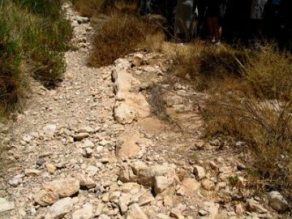
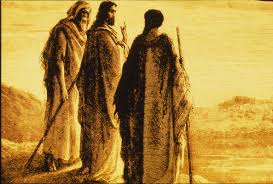
For more on the original road to Emmaus, click on the image above, or visit: http://www.jesus-story.net/emmaus.htm
They urged him strongly, saying, “Stay with us, because it is almost evening and the day is now nearly over.”
We journey through our Easter resurrection, carrying our doubts and fears, measuring, and even judging, ourselves and those who walk with us. We hope to avoid obstacles, not realizing that they provide us with opportunities for transformation. We see ourselves in a race against time, not understanding that God’s time is eternal. We perceive ourselves as small entities in competition with the billions of earth’s citizens, not comprehending that we are all the living stones of the temple that is God’s kingdom.
They urged him strongly, saying, “Stay with us, because it is almost evening and the day is now nearly over.”
A humble yet confident, vulnerable yet strong young man joins us on our journey. He speaks words that both comfort and challenge. He listens well. Asks thoughtful questions. We can feel the compassion and empathy coming from his eyes; his whole body exudes an essence we want to capture so that we might carry it along with us. Yet we need not. We try to possess what we already own. We try to control what we are already promised.
This man’s words are wisdom. His actions are mercy. He embodies hope, he enacts fidelity, he islove. Do we invite him to linger with us, or are we too busy tending to our pains and worries, monitoring our timelines and space?
They urged him strongly, saying, “Stay with us, because it is almost evening and the day is now nearly over.”
Hendrick Terbrugghen: Supper at Emmaus
Christ walks with us today as surely as he walked with these disciples in the journey to Emmaus. He breaks bread with us today just as he did at the supper table in Emmaus. Let us set aside the time and space to share our uncertainties with him. Let us dedicate the time and place to share our joy. And let us allow The Teacher to open our hearts to the enormity of God’s love and promise as we journey toward the Easter promise.
They urged him strongly, saying, “Stay with us, because it is almost evening and the day is now nearly over.”
Tomorrow, original grace . . .
For more on the Emmaus experience, click on the image of the Boe painting, or visit: http://www.jesus-story.net/emmaus.htm
We might imagine ourselves discovering Christ just as we break bread with him. We might imagine his disappearance as a disappointment or as an opportunity to share the joy of Good News with others. Our reaction to Christ’s presence brings us great fear, great sorrow, great joy, or a mixture of many emotions. How do we write our own story?
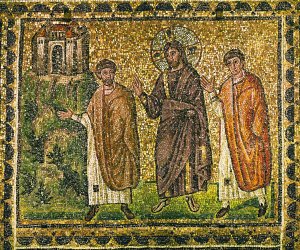
Christ appears to the Apostles on the road to Emmaus. Mosaic (6th Century mosaic)
They didn’t waste a minute. They were up and on their way back to Jerusalem. They found the Eleven and their friends gathered together, talking away: “It’s really happened! The Master has been raised up—Simon saw him!”
Then the two went over everything that happened on the road and how they recognized him when he broke the bread.
God says: You may find this story difficult to believe. You will want assurance that you would not miss my presence among you; yet you need not be afraid. I am not angered that you overlook me, gaze past me, and cringe away from me when I appear as the homeless, the hungry, the refugee, and the poor. When you suffer embarrassment, all you need do is turn to me with a vulnerable heart. When you are uncomfortable each time I come to you as the marginalized, all you need do is open your arms to me. When you are angry with circumstances you cannot control, ask for my guidance and protection. I have the strength and persistence, the love and fidelity, the hope and energy to be with you through every moment of your suffering. Give me your anxiety and fear. Come away and break bread with me. All the rest is nothing. I am all. And I am enough in this day and in all days.
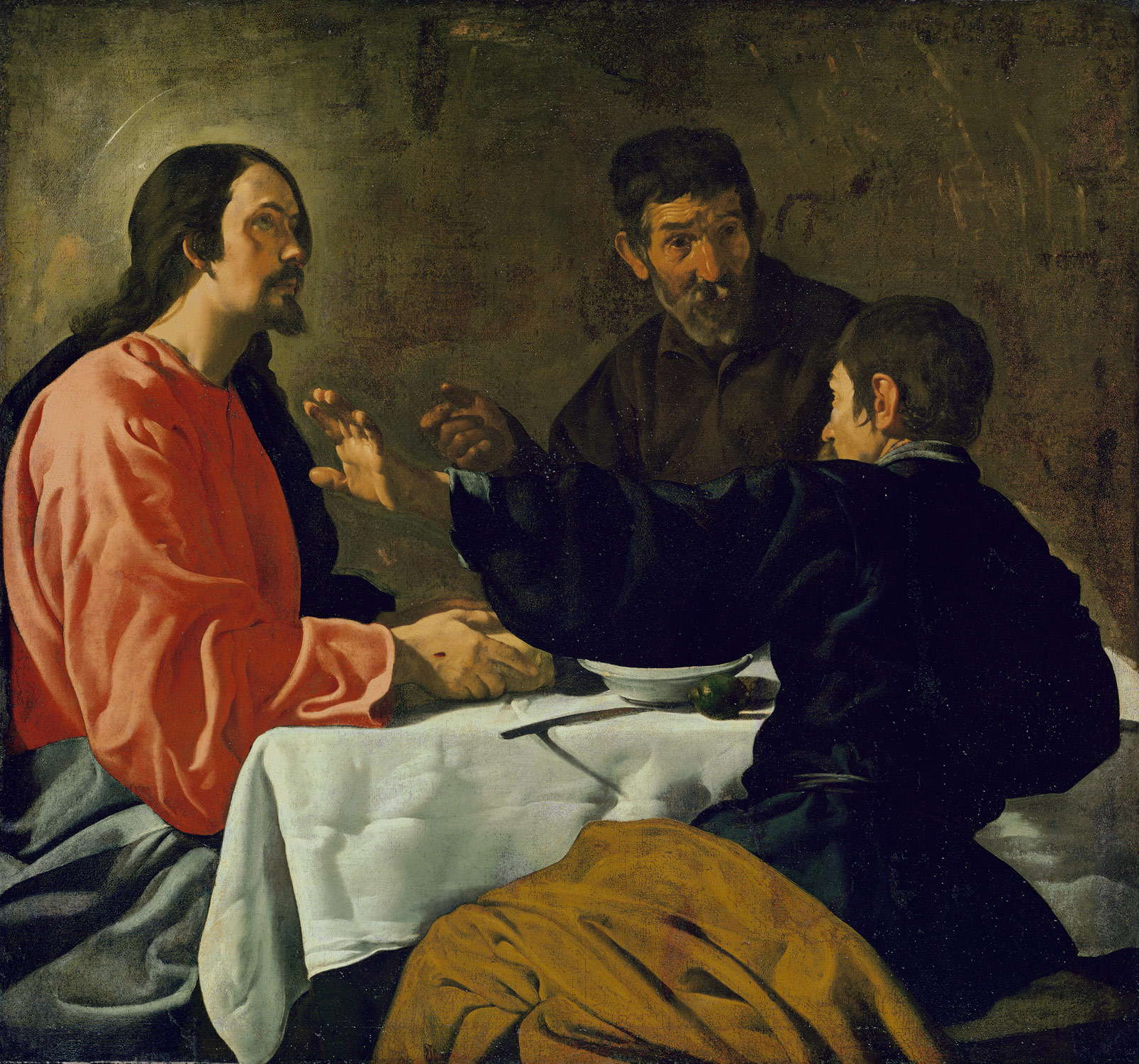
Diego Velázquez: The Supper at Emmaus
When we spend time reflecting on this story, and when we admit the number of times our anger or discomfort have gotten the best of us, we realize that we, like the Emmaus disciples, have the opportunity to break bread with Christ himself.
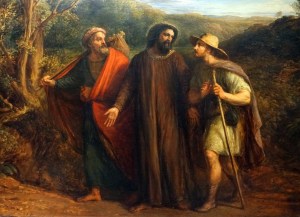
Paul Gustave Doré: Jesus and the Disciples Going to Emmaus
We know that Christ walks with each of us as we move along our pilgrimage way to the Easter resurrection. Would Christ speak to us as he speaks to the Emmaus disciples? Would he find us as open and as blind as the Emmaus believers? And would he linger with us even as we linger with him?
We look at THE MESSAGE translation of Jesus’ words to his disciples, and we explore our own connection with Christ.
So thick-headed! So slow-hearted!
Do we see ourselves as open or closed to the Good News story that everyone is a child of God, everyone is saved, everyone is healed?
Why can’t you simply believe all that the prophets said?
Do we resist the kingdom with great vigor and ignore the message of life with studied nonchalance?
Don’t you see that these things had to happen, that the Messiah had to suffer and only then enter into his glory?
Do we step away from obstacles and move toward comfort?
Then [Jesus] started at the beginning, with the Books of Moses, and went on through all the Prophets, pointing out everything in the Scriptures that referred to him.
The Nain Brothers: The Supper at Emmaus
Do we spend time with Scripture or decide that our days are too busy, our nights too long to turn to the simple words inspired by the Spirit?
Didn’t we feel on fire as he conversed with us on the road, as he opened up the Scriptures for us?
Like the Emmaus disciples, do we recognize the one who lives and teaches among us? Do we return to Jerusalem to share both joy and tribulation with those who know the Easter story? And do we allow our Emmaus conversion to last a lifetime of hoping and loving in Christ?
When we compare various translations of the Emmaus story, we open our hearts to the sorrow and joy of the Easter story.
Pieter Coecke van Aelst: Christ and His Disciples on Their Way to Emmaus
Yesterday we spent time with the story of the disciples who encounter Jesus on the road to Emmaus. Today we imagine the possibilities in our lives if every time we come up against an obstacle we might recognize Christ’s presence and invite him to linger.
In an intense flash, at the breaking of the bread, we suddenly become fully aware of the identity of our companion. We abruptly comprehend why we have felt so light and happy as we journey to Emmaus. We realize that the hopes we have put away may be taken back out. The faith we have placed in God’s plan is still valid. The love we wish to share is still viable. The Teacher has not lied to us in some silly attempt to ease the pain of our days. The Teacher has offered – still offers – an opportunity of intimacy with him previously unknown to humankind. And we disciples who have left Jerusalem in fear and sadness . . . now retrace our steps to return to the crucible of conflict which our Way of living brings us. We are transformed. We no longer allow fear overcome courage. We do what Paul urges all of us to do – and we heard this yesterday – we put on Christ, the only protection we need.
We notice that Jesus leaves when the disciples recognize him, but his Spirit remains. And Jesus expects that now we will be his hands, his feet, his teaching. We are Emmaus People . . .
We are full into Eastertide, my favorite time of year when we want to believe that the story we have heard is true: we are truly free, the miracle of restoration and resurrection exists, we are already building the kingdom. Today’s reading is The Road to Emmaus, a story we hear read out to us at Mass following Easter when our hearts are heavy from witnessing the crucifixion but light because the tomb is empty. If only we might realize that we are Emmaus People,a people who hold a truth too wonderful to keep secret.
I imagine that I have spent much of my life in the same way as these two disciples who leave Jerusalem after the events surrounding Christ’s Passion and Crucifixion. Things have gotten too hot to handle. Disappointment at the squashing of a ground swell movement and the execution of its leader has overcome any sense of joy they have previously experienced. It seems that all good has been wiped from the face of the earth; all light has been sucked from the world. And yet . . . they journey home in hope, sharing stories of the heady glory days when all possibilities were actually possible. They meet a fellow traveler and journey with him, drink in his words feeling oddly satisfied and content . . . they invite him to linger.
Léon-Augustin Lhermitte: Friend of the Humble (Supper at Emmaus)
In an intense flash, at the breaking of the bread, they suddenly become fully aware of the identity of this companion. They abruptly comprehend why they have felt so light and happy as they made their way to Emmaus. They realize that the hopes they had put away may be taken back out. The faith they had placed in God’s plan was still valid. The love they wished to share was still viable. The Teacher had not lied to them in some silly attempt to ease the pain of their days. The Teacher had offered – still offered – an opportunity of intimacy with him previously unknown to humankind. And these two disciples who had left Jerusalem in fear and sadness now retrace their steps to return to the crucible of conflict which their Way of living brought them. They are transformed. They are no longer allowing fear to overcome courage. They do what Paul urges the Ephesians and all of us to do; they have put on Christ, the only protection they need.
We can put ourselves into this story because Luke has left these protagonists nameless.
Things have gotten too hot to handle. Disappointment at the squashing of a ground swell movement and the execution of its leader has overcome any sense of joy we have previously experienced. It seems that all good has been wiped from the face of the earth; all light has been sucked from the world. And yet . . . we journey home in hope, sharing stories of the heady glory days when all possibilities were actually possible. We meet a fellow traveler and journey with him, drink in his words feeling oddly satisfied and content . . . we invite him to linger.
In this chapter of Romans, Paul puzzles over the lack of faith in the Christ story among the Jewish people. They are clearly chosen by God to convey the message of freedom and salvation to the world and in fact, one of their own is the Messiah; yet they reject the message of hope and promise that Jesus offers. This is also the message that Paul proclaims anew.
In the previous chapter (Romans 8), Paul reminds us that faith is the belief in things not seen; hope is the exercise of expecting something that is greater and better than we think likely (8:24-25). He reminds all of us that the Holy Spirit is at work in and among us, and that we must be open to God’s plan rather than forwarding our own. Now he puzzles over the lack of expectation and fidelity in those who have had the advantage of the special status; he finds it strange that the very people and tradition that have engendered the message now turn against it.
Do we see this same contradiction in our own age? Do we see it in ourselves? If not, we might be content to muddle forward as always. If so, we have a clear choice before us. Do we blame God for the failings and lacks in society? Or do we examine ourselves, and then rely on God as we take action?
Paul answers some of his, and our, questions in verses 14 to 16: What then are we to say? Is there injustice on the part of God? Of course not . . . it depends not upon a person’s will or exertion, but upon God, who shows mercy.
We are part of God’s great design and are called to take part in the redemption of the world.
Shall we say, then, that God is unjust? Not at all . . . So then, everything depends, not on what we humans want or do, but only on God’s mercy. (GNT)
We are God’s precious children, and are asked to demonstrate the same mercy that God shows us.
What shall we say then?There is no injustice with God, is there?May it never be! . . . So then itdoesnotdependon the man who wills or the man whoruns, but onGod who has mercy. (NASB)
We are the receivers of God’s great promise. Let us accept this gift graciously, and act with God’s justice for all.
Tomorrow, more of Paul’s thinking. How does it affect all that we do?
Adapted from a reflection written on June 3, 2010.
We have seen the Christ crucified and buried, now we await his return. Are we ready to receive him? Are we prepared to believe?
From the Letter of Paul to Titus: It wasn’t so long ago that we ourselves were stupid and stubborn, dupes of sin, ordered every which way by our glands, going around with a chip on our shoulder, hated and hating back. (MSG)
Father Alfred Delp, S.. was hanged for high treason against Hitler’s Nazi Reich just a few months before the end of WW II. Hitler hoped to erase Delp from history by ordering that his body be cremated and his ashes scattered; but despite this effort, Delp and his words are remembered today. We might take them in as part of our Lenten journey. From Prison Writings,
Toil, heat, and grief express fundamental conditions of human nature which always make themselves felt as long as one is on one’s journey through life. They are not always so abnormally prevalent as they are today but they are nevertheless an indispensable part of our existence. And only when we fail to go through life in partnership with God do these things get the upper hand, bursting all bounds and overwhelming us with trouble of all kinds.
Can we imagine ourselves in partnership with God? What is it like to have an intimate relationship with one who is capable of great authority and great love?
Paul to Titus: But when God, our kind and loving Savior God, stepped in, God saved us from all that. It was all God’s doing; we had nothing to do with it. God gave us a good bath, and we came out of it new people, washed inside and out by the Holy Spirit.
How might we use these verses in our journey toward Easter peace?
Michelangelo: Creation of Adam – Detail
More from Delp:I am not concerned here with the material needs of humankind but with our own degeneration, our blunted faculties and spiritual poverty – all the burdens in fact which the kind of existence one leads have introduced into one’s life and which have now become characteristic of one’s nature. Just as there are virtues that can be acquired so also there are faults that result from repetition such as habitual unawareness of individuality, perpetual relinquishment of powers of decision, permanent weakening of the sense of reality, and so on. Faced with these shortcomings we find ourselves under a terrible strain and utterly helpless.
Do we see Delp’s description of his society reflected in our own? Are there any parallels to discern or lessons to learn? What do we do when we feel helpless or under great strain? Whose counsel do we seek? What transformation do we hope to experience?
Delp:One must accept responsibility for the misuse of one’s free will. Being prone to such errors of judgment the only thing one can do is to turn again and again to God praying earnestly that the Holy Spirit may take pity on one’s failings and let the healing current flow freely through one’s life.
Where do we turn when we are overwhelmed by our own shortcomings or those of others? What are the prayers we offer to God? How often do we allow the Spirit’s healing current to flow freely through our lives?
Both Delp and Paul remind us of the great partnership we are offered, and the consequences of this gift.
Paul to Titus: God’s gift has restored our relationship with him and given us back our lives. And there’s more life to come—an eternity of life! You can count on this.
Partnership with God is the eternal transformation we seek. It is the gift we already hold. We are even now beloved children in God’s kingdom of mercy, forgiveness, redemption and love. Let us move forward in our Lenten journey, and forward into the world, transformed in this belief. Let us behave as if we hold these truths in our hearts. And let us be eager to share with others the promise and goodness of God’s love.
For more on Michelangelo, the Italian Renaissance, and his paintings in the Sistine Chapel, click: http://www.italianrenaissance.org/a-closer-look-michelangelos-painting-of-the-sistine-chapel-ceiling/
Cameron, Peter John. “Meditation of the Day.” MAGNIFICAT. 17.3 (2017): 260-261. Print.
Today we remember the passion of Christ who suffered in order that we might be free to know God fully. Today we pray for all those who are persecuted. And we pray that we see the many small ways in which we judge and persecute others.
Restore us, O LORD of hosts; let your face shine upon us, and we will be saved.
Persecution often follows us when we answer God’s call to act as God’s disciples, when we carry truth to people who do not want to see it. When we witness to an injustice, we want to rely on God’s wisdom, strengthen our resolve with Scripture – a manifestation of Christ among us, and rest in prayer with the Spirit.
Several years ago when I struggled with a particularly challenging set of circumstances, I left the student dining hall to go to my classroom where I might find some quiet. I had to prepare a report I knew would displease our leaders in that it spoke to a truth they did not want to hear. In the hush of that noontime, I flipped open the Bible that always lies near my desk and the pages fell open to Psalm 80, a prayer for those living through persecution. Had I come across an immediate answer to my prayer?
The opening lines call for help and restoration, and are followed by an image of the vine brought out of Egypt, an allegory familiar to the prophets Ezekiel, Jeremiah, Isaiah, Hosea and Micah. Jesus uses this symbolic tale to describe his relationship with us: he is the vine, we are the branches (John 15:1-17). He sustains and nourishes; we are the fruit of Christ’s labor and love in us.
Anyone familiar with vineyard work knows that each winter the vines are cut back drastically in order that the plant become stronger and the fruit more dense and fine. Father Richard Veras writes that our hearts are encrusted and that Jesus must break through that crust in order to soften our hearts. “This crust is a barrier between him and the heart, and he will never respect or politely tolerate any such barriers”. Veras uses the examples of the Samaritan Woman at the well and Pontius Pilate to make his point. “The Samaritan woman’s barrier was doubt that true love and friendship could exist. Pilate’s barrier was power and position”. Jesus prunes their hearts and gives them the opportunity to do what is right. They have the option to choose.
And so do we. Each day. In every encounter with each person we encounter. Do we withdraw to hide within a structure of deceit and authority, or do we call for help and pruning? Do we turn away from the Creator, Savior, and Keeper, or do we ask for redemption?
Restore us, O LORD of hosts; let your face shine upon us, and we will be saved.
If we spend time with this psalm today, we might find our own prayer for the times when we are persecuted in Christ’s name.






 The Noontimes
